by Anders Bakkethun | Aug 23, 2013 | Climate Justice, World Citizen
Climate change is scary right? Well it’s about to get scarier. The Intergovernmental Panel on Climate Change leaked a report that has five terrifying statements about how bad climate change really is. There is a silver lining though. NBC covered the report for 2 minutes and 59 seconds.
A draft copy of the Intergovernmental Panel on Climate Change’s 2013 Summary for Policymakers Report was leaked earlier this week and revealed the true extent of the changes to our environment. Of course the report is only a draft and subject to change, but here are some shocking facts it includes, as highlighted by Mother Jones:
- Ocean acidity is “virtually certain” to increase. Acidity threatens the survival of entire ecosystems, from Antarctic systems to many human food webs dependent on everything from oysters to salmon.
- We are on course to change the planet in a way unprecedented for hundreds or thousands of years. For such a conservative, nonpartisan, and well respected body as the IPCC to use such language is shocking and reflects how seriously they see the problem.
- The sea level could increase from 5 to 10 meters. The report says with “very high confidence” that if we exceed two degrees increase in temperature, we could seeradically higher oceans, submerged coastal cities – all in as little as a century.
- Rising sea levels implies a substantial melting of the Greenland ice sheet.
- Perhaps the worst news is that greenhouse gases already emitted will stay in the atmosphere for a millennia.
The panel, which consists of several hundred scientists, won the Nobel Peace prize in 2007 along with Al Gore. Summaries of its findings are published every five or six years and are largely considered the definitive voice on the risks of climate change. Hundreds of billions of dollars are spent to reduce greenhouse gases based on the group’s findings. Dr. Christopher B. Field of the Carnegie Institution for Science and on the panel (but not involved in the draft) posits, “I think that the I.P.C.C. has a tradition of being very conservative. They really want the story to be right.” Since they are so conservative and tend to only report the most substantiated findings on climate change every 5 years, they are well respected among governments and scientists alike.
Following our #CoverClimate campaign, NBC produced a 3 minute segment on the leaked report. Network news listened and is covering climate and its effects on our environment and lives. Let’s keep the pressure up and let the media know what our priorities are – #CoverClimate
by Mona Funiciello | Aug 20, 2013 | Climate Justice, Global Cooperation
The first – and so far only – time I visited Idaho I stayed in a rustic cottage surrounded by open fields. The mountains on the horizon were so far off they blurred into the distant haze and looked more like hills. But, being a hiker, I knew the peaks were just hidden and planned to return one day for a trek into the wilderness. Now a huge chunk of that area is either scarred or gone.
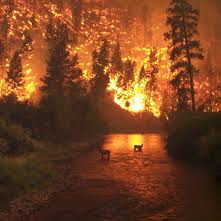
In the last few days, wildfires have incinerated more than 100,000 acres in the Sawtooth mountain range and scorched homes, businesses, and wilderness areas across 11 U.S. states – one of the many devastating impacts of droughts that have reached near historic levels. “I’ve never seen anything like this,” said Dale Byington, a restaurant manager who has lived and worked in Ketchum, Idaho for 23 years. I heard and read that same line over and over during superstorm Sandy and following other severe weather events in recent years. But the shock and disbelief expressed by people closest to these catastrophes hasn’t budged Congressional gridlock on climate change.
Not so with terrorism. In early August the U.S. issued a worldwide travel alert and shut down 21 embassies and consulates in response to al-Qaeda threats. U.S. citizens and government officials quickly heeded the warnings, despite considerable disruption and inconvenience. It’s understandable that few are willing to risk another 9-11 or Benghazi. But if the safety, health, and well-being of American citizens are truly paramount, then climate change would be treated as a security risk on par with terrorism.
There’s ample evidence that climate change poses near-term risks – not just 20, 50, or 100 years from now. “I think there is a fundamental error: that is, to talk about it in the future tense…there are pretty clear manifestations now and considerable data from the last several decades showing that it’s happening,” says Doug Boucher, a climate expert with the Union of Concerned Scientists.
A recent Harvard study identified four climate-related security risks that will impact the U.S. in the near-term: Water, Energy, Food, and Critical Infrastructure. Public health risks also loom large. High-level government officials have publicly acknowledged the links between climate change and security going back several years. Tom Donilan, former National Security Advisor to President Obama, recently spoke about them at Columbia University’s Center on Global Energy Policy: “The change wrought by a warming planet will lead to new conflicts over refugees and resources; new suffering from drought and famine; catastrophic natural disasters; and the degradation of land across the globe.”
However, as GlobalSolutions.org reported in July, U.S. concern about climate change takes a back seat to fears of terrorism. Americans ranked ‘Islamic extremist groups’ among the nation’s top three security threats, with global climate change coming in a distant sixth. This stands in stark contrast to survey respondents in Canada, Europe, the Middle East, the Asia/Pacific region, Latin America, and Africa, who all placed global climate change at or near the top of their lists of security threats.
Obama developed his national climate action plan as a way to bypass the partisan gridlock that has halted legislative action on climate change. His reasoning was unequivocal: “It demands our attention now.” Clearly political will for action on climate change is accelerating, but not fast enough. The threats to Americans’ safety and security are imminent.
These wildfires are a warning flare that Congress can’t ignore. Carrying on with business-as-usual is sure to result in death and destruction on a far greater scale than any terrorist attack. The U.S. must elevate climate change on its national security agenda, break partisan gridlock, and take a leadership role at the November 2013 climate negotiations.
U.S. legislators have the power to mitigate the worst impacts of climate change, but must act now. As temperatures continue to rise the U.S. has one last chance to get it right and there’s no room for error.
by Ellen Moore | Jul 30, 2013 | Climate Justice, Global Cooperation
All throughout this summer, I have had the opportunity to speak with a variety of top U.S. climate scientists and write up some of their comments in a series of blog posts for you all to read. I have really enjoyed the experience and have learned more than I could have anticipated from these experts, who each shed light on the issue of climate change from their own unique perspective.
The purpose of this series was to gain insight from climate experts on which climate related stories have not been getting adequate coverage by the media. GlobalSolutions.org has been running our #CoverClimate campaign this summer in efforts to call on the broadcast media to do a better job of this, and these posts have been one component of that campaign.
The final interview I conducted was with Dr. Jeffrey Kiehl. Dr. Kiehl is the Section Head and Senior Scientist at the University Corporation for Atmospheric Research’s Climate Change Research Section. His personal research interests include Earth’s changing hydrological cycle, ways to effectively communicate climate change to the public, and the links between climate science and psychology. His additional interest and experience in psychology brought an intriguing new angle to his answers that made this interview particularly interesting.
Here are some of the key excerpts from my conversation with Dr. Kiehl:
GS.org: What are some specific climate related topics that you feel haven’t gotten adequate coverage recently?
Dr. Kiehl: [The story of why the scientific community is certain humans have caused climate change is important to tell.] That’s one question that often comes up: “Well, how do you know? How can you be so certain?” So an article or a series of articles clearly defining … how we are so certain about it would be I think a very powerful message. And hopefully would be written in a way that involved personal discoveries of people. …Because people are always interested in how a discovery is made. Was it serendipitous? How long did it take?
…I think the second one is … how we can use Earth’s past to understand its future. And what are the differences and what are the similarities? …And we’ve learned a lot by looking at Earth’s past and if we continue business as usual then there’s going to be about 800 to 1000 parts per million of CO2 [in the atmosphere] in 90 years. Well, when was the last time there was that much carbon dioxide? Chemistry tells us it was about 40 million years. So in a matter of 90 years we’re going to be putting Earth’s climate back to a state that it hasn’t been in for the past 30-40 million years…. That’s what we’re doing. That’s where we’re headed.
…The other one that is getting some attention but I think it’s not getting enough is the carbon in the arctic. I’ve seen stories slowly coming out about observations of increased methane in the arctic atmosphere and there’s certainly an indication that the past is telling us that the temperatures have destabilized, and if it gets warm enough, it’s a huge amplifier on global warming. So that’s a potential… tipping point for the Earth’s climate.
…Another issue, [which is] related to …policy, is … the one agency that’s talked about the looming national security issue [climate change poses] is the Department of Defense. The DOD doesn’t question [the existence of climate change. It] recognizes climate change is a serious issue for stability, political stability and a potential threat to the security of the United States. I’ve never seen an extensive article written on that.
…I think these stories have tremendous power to them and would be interesting to the public and yet, they get no attention or very little.
GS.org:What kind of climate-related news do you see on the horizon that you feel the media should cover?
Dr. Kiehl: [A] story that [has huge implications for our future is] ocean acidification. I do not believe the public understands the scale of ocean acidification-why it can happen, [the fact that] we’re certain [it is happening…This has] tremendous implications for the biosphere of the ocean, the ecosystem. And if there’s ever a story that needs to get out there and be told, that would be the way that the ocean is becoming more acidic, that this has happened in the past. There are ramifications… that need to be taken into serious consideration.
…There’s another one, and that’s health issues-the implications that climate change can have on both physical and mental health… We’re starting to move millions of people because of sea level rise. …Towns and cities are being destroyed by severe storms. That has a huge impact on people’s ability to deal with trauma. … You look at post-Katrina New Orleans. There was a significant increase in reported cases of depression and the mental health facilities in that area were saturated. They just couldn’t deal with all the people coming in, suffering post trauma.
GS.org: Ninety seven percent of scientists agree that humans are major contributors to climate change. What about the other 3%? Why don’t they agree?
Dr. Kiehl: …There are [several] …explanations for the 3%. [One] is something I’m deeply interested in [as it relates to] the psychology of this issue. I think what we tend to do as a species is to try to reduce anxiety associated with perceived loss.
So, for example, if I were to admit that climate change is real and that humans are the major cause of it [that] would then in turn imply that we need to mitigate the use of fossil fuels. If a deeper held belief is one of personal independent choice-if that’s a deeply held principle in… how I define my sense of self-then to admit the climate is changing and humans are the cause of it, puts me in direct conflict with that value system. Why? Well, it’s because the follow up to that is that we would have to do something about it. And the doing something about it means ultimately getting off of fossil fuels, which in turn, means I wouldn’t have the choice to go to a gas station and put gas in my car. … I wouldn’t have the choice to buy the kind of car that I want to buy. I wouldn’t have the freedom as an owner of a corporation that extracts fossil fuels to make that choice as to how to live my life. In other words, my freedom of choice would be taken from me. Such perceived loss creates tremendous anxiety.
…And it’s not just freedom of choice, it’s fear of loss of my job. If I’m hearing the message that if we were to do something about this problem, tens of thousands of people would lose their jobs-I don’t want to lose my job-so the fear of economic insecurity is enough to prevent me from agreeing that this is a serious issue. So there are all these perceived losses that I would experience if I were to admit the degree [of scientific consensus] on this issue. Rather than do that, I deny it. It’s the root of denial, which helps me avoid feeling anxiety around the problem.
This conversation with Dr. Kiehl, and all those I have had with the other scientists have opened me up to many interesting and important aspects of the climate change problem. I hope you have enjoyed reading along with me and have learned a lot as well!
by Ellen Moore | Jul 19, 2013 | Climate Justice, Global Cooperation
The past few weeks have been full of excitement for the GlobalSolutions.org team! We recently launched our #CoverClimate campaign. The campaign aims to draw attention to the lack of coverage of climate change related stories by ABC, CBS, and NBC, and call on these major networks to make climate change stories a priority.
As a part of the campaign, I’ve had the opportunity to interview a handful of top U.S. climate scientists about their take on this lack of coverage and about which stories in particular they think should be more widely broadcast.
Dr. John Harte is one of the scientists I interviewed. He is a professor at the University of California, Berkeley’s College of Natural Resources. Dr. Harte has done extensive research over the past 24 years on the connections between the climate and ecosystems, including working on an ongoing study on the effects of warming on a subalpine meadow. Dr. Harte and his wife, Dr. Mary Ellen Harte, are the authors of a new book, Cool the Earth, Save the Economy: Solving the Climate Crisis is EASY that is available as a free download. The two also blog for the Huffington Post on climate change and global warming related issues.
Here are a few key excerpts from my interview with Dr. Harte:
GS.org: What do you think about the quality and the quantity of the coverage of climate change by the broadcast media?
Dr. Harte: There are huge problems both with quality and quantity. The quantity problem is that there are numerous opportunities when the climate issue could be raised in connection with current events, like forest fires, droughts, floods and storms and the media keeps dropping the ball.
It’s related to a quality issue. I see a couple of hang-ups. One is that there’s a failure to report on the successes and the co-benefits of various efforts around the country and around the world to actually deal with global warming. The myth persists that …solving the [climate] problem is going to bankrupt us. That is, to my mind, a more dangerous myth than some of the ridiculous myths that the climate deniers propagate. It hasn’t been challenged in the media; it’s accepted even by people who care about the climate problem. So that’s one aspect of the problem.
The other, more sort of technical issue that I find lowers the quality of reporting on this issue is the huge confusion about the word “cause.” The word “cause” has done a lot of damage because the way a typical reporter will interview a scientist or a politician will be by asking the question “Did global warming cause Katrina?” “Did global warming cause the Colorado Springs fire?” “Did global warming cause the drought in Texas?” And that’s the wrong question. The word “cause” is enormously complicated. Things don’t have single causes; there are multiple causes. There are influences and contingent events that help play a role and there are all kinds of subtleties to this notion of how events interconnect with one another.
GS.org: What are some specific climate related topics that you feel haven’t gotten adequate coverage recently?
Dr. Harte: [The area] where I see [the coverage is] most deficient is in… the solutions part of the problem. I think that slowly but surely the public is beginning to realize that freaky weather and unusual events are connected to climate. But the real battle over the next five years, the real controversy, the real debate is going to be over [questions such as:] “Can we do something about it?” rather than “Should we do something about it?” Or “What is the best way to solve it?” rather than “Is there a problem that something needs to be done about?” And I’ve come to the conclusion that solving the problem actually isn’t going to cost, it’s going to make us wealthier… The more I look into the benefits of solutions, the more I realize that [the clean energy] approach makes very, very good sense. But the many benefits of reducing dependence on fossil fuels is not getting any coverage, nobody is talking about it.
…And I think the next phase of coverage, other than about solutions, that really needs to be done is generating more anger towards the corporate role that puts profits above public interest. …When the public gets angry at business or… corporate greed, it’s a very powerful thing. From Upton Sinclair years ago to more recent examples of that in other areas, it’s a very powerful force and the media… should be doing more to expose the narrow self-interest and greed of the [leaders] of the fossil fuel industry.
GS.org: What aspects of climate change do you feel are the most pressing?
Dr. Harte: What is it about global warming that scares me the most? … [That would be] matters related to water. The exacerbation of conflicts over water, wars over water… All through the world we’re going to be seeing water scarcity is an issue. …Losing the winter snowpack is going to have enormous implications for irrigation water in the [American] West. [Other countries such as Turkey and China are also experiencing water-related challenges]. So I see probably the single-biggest issue is going to be the effects of climate change on the hydro cycle and the exacerbation of both droughts and floods. In other words, the extremes are going to get more extreme and devastating. The second… issue that I would probably turn to would be sea level rise and effects of storm surges in Bangladesh and Pacific Island nations [among others]. That’s a really big one. Those [aspects] are what scare me the most.
GS.org: What has surprised you in your own research on climate change?
Dr. Harte: I’m [currently] at the Rocky Mountain Biological Lab where I do research on ecosystems. 24 years ago we started an experimental warming of a meadow… It’s been running now for 23 years. We heated with electrical heaters a large area of a subalpine meadow and we’ve been following over 23 years the responses from the plants, the microbes, the soil, and the nitrogen cycle. [The] fascinating and scary thing from the experiment is that we really discovered empirically that when you heat ecosystems, they respond in ways that create further warming: positive feedback. Not positive in that it’s good for you but positive because it’s exacerbating the problem. It releases carbon from the system. Some plants, other shrubby plants do better. Some flowers do worse. And that leads to a darkening of the ground surface which means more warming from solar absorption.
…We wanted to see how ecosystems would change but we didn’t anticipate that we’d also learn about how changing ecosystems could feed back to change the climate. So for me that was the eye-opener of this research we’ve been doing.
—-
Learning more about climate change related issues from Dr. Harte was both informative and enjoyable. If you’re interested in reading about the rest of my interviews, stay tuned!
by Zoey Krulick | Jul 12, 2013 | Climate Justice, Global Cooperation
Alarming stories of the impact of climate change. Ever-changing developments in Egypt. A surge of anti abortion legislation in the U.S. Prison riots in Indonesia. Tales of bribery and corruption worldwide. But depending on how closely you read the news, you could miss some of this important information. Why is this?
Part of my responsibilities as a Research Associate at GlobalSolutions.org is to keep up with current events. This includes putting together a news report once a week so that our team stays well-informed on relevant issues. This past Wednesday, I was searching for news stories on Google, and the top item did not relate to anything listed above. Instead, showcased as one of the most important stories of the day, was an article on the eagerness of the world to know what Britain’s as yet unborn, but soon to be third in line to the British throne, royal baby, will be named.
Now, I definitely do not want to sound like someone who believes that being interested in pop culture is a bad thing. I am guilty of knowing more than I should about the Amanda Bynes saga or the narcissism of Justin Bieber. I also understand that not everyone can be one-hundred percent up to date on the news at every moment, simply because of the fact that it is news and therefore constantly changing. The problem arises when pop culture “news” or as it is sometimes called, “infotainment,” edges out authentic news, leading to a public that is less aware of the more important issues that truly affect their lives.
As I have learned, a less aware public can be dangerous. Part of the reasoning behind Globalsolutions.org’s #CoverClimate Campaign is the desire and need to increase public awareness about climate change by getting the major news outlets to better cover this serious and relevant matter. This is imperative because we believe that when people are more aware about the dangers of climate change, they will more forcefully and effectively advocate for action. This need to be aware applies to any issue – one has to know about a problem before attempts can be made to solve it.
Some might counter that everyone being more informed might be dangerous, because what if all of these newly knowledgeable people cannot agree with one another? But wait a minute – people already argue about everything – wouldn’t it be great if they could actually cite facts to back up their arguments?
Unfortunately, this can’t happen until politically relevant news receives at least an equal amount of coverage as Kim Kardashian’s baby or Gwyneth Paltrow’s diet. Part of the solution certainly lies in each individual becoming motivated to be more well-informed, but the media has a responsibility to make it easier by placing a greater emphasis on current and politically pertinent stories. More important than Kate Middleton’s baby’s name is the kind of world that his or her future royal highness will grow up in.
by Alisondra Maykranz | Jul 10, 2013 | Climate Justice, Global Cooperation
U.S. relations with Latin America have not always been exemplary, but climate change is an issue that presents an opportunity for the U.S. to cooperate with its southern neighbors and to provide the leadership that such a global threat requires.
According to the Pew Research Center data cited in Harrison’s blog, Latin America as a whole is a region very concerned with climate change. In each of the seven Latin American countries polled, climate change was the most widely recognized threat. Sixty-five percent of Latin Americans identify climate change as a threat to their respective countries, compared to 40 percent of people in the United States. In Brazil the percentage is as high as 76, and Argentina is not far behind at 71 percent. Furthermore, not a single Latin American country reported numbers below 50 percent. Even in the oil-rich country of Venezuela, 53 percent of the public recognizes climate change as a threat. This is significant considering that oil-exporting countries generally resist the implications of climate change.
A 2012 study by the World Bank shows that Latin America is at greater risk to the dangers of climate change than most of the world. To make matters worse, many regions within Latin America have insufficient capability to cope with these potentially devastating effects of climate change.
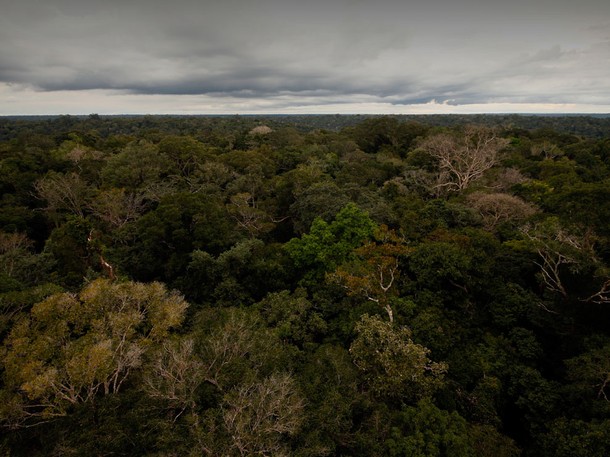
The Amazon rainforest, one of the most delicate regions of Latin America, is already experiencing negative effects from climate change. The indigenous peoples who depend on the rainforest are also among the most vulnerable populations in the world, according to a 2010 World Bank study. Climate change in the Amazon not only affects Brazil’s population, but also has a far reaching impact on many other parts of Latin America, as explained by Amazon Watch:
“The Amazon Basin’s hydrological system plays a critical function in regulating the global and regional climate…Among the regions directly linked to the Amazon by a complex weather system is the Rio de la Plata basin of southeastern South America, one of the most important agricultural zones on the planet.”
The success of the region’s agriculture rests largely on the conditions in the Amazon. Environmental economists S. Niggol Seo and Robert Mendelsohn, through a project with the World Bank, found that climate change could lead to as much as a 62 percent loss in farm earnings in Latin America, with the Amazon and Equatorial regions likely losing the most. Given this information, it is no surprise that Brazil and Argentina reported the highest percentages of people who recognize climate change as a threat.
As the Obama Administration turns its focus toward domestic policies on climate change, it should also put climate change on its international agenda. At the end of May, Vice President Biden traveled to Rio de Janeiro as part of the effort to strengthen U.S.-Brazil relations. He spoke in Rio about a “new era of relations” between the U.S. and Brazil, as well as Latin America more generally, but the focus was on increasing economic ties. Not once was the subject of climate change even mentioned, let alone given the attention it deserves.
With 76 percent of Brazilians and 65 percent of Latin Americans concerned about climate change, it would truly signal a “new era of relations” between the U.S. and Latin America if the Administration were to demonstrate their own concern for what is taking place in the Western Hemisphere by taking the lead in multilateral climate change initiatives. This really is an opportunity that I can only hope the Obama Administration will consider as important as the economic opportunities it is currently pursuing in Brazil and Latin America.