by David Gallup | Dec 8, 2023 | World Citizen
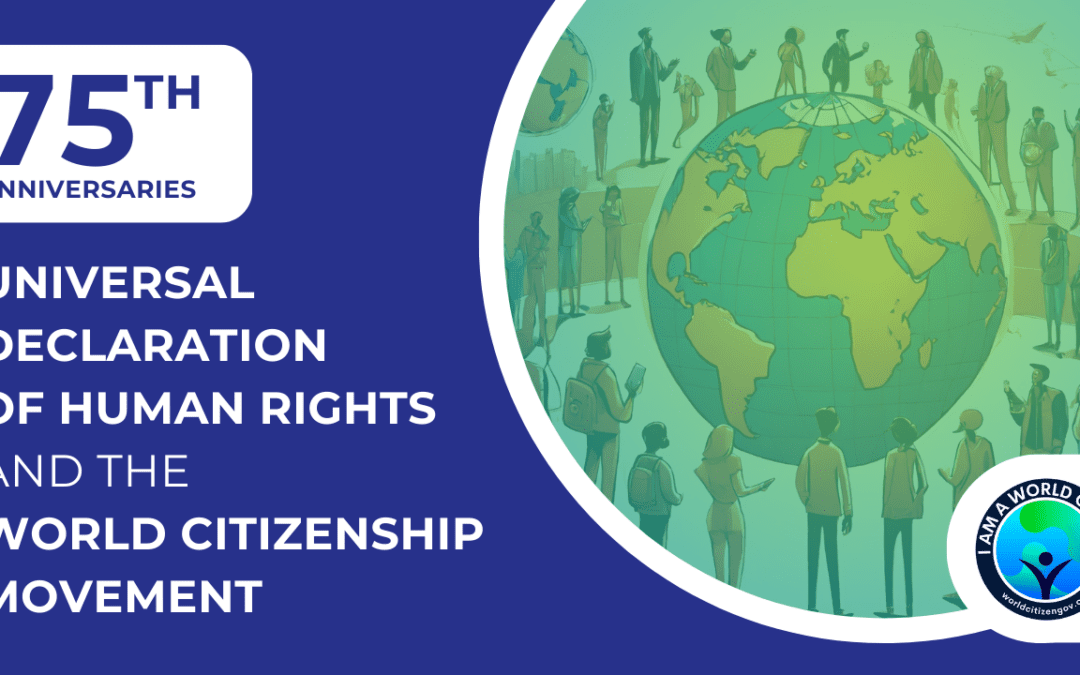
This year marks the 75th anniversary of the Universal Declaration of Human Rights (UDHR) and the World Citizenship Movement (WCM).
As a response to the devastation of World War II, the drafters of the UDHR sought to ensure that human rights would be protected by the rule of law. The Declaration provides a statement of our civil, cultural, economic, political, and social rights.
The WCM links our universal rights to our identity as citizens of the world. Former WWII bomber pilot Garry Davis gave up his US citizenship in favor of world citizenship, launching the World Citizenship Movement in 1948 to promote peace and human unity.
The UDHR and the WCM offer a framework of universal rights and universal identity to achieve the peaceful and governed world envisioned in 1948 by both the drafters of the UDHR and World Citizen Garry Davis.
Although we have enumerated our rights over the past 75 years, we have not yet fully implemented them. To paraphrase Rousseau from The Social Contract, humans are born free, but everywhere we are in chains. We have empowered a governing system — the nation-state — that because it is partial, can never fully affirm our rights and duties. The nation-state system where states maintain absolute sovereignty enslaves us to corporate interests and national security at the expense of human needs and world security.
As we celebrate how far humanity has come in the past seventy-five years, and simultaneously recognize the many existential challenges we currently face — war, climate destruction, injustice – let’s consider what kind of world we want for humanity in 2098, seventy-five years from now on the cusp of the 22nd Century.
Over the next 75 years, we must build a human rights institutional architecture that affirms our universal rights. That framework must be built on the global rule of law, world law that applies to everyone, everywhere. We must recognize the importance of seeing ourselves as world citizens and must legalize this status.
To achieve the peaceful and just world that the drafters of the UDHR and the advocates of the World Citizenship Movement envisioned, we must build the law, citizenship and governing structures at the world level that will help humans live together peacefully with each other and sustainably with the earth based on the principles of universal rights and universal citizenship.
How do we arrive at 2098, 75 years from now, having built a peaceful, just, sustainable, and united world?
- The UDHR must become a universal bill of human rights incorporated into a world constitution legally binding on everyone, everywhere. This would ensure that all governments, ranging from local town councils and nation-states to the world federal government would place rights above self-interest and the force of law above the law of force.
- World citizenship must become a recognized legal status for everyone, everywhere. This would mean that no one would be stateless anymore. Everyone would be able to exercise all rights no matter where they are or where they go throughout the world.
- We, humanity, must create a World Parliament to participate in governing the world as one united planet. This would put the rights of individuals above the power of states.
- A World Court of Universal Rights must be established where individuals and groups could seek redress when local judicial systems fail them. A global judicial system with subsidiary regional courts would provide venues for people to resolve conflicts peacefully.
- To secure our peacebuilding efforts, we must outlaw war and weapons manufacturing. We must use resources sustainably for peaceful means. Because war and its preparation are the biggest wasters of resources, we need to develop peace and indigenous-based economies that will protect the Earth and ensure humanity’s survival.
Ultimately, we must fulfill human needs, affirm rights, resolve conflict, and protect the environment. We must build an ethical identity and governing system that allows us to accomplish these human and planetary requirements and manage our human and environmental interactions equitably and peacefully.
In 1948, the UDHR and the World Citizenship Movement provided a vision of a united world as an alternative to absolute national sovereignty that perpetuates war and continues to fracture humanity. The UDHR and world citizenship together provide the ethical framework we need to have a thriving Earth community in 2098.
By fully implementing the Declaration of Human Rights and world citizenship, in 75 years from now, we will have transcended the “Divide and Conquer” approach in favor of a “Unite and Prosper” paradigm.
by Marta Simoncini | Mar 7, 2023 | World Citizen
In 2019, 10 entrepreneurial families from Fiji, France, Germany, Italy, Kenya, Portugal, Romania, and the Swedish Saami Youth Association found common cause when their businesses – largely in agriculture and tourism – were affected by climate change disasters. With the support of scientists and non-governmental organizations, they brought a case to the European Union Court of Justice in which they demanded more commitments from European institutions in reducing greenhouse gas emissions. This group, the People’s Climate Case, became one of the largest global actions related to climate change. Despite its strategic importance, the case ended with the Court of justice declaring on appeal that it was inadmissible because the plaintiffs were not eligible for direct access to the court.
In an increasingly globalized world, many people have acquired multiple legal identities that are formed “beyond the state.” These individuals have gained a form of administrative citizenship of the world – not a passport that is derived from belonging to a national community but that is the fruit of legal globalization. More cases like these will pose new legal challenges.
The 1998 case brought to the World Trade Organization (WTO) by India, Malaysia, Pakistan and Thailand on shrimp fishing is another example. The fisherman’s activities were severely affected by the U.S. embargo on imports of shrimp caught using methods dangerous to sea turtles. The U.S. embargo aimed to protect endangered sea turtles from becoming trapped in certain types of fishing nets. To protect fishermen and traditional fisheries, Asian states said the embargo had violated international trade rules. While the WTO recognized the legitimacy of restrictive measures to protect the environment, it found the U.S. measure unlawful because it was adopted in the absence of discussion with the states concerned and, thus, in violation of the principles of due process.
Although different, these stories demonstrate how citizens are impacted by decisions made by global or supranational authorities. They also highlight how the exclusive condition of citizenship is no longer just realized at the state level. The interdependence resulting from economic globalization is governed through orders that are formed across national borders.
Although states remain central actors in international society, different forms of sovereignty are emerging in what Sabino Cassese has called a global public arena, in which public and private actors participate in different ways in the creation and implementation of norms.
Recognizing global rights and obligations promises a cosmopolitan ideal of universal rights outside the nation-state framework, but which proceeds from the inalienable contents of national citizenship – such as the right to vote and the duty to pay taxes. In a globalized world, this trend has arisen from conflict mediation outcomes between global actors. There are three main interpreters of these conflicts: the courts; administrative bodies; and political institutions. It is useful to briefly highlight different aspects of their activities to better understand the nature of the current processes.
Global Citizenship and Global Justice: The Role of the Courts
Courts play a key role in the process of asserting rights, but do not always succeed in meeting the demand for global justice.
Going back to the People’s Climate Case, the discrepancy between the demand for justice and European procedural constraints generated an obvious and painful paradox: the more generalized the prejudicial effects of the European Union act were, the more access to the courts was limited. In the words of the entrepreneurs involved in the case, “the more serious the harm and the higher the number of victims, the less judicial protection is guaranteed.”
The legal definition of who and under what conditions those persons can access the courts creates a bottleneck in the quest for justice. What happens, then, to all those situations that are not jurisdictionally protectable, yet embody interests of global significance? When the courts are not equipped to meet demands for justice, who responds to these demands in a global setting that does not have an aggregate political system?
Global Citizenship and Soft Law: The Role of Administrative Bodies
Public administrations are another crucial interlocutor in conflict mediation. Through informal cooperation between jurisdictions – and setting up standards, guidelines, and best practices – a so-called ‘soft law’ emerges, although without binding legal force. The guidelines of the European Securities and Financial Instruments and Markets Authority are one example. In theory, they ensure that advice on investment products is appropriate to the risk profile of clients. National authorities and firms can only deviate from these guidelines by justifying their dissent. In practice, not conforming to the guidelines inevitably means exposing oneself to an eventual international process of ‘naming and shaming.’
‘Soft law’ thus functions as a kind of glue. While not legally binding, it can become so in practice. But in the face of non-traditional, coercive techniques, how can the certainty of individual rights and obligations be ensured? Or how can global citizens recognize and defend themselves when administrations abuse their powers or act in violation of the law?
The quest for soft law legitimacy comes through sharing rules of conduct. Furthermore, a bottom-up process and transparency promotes consensus. But who influences these decision-making processes and who is represented? Selecting globally relevant interests is not a neutral, or just a legal, process. It is also a social and political process of discernment and mediation between diverse interests.
Global Citizenship and the Nation State: The Role of Political Institutions
Finally, politics plays a central role in mediating conflicts. Gaps between multiple legal identities create tensions between those benefitting from taking a global or regional perspective and those who hold conflicting rights and interests protected by national citizenship. Policy can either help to mitigate, or exacerbate, these conflicts. National leaders have exploited these contradictions to construct ‘us vs. them’ identities.
In the last decade these tensions strongly characterized European citizenship. The ideal of a cultural European identity has, for example, been challenged by the problems that have emerged when people who are not actively working – such as students, the unemployed, and retirees – request to live in another European country under conditions of non-discrimination compared to nationals. The latter wish to limit the ‘free riding’ phenomenon of access to public resources, at least if those moving are not actively contributing to the economic life of the host country.
The European Court of Justice, at first a proponent of European citizenship as the “fundamental status of citizens of member states,” has since aimed to remove the risks of this ‘welfare tourism.’ However, this development undermines the right to migrate to realize a better future and European citizenship has lost much of its potential in promoting social mobility.
National leaders have exploited these contradictions to construct ‘us vs. them’ identities.
The reduction of European immigration was former U.K. Prime Minister David Cameron’s rationale for the renegotiation of the British participation in the European Union as well as central to the referendum campaign in favour of leaving it.
Conclusion
A more useful approach may be to look beyond political propaganda to the existence of multiple legal identities. How can such identities be reconciled so that uneven norms do not contribute to dramatically exacerbating latent social conflicts? The answers may come from a more cosmopolitan approach based on the principles of tolerance and dialogue.
There are many knots to unravel to make the globalized world a space for exploring multiple identities. Our future depends on understanding these challenges in their complexity and seeking adequate solutions.
by David Gallup | Feb 13, 2023 | World Citizen
Classified documents, top secret files, spy balloons, clandestine surveillance. What kind of world are we living in where we hide information about and from each other, spying to get the upper hand? Why do leaders and legislators feel compelled to keep government secrets from the public?
In the current political system of independent, sovereign states, national governments seek to exact a competitive edge over perceived rivals by hiding information, spying, and governing secretively. Day-to-day governance becomes a zero-sum game. Governmental success comes at the expense of human interdependence, turning our fellow humans into foes rather than friends.
What are the costs of keeping secrets?
Nation-state secrets and spying come with economic, environmental, political, and social costs.
Nearly all countries have their own spies, covert agencies, and departments of “defense,” costing billions of dollars to conduct “intelligence” operations and keep secrets. Furthermore, national governments feel compelled to spend countless billions on embassies, consulates, border walls, and border guards for “national security.” Consider the two trillion dollars total that national governments spend on preparing for and waging wars every year.
Weapons manufacturers, military contractors, government officials, and wealthy shareholders reap the profit from producing and selling tools of deceit and destruction. Meanwhile, a billion people are starving, and millions must flee their homes to survive. Moreover, war preparation and clandestine operations are some of the most devastating despoilers of the environment.
To outmaneuver each other, national governments steadfastly control resources and data, refusing to share information with anyone they consider an outsider. Keeping secrets hampers leaders from governing effectively, causing them to focus on their nation instead of humanity’s survival.
State secrets for “national security” and “public order” allow governments to act extra-judicially and to violate human rights with impunity. Hiding information leads to public mistrust in government. When secrets take precedence over transparency, governing decisions are made without analysis, oversight, or consent. The public is precluded from participating in decision making and mistrust of government grows.
Secrets and the rhetoric of divisiveness – the “us versus them” approach – also take a psychological toll. Overzealous national pride turns our neighbors into enemies and ignites a mindset of fear, distrust, jealousy, and anger. We are constantly looking behind our backs, rather than looking forward.
What are the benefits of humans sharing information instead of privileging secrets?
Human and natural resources would be better spent on environmental, scientific, and technological advancements than on secrets, spying, and information suppression.
Governments, as representatives of the world’s people, could focus on information sharing and unifying humanity. Humans could work together to overcome the divisions that hold us back, rather than maintain nearly 200 separate national departments of defense, and science research, environmental, and intelligence agencies all seeking similar data and advancements. Access to more data would enhance governmental decision-making and lead to quicker scientific, health, and technological progress.
By encouraging the open exchange of information, we would be better equipped to improve understanding among diverse cultures and governing styles, to interact more peaceably and to share resources more equitably. With transparency and accountability as top priorities, we could build a framework of world security.
Resources and funds, historically tied to the military-industrial complex, could be used to feed, house, and educate people. Human and planetary health could take precedence over conflict among people and contamination of the Earth. Global collaboration is far preferable to war or cloak-and-dagger diplomacy.
How can we govern with compassion rather than deception?
Sharing ideas, solutions, technologies, and data would help humanity deal with global problems that can only be handled at the global level – problems that national governments cannot resolve on their own with hushed voices behind closed doors. Eight billion minds are better than one.
People united under one citizenship would see each other as friends with common goals that they implement together. Democratic world federation and world citizenship would provide a holistic framework for uniting our political governing structures and for uniting us as humans. World citizenship and government could liberate us from the shackles of a divided world.
Above all, governments could act like friends do.
Friends are free because they do not compel, restrain, or confine each other. Friends do not keep secrets to feel special or better. Friends share their concerns. Friends are willing to consider others’ perspectives. Friends have empathy and love for one another.
The words “friend” and “free” come from the same Proto-Indo-European root which can mean both to love and to be free.
Friendship, in place of secrecy, would free us to achieve a peaceful, just, sustainable, and united world.
by Rene Wadlow | Sep 15, 2016 | Global Justice, World Citizen
Maria Montessori (1870-1952), an Italian childhood educator and world citizen, would have been pleased at the efforts of the United Nations and UNESCO to promote Global Citizenship Education1. Montessori argued for a child’s dignity and autonomy and for the ability of the child to break out of the narrow bonds of nationalistic education. She stressed that children have a unique consciousness and a special sensitivity in the early years which must be nurtured and allowed to develop along its own course.
The world citizen spirit of Maria Montessori’s teaching displeased the narrow nationalist leaders in power in the 1930s. The Fascist government of Mussolini closed the Montessori schools in Italy in 1934 as did Hitler in Germany and then in Austria when Hitler’s troops moved into Vienna. The dictators saw that creative thinking among children was a danger to their authoritarian rule. She spent the Second World War years in India where her educational ideas influenced a growing number of Indian teachers.
She stressed education for world citizenship in both content and methodology for as she pointed out access to education and to various forms of learning is a necessary but not sufficient condition to world citizenship education. A comprehensive system of education and training is needed for all groups of people and at all levels, both formal and non-formal. The development of a holistic approach based on participatory methods is crucial.
Education for world citizenship today builds upon the values and activities of the UN-designated International Decade for a Culture of Peace and Non-violence for the Children of the World (2001-2010). The UN General Assembly proclaimed the International Decade stating that the Decade “would greatly assist the efforts of the international community to foster peace, harmony, all human rights, and democracy throughout the world.” The Decade was to lead to “the promotion of democracy, tolerance, dialogue, reconciliation and solidarity as well as to international cooperation and economic development, and thus to sustainable human development.”
Education for world citizenship is necessary to embrace all facets of human experience. Such education must prepare us to help meet the challenges which face us, challenges so vast, so complex and so constantly changing their nature and scope. Education for world citizenship must prepare us collectively to know the yet unknown. Our physical, social, and spiritual development expands naturally from the personal towards the global. This learning process leads through both chartered and unchartered territory in an ongoing exploration of life.
The visionary and yet very practical educational spirit of Maria Montessori remains an inspiration as we develop world-wide educational forms to prepare us for the emerging world society.
Notes
1. UNESCO has produced a very useful guide “Global Citizenship Education: Topics and Learning Objectives” with a good bibliography and websites of organizations dealing with education for global citizenship. See their website for further information http://www.unesco.org/new/en/global-citizenship-education
by Rene Wadlow | Mar 11, 2016 | Global Justice, World Citizen
“The time has come for the implementation of a spiritual vision of the world’s affairs. The entire planet must elevate itself into the spiritual, cosmic throbbing of the universe.”— Robert Muller
Robert Muller, whose birth anniversary we mark on 11 March, was the former Assistant Secretary-General for Economic and Social Service of the United Nations, and, after his retirement, he served as Honorary President of the Association of World Citizens. He was brought up in Alsace-Lorraine still marked by the results of the First World War. As a young man, he joined the French Resistance movement during the Second World War when Alsace-Lorraine had been re-annexed by Germany. At the end of the War, he earned a Doctorate in Law and Economics at the University of Strasbourg. Strasbourg was to become the city symbolic of French-German reconciliation and is today home of the European Parliament.
Determined to work for peace having seen the destructive impact of war, he joined the United Nations Secretariat in 1948 where he worked primarily on economic and social issues. For many years, he was the Secretary of the United Nations Economic and Social Council. His work with ECOSOC brought him into close contact with NGOs whose work he always encouraged
In 1970, he joined the cabinet of the then Secretary-General U Thant, who was Secretary-General from 1961 to 1971. U Thant had a deep impact on the thinking of Robert Muller. U Thant’s inner motivations were inspired by a holistic philosophy drawn from his understanding of Buddhism, by an intensive personal discipline and by a sense of compassions for humans. U Thant had been promoted to his UN post by the military leaders of Burma who feared that had he stayed in the country, he would have opposed their repressive measures and economic incompetence. Although U Thant was reserved in expressing his spiritual views in public speeches, he was much more willing to discuss ideas and values with his inner circle of colleagues. U Thant held that “the trouble of our times is that scientific and technological progress has been so rapid that moral and spiritual development has not been able to keep up with it.”
Muller agreed with U Thant’s analysis. As Muller was a good public speaker, he often expressed these views both in UN meetings and in addresses to NGOs and other public meetings. Muller became increasingly interested in the views of the French Jesuit philosopher Pierrre Teihard de Chardin who had lived his last years of his life in New York City. For Teihard, as he wrote in Phenomenon of Man, “No longer will man be able to see himself unrelated to mankind neither will he be able to see mankind unrelated to life, nor life unrelated to the universe.”
Muller saw the UN as a prime instrument for developing a sense of humanity as all members of one human family and for relating humans to the broader community of life and Nature. As Muller wrote “We are entering one of the most fascinating and challenging areas of human evolution. In order to win this new battle for civilization, we must be able to rely upon a vastly increased number of people with a world view. We need world managers and servers in many fields.”
I had the pleasure of knowing Robert Muller well as he was often in Geneva for his UN economic and social work and, at that time, had a home in France near Geneva, where he did much of his writing. Muller was also deeply influenced by the thinking of another Alsatian, Albert Schweitzer who had also spent most of his life outside France. I had known Albert Schweitzer when I was working for the Ministry of Education of Gabon in the early 1960s. Both Schweitzer and I, influenced by Norman Cousins, had been active against A-Bomb tests in the atmosphere, and so I had been welcomed for discussions at the hospital in Lambaste. For Muller, Schweitzer with his philosophy of reverence for life and the need for a spiritual – cultural renewal was a fellow world citizen and a model of linking thought and action.
For Muller, the UN was the bridge that helped to cross frontiers and hopefully to develop reconciliation through a common vision of needs and potential for action.
Notes:
For two autobiographic books, see Robert Muller. What War Taught Me About Peace (New York: Doubleday ) and Robert Muller. Most of All, They Taught Me Happiness (New York: Doubleday, 1978)
by CGS Blog Archive | Jul 1, 2015 | Global Justice, World Citizen
I consider myself a pretty culturally diverse person. I was raised as Serbian-American, and I remain highly involved in this community today. You can ask my friends. I have always been playfully teased about my “obsession” with being a Serb, inviting them to “crazy Serb” events, and forcing them to try my mother’s food.
My connection to my ethnicity inspired me to love and appreciate learning about others. I chose to major in Global and International Studies with the regional focus on Latin America and a specialization in comparative politics. Throw in a Spanish minor and a semester abroad, and there you have it: culturally diverse.
My fascination with global affairs also led me to apply for an internship with Global Solutions Pittsburgh. Nevertheless, when I read their Spring Fundraiser program last week during the event, they had a section about “Global Engagement” that caught my attention:
“What does it mean to be globally engaged?”
I had always associated the word “global” with international; over there; foreign and exotic lands different than my own. But is that always the case? What does it really mean to be globally engaged? Can you be globally engaged in your own backyard?
Merriam Webster defines global as “involving the entire world.” Although that can mean abroad, it doesn’t always have to. The entire world includes the United States. It includes your state, your city, and your home. How is it possible to be globally engaged in your own neighborhood, though? Can you make a global impact without a passport?
The amount of injustice around the world is absurd. How many times have your parents told you to eat your dinner because there are starving kids in Africa? Well, they are correct. Seventy-five percent of the world’s poorest countries are located in Africa, and a sickening one in three people living in sub-Saharan Africa are malnourished. That being said, were you aware that one in every six Americans lives in poverty, and that the population of Americans living in poverty is equal to the population of Texas, New Mexico, Oklahoma, Kansas, Colorado, Arizona, Utah, Wyoming, Nevada and Nebraska combined? Poverty is not a far-away problem; a distant or foreign concept solely stereotyped with abandoned African children. Poverty is global.
Another issue that affects all humans living on this earth is climate change. Environmental affairs are often seen as a domestic issue. However, the environment is a concept that affects every single one of us, whether we agree with certain ideologies or not.
Just this week, Pope Francis addressed climate change in his 183-page encyclical. In this document, the Pope states that humans are the main cause of global warming and climate change. He then analyzes the science behind global warming and provides suggestions for curbing the problem. Francis advises all humans to not cook more than they can eat, to wear an extra sweater instead of turning on the heat, and to carpool or walk to work if possible.
Pope Francis marked a turning point in focusing on this controversial topic. Many conservative Catholics are climate change skeptics, which makes the encyclical that much more significant. The Pope is an important Catholic figure that represents over 1 billion individuals around the world. His goal is to awaken the people and involve the entire world in taking action.
In today’s global society, there are many aspects that connect people from different backgrounds all around the world—including injustice. We need to come together and fight for what is right. The best thing the whole world has in common right now is our dream for improving it—for ourselves and for generations to come.
Whether you travel to a third-world country, study abroad, or participate in a mission trip is up to you. While I am not diminishing any of the problems that exist in these foreign countries, it is important to be aware that injustice is a threat everywhere. Be a global citizen, but don’t think that you can’t change the world only ten minutes away from where you live.
I still consider myself multicultural. I will always feel the need to travel, live in foreign destinations, and explore different ethnicities. I encourage everyone to do the same. However, the next time you want to engage yourself on a global level, put your passport away for a while. I think you’ll be surprised to find how much of an impact you can make right outside your front door.
The full version of this article was originally published by Global Solutions Pittsburgh. It has been cross-posted with the author’s permission. To read the original, click here.