
Originally published on the CGS blog on August 20, 2013.
The first – and so far only – time I visited Idaho I stayed in a rustic cottage surrounded by open fields. The mountains on the horizon were so far off they blurred into the distant haze and looked more like hills. But, being a hiker, I knew the peaks were just hidden and planned to return one day for a trek into the wilderness. Now a huge chunk of that area is either scarred or gone.
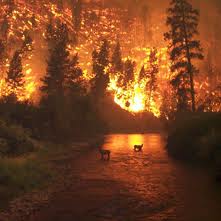
In the last few days, wildfires have incinerated more than 100,000 acres in the Sawtooth mountain range and scorched homes, businesses, and wilderness areas across 11 U.S. states – one of the many devastating impacts of droughts that have reached near historic levels. “I’ve never seen anything like this,” said Dale Byington, a restaurant manager who has lived and worked in Ketchum, Idaho for 23 years. I heard and read that same line over and over during superstorm Sandy and following other severe weather events in recent years. But the shock and disbelief expressed by people closest to these catastrophes hasn’t budged Congressional gridlock on climate change.
Not so with terrorism. In early August the U.S. issued a worldwide travel alert and shut down 21 embassies and consulates in response to al-Qaeda threats. U.S. citizens and government officials quickly heeded the warnings, despite considerable disruption and inconvenience. It’s understandable that few are willing to risk another 9-11 or Benghazi. But if the safety, health, and well-being of American citizens are truly paramount, then climate change would be treated as a security risk on par with terrorism.
There’s ample evidence that climate change poses near-term risks – not just 20, 50, or 100 years from now. “I think there is a fundamental error: that is, to talk about it in the future tense…there are pretty clear manifestations now and considerable data from the last several decades showing that it’s happening,” says Doug Boucher, a climate expert with the Union of Concerned Scientists.
A recent Harvard study identified four climate-related security risks that will impact the U.S. in the near-term: Water, Energy, Food, and Critical Infrastructure. Public health risks also loom large. High-level government officials have publicly acknowledged the links between climate change and security going back several years. Tom Donilan, former National Security Advisor to President Obama, recently spoke about them at Columbia University’s Center on Global Energy Policy: “The change wrought by a warming planet will lead to new conflicts over refugees and resources; new suffering from drought and famine; catastrophic natural disasters; and the degradation of land across the globe.”
However, as GlobalSolutions.org reported in July, U.S. concern about climate change takes a back seat to fears of terrorism. Americans ranked ‘Islamic extremist groups’ among the nation’s top three security threats, with global climate change coming in a distant sixth. This stands in stark contrast to survey respondents in Canada, Europe, the Middle East, the Asia/Pacific region, Latin America, and Africa, who all placed global climate change at or near the top of their lists of security threats.
Obama developed his national climate action plan as a way to bypass the partisan gridlock that has halted legislative action on climate change. His reasoning was unequivocal: “It demands our attention now.” Clearly political will for action on climate change is accelerating, but not fast enough. The threats to Americans’ safety and security are imminent.
These wildfires are a warning flare that Congress can’t ignore. Carrying on with business-as-usual is sure to result in death and destruction on a far greater scale than any terrorist attack. The U.S. must elevate climate change on its national security agenda, break partisan gridlock, and take a leadership role at the November 2013 climate negotiations.
U.S. legislators have the power to mitigate the worst impacts of climate change, but must act now. As temperatures continue to rise the U.S. has one last chance to get it right and there’s no room for error.


