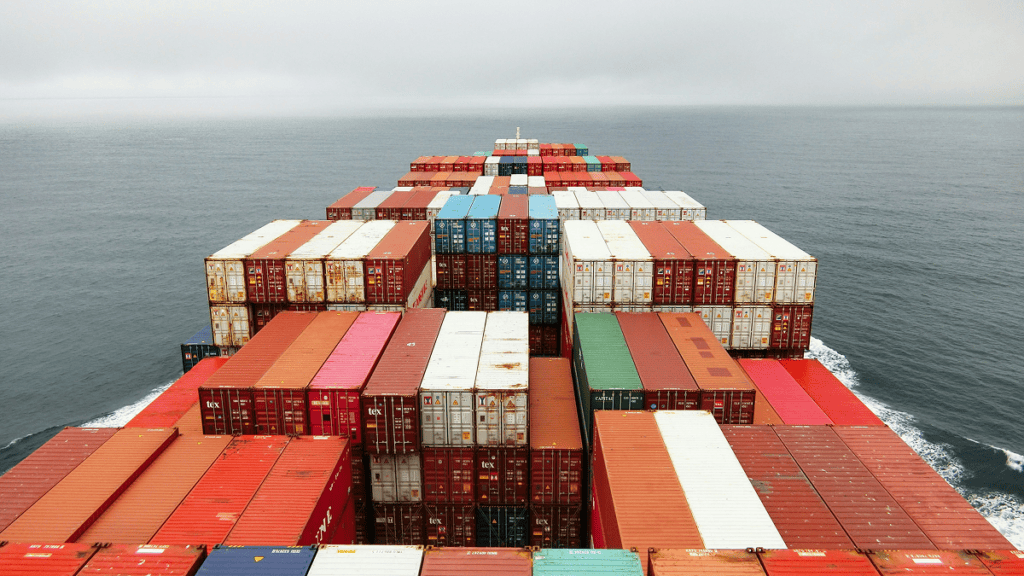
From raw materials and food staples, to advanced manufactured goods and life-saving humanitarian supplies, 12.3 billion tons of goods move by sea each year—a nearly fivefold increase from 2.6 billion tons in 1970, and the highest volume in recorded history (UNCTAD, 2018, 2024). This level of trade is facilitated largely by the expectation that shipping lanes remain open and free. Yet, this expectation may not always hold, and disruptions to sea lanes can have far-reaching, long-lasting, and unevenly experienced impacts.
During the eight years that the Suez Canal was closed between 1967 and 1975, trade between countries whose shipping routes depended on the canal fell by roughly one-fifth (Feyrer, 2009). For every dollar that was lost in trade, national incomes across the affected countries contracted by 25 cents (Feyrer, 2009).
Today, over 80% of world trade by volume moves by sea (UNCTAD, 2018). Much of this trade concentrates through a handful of chokepoints—the Strait of Malacca carries 23.7% of seaborne trade volume, the Strait of Hormuz 11.1%, and the Suez Canal roughly 10% (UNCTAD, 2024)—making the entire system vulnerable to disruption at just a few narrow passages. Recent disruptions in the Red Sea caused by the Houthis, a Yemeni armed group controlling much of northern Yemen, reduced Suez traffic by 90%, added approximately $1 million per voyage in rerouting costs, and may have increased global consumer prices by approximately 0.6% (Defense Intelligence Agency, 2024; UNCTAD, 2024).
And more than just merchant trade is disrupted. Freight costs rose more than 40% and transit times increased from two weeks to over a month when the International Rescue Committee (IRC) suspended the humanitarian shipping route through the Red Sea to Sudan (Yusuf, 2024). In Yemen, where food insecurity threatens half of the roughly 34 million population, the United Nations World Food Programme’s (WFP) sea-freighted cargo dropped 81% year over year (World Food Programme, 2024). These are not isolated incidents. They reveal a failure of world governance in critically shared spaces.
While collective security for land-based conflict was addressed in Chapter VII at the UN’s founding, the same cannot be said of conflict on the remaining 70% of the Earth’s surface. In 1982, the United Nations Convention on the Law of the Sea (UNCLOS) codified freedom of navigation as a legal right but created no enforcement mechanism. This may be the Charter’s most consequential and under-appreciated gap. Put simply, freedom of navigation is the fundamental global public good left ungoverned by the UN. The current system of unilateral provision is economically irrational and strategically fragile. At the same time, the technology necessary to enforce freedom of navigation is increasingly more affordable. Therefore, Article 109 should be invoked to add a new chapter to the Charter establishing a multilateral maritime security force.
The current system faces two distinct and interconnected problems.
First, freedom of navigation on the high seas is a classic global public good: one ship’s safe passage does not reduce another’s, and it cannot, by definition, be denied to non-contributors (Ostrom, 1990; Sandler, 2020). This naturally creates a free-rider problem because every trading nation benefits from secure sea lanes whether or not it contributes to their protection, each has an incentive to let others bear the cost. Today, one state provides the overwhelming share of the world’s maritime security: the U.S. Department of the Navy (DON) alone spent $255.8 billion in fiscal year 2024. Historically, Washington’s commitment to global freedom of navigation has been so credible that allies can rationally redirect their own defense spending elsewhere (Feldman & Shipton, 2024). After the North Atlantic Treaty Organization’s (NATO) 2014 Wales spending pledge, even non-U.S. allies’ naval capabilities declined–a pattern consistent with burden shifting away from maritime assets when U.S. commitment remains credible.
It is only rational for other states to free ride such an under-institutionalized public goods regime. Furthermore, a perverse structure emerges: the better the U.S. Navy is at assuring maritime stability, the less anyone else needs to invest in it. The United States improving actually makes the system more fragile, because the gap between its contribution and everyone else’s widens with every success (Heerman & Wessel, 2025).
The second issue lies in UNCLOS’ enforcement-mechanism-free legal structure. While establishing the legal right of freedom of navigation (FON), enforcement rests entirely on flag state jurisdiction. Flags of convenience—where shipowners register vessels in states like Panama, Liberia, or the Marshall Islands that impose minimal regulation—create what the House of Lords called a “jurisdictional vacuum on the high seas” among states with “no meaningful capacity to enforce regulations” (House of Lords International Relations and Defence Committee, 2022). Its dispute settlement mechanisms are “not applicable to breaches of law carried out by non-state actors” (House of Lords International Relations and Defence Committee, 2022)—exactly the actors, from Houthi missile crews to Somali pirates, that pose persistent threats to shipping. Even when arbitration does apply to state actors, compliance is voluntary: China rejected the 2016 Permanent Court of Arbitration ruling on the South China Sea and continued building military installations on disputed reefs with no enforcement consequence (Permanent Court of Arbitration, 2016).
The clearest illustration of both failures together is the Black Sea Grain Initiative (BSGI). Brokered by the United Nations and Türkiye in July 2022, the BSGI was a diplomatic success. It moved roughly 33 million metric tons of grain to 45 countries in a single year, including 725,000 tons purchased by WFP for Afghanistan, Ethiopia, Kenya, Somalia, Sudan, and Yemen. It helped drive the FAO Food Price Index down more than 23 percent from its March 2022 peak (United Nations, 2023). But its Joint Coordination Centre had only voluntary security guarantees. On 18 July 2023, Russia simply walked away. Two days later, it struck Odesa’s port infrastructure, destroying an estimated 60,000 tons of grain. The Security Council could not act against a withdrawing permanent member.History shows that enforceable protection works when it is provided. During the Somali piracy crisis, roughly 90% of WFP food aid to Somalia arrived by sea. When naval escorts began in November 2007, no escorted WFP ship was ever attacked. When escorts lapsed in mid-2008, shippers refused to load WFP cargo for Somalia entirely (UN News, 2008). The lesson is plain: armed maritime protection of humanitarian corridors works, and without it, the corridors collapse.
Ad hoc coalitions of the willing are useful as stopgaps and moral victories, but they remain voluntary, temporary, and are often commanded by a single capital. This is a recurring pattern. They are not a standing public institution for a standing public good. The issue is not that diplomacy fails, but that diplomacy without enforceable maritime security has no base on which to be effective. So what is to be done?
The Charter’s framers expected Article 109’s comprehensive review mechanism to be used relatively early in the organization’s life (Global Governance Forum, 2024; United Nations, 1945). Eighty years on, it has not occurred once. The failure to address the gaps in securing the maritime commons is a fitting candidate for a first review.
A helpful reform may look like a new Charter chapter creating a Maritime Collective Security Organization (UNMCSO). It would have three clear mandates: (1) protect freedom of navigation in designated international chokepoints and sea lines of communication; (2) secure humanitarian maritime corridors when disruption risks mass civilian harm; and (3) provide integrated surveillance, deterrence, and response against maritime coercion by state and non-state actors. Funding would be assessed in proportion to each member’s share of global seaborne trade by volume: durable commons governance requires proportional equivalence between the benefits a member receives and the costs it bears Ostrom (1990). The UNMCSO would operate in two layers.
First, a persistent network of unmanned surface vessels (USVs), aerial drones, and shared maritime domain awareness systems would provide wide-area monitoring, convoy screening, and low-cost interception against asymmetric threats. This is where technological change alters feasibility. Low-cost interceptors have increasingly challenged unfavorable cost-exchange ratios in drone defense, with systems in the low-thousands range engaging attack drones priced an order of magnitude higher (Khan, 2026; Segal, 2026). At the platform level, U.S. congressional planning around the Modular Attack Surface Craft (MASC) program points toward several dozen armed autonomous vessels as a credible force concept, while conventional frigates remain billion dollar platforms (Congressional Budget Office, 2020; Congressional Research Service, 2026). These autonomous systems don’t replace navies, but they dramatically reduce the fixed cost of presence.
Second, an international, rotating conventional-deterrent fleet of frigates and destroyers contributed by member states, modeled directly on UN peacekeeping troop contributions, would provide credible deterrent presence at major chokepoints such as Malacca, Hormuz, and Bab el-Mandeb. Command would rotate among contributing regions rather than resting permanently with one state, unlike the U.S.-commanded Combined Maritime Forces (CMF).
Evidence that this model works comes from the field: Ukraine reopened its own grain corridor unilaterally, using naval drones for sea denial rather than escort. Relatively low-cost Ukrainian uncrewed systems helped force a much larger fleet into a defensive posture and retreat key assets away from contested waters (Raveendran, 2025; Sutton, 2024). In the assessment of the Royal United Services Institute, this force pushed the Russian fleet back toward Novorossiysk and, “denied Russia sea control” over the western Black Sea (Sutton, 2024). By December 2023, Ukraine was exporting 4.8 million metric tons of grain per month, exceeding the BSGI’s own peak volume, without any diplomatic concession from Moscow. The drones did not escort grain ships. Instead, they removed Russia’s capacity to threaten the corridor, and that removal of threat persuaded insurers and shippers to use the route again. This is credible enforcement that functions independent of the adversary’s cooperation, and such capacity is now affordable to more states at war, not only to a superpower.
Ratification would be no easy feat. Any Charter amendment under Article 109 requires approval by two-thirds of UN member states, including all five permanent members of the Security Council (United Nations, 1945). But every P5 member is a major maritime trading nation with a direct stake in stable sea lanes, and burden-sharing reduces what each of them, including the United States, must spend unilaterally. Additionally, some will ask whether autonomous systems can be trusted with enforcement authority. The EU’s COLOSSUS project, a Horizon Europe initiative building unmanned swarm patrol systems for port security (European Commission, 2025), and the deployment of Ukrainian-designed STING interceptors at the U.S. Central Command’s (CENTCOM) Prince Sultan Air Base (Khan, 2026) demonstrate that these technologies already operate within existing legal and command structures.
By trade-assessing and rotating command, UNMCSO would be far more democratic than the status quo, in which one state’s domestic politics largely decide whether the global commons remains open. Nations disproportionately dependent on seaborne imports and disproportionately harmed by shipping disruptions currently have no voice in maritime security decisions made almost entirely in Washington (UNCTAD, 2024). Trade-proportional funding lets smaller nations contribute in proportion to their stake while still holding formal governance standing.
The causal chain has already been demonstrated twice across generations. In Feyrer’s historical natural experiment, chokepoint closure reduced trade and then income (Feyrer, 2009). In current crises, maritime disruption increases logistics costs, raises consumer prices, and degrades humanitarian delivery (Defense Intelligence Agency, 2024; UNCTAD, 2024; World Food Programme, 2024; Yusuf, 2024). The status quo responds with legal rights that lack executors, diplomacy that lacks enforcement, and burden sharing that relies on voluntary restraint of free-rider incentives.
In that light, Charter reform is not institutional ambition for institutional ambition’s sake—it is a needed correction. If convened, an Article 109 General Conference should consider a new chapter establishing an institution like the one explored in this paper: a standing, trade-proportionally funded, democratically governed maritime collective security institution built on cooperation and the force asymmetries enabled by technology. The mechanism exists and the technology exists. The only variable remaining is political will.
References
Congressional Budget Office. (2020). The cost of the Navy’ s new frigate. Congressional Budget Office. https://www.cbo.gov/publication/56675
Congressional Research Service. (2026). Navy large unmanned surface vessels (USVs): Background and issues for Congress (No. R45757). Congressional Research Service. https://www.congress.gov/crs-product/R45757
Defense Intelligence Agency. (2024). Yemen: Houthi attacks placing pressure on international trade. Defense Intelligence Agency. https://www.dia.mil/Portals/110/Images/News/Military_Powers_Publications/YEM_Houthi-Attacks-Pressuring-International-Trade.pdf
European Commission. (2025). COLOSSUS: Multi-purpose unmanned vehicle swarm patrol intelligence platform for port security and resilience (Project 101225980). European Commission, CORDIS. https://cordis.europa.eu/project/id/101225980
Feldman, N., & Shipton, M. (2024). Gunboats and butter: The two percent guideline and NATO burden shifting in the maritime domain. Contemporary Security Policy. https://doi.org/10.1080/13523260.2024.2343637
Feyrer, J. (2009). Distance, trade, and income: The 1967 to 1975 closing of the Suez Canal as a natural experiment. NBER Working Papers, (15557). https://doi.org/10.3386/w15557
Global Governance Forum. (2024). Article 109, for a renewed UN Charter. https://globalgovernanceforum.org/un-charter-reform-coalition/
Heerman, K., & Wessel, D. (2025). Chokepoints and coercion: Iran’ s challenge to maritime openness. Brookings Institution. https://www.brookings.edu/articles/chokepoints-and-coercion-irans-challenge-to-maritime-openness/
House of Lords International Relations and Defence Committee. (2022). UNCLOS: The law of the sea in the 21st century (HL Paper 159). House of Lords. https://committees.parliament.uk/publications/9005/documents/159002/default
Khan, B. (2026). Shahed drone: Iran’ s attrition weapon and the 2026 cost crisis. Quwa. https://quwa.org/iran/military-news-iran/shahed-drone-irans-attrition-weapon-and-the-cost-exchange-crisis-of-2026/
Ostrom, E. (1990). Governing the commons: The evolution of institutions for collective action. Cambridge University Press.
Permanent Court of Arbitration. (2016). The South China Sea arbitration (The Republic of the Philippines v. The People’ s Republic of China) (Case No. 2013-19). Permanent Court of Arbitration. https://pca-cpa.org/en/cases/7/
Raveendran, S. (2025). Sea denial: The Ukrainian case study and the future of naval warfare. Journal of Strategic Security, 18 (4). https://doi.org/10.5038/1944-0472.18.4.2564
Sandler, T. (2020). Global public goods: A survey. Journal of Economic Literature, 58 (3), 648–680. https://doi.org/10.1257/jel.20191546
Segal, J. (2026). Better late than never, US and allies race toward Ukrainian counter-Shahed tech. Foreign Policy Research Institute. https://www.fpri.org/article/2026/03/better-late-than-never-us-and-allies-race-toward-ukrainian-counter-shahed-tech/
Sutton, H. I. (2024, August 20). Uncrewed platforms have been critical to Ukraine’ s success in the Black Sea. Royal United Services Institute. https://www.rusi.org/explore-our-research/publications/commentary/uncrewed-platforms-have-been-critical-ukraines-success-black-sea
UN News. (2008, August 6). UN hails Canada’ s decision to provide escorts for food ships heading to Somalia. https://news.un.org/en/story/2008/08/268492
UNCTAD. (2018). 50 years of review of maritime transport, 1968–2018: Reflecting on the past, exploring the future. United Nations Conference on Trade; Development. https://unctad.org/system/files/official-document/dtl2018d1_en.pdf
UNCTAD. (2024). Review of maritime transport 2024 . United Nations Conference on Trade; Development. https://unctad.org/publication/review-maritime-transport-2024
United Nations. (1945). Charter of the United Nations. https://www.un.org/en/about-us/un-charter/full-text
United Nations. (2023). The Black Sea Grain Initiative: What was achieved? Why was it important? https://www.un.org/en/black-sea-grain-initiative/achievements
World Food Programme. (2024). Yemen annual country report 2024. United Nations World Food Programme. https://reliefweb.int/attachments/bd15b9d7-efcc-472c-ab20-bd1eb2f8bb27/WFP%20Yemen%20-%20Annual%20Country%20Report%202024%20-%20Full%20Report%20%28English%29.pdf
Yusuf, M. (2024). IRC suspends Red Sea route for Sudan aid amid rising cost, risks. Voice of America. https://www.voanews.com/a/irc-suspends-red-sea-route-for-sudan-aid-amid-rising-cost-risks/7506761.html