by Jennifer Welden | Aug 6, 2014 | Climate Justice, Global Cooperation
For approximately 3 billion people in the world, both wild-caught and farmed seafood are their primary source of protein. Moreover, an estimated 85 percent of marine fish stocks are either overfished or fully exploited. But the problem of overfishing is not just an issue of consumption; the types of fish we choose to eat and the way in which we catch these fish are related to many other issues–namely food waste, environmental destruction, corruption, and even human rights.
Bycatching, or the portion of a commercial fishing catch that consists of marine life caught unintentionally, is a persistent problem. Some estimate that the global bycatch may make up 40% of the world’s overall catch, which totals 63 billion pounds per year. This has a significant effect on sea life, with many fisheries discarding more fish at sea than they bring in, while also “injuring and killing thousands of whales, dolphins, seals, sea turtles, and sharks each year.”
Its not just about the way fish are harvested, though, but rather the types of fish being harvested. Some of the most popular fish, such as Bluefin Tuna, have the biggest appetites. The Bluefin’s natural diet consists of a lot of other, smaller fish; farmed tuna are fed up to 15 pounds of other fish such as sardines and mackerel for each pound of tuna that can be sold.
But these small fish can, in fact, be used as much more than a tuna’s meal. Small fatty fish (i.e., mackerel, herring, sardines and anchovies) are high in omega-3s, vitamin D, and low on the food chain; and the fisheries that produce them are “among the most energy and carbon-efficient forms of protein production.” This has caused many to point to small fish as sustainable and healthy alternatives to popular seafood such as shrimp, particularly as a way to reduce the carbon footprint created by food production and waste. However, due to their typically unappealing taste, they have yet to reach widespread appeal.
In the face of illegal fishing, however, these arguments about best practices become pointless. “Ocean-grabbing” – the practice of pirating fish from the shores of developing countries – has become increasingly problematic, and represents between 24 to 26 billion pounds of fish. This not only negatively impacts fish populations (i.e., overfishing), but also has a profound impact on local fisherman in developing countries. Today, 12 million small-scale fisherman around the world rely on fishing as their main source of income. As Issa Fall, member of the Fisherman Committee in Senegal notes:
Families have lived off fish for generations … we used to be able to save a bit for our children’s education or to fix our boats but it has now become harder to make ends meet.
Many blame corruption between governments and the private sector for the recent trend, pointing to “shady access agreements, unreported catch, incursions into protected waters, and the diversion of resources away from local population.” As Max Jarrett, deputy executive director of the Africa Progress Panel, points out:
This is a global issue: 60% of the vessels which are carrying out these practices have been traced to east Asia, south Korea and Russia, among others. What’s particularly disturbing is that many of these countries are giving aid to African fisheries while also pirating fish illegally on a large scale.
In response to declines in fish populations and threatened livelihoods, many local fisheries (as well as big corporations) have turned to exploitative practices. A study by ecologists at the University of California, Berkeley found that “as fish and fauna are wiped out, more children around the world are forced to work, and more people are forced into indentured servitude.” The increased time and energy it now takes to find a decreased amount of food has forced many to turn to cheaper forms of labor, specifically child labor or slavery.
How do we address these issues? Justin Brashares, who led the study, argues that current policies focus on stopping traffickers rather than the source of the problem. He states:
The government’s strategy of tracking down key traffickers and arresting them is missing the scale of the problem and the underlying issues driving them: the rapid destruction of wildlife. We need to target areas where we know reliance on wildlife is the largest. Then local communities need to have tenure rights to these animals. This strategy may be working against the U.S. economically in the short term, but in the long term, it’s a no-brainer for the world.
There is clearly a need for increased international regulation, such as through the Law of the Sea Treaty, as well as improved fishing practices at the local and commercial levels. It’s also important, however, to encourage more sustainable consumption of fish on the consumer level; we must continue to discuss the effect our own purchases have on those seemingly a world away.

by CGS Blog Archive | Jul 28, 2014 | Climate Justice, Global Cooperation
The United States and the global community currently face a variety of challenges, and it is becoming increasingly clear that no one actor is capable of solving all of our global problems. In particular, issues related to the environment need to be resolved collectively, since many environmental concerns do not respect borders or sovereignty.
These issues range from the preservation of biodiversity to the maintenance of clean watercourses. Many natural resources are labeled as common-pool resources, since single proprietary ownership is not possible and many different groups of people are able to use the same resource simultaneously.1
These resources often face collective action problems due to actors’ inability to work together for a common purpose due to self-interest. Moreover, there are also free-rider issues; it is difficult to force all actors to follow actions beneficial to the group if they can receive benefits without doing so.2 This issue is often conceptualized as the tragedy of the commons, which is defined as “the degradation of the environment to be expected whenever many individuals use a scarce resource in common.”3
However, these results are not inevitable and can be avoided with effective governance strategies. These strategies need to incorporate the wide variety of actors that use the same resources, and in cases of transnational resources (such as trans-boundary river basins), it is important to coordinate actions between state actors.
Additionally, since the type of actors participating in the international system has proliferated beyond states, it is essential to incorporate non-state actors like nongovernmental organizations and multinational corporations. The scales of governance related to these different resources can also vary from local to international, and as a result, connecting these different scales is necessary to maintain effective strategies that hold the different users and uses of a resource accountable.
International regimes can also be useful in resolving issues related to the environment. Krasner defines regimes as “sets of implicit or explicit principles, norms, rules, and decision-making procedures around which actor expectations converge in a given issue-area of international relations.”4 Regimes can also help promote cooperation, which is needed in order to guarantee effective governance and management strategies.
The United States, as a global leader, has a responsibility to promote good environmental governance.
Within the United States, there are nongovernmental organizations that work to connect local, state, and federal actors. The United States has also entered into partnerships with its neighboring countries, particularly Canada. The International Joint Commission, for instance, is a body dedicated to the management of trans-boundary watercourses shared between Canada and the United States, and works to promote cooperation and limit conflict between the two nations.
Governmental bodies, such as the Environmental Protection Agency, also work globally with organizations and other states to promote sustainable development and limit the impact of pollution. However, there is a need for greater cooperation between the United States and other state and non-state actors related to the environment. For instance, the United States should sign international agreements related to limiting carbon emissions in order to legitimize them and demonstrate to the international community our commitment to limiting the effects of climate change.
The United States, along with other international organizations and states, should work with other states (especially developing ones) to help them form effective governance strategies for their common-pool resources. By demonstrating our commitment to environmental issues and helping other states to establish effective governance, the United States will truly become a global leader in the realm of effective environmental governance.
There are a variety of environmental issues that our global community faces. Unilateral action is not enough to solve them, especially the ones that are transnational. Through effective governance and cooperation, we can address these issues, mitigate potential problems in the future, and guarantee that our global habitat is safe for future generations.
1 Elinor Ostrom. Governing the Commons: The Evolution of Institutions for Collective Action. (Cambridge: Cambridge University Press, 1990).
2 Mancur L. Olson. The Logic of Collective Action. (Cambridge: Harvard University Press, 1965).
3 Ostrom, 2.
4 Stephen D. Krasner (Ed.). International Regimes. (Ithaca: Cornell University Press, 1983), 2.
by Rene Wadlow | Jul 21, 2014 | Global Cooperation, Peace & Disarmament
The use of rockets by Islamic groups from Gaza toward Israel and the more deadly use of rockets and bombs by Israeli forces toward Gaza have dramatically raised the possibility of banning rocket use in the Middle East.
Arms control in this region has always been difficult, as the Middle East has no equivalent of the Organization for Security and Cooperation in Europe (OSCE). As a universal organization, the United Nations has difficulty dealing with regional security matters. There are UN regional bodies to deal with economic and social issues, but not security-related ones.
Thus, discussions and negotiations on the Iranian nuclear program is an ad hoc grouping. Likewise, negotiations on a Middle East Nuclear-weapon Free Zone often proposed by UN General Assembly resolutions—as well as agreed upon during the 5-year reviews of the Treaty on the Non-proliferation of Nuclear Weapons—has never advanced (though Finland had proposed to host a governmental conference on the issue).
The Arms Control and Regional Security Working Group (ACRS) was created during the 1992-1995 period, evolving from the Madrid “peace process” with 14 States. In the words of then US Secretary of State James Baker, the agenda of the Working Group was to consider
a set of modest confidence-building or transparency measures covering notification of selected military-related activities and crisis-prevention communications. The purpose would be to lessen the prospects for incidents and miscalculations that could lead to heightened competition or even conflict.
The approach followed the pattern of NATO-Warsaw Pact discussions as part of what was then the Conference for Security and Cooperation in Europe. The ACRS confidence-building and transparency measures were so modest that it went unnoticed when they ended in 1996.
Arms control can succeed when it is part of a larger process that addresses the human, social, and psychological elements that undermine security. The NATO-Warsaw Pact confidence-building measures took place as the first “winds of change” were blowing in Eastern Europe, and there were subtle signs of change in the Soviet Union leading to the 1990 Treaty on Conventional Armed Forces in Europe.
Unfortunately, confidence and security-building measures leading to missile control do not seem to be high on the current agendas of Middle East governments. With violence exploding, hopes for positive steps toward an Israeli-Palestinian accord in the near future seem dim. Some believe that regional arms control can only come after a comprehensive peace has been established in the region, to be followed by a state of peace among peoples beyond the terms of a formal peace agreement. Only then can there be an arms control process linked to confidence-building measures. In this approach, arms are seen as a result of political tensions, not the cause of political instability.
Thus, some feel that pressures to force premature disarmament in the absence of reliable alternative security structures will be seen as efforts to gain unilateral advantage rather than promote co-operative security and stability.
No one will argue that the general political “climate” is not important to arms control efforts. However, a “one-weapon-at-a-time” approach has had some success at the world level concerning chemical weapons, land mines, and cluster bombs, as well as the small-arms trade. In nearly all of these situations, non-governmental organizations played an important role in raising the issue and then building momentum once a few governments took interest and provided leadership within government meetings.
Thus, the Association of World Citizens proposed in an 18 July 2014 message to the Secretary General of the United Nations and the Secretary General of the League of Arab States that serious consideration be given to a pledge by States and non-State actors (such as Hamas) to refuse to use rockets and missiles at any time.
The Association of World Citizens’ proposal is based on the “no first use” pledges concerning the use of nuclear weapons − a commitment never to initiate a nuclear attack under any circumstance. This commitment has become an accepted international norm, though few nuclear-weapon States have made such a pledge. The norm is reiterated in UN General Assembly Resolution 36/100n, which states in its Preamble,
Any doctrine allowing the first use of nuclear weapons and any actions pushing the world toward a catastrophe are incompatible with human moral standards and the lofty ideals of the UN.
The Association of World Citizens’ proposal follows the pattern of the 1925 Geneva Protocol, aka the Protocol for the Prohibition of the Use in War of Asphyxating, Poisonous or Other Gases and of Bacteriological Methods of Warfare. The Protocol bans the use (but not the possession) of the poison gas so widely used during the 1914-1918 World War. The idea of inspection and total destruction of stocks of chemical weapons came much later. It was Syria’s signature on the 1925 Geneva Protocol that led to the country’s recent agreement to honor the no-use provisions and ultimately to destroy existing stocks under the provisions of the more recent Chemical Weapons Treaty, which Syria also signed. However, it was the 1925 Geneva Protocol, as incomplete as it is, that “opened the door” to effective action.
Efforts to eliminate stocks of rockets and missiles seem unlikely to succeed in the current context. However, a ban on use might be a real possibility and merits speedy consultations.
by Logan Cotton | Jul 18, 2014 | Climate Justice, Global Cooperation, News
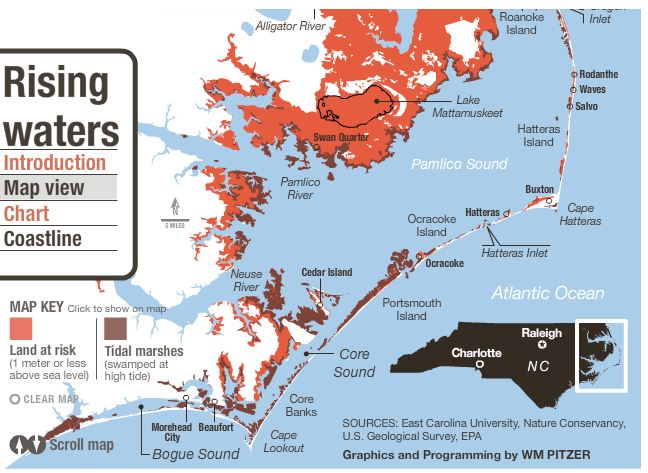
Despite the obvious danger that rising sea levels pose to communities on the Gulf Coast, tensions over climate change are flaring most acutely in the beach towns of North Carolina. In 2010, the North Carolina Department of Environment and Natural Resources (NCDENR) established the North Carolina Coastal Resources Commission (NCRC) to study the effects of rising sea levels by 2100. Lawmakers were dismayed when the report predicted a 39-inch rise in sea level by 2100.
By the summer of 2011, realtors and community members living on North Carolina’s Outer Banks saw the figures and were shocked. Even worse, the state was already developing a website to enable residents to check the vulnerability of their property. In response to this news, realty organizations fought back against the commission’s report, arguing that its scientific methods were questionable, lacking an assessment of economic impact, and devoid of any maps.
As the state produced the maps using Light Detection and Ranging (Lidar) technology, the outlook was increasingly dour for NC residents. Highway 12, Roanoke Island, and Pamlico Sound all faced significant flooding. Homeowners and businesses were understandably outraged at the report. The projections drove many to call for re-zoning of the North Carolina Coast in a manner that would consider much of the populated communities as uninhabitable land, devastating tourism and property values.
Lori Montgomery wrote in the Washington Post that one realty lobbyist, “worries that codifying the 39-inch forecast would crush the local economy, which relies entirely on tourism and the construction, sale and rental of family beach houses. In Dare County alone, the islands’ largest jurisdiction, the state has identified more than 8,500 structures, with an assessed value of nearly $1.4 billion, which would be inundated if the tides were 39 inches higher.”
Montgomery continued to explain that even a more modest forecast would be devastating to North Carolina. There are 414 properties in Dare County, valued at $70 million, which would be underwater. Widespread awareness of this danger would torpedo property values in the area.
North Carolina’s state legislature called for a new study, considering the work of the NCRC into question. Instead of projecting to 2100, the new study will only look 30 years forward – likely hoping to assuage concerns about the viability of NC’s coastline. The move has angered many, particularly environmental advocates. Gov. McCrory has stymied efforts to publish or publicize any sort of climate research.
Decreasing the timetable for the new climate study will help lawmakers avoid another glaringly alarming figure, like the 39-inch prediction. The new study, however, does not evade the urgency of the climate crisis. Short of serious legislation and action on climate change, there is little hope to save much of the United States’ coastal land.
Clearly there is need for civil society to push lawmakers at the state and federal level to honor climate studies instead of simply playing games with numbers. As the United States looks to develop infrastructure in the 21st Century, climate change plays an increasingly significant role. As seasons shift, temperatures rise, and the oceans press above their previous limits, our previous designs grow obsolete. While no one wants to see the worth of homes on North Carolina’s coast sunk, the seemingly-imminent danger of rising sea levels demands a more proactive approach by our governments.
As much as we may like to do so, covering our eyes and fudging the truth will still leave us high and dry – or below sea-level and quite wet, I suppose.
by Don Kraus | Jul 17, 2014 | Global Cooperation
Cell phones have facilitated access to health care for millions of people living in Sub-Saharan Africa. Mobile applications are enhancing government accountability with respect to sexual violence. Social media is augmenting disaster response and emergency management.
Digital technology has drastically impacted some of the most routine facets of our lives. Beyond this new threshold of interconnectedness, we should consider digital technology’s impact on citizenship and governance in the future.
When Gutenberg invented the printing press in 1436, he knew it would ease the labor of monks who spent all day manually copying the Bible. He probably didn’t think it would fuel colonization of the New World, make custom t-shirts or enable representative democracy. Imagine the difficulties of lobbying, holding elections, and organizing political parties without the ability to mass produce written correspondence.
In Guns, Germs, and Steel, Jared Diamond says, “Invention is often the mother of necessity, rather than vice versa.” Diamond’s point, outlined in the NY Times, is that inventors often create new products and the society finds a use for the product afterward.
Just as Gutenberg did not anticipate his press would promote literacy, mass media, and eventually enable the rise of Twitter, today’s technological developments have immeasurable possibilities.
We take the nation-state for granted, but the idea of “state sovereignty” was also invented. The unrelenting force of digital communication has complicated the usefulness of geographically determined borders and communities. Globalization, the prominence of non-state actors, and the nature of global challenges—like mass migration and climate change—have shown us that we are confronting 21st-Century problems with 17th-Century tools.
Looking toward the future, the movement of people and money will continue to outpace the ability of any one govern ment to control them. Technology has perforated the concept of national sovereignty. Nations no longer control their currency or the information flow across their borders. In response to this new reality, international organizations like the UN and WTO and regional blocs are blossoming around the world. The relevance of the “state” as we know it continues to erode with every bloc, common currency, and open border.
Democracy, too, has been affected by technology. Germany’s Pirate Party (yes, it exists, and holds 45 seats in German state parliaments and 1 seat in the European Parliament) has developed something called “Liquid Democracy.” With Liquid Democracy, citizens use a web-based platform to assign their votes to delegates who can best represent them on different issues. This method of voting has enabled members of the Pirate Party to more dynamically participate in decision-making.
At the intersection of the material and virtual worlds, web corporations are being lobbied by groups to maintain privacy protections and advance human rights. Facebook, for example, has 1.28 billion monthly active users. “Facebookistan” would be the second-most populous country after China.
When a many Taiwanese activists abruptly had their Facebook deactivated without explanation, citizens pushed Facebook to be more accountable. Taipei City Councilor Ho Zhi-Wei wrote an open letter to Mark Zuckerberg arguing that Facebook, as a publicly traded company, has an obligation to promote public welfare. As citizens surrender more time and information to the Net, they are also demanding more protections and rights from these “benevolent sovereigns.”
For many of us, our social networks are no longer defined by where we live. Instead they are tied to our professional, social or political interests. In the future, these networks might supplant where we live as a means of determining how we are represented as citizens.
Many of us have an idea of the future we would like to see. We expect human rights. We want to avert climate change. Bottom line, we want governments to provide us sufficient security in return for the personal sovereignty that we delegate to them. When national governments can’t do the job, we’ll need to develop something more effective. We know what values we want to uphold, though the path forward is mysterious.
Regardless, we know that digital technology is pushing humankind toward a networked and globalized future. Gutenberg couldn’t have imagined that his humble press would aid the rise of representative democracy. Certainly, any efforts to create an often-dreamed-of global democracy will grow from our current technological revolution. Perhaps the next great invention, the one that will help us implement global solutions, has already been invented and we simply haven’t found its proper use.
This post is co-authored by Logan Cotton, a Research Associate at GlobalSolutions.org
by CGS Blog Archive | Jul 17, 2014 | Global Cooperation, World Citizen
I never would have imagined that my 2010 summer in Egypt would change the trajectory of my life. However, my time there gave me critical exposure to social inequities in “Pre-Arab Spring” Cairo. It was there that I discovered my passion for social justice and the strength of global cooperation.
Six months later, it was at that same Tahrir Square that I passed every day in which thousands mobilized to demand change in what began the 25 January 2011 Revolution and Arab Spring of Egypt.
The truth is that young people around the world are becoming larger players in their societies. When we speak about global issues that we urge our international communities to address– such as poverty alleviation, women’s empowerment, access to education, and health equity–we cannot deny the role of young people in seeking change.
One of the biggest root issues that plague our global community is the lack of outlets that young people have to make their voice heard and create those changes. Local governments are not always doing the best job and aren’t holding themselves accountable.
As a country and government, we can help create outlets for young people to raise their voices globally. We must invest in local NGOs and help develop civic society so that young people have channels to properly voice their concerns and demand systemic reforms from their local institutions.
The Arab Spring is a prime example of how active our youth is; oftentimes youth will take to the streets if they feel that they are not being heard. Young people are interconnected, multilingual, and globalized. Before our global community can tackle any issue on a larger level, we must look at ourselves and ensure that we are investing in local, youth-driven initiatives for change towards issues related to health, education, and economic opportunity. Young people have answers, and they can be part of the solution.
I believe that the United States government can serve as an institution that supports the aspirations of people around the world who recognize the rights to a government and freedom of speech. This is one of the most sustainable ways to maximize prosperity and opportunity for people in the future. Creating partnerships with multilateral organizations will establish a new norm when combating issues on a global scale. Local initiatives that are already doing effective grassroots work must continue to invest in it.
History shows that political participation does exist, whether positive or negative, and youth are acting. If we can maximize their potential in a positive way by investing in local NGOs and civil society, then we are establishing channels for young people to be heard.
As a Pakistani Muslim woman, I am extremely passionate about girls’ education and access to reproductive and sexual health. However, I think that the most sustainable way to address these issues is to invest in locally driven initiatives to create systemic change.
As US citizens, we can act foremost by informing ourselves. We must strive to be religiously and culturally competent before we can advocate for any cause or change.
We, as an international community, must create a global ethic in which we all hold ourselves accountable to a standard. The world is suffering from injustices related to war; famine; genocide; and inequities in health, education, and the economy. We must invest in local communities and work alongside individuals to cultivate our shared values.
Building off of those shared values is the only sustainable way to create a peaceful and just global community. Only when we rise together in solidarity will our advocacy efforts take effect. Something as simple as a phone call to a legislator, signing an online petition, attending a Lobby Day on the Hill, or organizing a social justice initiative in our community can make a world of a difference.