by Lawrence Wittner | Aug 10, 2026 | Peace & Disarmament
Although 81 years have passed since the atomic bombing of Japan in August 1945, the rulers of major nations continue their reckless march toward nuclear annihilation.
The nine nuclear powers (the United States, Russia, China, Britain, France, Israel, India, Pakistan, and North Korea), possessing some 12,100 nuclear warheads, are all busily upgrading and expanding their nuclear weapons arsenals at an accelerating pace. Nuclear weapons spending rose to an all-time high of $119 billion in 2025―a 19 percent increase over the preceding year. The U.S. government alone, which accounted for more than half of this spending, is embarked on a $1.7 trillion, decades-long nuclear weapons buildup.
As the International Campaign to Abolish Nuclear Weapons (ICAN) has observed, “this overwhelming spending on nuclear weapons shows a willingness to research, develop, finance and build tools to exterminate humanity.”
Moreover, international nuclear arms control and disarmament agreements among the nuclear powers have collapsed. Russia and the United States own 86 percent of the world’s nuclear weapons and, although they signed numerous treaties in the past to limit or reduce the size of their nuclear arsenals, the last of these treaties, New START, expired this February.
The accelerating nuclear arms race is accompanied by repeated threats of nuclear war. Russian officials are particularly notorious in this connection. According to the Voice of America, from early 2022 to late 2024 Russian officials publicly issued 135 nuclear threats, with 27 of them coming from Vladimir Putin. But America’s Donald Trump has also publicly and repeatedly threatened other countries with nuclear destruction, as has North Korea’s Kim Jong Un.
Early this year, the editors of the Bulletin of the Atomic Scientists, assessing this deteriorating situation, moved the hands of their famous “Doomsday Clock” to 85 seconds to midnight, the most dangerous setting in its history.
Of course, there have been a great many warnings that nuclear weapons portend global disaster, including many beginning right after the shocking annihilation of Hiroshima and Nagasaki. “Seldom, if ever,” reported CBS radio commentator Edward R. Murrow, “has war ended leaving the victors . . . with such a realization that . . . survival is not assured.” The Chicago Tribune warned that a future atomic war would leave the world “a barren waste, in which the survivors . . . will hide in caves.” In France, the resistance leader Albert Camus declared that the modern world had “reached the last degree of savagery,” in which nations were faced with the prospect of “collective suicide.”
As nuclear fear swept around the world, large numbers of people sought to avert catastrophe. Some called for dramatically strengthened global governance to prevent the outbreak of nuclear war, while others, with the same goal in mind, championed nuclear disarmament. Speaking on behalf of the newly-formed Emergency Committee of Atomic Scientists, Albert Einstein typified this popular uprising by arguing that “a new type of thinking is essential if mankind is to survive.”
Over subsequent decades, the antinuclear movement ebbed and flowed, but, at times of mass mobilization, it had an important effect on nuclear weapons policies. Naturally, the leaders of many nations felt the allure of nuclear weapons, especially after thousands of years of human history in which national security often seemed to rest upon military strength. Nevertheless, as indicated by opinion polls and massive demonstrations, antinuclear agitation inspired revulsion against nuclear weapons and nuclear war among large portions of the public. Consequently, most governments decided not to build nuclear weapons or even to deploy them on their territory.
Hard-pressed by antinuclear campaigners and public opinion, even the small number of governments that built nuclear weapons found themselves unable to resist agreement on nuclear arms control and disarmament measures. Dwight Eisenhower, John F. Kennedy, Nikita Khrushchev, Ronald Reagan, and George H.W. Bush were not nuclear “doves” when they entered office, but, in response to popular pressure, they took significant action to curb nuclear dangers. Some government officials, like Mikhail Gorbachev, even became fervent converts to the antinuclear cause.
As the 20th century came to an end, however, progress in rolling back the nuclear menace began to unravel. Popular protest declined, and nuclear disarmament organizations dwindled in size. By contrast, conservative and militarist forces grew more assertive, blocking U.S. Senate ratification of the Comprehensive Test Ban Treaty, demanding the building of new nuclear weapons, and derailing Barack Obama’s initiative for creating a nuclear weapons-free world.
Although nuclear disarmament organizations were on the defensive during the early 21st century, they retained enough strength to produce one major victory. Joining together in the International Campaign to Abolish Nuclear Weapons, they cooperated closely with officials in small, non-nuclear nations to produce a series of UN conferences on nuclear issues. Then, at the 2017 conference, the national delegates voted 122 to 1 to adopt the UN Treaty on the Prohibition of Nuclear Weapons (TPNW), which banned nuclear weapons. Entering into force in January 2021, the treaty has been signed, thus far, by 100 countries―a majority of the world’s nations.
Even so, the situation remains dire. Today, most rulers of the nuclear powers are nationalistic, militaristic, and authoritarian. Faced with a world plagued by international conflict, they show no interest in strengthening global governance or even in securing nuclear arms control and disarmament. Instead, they are busy arming their nations for war, including a disastrous nuclear war. Not surprisingly, none of them is willing to sign or even abide by the TPNW. Although the antinuclear movement continues to oppose their priorities, it remains weak and unable to halt the momentum toward nuclear catastrophe.
Thus, unless there is an advent of new, less hawkish rulers, a movement revival, or both, a nuclear war seems likely.
Admittedly, it’s possible that, when a calamitous nuclear war does occur, it will finally convince even the slow learners among government officials that the nuclear age requires new thinking about international relations. Unfortunately, that recognition will arrive too late to matter, for such a war will snuff out most life on earth.
by Lawrence Wittner | Jul 28, 2026 | Peace & Disarmament
On March 1, 1945, only six weeks before his death, U.S. President Franklin D. Roosevelt delivered an address to Congress that pointed toward a sweeping transformation of international relations.
With the Axis powers tottering toward defeat in World War II, Roosevelt reported that the recently concluded Yalta conference of Allied leaders had agreed upon “a common ground for peace.” It would “spell the end of the system of unilateral action, the exclusive alliances, the spheres of influence, the balances of power, and all the other expedients that have been tried for centuries―and have always failed.” These approaches would be replaced by “a universal organization,” a “permanent structure of peace upon which we can begin to build . . . that better world in which our children and grandchildren . . . must live, and can live.”
As a follow-up, delegates from fifty nations met in San Francisco from April 25 to June 26, 1945 and drafted the United Nations Charter. Although the Charter affirmed “faith in fundamental human rights, in the dignity and worth of the human person, in the equal rights of men and women and of nations large and small” and promised to promote “justice,” “social progress,” and “better standards of life in larger freedom,” its first proclaimed goal (and top priority) was “to save succeeding generations from the scourge of war.”
In subsequent decades, the United Nations did an effective job of encouraging human rights and social progress. The 1948 Universal Declaration of Human Rights, which Eleanor Roosevelt occupied a pivotal role in creating, drafting, and seeing through to unanimous adoption, represented a substantial advance in social, cultural, and economic rights. In addition, the United Nations played an essential part in the widespread decolonization process in Africa, Asia, and the Caribbean, in promoting economic development and public health in impoverished nations, and in developing international agreements to address environmental issues.
Ironically, however, when it came to preventing military aggression and war, the UN record was less impressive. Yes, the international organization successfully mediated more than 170 peace settlements, deployed over 70 peacekeeping missions to stabilize post-conflict zones, and fostered important measures for arms control and disarmament. Nevertheless, more than 285 military conflicts have erupted around the world in the years since 1945, taking a vast human and economic toll. Furthermore, the number of wars between nations has increased sharply over the past decade, reaching, in 2025, the highest level since World War II.
If the United Nations has fallen short of its goal of ending war, this is largely due to the behavior of the “great powers.” The United States, the Soviet Union (and its successor, Russia), France, Britain, and China have employed their veto at least 320 times in the UN Security Council to frustrate UN action. They have also been leading participants in some of the world’s most disastrous wars fought since 1945―in Korea, Hungary, Vietnam, Algeria, Afghanistan, Iraq, Syria, Ukraine, and numerous other nations.
With the United Nations frequently hobbled by the most powerful nations, the defense of peace has often been left to citizen activism, especially the peace movement. And, indeed, that movement has managed to stir up popular opposition to militarism, occasionally succeeding in bringing wars to an end. Working with its natural allies among smaller nations and at the United Nations, the peace movement has been particularly successful at generating nuclear arms control and disarmament measures.
Sometimes the movement even made converts among the leaders of the major powers. Soviet party leader Mikhail Gorbachev, the key government official who brought the Cold War to an end, credited much of his “New Thinking” to the nuclear disarmament activism of his time. In a remarkable address, delivered on December 7, 1988, Gorbachev told the United Nations that “the use or threat of force no longer can . . . be an instrument of foreign policy.” In their place, he said, the world needed the establishment of a strong international security system, under the direction of a revitalized United Nations. It was time “put an end to an era of wars, confrontation and regional conflicts,” he said. “This is our common goal, and we can only reach it together.”
Although Gorbachev was swept from power thanks to the dissolution of the Soviet Union, another government official, Barack Obama, took up his role. Deeply influenced when still a student by the nuclear disarmament movement of the 1980s, Obama, during his 2008 presidential campaign, promised to seek “the peace of a world without nuclear weapons.” After his election as President of the United States, he followed through by chairing a dramatic meeting of the UN Security Council―only the fifth in the Council’s history held at the level of heads of state―that proclaimed a commitment to the goal of a world free of nuclear weapons. UN Secretary-General Ban Ki-moon termed it “an historic event.”
But the end of the Cold War provided the best opportunity for a decisive turn toward peace, and that opportunity had already passed. Neither Gorbachev’s successors nor Congressional Republicans could stomach Obama’s proposal, which sank amid a rising tide of rightwing nationalism. New government leaders like Donald Trump, Vladimir Putin, and Benjamin Netanyahu took power, assailing the United Nations and embarking on programs of weapons buildups, unilateral action, and wars.
Even so, the books have not been closed on the future. As opinion polls reveal, public support for heightened global cooperation is widespread, as is public disdain for military invasions and occupations of other lands. The smaller nations of the world are revolting against the major military powers, as revealed by overwhelming votes at the United Nations to condemn great power military aggression and to implement the UN Treaty on the Prohibition of Nuclear Weapons―now ratified by more than half the world’s countries. Recently, in fact, an international campaign has begun to strengthen the United Nations by amending its Charter.
The dream has been deferred, but it remains alive.
by Jerry Tetalman | Jul 2, 2026 | Peace & Disarmament
If those killed in war could speak, this is what I imagine they would say. They would claim that war is humanity’s biggest moral failure and that war is the real enemy. They might ask, “Are we savage animals or are we civilized human beings?” and “When will war be outlawed?”
They might state, “We live in a world where the vilest of crimes―murder, torture, and rape―which are punished with severe consequences within most societies, are somehow accepted when committed as part of war.” They might think about how the organized murder of one group of humans by another group of humans, which is the definition of war, is encouraged by so many people.
War has been an integral part of human history for some 11,000 years or so, depending on the definition of war. Iconic anthropologist Margaret Mead wrote an essay in 1940 that declared that, like so many other human practices, war is an invention—we are not doomed to wage war simply because of human nature. She proved her hypothesis simply by describing peoples that not only didn’t ever wage war, but often didn’t even have a concept of what war is.
In the nuclear age, it is the most imminent threat to our continued existence. As modern civilized people, most of us find war abhorrent, but few of us call for the abolition of war or understand why war still exists in the contemporary world.
War exists for many reasons:
- One is because human society has been organized around the concept of the in-group and the out-group. The in-group could be a tribe, a city, a nation, a religion, a language group, or several associated nations. The out-group may be tolerated, but in many instances, it is considered the enemy.
- Sociologists point to relative deprivation, that is, when everyone is poor, that isn’t a conflict, but if we see one group living quite well while we are not, that can lead to conflict and has led ultimately to casus belli, a reason to wage war.
The question of our time is: can we create a new story in which humanity as a whole is the in-group? Can we civilize a lawless world by creating a basic system of rules, a system of enforceable global law?
Having an understanding of what behavior is acceptable is the prerequisite to creating law. Law is the basis of civilization and allows for the nonviolent resolution of disputes. We currently live in a state of relative anarchy between nations, in which military power, rather than law, makes the rules. The greatest challenge of our time is bringing the rule of law to the global level, thereby replacing war with courts and parliaments. We have peace and order within most countries because of the enforceable rule of law, but between nations, international law is unenforceable, thus ineffective.
The United Nations has succeeded in bringing almost all countries of the world together for dialogue and has laid the foundation for international law through many multilateral treaties. But the United Nations has fallen short because it lacks the enforcement mechanism that true law requires. The law is what protects individual citizens from criminal abuse. We are relatively safe in society because crimes are prosecuted and have consequences. But, at the international level, laws between nations lack an enforcement mechanism. The United Nations is based on treaty law, a voluntary system of agreements between nations. Thus, it lacks an enforcement mechanism that true law provides.
A new, more powerful, and democratic United Nations is needed to create peace among the world’s countries.
Fortunately, transforming the United Nations along these lines is possible. Article 109 of the UN Charter provides a mechanism for initiating a UN Charter Review Conference. Such a conference would open the way to engaging the world’s countries in creating a rules-based system of international law that is enforceable rather than voluntary. In this new, more civilized world, based on law and rules rather than on military power, nations would no longer have the need or ability to engage in war.
Under Article 109 of the UN Charter, convening a global Charter review conference requires approval from three-fourths of the members of the General Assembly and nine members of the Security Council. The final approval of the conference results rests with the five permanent members of the Security Council―the United States, China, Russia, France, and Britain―each of which has veto power. If successful, the conference could transform the United Nations into a more effective international institution―one capable of enforcing laws among nations.
Admittedly, the ability of any of the five permanent members of the Security Council (the P5) to veto UN Charter revisions poses a potential obstacle to UN reform. Even so, implementing the UN Charter revision process will take considerable time, during which the most likely nay-sayers among the P5 governments may change, perhaps for the better. Moreover, a P5 recalcitrant might hesitate to exercise a veto at a momentous conference with overwhelming support for change. It is also possible that, when faced with one or two holdouts, the delegates to a UN Charter revision conference would surge beyond their original mandate and create a new, more effective system of global governance.
To begin gathering public and diplomatic support for holding an appropriate Charter review conference, proponents of UN reform turned in September 2025 to launching the Article 109 Coalition during the annual UN General Assembly High-Level Week. Since then, the campaign has been picking up steam, with civil society groups like Citizens for Global Solutions working to mobilize U.S. support.
In their campaign, they can point to important evidence that strengthened governance reduces the likelihood of war.
The countries of the European Union, for example, have achieved peace after thousands of years of warfare, including two world wars, by trading a small portion of their sovereignty for security. They now resolve disputes in the European Union’s parliament and courts. Similarly, countries around the world could achieve peace by establishing a global system of courts and parliaments through a transformation of the United Nations.
Just as slavery was abolished in the nineteenth century and is now illegal in all countries, war too can be abolished by law. Indeed, with the strengthening and enforcement of international law, war could become an obsolete relic of a barbaric past.
by Lawrence Wittner | Jun 22, 2026 | Peace & Disarmament
Although the U.S. labor movement is sometimes depicted as hawkish and xenophobic, this characterization ignores its repeated attempts to grapple with the global problem of war.
On June 9, 2026, for example, delegates at the annual national convention of the AFL-CIO, the 15-million member labor federation with which most American unions are affiliated, voted to adopt Resolution 9, “We Want a Just and Peaceful World.”
Declaring that “working people must never be treated as pawns in geopolitical power struggles,” the resolution promises that “we will stand with workers and communities harmed by war” and “will advocate for an end to wars that threaten workers’ livelihoods, security and rights.”
“In Gaza,” notes the AFL-CIO statement, “we demand an immediate and permanent ceasefire; full, safe and sustained humanitarian access; a halt to arms transfers that may facilitate violations of international law by all parties; and a credible political process grounded in international law and UN resolutions to achieve a just and lasting peace.”
Furthermore, it declares, the AFL-CIO “will engage forcefully in international institutions,” such as the United Nations and the International Labor Organization, and “will advocate for continued U.S. government and labor engagement in international negotiations,” including those focused on climate change and energy under the UN Framework Convention on Climate Change and the Paris Agreement.
Assailing demagogic “efforts to divide working people through fear, exclusion, and racist anti-migrant rhetoric,” the labor federation opposed “discriminatory travel bans and migration policies,” denounced “the abandonment of refugee and asylum commitments under international law,” and demanded “due process for all.” It promised to “seek . . . foreign policies that promote peace and halt support for repressive governments.”
Three months earlier, rebuking the U.S. and Israeli governments for initiating a war with Iran, the AFL-CIO issued a statement calling for an end to the conflict and demanding “strict respect for international law, the United Nations Charter, and the U.S. Constitution that call[s] for the people’s voice through Congress in any war authorization.”
Of course, organized labor’s expressions of support for peace and international cooperation are not always accompanied by major labor movement campaigns to secure them. Within the U.S. labor movement, domestic policy concerns, which have a direct impact upon American workers, tend to outweigh foreign policy concerns.
Furthermore, during most of the Cold War, much of the AFL-CIO leadership was, in fact, quite hawkish, rallying around the flag and supporting U.S. military intervention in Asia, Latin America, and Africa. AFL-CIO president George Meany worked vigorously and successfully to get the labor federation to give “unqualified support” to the U.S. war in Vietnam and, in 1972, to reject backing the peace candidacy of Senator George McGovern, the Democratic nominee for President.
Even so, for more than a century, a significant number of prominent American union leaders have been peace proponents. These include Eugene Debs (president, American Railway Union), a sharp critic of the Spanish-American War and of World War I, who, thanks to this stance, became the nation’s best-known political prisoner. Another was “Big Bill” Haywood (leader of the Industrial Workers of the World), who condemned World War I and, to escape Debs’s fate, fled the country.
In later years, peace-oriented labor leaders included Walter Reuther (president, United Auto Workers and vice president of the AFL-CIO), a world federalist who also served on the board of the National Committee for a Sane Nuclear Policy (better-known as SANE) and opposed Meany’s hawkish approach during the Cold War. Another, William Winpisinger (president, International Association of Machinists), became co-chair of SANE, as well as a champion of conversion from a military to a peacetime economy.
Indeed, Samuel Gompers, the founder and long-time president of the American Federation of Labor, began his labor career as a strong advocate of peace. In 1893, answering the question “What does labor want?” Gompers replied: “We want more schoolhouses and less jails; more books and less arsenals.” A few years later, he sharply criticized America’s imperialist role in the Philippines.
On numerous occasions, American labor activists expressed similar views.
Even during the Vietnam War, when the AFL-CIO leadership and numerous unions voiced hawkish sentiments, substantial dissent grew within the labor movement. Several large unions broke with AFL-CIO policy and, by 1970, the leaders of 22 U.S. unions had joined a call for the withdrawal of U.S. military forces from Vietnam.
Antiwar activism within labor’s ranks flared up again in the 1980s. A National Labor Committee in Support of Democracy and Human Rights in El Salvador emerged and denounced the Reagan administration’s military aid to rightwing, repressive governments battling leftwing rebels in Central America. Responding to such pressure, the delegates at the 1985 AFL-CIO national convention voted overwhelmingly for a resolution that challenged U.S. government policy by calling for “a negotiated settlement, rather than a military victory” in the region. Also, by 1986, well over half of the AFL-CIO’s affiliated unions backed the U.S. peace movement’s Nuclear Freeze campaign, which called for a halt to the nuclear arms race.
The Iraq War triggered another surge of peace activism within the labor movement. In January 2003, as a U.S. military invasion of Iraq loomed, some 125 delegates from various labor unions met at Teamsters local 705 hall in Chicago and formed U.S. Labor Against the War (USLAW). After the invasion began that March, the new organization grew quickly and became a powerful voice within union locals, individual unions, and the AFL-CIO’s state affiliates. It grew so powerful, in fact, that, at the labor federation’s 2005 convention, the delegates voted overwhelmingly for a resolution demanding the “rapid withdrawal” of U.S. troops from the conflict.
Consequently, this June’s AFL-CIO call for a just and peaceful world is in line with much of labor’s past. And the labor movement shouldn’t be written off as a force for peace and international cooperation in the future.
by Charles Howlett | Jun 2, 2026 | Peace & Disarmament
In his award-winning book about World War I, the historian Paul Fussell began The Great War and Modern Memory with the words: “Every war is ironic because every war is worse than expected.”
He was all too correct. During four years of bloodshed, 1914 to 1918, at least 8.5 million combatants were killed, many more were wounded, and close to 10 million non-combatants perished. In terms of economic expenditure, the war cost between $185 billion and $200 billion, roughly equivalent to $6 trillion today.
World War II was even more devastating in terms of lost lives and economic costs, with the economic loss alone running between $4 trillion and $5 trillion in 1940 dollars. Today that would be somewhere around $104 trillion. The Vietnam War cost approximately $168 billion (in today’s dollars, $1 trillion). The Gulf War of 1990-91, though brief, ended up devouring approximately $600 billion, and the Iraq-Afghanistan Wars around $8 trillion. The cost of the current conflict in Iran is expected to exceed $1 trillion.
The Iran war raises a fundamental question peace advocates have been asking since the conclusion of World War I: shouldn’t the wealth of nations be spent improving the lives of their citizens instead of wasting it on war? What if the money allocated for military purposes was used, instead, to make college more accessible, fund health care for all, ameliorate world hunger, fund disease prevention programs, and expand education programs for all children? The costs for this present conflict are already being borne out in terms of high energy costs and rising food prices directly impacting the lives of the less fortunate in our society.
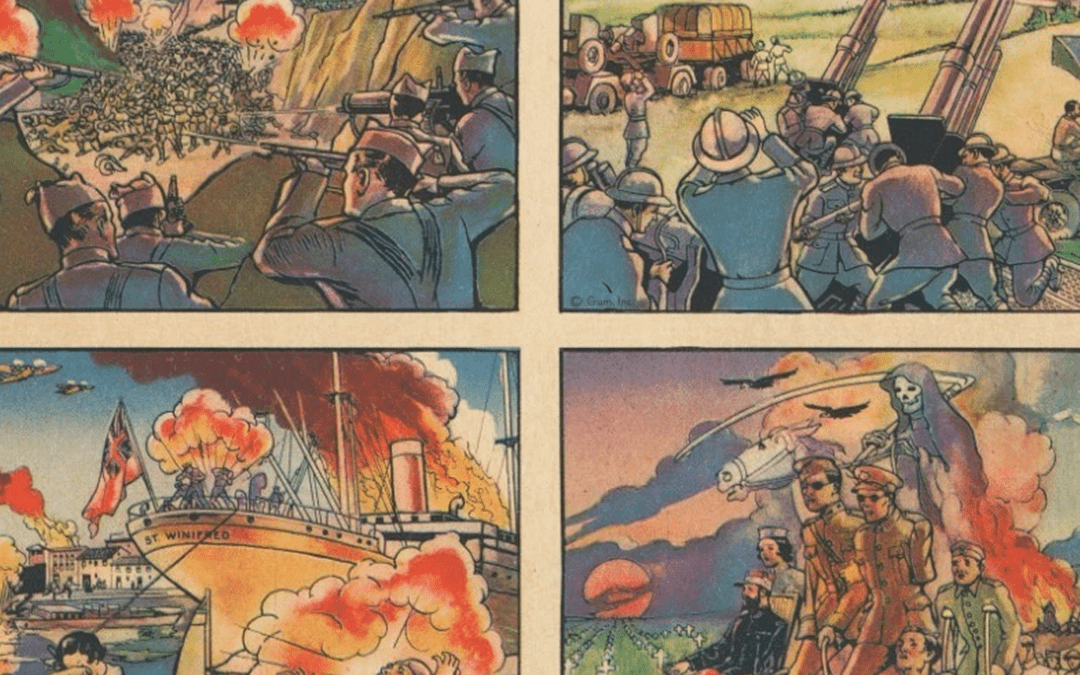
Curiously, this question was conveyed in a popular bubble gum trading card marketed shortly before the advent of World War II. That card, “The Frightful Cost of War,” resonates just as loudly today as it did 88 years ago.
Historically, the card’s origin dates back to July 1937. While listening to radio broadcasts and reading press accounts about Japan’s unprovoked military invasion of the Chinese mainland, Warren Bowman, a Philadelphia gum manufacturer, commissioned an advertising company from nearby Abington, Pennsylvania, to create a series of collector cards depicting the brutality of war. All depictions and descriptions created were based on current radio reports and newspaper stories. Each piece of gum contained in a wrapper, which sold for a penny, also included a card. On the back of each card was printed the caption: “To Know the HORRORS OF WAR is to wantPEACE.”
“The Horrors of War” collection became an instant financial success, producing some 100 million cards and netting the company over $40,000 a week. Indeed, the collection remains the most popular non-sports card set ever manufactured. A portion of the cards covered the Spanish Civil War, Mussolini’s incursion in Ethiopia, and―a very small number―Hitler’s threats to peace in Central Europe. The initial set consisted of 240 cards. Another 48 were added later. These cards contained crisp depictions with colored artwork―illustrating and describing the various military conflicts and bombings of civilians then taking place—on the front of each 2.5”x 3” rectangular card. Eye-popping drawings and chilling narratives appeared on the back.
Nearly one-third of the set focused on the impact of war on innocent civilians. In an effort to influence the mind-set of pre-adolescent purchasers, many of these cards depicted young children and babies being killed. This novel cultural approach led some critics to charge that the cards exaggerated combat scenes and ruthless killings of noncombatants by using red ink for maximum effect, thus appearing to instrumentalize war in the minds of children rather than rejecting it. Mothers and many schoolteachers questioned the effectiveness of the set as an educational lesson due to its graphic nature.
Yet most commentators agreed about the set’s lesson for children, as well as for adults, when it came to one very special card. By design, when the trading cards hit the market in the spring of 1938, the very last one in the initial set encapsulated the true message of the “Horrors of War.” That card, “The Frightful Cost of War,” is cast in a setting where children’s eyes are directed to gaze upon a blood-red setting sun surrounded by an atmosphere of smoke and fire from a destroyed farm, a cemetery filled with white crosses, fleeing wounded soldiers walking or being carried on a stretcher, amputees in a wheelchair and crutches, and what appear to be scavengers, soaring overhead. In the middle is the Grim Reaper on a white horse wielding his scythe. Frightening, yes indeed! But it also effectively challenged the popular idea that war is glorious, by illustrating the losses it entails.
This message was powerfully conveyed in the narrative on the back of the card. “War costs money…billions of dollars!” it declared. “War takes human lives…millions of them! War makes children old, breaks parents’ hearts, kills morale! War destroys cities, art treasure, civilization.”
Unfortunately, the set soon fell victim to the very evil it sought to eradicate. Less than a year after the complete set was produced, another global conflagration was underway―the most destructive war in human history. In this context, the message of the bubble gun card was quickly forgotten.
That message is needed now. When it comes to yet another unpopular war in the Middle East, “The Frightful Cost of War” remains as powerful today as it was when it first appeared on the doorstep of World War II. Now is the time for people and nations to learn its lesson and not forget it.
And, if we have learned its lesson, we need to create an international alternative to war―one providing the security we need, not the false promise of security through war. Merely repeating “war is bad, war is bad” when it comes to money and lives is simply whistling past the graveyard and will never take the politics out of national interests. Now is the time we should consider, seriously and unreservedly, creating a democratic world federation based on justice and law.
by Lawrence Wittner | Apr 27, 2026 | Peace & Disarmament
If the objective of the U.S. war upon Iran is to ensure that that country does not develop nuclear weapons, that goal was attained more than a decade ago through a far different approach than the one now being followed by the Trump administration.
Iran, as a signer of the Nuclear Nonproliferation Treaty of 1970, had agreed to forgo the development of nuclear weapons. Even so, fears grew during the early 21st century that Iran’s uranium enrichment program, used for peaceful purposes, might be diverted to the development of the Bomb, thereby throwing the volatile Middle East into yet another crisis, including a frenzied nuclear arms race.
As a result, the five permanent members of the UN Security Council (the United States, Russia, China, Britain, and France) and Germany began lengthy negotiations with Iran, offering it various incentives to halt uranium enrichment. A key incentive was the lifting of international sanctions, which were having a severe impact on sales of Iran’s oil and, thus, its economy. After the election in 2013 of an Iranian reformer, Hassan Rouhani, as president, the negotiators came to a preliminary accord to guide their talks toward a comprehensive nuclear agreement.
The final agreement, formally known as the Joint Comprehensive Plan of Action (JCPOA), was negotiated by the five permanent members of the UN Security Council, Germany, and the European Union. Signed in July 2015, it granted Iran sanctions relief in exchange for significant restrictions on its nuclear program. These included Iran’s agreement to ban production of highly enriched uranium or plutonium, ensure that its key nuclear facilities pursued only civilian work, and limit the numbers and types of centrifuges that it could operate. In addition, Iran agreed to allow inspectors from the International Atomic Energy Agency (IAEA), the UN’s nuclear watchdog, unfettered access to its nuclear facilities and undeclared sites.
In the United States, the Iran nuclear agreement was strongly supported by the Obama administration, which played a key role in securing it, and by Democrats, but denounced by Republicans. Jeb Bush, then a leading presidential contender, called it “dangerous, deeply flawed, and short-sighted,” while U.S. Senator Lindsey Graham claimed that it was a “death sentence for the state of Israel.” Indeed, Benjamin Netanyahu, Israel’s Prime Minister, lobbied ferociously against U.S. acceptance of the Iran agreement, furiously attacking it as a “historic mistake.”
Despite the opposition, the agreement went into effect in January 2016 and, initially, had smooth sailing. The IAEA certified that Iran was keeping its commitments, nations repealed or suspended their sanctions, Iran’s oil exports surged, and the United States and European nations unfroze about $100 billion of Iran’s frozen assets.
In May 2018, however, Donald Trump, Obama’s successor as President, breaking with America’s European allies, unilaterally withdrew the U.S. government from the Iran agreement and announced the reimposition of oil and banking sanctions. “It is clear to me that we cannot prevent an Iranian nuclear bomb under the decaying and rotten structure of this deal,” Trump announced. Assailing the Iran agreement as “defective to its core,” Trump condemned it for failing to deal with Iran’s ballistic missile program and its proxy warfare in the Middle East, as well as for the agreement’s 10-year sunset provision.
In response, Iranian President Rouhani, stating that the U.S. government had failed to “respect its commitment,” declared that he had “ordered the Atomic Energy Organization of Iran to be ready for action if needed, so that if necessary we can resume our enrichment on an industrial level without any limitations.” Even so, he promised, he would wait to speak about this with allies and the other signatories to the agreement.
Thereafter, things went downhill. Although France, Germany, and Britain sought to keep the agreement alive by evading the U.S. banking sanctions through a barter system, this effort eventually collapsed. Meanwhile, Trump got into a verbal brawl with Rouhani, threatening Iran with what he called “CONSEQUENCES THE LIKES OF WHICH FEW THROUGHOUT HISTORY HAVE EVER SUFFERED BEFORE.” Ultimately, Iran began exceeding the agreed-upon limits to its stockpile, enriching uranium to higher concentrations, and developing new centrifuges.
Although Joe Biden, as a 2020 presidential candidate, promised to rejoin the Iran nuclear agreement and “to work with our allies to strengthen and extend it,” by the time he was in office the relationship with Iran had deteriorated too far to make this feasible. Coming under a new, more reactionary leadership, the Iranian regime grew more repressive, as well as more distant from the United States and more politically toxic. As a result, a new agreement was increasingly out of reach.
In retrospect, are there any lessons that can be learned from these events?
One is that, to the degree that the development of nuclear weapons by Iran is currently a problem, it is a result of Trump’s decision to pull out of the JCPOA. Or as Biden put it years ago, Trump’s pullout from the 2015 Iran nuclear agreement was “a self-inflicted disaster.”
Another is that getting a country to forgo nuclear weapons development is easier to accomplish through international―and especially UN Security Council―action than through unilateral action. A threat from one nation to another can easily be viewed and dismissed as bullying. But pressure from a worldwide organization representing the community of nations has greater impact.
More generally, if nations are going to be asked (or pressured) to forgo development of nuclear weapons, it is useful to have a framework that treats nations equally. The Nuclear Nonproliferation Treaty fosters this equality through a bargain, in which the non-nuclear nations forgo building nuclear weapons in exchange for the nuclear nations eliminating their own nuclear arsenals. The next time the President of the United States or the Prime Minister of Israel threatens to annihilate Iranian civilization, someone might remind him of that.