by Ezra Douglas | Sep 17, 2014 | Climate Justice, Global Cooperation
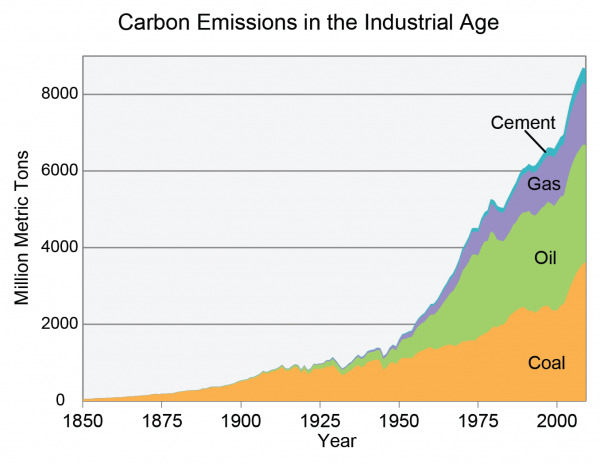
In our world, there has never been a greater threat to humanity since the emergence of climate change. Last week, the UN Meteorological Organization released a report that CO2 levels on our planet are rising at an uncontrollable rate. If that’s not concerning enough, most of the major greenhouse gases emitted into our atmosphere reached an all-time high level in the year 2013.
Eventually, these gases will become more catastrophic and inflict widespread devastation to the point where the planet can no longer cope. In fact, the rise of these gases on earth are the leading cause of climate change, resulting in changes in the earth’s atmosphere and temperature as well as widespread drought, flooding, and devastating storms. And while one may think that CO2 only affects the atmosphere, that’s wrong too! Higher CO2 levels drastically change our oceans and raise the acidity of the water. With a greater output in the amount of greenhouse gases in our atmosphere, our planet will not have the ability to convert these gases back into the air that we breathe. Although invisible, the effects from these gases will eventually force animals to migrate or go extinct, increase the probability of war, cause drought and famine, and ultimately threaten our very existence as a species.
While this report is alarming, it is critical that world leaders react to these changes to mitigate the effects of climate change. We have all heard of the effects of climate change through the accounts of scientists, reports, news articles, and even in some blockbuster hits like The Day After Tomorrow. World leaders must act at the upcoming UN Climate Summit, scheduled to be held on September 23rd.
It is at this Climate Summit that world leaders will discuss methods and solutions towards combating climate change. With these talks, we hope that they take action and consider the seriousness of an altered environment due to changes in the climate. With this recent UN report discussing the rise of CO2 and other greenhouse gases, I hope world leaders wake up to reality, take the initiative, and understand that our planet cannot sustain the current output of CO2 and other gases.
It is imperative that this summit galvanizes world leaders and countries to sign an agreement by 2015 to combat climate change. In fact, we must invest heavily into sources of renewable energy and change our habits as a people. Climate change is not going to wait for us to change, and if we wait too long, we will reach a point of no return where we can do nothing to save the planet. So let’s try to reduce our carbon footprint in an effort to limit the emission of these gases. The golden rule states that you should “treat others as you want to be treated.” Well, why shouldn’t we also treat the earth as we want to be treated?
by Donna Park | Sep 11, 2014 | Global Cooperation, World Federation
Letters to Jake Series, Letter #5
Dear Jake,
Our recent visit to the Natural History Museum was so much fun. Papa and I were very glad that you insisted on seeing the movie in the “Origin of Man” exhibit. “We Are All One Species” was a fascinating movie for children and adults alike. It was interesting to learn that the other human species died out 17,000 years ago, at about the same time that our species, Homo sapiens, migrated across the entire planet. It was good to see the images of men and women as a rainbow of one species from light- to dark-skinned and everything in between. Our differences are very minor compared to the commonalities that unite us.
This is at the heart of my desire to create a United Federation of Nations, to unite all human beings across the earth into a global community. I don’t want to eliminate the nations. Indeed, I want to be a proud American who can also say I’m a proud citizen of the world. I want the nations to deal with national issues and a federation of nations to deal with global issues that affect all Homo sapiens, like the environment, the oceans, war, and the world’s food supply and health threats.
Right now the world has so many problem areas, where adults and children are being killed or are fleeing their homes in an attempt to find safety. I believe that the best way to address these problems is with a strong, democratic united federation of nations to bring about the force of law rather than the law of force. We do need a strong peacekeeping force ready to go into problem areas to protect children and their communities. This force should include peacekeepers from multiple countries, not just from the US.
Although there is much to do to transform the United Nations into a strong, healthy, democratic United Federation of Nations, it is time for all Homo sapiens to demand that this be done. I believe the future of our species requires that we unite together.
Papa and I didn’t plan on taking you to the “Origin of Man” exhibit at the museum because we thought you were too young to appreciate it. But you definitely appreciated the fact that “we are all one species.” If a three-year-old can understand that, I have hope for the world.
I want a healthy, democratic and truly safe world for you, your twin sisters and all children of the world.
Love,
Gram
by Wade Meyerhoffer | Sep 5, 2014 | Global Cooperation, Peace & Disarmament
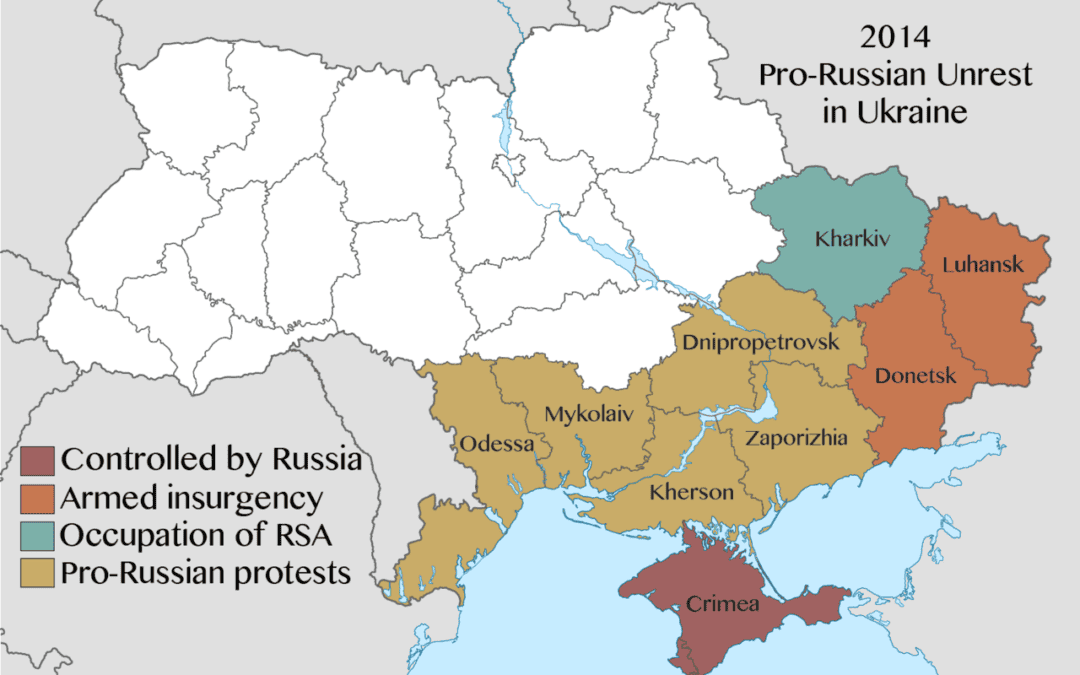
Eastern Ukraine has been at the forefront of the news for several months now, and if the events of the last few weeks are any indication, things will continue to escalate. The conflict was heated and popular enough when the downing of MH-17 brought the situation to the world’s doorstep. Furthermore, Russia’s involvement in Ukraine threatens to rehash old cold war mantras, to the dismay of the world’s observing players.
The PR teams of both the Russian and Ukrainian governments are doing their best to spin the violent events of the last few weeks to garner positive attention to their respective causes. Meanwhile, Vladimir Putin and Petro Poroshenko actively search for a solution to this debacle. It’s plausible that, for the situation to de-escalate, an international organization will have to intervene diplomatically with the aid of a humanitarian watch group to help sort out the facts.
Russian forces recently made their way across the Ukrainian-Russian border, and it is difficult to comprehend their intentions based on the news that is circulating. Russian officials have said that the contingent was made up of humanitarian trucks supplying cities in the region that have lost electricity and access to running water. Ukrainian officials have said that these “humanitarian” convoys have been supplying the pro-Russian separatists with supplies such as weapons and ammunition.
Furthermore, the Ukrainian government detained several Russian paratroopers who had crossed the border. According to a major Russian news outlet, the paratroopers allegedly had no idea they crossed into the border and did not resist when detained. While the Russians will surely play this off as another humanitarian aid maneuver, Ukraine seems just in their suspicions, given the increased Russian military presence on the border (which includes multiple tank units and air defense systems, as well as a force of around 20,000 soldiers). With these events in mind, it is hard to imagine a ceasefire agreement between the two sides anytime soon.
The talks held between Putin and Poroshenko on August 26th were slated to discuss the Ukraine’s trade relationship with Russia. However, the talks instead focused on the prospects of de-escalation. Putin has said that it is ultimately up to Poroshenko to deal with the rebels that reside within his jurisdiction. These talks could yield important consequences for the world system in the near future. Putin’s land grab is undoubtedly a step in his plan to return Russia to the spotlight as a global leader by increasing his sphere of influence. In the meantime, Putin seems content to outfit the pro-Russian rebels in their quest to free themselves from Ukrainian sovereignty and switch allegiance.
It remains to be seen whether or not the international organizations or superpowers of the world will choose to get involved militarily. The United States and several European powers have imposed economic sanctions on Russia to little effect. The United Nations and NATO have yet to get directly involved– though NATO does plan to station troops in various eastern European military bases and is discussing impending actions at a summit in Wales. Unfortunately, Ukraine is not a member of NATO; the organization therefore has no immediate responsibility to deploy ground troops–though it has the capability to provide the Ukrainian side with vital resources.
Aiding the Ukrainians through NATO seems to be the most pragmatic path that the US can take at this juncture. Direct military action has the potential to set off Putin in what could possibly become another geopolitically-charged cold war-era proxy conflict. Additionally, Washington should be pushing its major European partners to aid the Ukrainian government, as it is once again in a transitional period after Poroshenko dissolved Parliament. Despite the flagrant intervention and disrespect of sovereignty, it would be ill-advised for the US to intervene unilaterally in Ukraine.
Washington must therefore proceed cautiously and diplomatically through the appropriate international organizations. The situation could benefit from the help of an organization such as Amnesty International or a similar third-party watchdog group to discern what is actually happening on the border. Through greater transparency and international support, the US can play a role in de-escalating this violent conflict through multilateral international cooperation. Should there be any hope of negotiation between Putin and Poroshenko, NATO should have a spot at the table.
by Colleen Chiochetti | Aug 28, 2014 | Global Cooperation
This post was originally published on March 26, 2014. It has been reposted in light of the recent news that the Obama Administration is pursuing a climate agreement in lieu of a treaty for the 2015 UN summit meeting in Paris.
In an increasingly globalized world, multilateral engagement is becoming even more critical for the planet’s survival. No longer can a nation act unilaterally without being left behind. In light of this, a debate has emerged about what is the best way to engage on the international level: through treaties or agreements?
In a 2013 article posted by Foreign Affairs, David Kaye argues that treaties create reliable expectations and impose consequences for violators that agreements do not. Kaye points out that because a systematic rejection of treaties has developed in the US, treaty commitment and full US participation is no longer expected, hindering the government’s ability to engage in global policy making. While treaty opponents decry them as a threat to U.S. sovereignty, treaties actually create more stable and transparent relationships than gentlemen’s agreements, he says.
Kaye also asserts that treaty opposition has forced US presidents to use ‘stealth multilateralism,’ or engagement through back-channel agreements. Through stealth multilateralism, the U.S. has been able to influence policy to some extent, but it is not a long-term answer. Gentlemen’s agreements can only take an issue so far without the binding force of law. Kaye states that, “many global solutions require force and permanence that only treaties can provide.” He uses climate change to illustrate that in order for nations to undertake painful restrictions, each country needs to know that others are taking the plunge as well. Voluntary restrictions will only take an agreement so far as it does not impede national interest.
Using the same example of climate change, David Shorr voices an opposite opinion in Foreign Policy for moving the international norm toward less official agreements. Shorr argues that treaties work against themselves by setting a “self-imposed race against the diplomatic clock” that is fixated on consensus rather than effective policy. As a result, the threat of legal force only leads to countries agreeing to the lowest common denominator or walking away altogether.
Alternatively, Shorr suggests that “global agreements are most useful when they include a healthy measure of realism.” Instead of binding law, nations are more likely to stick to agreements that are flexible and allow countries to do their share based on the reality of their situation, creating a shared definition of success rather than blanket restrictions. Agreements should incentivize and encourage rather than constrain and hinder; any new agreement should act as “a measuring stick, not a bludgeon.” In Shorr’s model, the countries would monitor and encourage each other’s progress, essentially using peer pressure to enforce the agreement. By allowing nations to set their own goals that will not have a negative impact, they will be more willing to stick to the agreement, particularly with climate change policy.
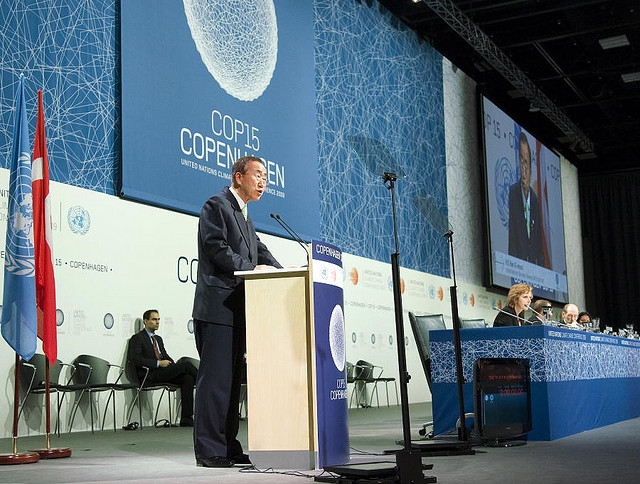
As the call for action on climate change grows ever louder, this debate will continue. Proponents of treaties will call on Kaye’s argument saying, treaties are the only way to affect change, binding the parties to an international law. Gentlemen’s agreements are only temporary and will fall apart at any sign of trouble. Conversely, those who have seen big players like the US back out of previous treaties that only promise weak policy, will use Shorr’s argument that treaties hinder progress. Instead they will throw their support behind policies such as the 2009 Copenhagen Agreement.
No matter which argument prevails, one thing is certain: we can no longer wait to act on climate change. It is a global problem that must be solved through global cooperation. Climate change is happening and the sooner there is a treaty or agreement to fight back, the better chance we have of winning.
by Logan Cotton | Aug 14, 2014 | Global Cooperation, Global Justice
The Gauntlet of Doha
This summer, Jennifer and I had the chance to conduct independent research on a topic that deeply interested both of us: soccer. With palpable excitement in the US regarding the World Cup, Jennifer and I looked toward the 2022 iteration of the tournament as the legitimacy of FIFA’s decision to award the tournament to Qatar was called into question. Myriad issues sprung forward after Qatar was awarded the tournament, including climate, lack of infrastructure, and the treatment of laborers in Qatar. All of these, only complicated by seemingly dishonest behavior from FIFA in a string of match-fixing scandals, has many observers calling for change.
Jennifer and I were lucky that CGS encouraged us to pursue this lead and try to address the question, “What, if anything, should be done to change the 2022 World Cup?” Each of us had the chance to read through primary documents from FIFA and the Qatari bid committee, as well as dig into the effects previous World Cups have had on their host countries. The findings might counter some commonly-held assumptions about the benefits of stadiums and major tournaments. If you are skeptical of many of these events, you will likely have many of your initial thoughts confirmed.
After researching, Jennifer and I came to the conclusion that moving the World Cup would be advisable. Looking toward the future, Doha needs to construct nine new stadiums and do major renovations to three others. Accomplishing this in eight years is no small feat — and this is without considering the massive infrastructure overhaul that Qatar outlined in its bid. NGOs project that at its current pace, thousands of laborers would die from the hostile working conditions as Doha frantically tries to finish the projects.
Our best suggestion for a new host would be to share the World Cup between the United States in Canada. For the Canadians, this would be their first time hosting. For the US Soccer Federation, this would help them cultivate interest among America’s youth. Interestingly enough, the three most-populous countries on Earth are only casual fans of the world’s most popular sport; therefore, FIFA has much to gain from tapping the American market.
The US and Canada have plenty of stadiums that are prepared to host. Others would only require small renovations and, perhaps, some investment in infrastructure to accommodate a tournament of that scale. We outline in the paper numerous cities that could host the World Cup, but we confess that there are many other options.
All in all, Jennifer and I hoped to provide a paper that was illuminating, that lifted the veil often shrouding bureaucracy. Qatar is by no means the worst choice for a host country. In fact, both of us found their bid proposal rather compelling. We just think that 2026 might be more feasible for the small Gulf state.
We certainly have more questions that we would like to pursue regarding the economics of the World Cup, as well as the political impact, and football’s ability to change social norms. We’re curious fans more than formal scholars, but hope that to have nudged the scholarship forward in some way.
Of course, we thank Citizens for Global Solutions for the opportunity to research this and hope you find it insightful.
by Jennifer Welden | Aug 13, 2014 | Climate Justice, Global Cooperation
In the age of world hunger, endangered species, and a crippled environment, we are constantly looking for new sources of food to take the pressure off our currently over-tapped resources. Insects have been increasingly pointed to as a more sustainable source of protein, as they have “a far smaller carbon footprint than most livestock.” The UN’s own Food and Agriculture Organization has even promoted this practice as a healthy and environmentally friendly alternative to meat in its 2013 report.
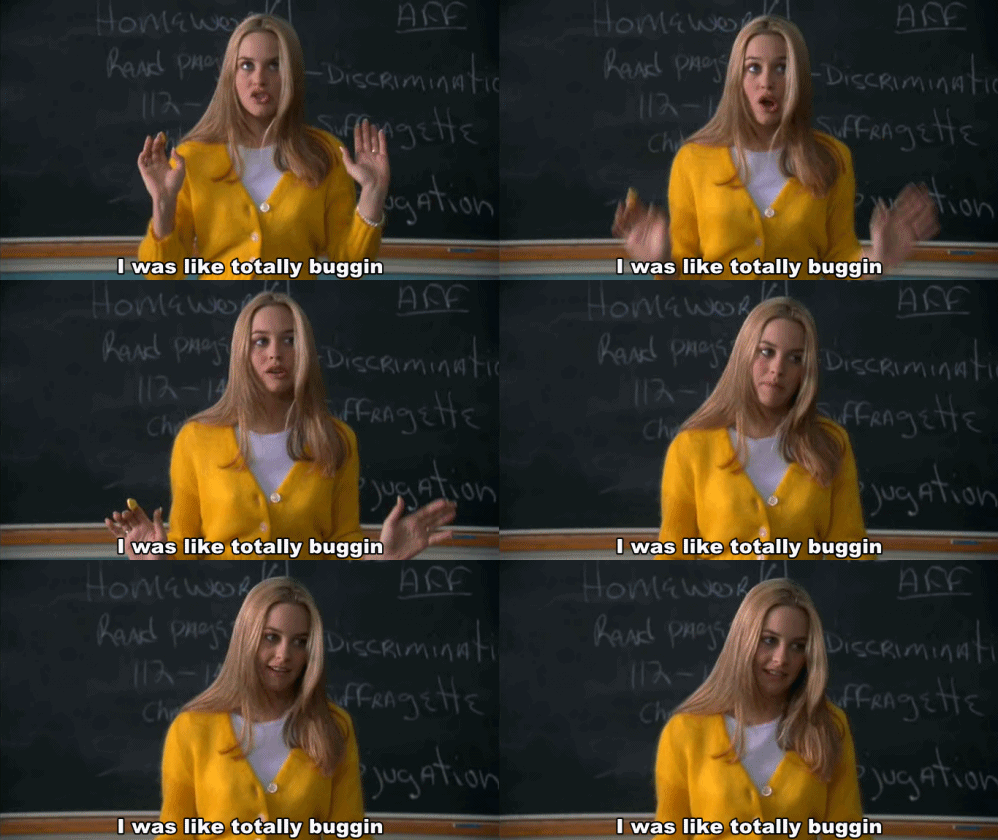
2 billion people worldwide have no qualms about eating insects – why are Americans totally buggin?
Many small companies have begun trying to market bug-filled products in cute and innovative ways as an attempt to overcome the inevitable “ick-factor”; my personal favorites are chips with a cricket base called “Chirps” and the movement to rename locusts “sky prawns.” There are also more subtle ways to consume insects, such as through the use of cricket flour, keeping these creepy crawlers out of sight and (hopefully) out of mind.
Some fast facts for why we should all start eating bugs include:
- They’re a great source of protein
- Crickets have as much calcium as milk (if you eat enough)
- Insects are not that biologically different from shellfish
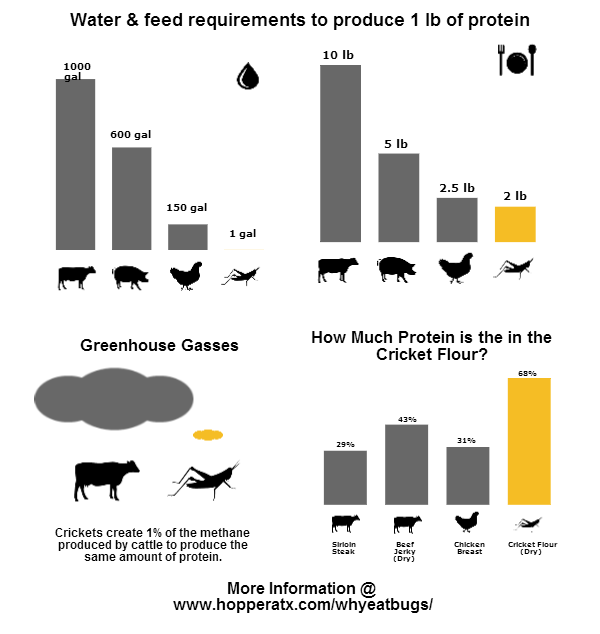
- They emit considerably less greenhouse gases and waste than other animals
- They require little to no land to cultivate
- Insects use about 2 pounds of feed to produce 1 pound of meat. Cattle, on the other hand, need 8 pounds of feed to produce 1 pound of beef
- In fact, many insects can consume waste products like animal blood, eliminating the need for feed made especially for them (i.e. soybeans or corn)
The consumption of insects also has huge implications for the developing world. “Insect-rearing is less capital-intensive than other animal husbandry, giving poorer farmers a method of entry”; this is extremely relevant in a time when many poor fisherman are competing with corporations for over-harvested populations of fish. Moreover, their feed-efficiency makes them perfect feed alternatives for farm animals (for those leery to stray from traditional protein sources). Insects could even prove beneficial to emergency relief efforts, with some working to make “Grow Your Own Locust” kits for African Refugees.
Disgust factor aside, there are still some regulatory barriers to widespread insect consumption. Currently, many countries do not have insect-product regulations; the US in particular has a lack of federal regulation, as there have been few studies regarding the use of insects as animal feed or main meals.
While it seems unlikely that “cricket crackers” or “French flies” will be a trend anytime soon, the entomophagy movement seems like a step in the right direction toward a more sustainable–and definitely more creative–world.