
Originally published on the CGS blog on August 28, 2014.
This post was originally published on March 26, 2014. It has been reposted in light of the recent news that the Obama Administration is pursuing a climate agreement in lieu of a treaty for the 2015 UN summit meeting in Paris.
In an increasingly globalized world, multilateral engagement is becoming even more critical for the planet’s survival. No longer can a nation act unilaterally without being left behind. In light of this, a debate has emerged about what is the best way to engage on the international level: through treaties or agreements?
In a 2013 article posted by Foreign Affairs, David Kaye argues that treaties create reliable expectations and impose consequences for violators that agreements do not. Kaye points out that because a systematic rejection of treaties has developed in the US, treaty commitment and full US participation is no longer expected, hindering the government’s ability to engage in global policy making. While treaty opponents decry them as a threat to U.S. sovereignty, treaties actually create more stable and transparent relationships than gentlemen’s agreements, he says.
Kaye also asserts that treaty opposition has forced US presidents to use ‘stealth multilateralism,’ or engagement through back-channel agreements. Through stealth multilateralism, the U.S. has been able to influence policy to some extent, but it is not a long-term answer. Gentlemen’s agreements can only take an issue so far without the binding force of law. Kaye states that, “many global solutions require force and permanence that only treaties can provide.” He uses climate change to illustrate that in order for nations to undertake painful restrictions, each country needs to know that others are taking the plunge as well. Voluntary restrictions will only take an agreement so far as it does not impede national interest.
Using the same example of climate change, David Shorr voices an opposite opinion in Foreign Policy for moving the international norm toward less official agreements. Shorr argues that treaties work against themselves by setting a “self-imposed race against the diplomatic clock” that is fixated on consensus rather than effective policy. As a result, the threat of legal force only leads to countries agreeing to the lowest common denominator or walking away altogether.
Alternatively, Shorr suggests that “global agreements are most useful when they include a healthy measure of realism.” Instead of binding law, nations are more likely to stick to agreements that are flexible and allow countries to do their share based on the reality of their situation, creating a shared definition of success rather than blanket restrictions. Agreements should incentivize and encourage rather than constrain and hinder; any new agreement should act as “a measuring stick, not a bludgeon.” In Shorr’s model, the countries would monitor and encourage each other’s progress, essentially using peer pressure to enforce the agreement. By allowing nations to set their own goals that will not have a negative impact, they will be more willing to stick to the agreement, particularly with climate change policy.
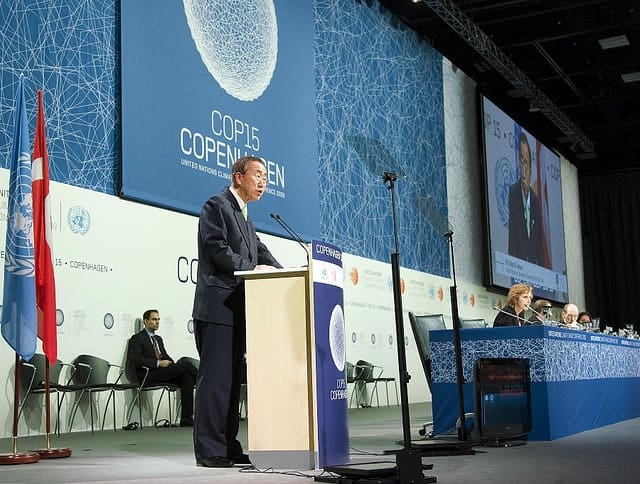
As the call for action on climate change grows ever louder, this debate will continue. Proponents of treaties will call on Kaye’s argument saying, treaties are the only way to affect change, binding the parties to an international law. Gentlemen’s agreements are only temporary and will fall apart at any sign of trouble. Conversely, those who have seen big players like the US back out of previous treaties that only promise weak policy, will use Shorr’s argument that treaties hinder progress. Instead they will throw their support behind policies such as the 2009 Copenhagen Agreement.
No matter which argument prevails, one thing is certain: we can no longer wait to act on climate change. It is a global problem that must be solved through global cooperation. Climate change is happening and the sooner there is a treaty or agreement to fight back, the better chance we have of winning.


