
Originally published on the CGS blog on July 18, 2014.
Despite the obvious danger that rising sea levels pose to communities on the Gulf Coast, tensions over climate change are flaring most acutely in the beach towns of North Carolina. In 2010, the North Carolina Department of Environment and Natural Resources (NCDENR) established the North Carolina Coastal Resources Commission (NCRC) to study the effects of rising sea levels by 2100. Lawmakers were dismayed when the report predicted a 39-inch rise in sea level by 2100.
By the summer of 2011, realtors and community members living on North Carolina’s Outer Banks saw the figures and were shocked. Even worse, the state was already developing a website to enable residents to check the vulnerability of their property. In response to this news, realty organizations fought back against the commission’s report, arguing that its scientific methods were questionable, lacking an assessment of economic impact, and devoid of any maps.
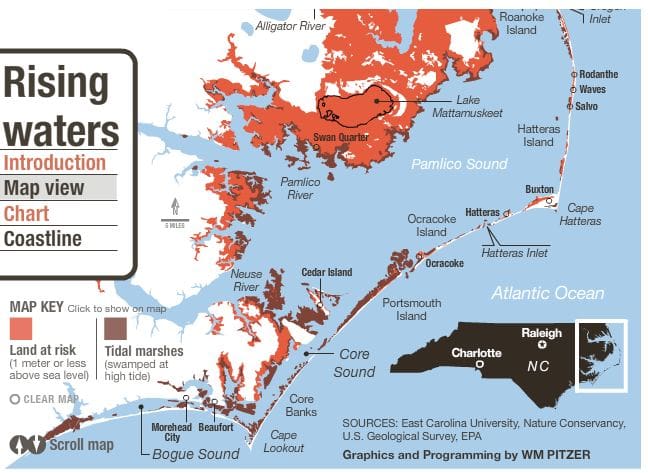
As the state produced the maps using Light Detection and Ranging (Lidar) technology, the outlook was increasingly dour for NC residents. Highway 12, Roanoke Island, and Pamlico Sound all faced significant flooding. Homeowners and businesses were understandably outraged at the report. The projections drove many to call for re-zoning of the North Carolina Coast in a manner that would consider much of the populated communities as uninhabitable land, devastating tourism and property values.
Lori Montgomery wrote in the Washington Post that one realty lobbyist, “worries that codifying the 39-inch forecast would crush the local economy, which relies entirely on tourism and the construction, sale and rental of family beach houses. In Dare County alone, the islands’ largest jurisdiction, the state has identified more than 8,500 structures, with an assessed value of nearly $1.4 billion, which would be inundated if the tides were 39 inches higher.”
Montgomery continued to explain that even a more modest forecast would be devastating to North Carolina. There are 414 properties in Dare County, valued at $70 million, which would be underwater. Widespread awareness of this danger would torpedo property values in the area.
North Carolina’s state legislature called for a new study, considering the work of the NCRC into question. Instead of projecting to 2100, the new study will only look 30 years forward – likely hoping to assuage concerns about the viability of NC’s coastline. The move has angered many, particularly environmental advocates. Gov. McCrory has stymied efforts to publish or publicize any sort of climate research.
Decreasing the timetable for the new climate study will help lawmakers avoid another glaringly alarming figure, like the 39-inch prediction. The new study, however, does not evade the urgency of the climate crisis. Short of serious legislation and action on climate change, there is little hope to save much of the United States’ coastal land.
Clearly there is need for civil society to push lawmakers at the state and federal level to honor climate studies instead of simply playing games with numbers. As the United States looks to develop infrastructure in the 21st Century, climate change plays an increasingly significant role. As seasons shift, temperatures rise, and the oceans press above their previous limits, our previous designs grow obsolete. While no one wants to see the worth of homes on North Carolina’s coast sunk, the seemingly-imminent danger of rising sea levels demands a more proactive approach by our governments.
As much as we may like to do so, covering our eyes and fudging the truth will still leave us high and dry – or below sea-level and quite wet, I suppose.


