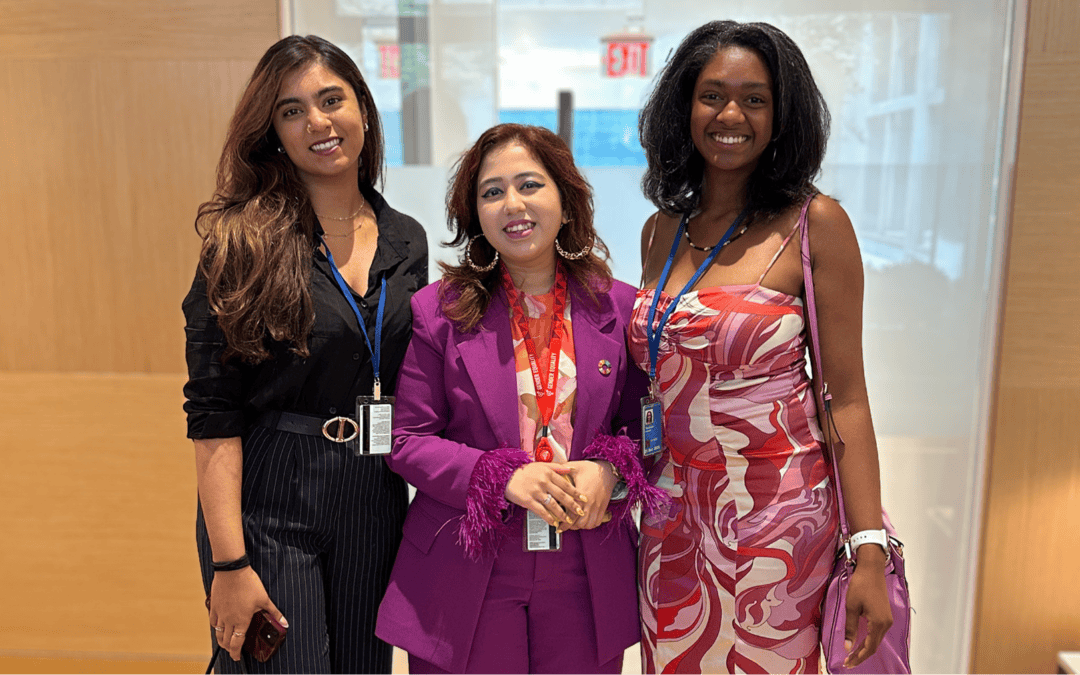
Building on their previous experience as keynote speakers during the 70th session of the Commission on the Status of Women (CSW70) parallel side events, the fellows returned to the United Nations to share their research. Their participation emphasized the growing recognition that young people are essential partners in shaping solutions to today’s most pressing global challenges.
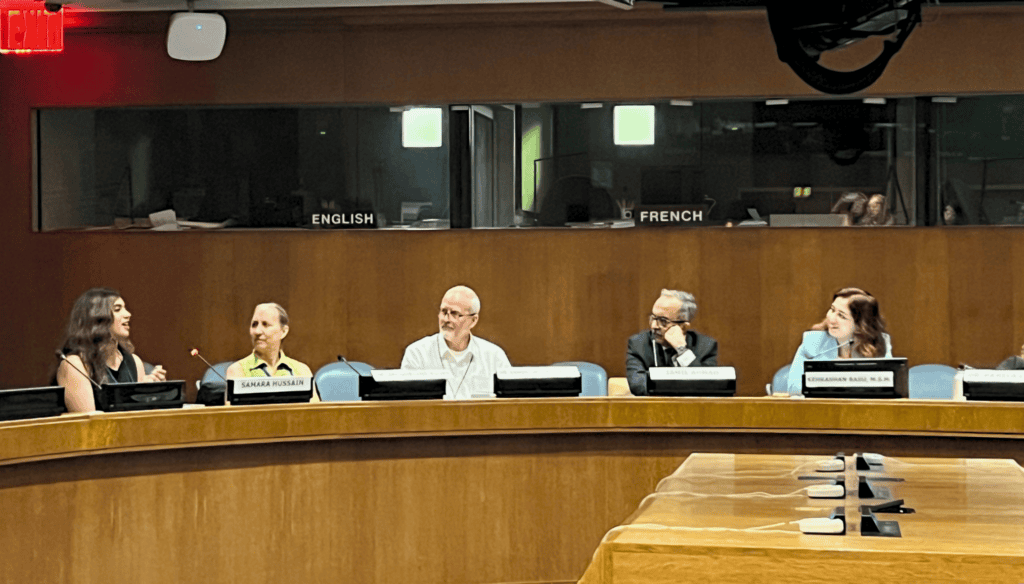
Samara Husain (far left) speaking as a keynote speaker and Kehkahshan Basu (far right) as moderator, founder and President of Green Hope Foundation.
Samara Husain is a senior nursing student at Trinity Washington University who is currently completing her externship at the Surgical Oncology Unit at MedStar Washington Hospital Center and an Alumni Fellow of the Global Governance Fellowship ‘26. As a keynote speaker, Samara brought a public health perspective to the conversation, demonstrating how housing is not only an urban planning issue but also one of the most important factors of health. Safe housing, clean environments, reliable water and sanitation, and accessible healthcare are all essential components of healthy communities. By reframing housing as a public health issue, Samara showcased the connection between SDG 11, Sustainable Cities and Communities, and SDG 3, Good Health and Well-Being.
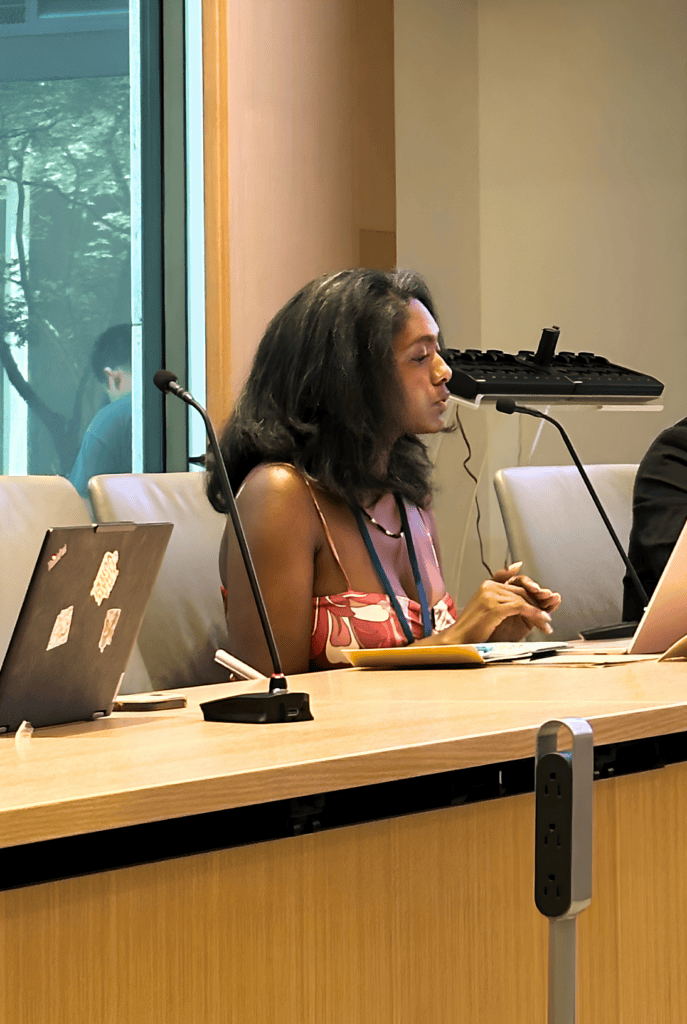
Anastasia Tomlinson presenting her research as keynote speaker.
Anastasia Tomlinson is a junior majoring in Politics and Policy and minoring in Public Health at Trinity Washington University, an advocate for nuclear disarmament and Alumni Fellow for the Global Governance Fellowship ‘26 cohort. Expanding her research on health, housing, and gender in Brazil, Anastasia focused on SDG indicator 9.1.1, which measures the number of rural people who live within 2 km of an all-season road. Anastasia detailed the gaps between this indicator’s reported data and the reality for the people living in Brazil. She highlighted the importance of accessible healthcare, specifically hospital access, and how not considering infrastructure from public health (SDG 3) and gendered (SDG 5) standpoints inhibits inclusive progress for rural women.
Samara and Anastasia’s presentation highlighted the power of grassroots initiatives and demonstrated how collaboration between youth leaders and community-based organizations can drive meaningful change. Through partnerships with organizations such as Green Hope Foundation and ImpulsoGov young advocates are helping bring grassroots solutions into global policy conversations.
One of the most impactful aspects of the discussion was its multifaceted approach, with each panelist contributing a unique perspective shaped by their expertise and lived experiences. The conversation explored both the tangible foundations of sustainable communities, such as housing, transportation, healthcare, and public infrastructure, and the equally important social infrastructure that creates a sense of belonging, trust, and community. As Samara reflected, sustainable development is “both about the spaces we build and also about the relationships, systems, and opportunities that enable people to thrive within them.”
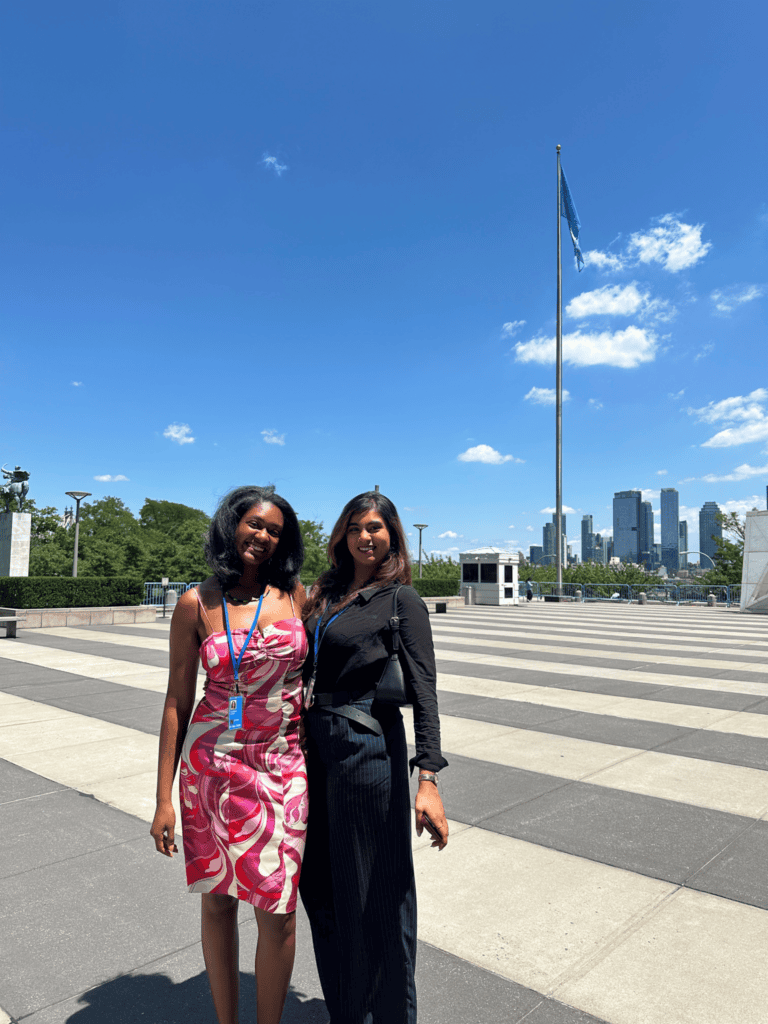
Anastasia Tomlinson and Samara Husain pose in front of the UN flag at the United Nations Headquarters in New York.
The greatest takeaway from the panel was recognizing just how interconnected the Sustainable Development Goals truly are. The SDGs do not exist in silos, progress in one area depends on collaboration across many others. The intergenerational dialogue among the panelists was mirrored by an equally diverse audience, and the thoughtful questions that followed enriched the conversation with both fresh perspectives and the wisdom of lived experience. This exchange demonstrated how meaningful solutions emerge when people from different backgrounds, generations, and disciplines come together to learn from one another. __
This article was first shared with subscribers of CGS Field Notes, our LinkedIn newsletter featuring insights, updates, and analysis on global governance from Citizens for Global Solutions. Subscribe on LinkedIn to get future stories like this one delivered straight to your feed.
Pandemics, nuclear risk, unmanaged AI, unpayable sovereign debt, and a destabilizing climate have one thing in common: no country can solve them alone. The institution built to coordinate that work was designed in 1945 and has never been fundamentally updated since.
The delegates who met in San Francisco knew they were writing a starting point, not a finished document. Truman said at the signing that the Charter would “be expanded and improved as time goes on.” They wrote that expectation directly into the text. Article 109 is the built-in mechanism by which each generation can revisit, revise, and remake the UN to meet the challenges of its own time.
Eight decades on, the gap between what the world needs from the UN and what the 1945 architecture was designed to deliver keeps widening. From the risks posed by nuclear and biological weapons, AI, and ecosystem collapse, to pandemic response, the Sustainable Development Goals, unsustainable sovereign debt, and unaddressed historical injustice, the present structure of the UN has too often blocked meaningful progress across exactly the domains where cooperation matters most.
What the special edition asks
This edition asks contributors to set aside the politics and structural limitations of today, to dream big, and to make the case for what a rewritten Charter could unlock in their own field. Three questions anchor every submission:
What could rewriting the UN Charter unlock in your area of international policy expertise?
What policies would you like to see an upgraded United Nations adopt and implement that have not been achievable or enforceable through existing treaty processes, voluntary pledges, or piecemeal reforms?
How would those policy changes improve the lives of people across the globe, improve our collective ability to handle the challenges we face, or help lead to a more peaceful, just, and sustainable future?
Proposed topics
The editors welcome submissions on any of the tracks below. This is a partial list, and proposals from any subject area or perspective are welcome.
Planetary boundaries and improving climate governance. What Charter review could do for the global commons that the Paris Accords and the COP process cannot, including a Global Commons Trusteeship, a Climate Council with binding authority, legal rights for nature, or planetary boundary indicators embedded in UN governance.
Existential and catastrophic risk management, disarmament. Regulation of artificial intelligence, nuclear weapons and disarmament, biosecurity, asteroid defense, and ecosystem collapse.
Historical injustice and reparations. UN reform as part of a broader process of historical repair, and as a way to correct the structural inequities embedded in post-1945 institutions.
Peace, security, and Security Council reform. What a functioning, reimagined Security Council could do to prevent genocide, end wars, and build positive peace, including options for ending impunity and for reforming or overriding the veto.
Why Charter review is in the P5’s interest. What enlightened self-interest looks like for major powers in the 21st century, and how weighted voting, General Assembly revitalization, or a redesign of Council mechanics could break the gridlock the P5 themselves bemoan.
Advancing equitable solutions for finance and development. The relationship between the UN and the international financial architecture, including standardized rates and risk premiums, centralized funding mechanisms, and restructuring unsustainable debt.
Global economic stabilization. Predictable rather than capricious tariff rules, guaranteed rights of navigation, a global UN-backed currency, and independent UN financing.
Global health and pandemic preparedness. Equitable access to medicines and vaccines, disease eradication, global health financing, unrestricted humanitarian access, and improved emergency coordination.
The SDGs, the Pact for the Future, and the post-2030 agenda. What comes after the SDG framework expires in 2030, and how Charter review could serve as a cross-cutting acceleration process.
Format
Articles run 700 to 2000 words and are allocated two to four large format magazine pages. The strongest submissions identify a specific structural flaw in the Charter or the wider global governance system, describe the state behavior and tensions that flow from it, and then devote the bulk of the piece to the proposed solution and how it resolves those tensions.
Mondial follows the AP Style Guide and is written for an educated, globally engaged audience. Scholarly depth is welcome. Unnecessary jargon is not.
How to submit
Send expressions of interest or first drafts to the editor, Dr. Justin Haner, at [email protected]. Submissions should include:
A working title, and the thematic track it most closely aligns with, if applicable.
Either a summary of the proposed article or a full first draft of 700 to 2000 words.
A brief bio of the author, or a link to one.
Expressions of interest are due by October 15, 2026. First drafts are due by October 30, 2026. The target publication date is March 2027.
Proposals must be submitted in English, though the editors are glad to work with and provide editorial support for authors whose first language is not English.
An invitation, not just a legal mechanism
At its best, Article 109 is much more than a clause in a treaty. It is an invitation to ask, with seriousness and imagination, what kind of United Nations humanity now requires. Mondial invites contributors to help answer that question.
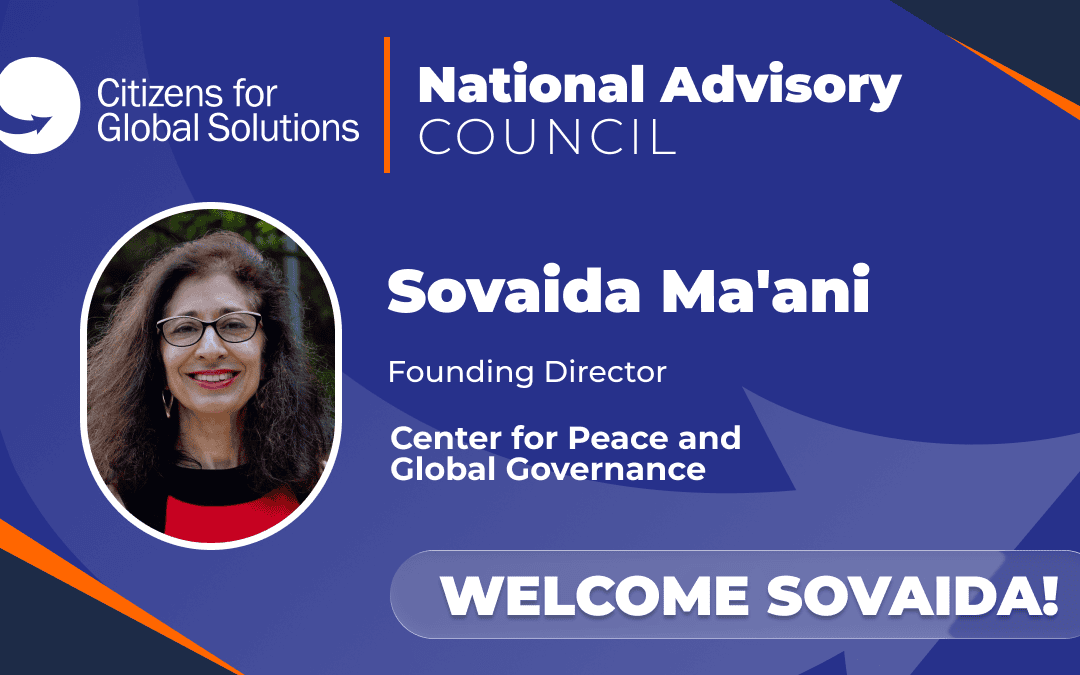
A barrister-at-law of England and Wales and an attorney-at-law in the United States, Sovaida holds an LLM in International Law and European Union Law from Cambridge University. Her distinguished legal career has included private practice in Washington, D.C., including her own law firm, service as an adjunct professor of law, and work as an attorney-advisor in the Legal Adviser’s Office of the U.S. Department of State.
For the past sixteen years, Sovaida has been serving as the Founder and Director of the Center for Peace and Global Governance (CPGG), a think tank and educational platform dedicated to developing principled solutions to some of the world’s most pressing challenges, including climate change, energy security, peace and security, arms control, resource equity, and global institutional reform. Through publications, podcasts, lectures, workshops, and strategic consulting, CPGG advances conversations and contributes to thinking about how ethical principles can inform and shape effective governance at every level. Sovaida is host of a popular audio and video podcast “Reimagining Our World,” which is dedicated to creating a vision of the world we want and infusing hope that we can make the choices necessary to attain it. It is available on most podcast platforms and video form on the CPGG YouTube channel,
Sovaida’s work has also played an important role in shaping CGS’s Global Governance Fellowship at Trinity Washington University, where she has served as a featured facilitator since the program’s pilot in 2022. Her workshops challenge students to imagine how ethical principles can be translated into practical institutional structures capable of addressing complex global challenges. Through exercises focused on a hypothetical Global Energy Authority and a principle-driven system of collective security, students learn that governance is not simply about power; it is about designing institutions that embody justice, accountability, cooperation, and shared responsibility.
As she joins CGS’s National Advisory Council, we sat down with Sovaida to discuss the future of ethics-based global governance and the role emerging leaders can play in building more peaceful, equitable, effective, and resilient systems.
In your view, what role can ethical principles play in advancing the long-term vision of democratic world federation, and what strategies are most effective for translating that vision into political reality?
I believe that a shared set of foundational principles or global ethics is an indispensable foundation for the establishment of a viable system of global governance—ideally in the form of a democratically elected world federation of nation-states. It behooves the international community to bend every effort to identify these principles and agree upon them. Having done that, they must be uncompromisingly operationalized in two ways: firstly, as a starting point when addressing any global challenge; and secondly, as the unshakeable basis upon which we design and build global institutions and their processes.
Two examples of such principles that should be incorporated into a new 21st-century-ready system of international relations are: firstly, the principle that all nations deserve to be treated with equal regard; and secondly, that the advantage of one nation (the part) can only be assured by guaranteeing the advantage of all nations (the whole).
Applying these two principles alone will yield solutions to the plethora of global challenges that plague us while ensuring that these solutions are congruent with each other (rather than undermining each other, as they often do today), proactive and informed by a long-term view, and considerate of the collective interest of humanity rather than narrow nationalistic or individual interests.
In this way, we can avoid the pitfall we so often fall into of reaching for expedient, short-term, and reactive solutions that cater to a narrow set of interests and not only fail to solve the original problem but also sow the seeds of the next disaster.
So, whether we’re considering the challenge of revamping the nuclear non-proliferation regime or whether we should continue to allow a limited number of nation-states to wield veto power in the Security Council, the way forward becomes clear. In the former instance, it becomes apparent that treating nations even-handedly requires the creation of a system in which all nations participate and which binds them all, with no opt-outs. Moreover, if any nation flouts the rules, the consequences should apply to all equally, whether we view the country as an ally or an enemy, as trustworthy or not. With respect to the question of the veto in the Security Council, it quickly becomes apparent that affording nations any sort of veto is antithetical to the claim that nation-states should be treated equally.
The strategy I would recommend for nations to identify and unitedly agree upon a set of global ethics is the one I proposed in my book, “Building a World Federation: The Key to Resolving Our Global Crises.” Essentially, I suggest we follow the roadmap created by the International Commission on Intervention and State Sovereignty (established by the Canadian government in 2001) in crafting the principle of the Responsibility to Protect, which was ultimately unanimously endorsed by all 192 nation-states at the World Summit in New York in 2005. This principle is considered an emerging norm in international practice, while some would even argue that it has become part of customary international law.
How do you envision students and emerging leaders contributing to the development of a Global Energy Authority or a principle-driven system of collective security?
Students and emerging leaders can contribute to a principle-driven system of collective security by recognizing certain realities: in today’s interconnected and interdependent world, wars are no longer local or regional in their impact but rather have the capacity to trigger global crises.
Take the civil war in Syria. It led to a refugee crisis that impacted not only neighboring states like Jordan, Lebanon, and Turkey but also regions farther afield, particularly Europe. The waves of refugees arriving in Europe contributed to a rise in far-right populist movements and, some would argue, were a main trigger for Brexit. The conflict also created fertile ground for ISIL to take root, with devastating and bloody consequences for many.
Meanwhile, the war in Ukraine spawned a global food crisis, a global energy crisis, and a resurgence of the global nuclear threat to its highest level since the Cuban Missile Crisis. The war with Iran has, similarly, set in motion multiple global crises, including dangerous worldwide inflation that threatens to pull the world into a global economic recession.
We must also recognize the fact that most nations of the world feel insecure. It is this feeling of insecurity that leads them to amass arms and seek weapons of mass destruction, which they misguidedly believe will keep them safe from aggression. The ensuing arms race and proliferation of weapons, including nuclear weapons, pose a huge danger to the world as a whole.
It is clear that the path we are on is untenable and will only lead to increased suffering and self-destruction. The time has come for the international community to come together and collaboratively craft a system of collective security that ensures that all nations are secure. They must recognize that, in a world as interconnected and interdependent as ours, a collective challenge of this order demands a collective solution.
The days of unilateral responses or the creation of ad hoc coalitions to respond to threats are over. The collective solution we need requires that all nations collaborate and participate in the creation of a global system of collective security in which they each contribute troops and arms to an international police force that will act at the behest of a democratically elected World Parliament, in the collective interests of humanity, and in accordance with predetermined and collectively agreed-upon rules and guidelines.
In the spirit of operationalizing the principles of oneness and equality, all nations must participate. There can be no opt-outs, and there must be a binding agreement among all nations that, if one nation were to breach or threaten the peace, all nations would arise to bring it to heel using the mechanism of the global standing force.
Having understood that this system is indispensable to ensuring the peace of the world, these students and emerging leaders would strive to raise awareness of this 21st-century-ready idea in all their spheres of endeavor, work, and social discourse, with the goal of spreading this idea to such a degree that we will eventually elect the kinds of leaders who have the requisite sense of responsibility to create the sort of principle-driven system of collective security that constitutes the indispensable foundation for a peaceful world.
Looking Forward
Sovaida Ma’ani Ewing’s appointment to the CGS National Advisory Council reflects CGS’s commitment to engaging thought leaders who bring both deep expertise and innovative perspectives to the challenges shaping our world.
At a time when global issues increasingly demand collaborative solutions, her work offers a compelling reminder that ethical principles are not abstract ideals but practical foundations for effective governance. Through her leadership, scholarship, and commitment to mentoring future changemakers, Sovaida continues to inspire a new generation to think boldly about how institutions can be designed to advance peace, justice, sustainability, and human flourishing.
Sovaida has published five books in the area of peace and global governance including“Building a World Federation: The Key to Resolving our Global Crises.” “Bridge to Global Governance: Tackling Climate Change, Energy Distribution, and Nuclear Proliferation” and “Collective Security Within Reach.” Her latest book, available on Amazon, is“The Alchemy of Peace: 6 Essential Shifts in Mindsets and Habits to Achieve World Peace.” She also hosts a popular monthly podcast – Reimagining Our World – available on most podcast platforms and on the CPGG YouTube channel that is dedicated to creating a vision of the world we want and infusing hope that we can make the choices necessary to attain it. Sovaida is also a certified mediator and a life mastery coach.
We are honored to welcome her to the CGS National Advisory Council and look forward to the insights and leadership she will bring to our community. Citizens for Global Solutions has worked for democratic, accountable global cooperation for seventy-nine years. Subscribe to follow our work.
__
This article was first shared with subscribers of CGS Field Notes, our LinkedIn newsletter featuring insights, updates, and analysis on global governance from Citizens for Global Solutions. Subscribe on LinkedIn to get future stories like this one delivered straight to your feed.
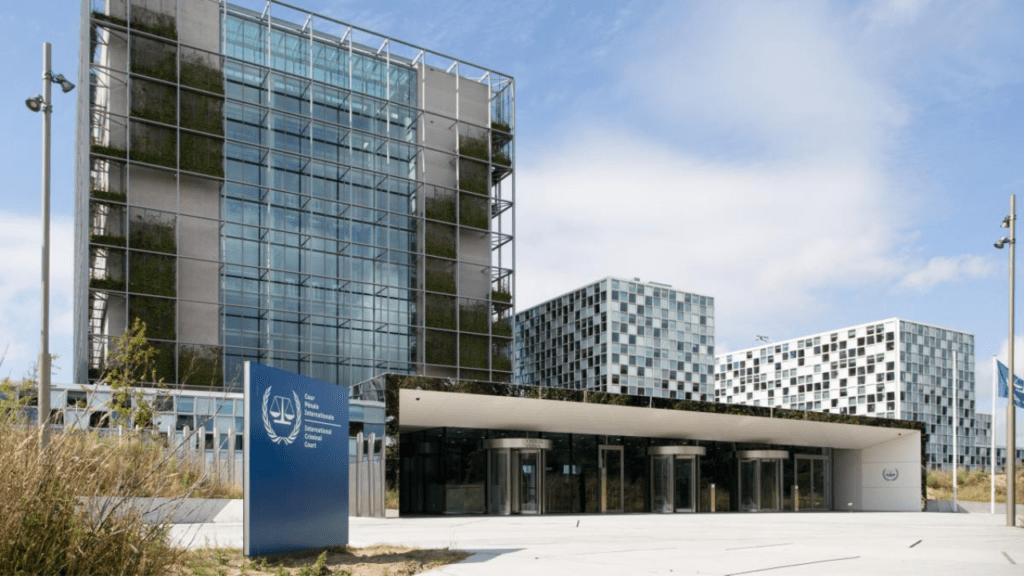
Washington, DC—On January 9, the United States House of Representatives voted in favor of a bill that would sanction the International Criminal Court (ICC). The bill was created to protest the ICC’s arrest warrants for Israeli Prime Minister Benjamin Netanyahu and his former defense minister over Israel’s crimes against humanity in Gaza. CGS led 116 organizations—including faith-based groups, human rights organizations, peace advocates, and legal associations—in an open letter decrying the attack on an independent judicial institution established to advance justice for victims of the most heinous crimes.
The vote passed by an overwhelming margin, with 243 in favor (including 45 Democrats) and 140 against the “Illegitimate Court Counteraction Act,” which threatens sanctions for any foreigner who helps the ICC in its attempts to investigate, detain, or prosecute a US citizen or citizen of an allied country that does not recognize the court’s authority.
The bill will now be passed to the Senate for consideration by the Senate Foreign Relations Affairs, emphasizing the importance of our continued efforts to speak out against it and its implementation, as it is a direct attack on the ICC. Not only that, but the passage of sanctions on the ICC jeopardizes the ability of desperate victims across all the court’s investigations to access justice, weakens the credibility of sanction tools in other contexts, and places the United States at odds with its closest allies, as outlined in the letter we issued to Congress and the incoming presidential administration on January 6.
Washington, DC—As co-convener of the Washington Working Group for the ICC, Citizens for Global Solutions led the effort to join 76 human rights organizations, faith-based groups, legal associations, and academic institutions in an open letter to Congress and the incoming US Presidential administration decrying sanctions against the International Criminal Court (ICC).
As the House of Representatives is scheduled to review this legislation among its first orders of business, we urge Members of Congress to consider the perspectives of the signatories, who include constituents, allies, experts, and survivors in ICC situation countries.