Pandemics, nuclear risk, unmanaged AI, unpayable sovereign debt, and a destabilizing climate have one thing in common: no country can solve them alone. The institution built to coordinate that work was designed in 1945 and has never been fundamentally updated since.
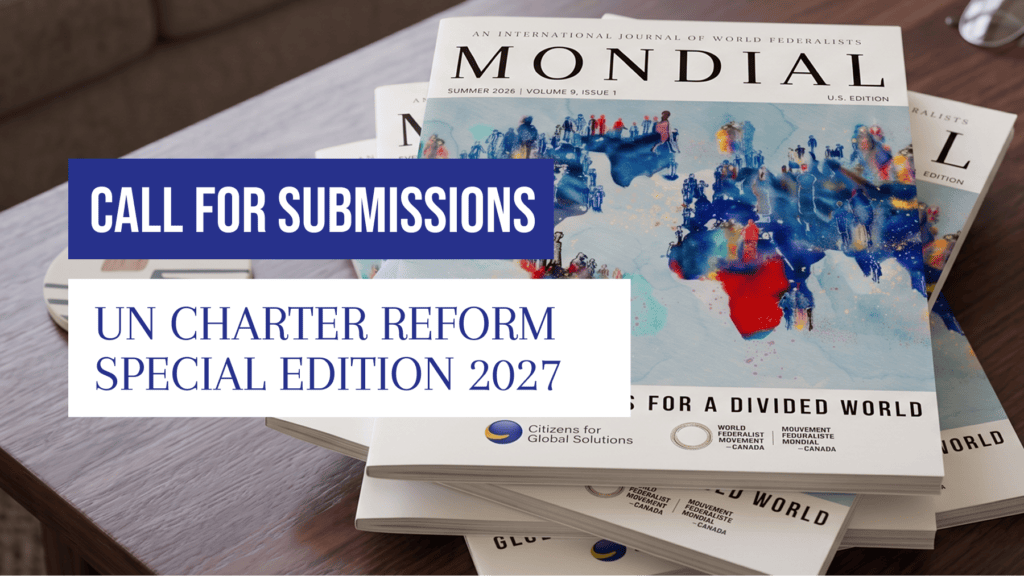
Citizens for Global Solutions and World Federalist Movement-Canada are now inviting proposals for a special edition of Mondial: An International Journal of World Federalists, devoted to what an upgraded UN Charter could deliver for humanity across a wide range of policy areas.
Read the full call: Call for Papers, Mondial Special Edition on Article 109 (PDF)
Why this edition, and why now
The delegates who met in San Francisco knew they were writing a starting point, not a finished document. Truman said at the signing that the Charter would “be expanded and improved as time goes on.” They wrote that expectation directly into the text. Article 109 is the built-in mechanism by which each generation can revisit, revise, and remake the UN to meet the challenges of its own time.
Eight decades on, the gap between what the world needs from the UN and what the 1945 architecture was designed to deliver keeps widening. From the risks posed by nuclear and biological weapons, AI, and ecosystem collapse, to pandemic response, the Sustainable Development Goals, unsustainable sovereign debt, and unaddressed historical injustice, the present structure of the UN has too often blocked meaningful progress across exactly the domains where cooperation matters most.
What the special edition asks
This edition asks contributors to set aside the politics and structural limitations of today, to dream big, and to make the case for what a rewritten Charter could unlock in their own field. Three questions anchor every submission:
- What could rewriting the UN Charter unlock in your area of international policy expertise?
- What policies would you like to see an upgraded United Nations adopt and implement that have not been achievable or enforceable through existing treaty processes, voluntary pledges, or piecemeal reforms?
- How would those policy changes improve the lives of people across the globe, improve our collective ability to handle the challenges we face, or help lead to a more peaceful, just, and sustainable future?
Proposed topics
The editors welcome submissions on any of the tracks below. This is a partial list, and proposals from any subject area or perspective are welcome.
- Planetary boundaries and improving climate governance. What Charter review could do for the global commons that the Paris Accords and the COP process cannot, including a Global Commons Trusteeship, a Climate Council with binding authority, legal rights for nature, or planetary boundary indicators embedded in UN governance.
- Existential and catastrophic risk management, disarmament. Regulation of artificial intelligence, nuclear weapons and disarmament, biosecurity, asteroid defense, and ecosystem collapse.
- Historical injustice and reparations. UN reform as part of a broader process of historical repair, and as a way to correct the structural inequities embedded in post-1945 institutions.
- Peace, security, and Security Council reform. What a functioning, reimagined Security Council could do to prevent genocide, end wars, and build positive peace, including options for ending impunity and for reforming or overriding the veto.
- Why Charter review is in the P5’s interest. What enlightened self-interest looks like for major powers in the 21st century, and how weighted voting, General Assembly revitalization, or a redesign of Council mechanics could break the gridlock the P5 themselves bemoan.
- Advancing equitable solutions for finance and development. The relationship between the UN and the international financial architecture, including standardized rates and risk premiums, centralized funding mechanisms, and restructuring unsustainable debt.
- Global economic stabilization. Predictable rather than capricious tariff rules, guaranteed rights of navigation, a global UN-backed currency, and independent UN financing.
- Global health and pandemic preparedness. Equitable access to medicines and vaccines, disease eradication, global health financing, unrestricted humanitarian access, and improved emergency coordination.
- The SDGs, the Pact for the Future, and the post-2030 agenda. What comes after the SDG framework expires in 2030, and how Charter review could serve as a cross-cutting acceleration process.
Format
Articles run 700 to 2000 words and are allocated two to four large format magazine pages. The strongest submissions identify a specific structural flaw in the Charter or the wider global governance system, describe the state behavior and tensions that flow from it, and then devote the bulk of the piece to the proposed solution and how it resolves those tensions.
Mondial follows the AP Style Guide and is written for an educated, globally engaged audience. Scholarly depth is welcome. Unnecessary jargon is not.
How to submit
Send expressions of interest or first drafts to the editor, Dr. Justin Haner, at JHaner@globalsolutions.org. Submissions should include:
- A working title, and the thematic track it most closely aligns with, if applicable.
- Either a summary of the proposed article or a full first draft of 700 to 2000 words.
- A brief bio of the author, or a link to one.
Expressions of interest are due by October 15, 2026. First drafts are due by October 30, 2026. The target publication date is March 2027.
Proposals must be submitted in English, though the editors are glad to work with and provide editorial support for authors whose first language is not English.
An invitation, not just a legal mechanism
At its best, Article 109 is much more than a clause in a treaty. It is an invitation to ask, with seriousness and imagination, what kind of United Nations humanity now requires. Mondial invites contributors to help answer that question.
Download the full call for papers (PDF) or browse past issues of Mondial.