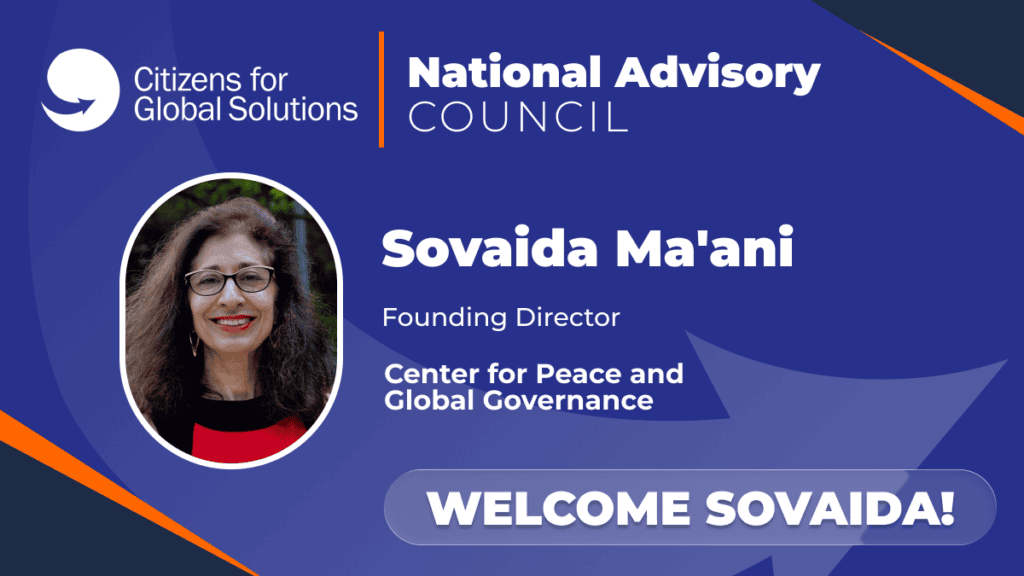
Citizens for Global Solutions (CGS) is pleased to welcome Sovaida Ma’ani Ewing to its National Advisory Council (NAC), bringing to the organization decades of experience in international law, global governance, peacebuilding, and ethics-based institutional design.
A barrister-at-law of England and Wales and an attorney-at-law in the United States, Sovaida holds an LLM in International Law and European Union Law from Cambridge University. Her distinguished legal career has included private practice in Washington, D.C., including her own law firm, service as an adjunct professor of law, and work as an attorney-advisor in the Legal Adviser’s Office of the U.S. Department of State.
For the past sixteen years, Sovaida has been serving as the Founder and Director of the Center for Peace and Global Governance (CPGG), a think tank and educational platform dedicated to developing principled solutions to some of the world’s most pressing challenges, including climate change, energy security, peace and security, arms control, resource equity, and global institutional reform. Through publications, podcasts, lectures, workshops, and strategic consulting, CPGG advances conversations and contributes to thinking about how ethical principles can inform and shape effective governance at every level. Sovaida is host of a popular audio and video podcast “Reimagining Our World,” which is dedicated to creating a vision of the world we want and infusing hope that we can make the choices necessary to attain it. It is available on most podcast platforms and video form on the CPGG YouTube channel,
Sovaida’s work has also played an important role in shaping CGS’s Global Governance Fellowship at Trinity Washington University, where she has served as a featured facilitator since the program’s pilot in 2022. Her workshops challenge students to imagine how ethical principles can be translated into practical institutional structures capable of addressing complex global challenges. Through exercises focused on a hypothetical Global Energy Authority and a principle-driven system of collective security, students learn that governance is not simply about power; it is about designing institutions that embody justice, accountability, cooperation, and shared responsibility.
As she joins CGS’s National Advisory Council, we sat down with Sovaida to discuss the future of ethics-based global governance and the role emerging leaders can play in building more peaceful, equitable, effective, and resilient systems.
In your view, what role can ethical principles play in advancing the long-term vision of democratic world federation, and what strategies are most effective for translating that vision into political reality?
I believe that a shared set of foundational principles or global ethics is an indispensable foundation for the establishment of a viable system of global governance—ideally in the form of a democratically elected world federation of nation-states. It behooves the international community to bend every effort to identify these principles and agree upon them. Having done that, they must be uncompromisingly operationalized in two ways: firstly, as a starting point when addressing any global challenge; and secondly, as the unshakeable basis upon which we design and build global institutions and their processes.
Two examples of such principles that should be incorporated into a new 21st-century-ready system of international relations are: firstly, the principle that all nations deserve to be treated with equal regard; and secondly, that the advantage of one nation (the part) can only be assured by guaranteeing the advantage of all nations (the whole).
Applying these two principles alone will yield solutions to the plethora of global challenges that plague us while ensuring that these solutions are congruent with each other (rather than undermining each other, as they often do today), proactive and informed by a long-term view, and considerate of the collective interest of humanity rather than narrow nationalistic or individual interests.
In this way, we can avoid the pitfall we so often fall into of reaching for expedient, short-term, and reactive solutions that cater to a narrow set of interests and not only fail to solve the original problem but also sow the seeds of the next disaster.
So, whether we’re considering the challenge of revamping the nuclear non-proliferation regime or whether we should continue to allow a limited number of nation-states to wield veto power in the Security Council, the way forward becomes clear. In the former instance, it becomes apparent that treating nations even-handedly requires the creation of a system in which all nations participate and which binds them all, with no opt-outs. Moreover, if any nation flouts the rules, the consequences should apply to all equally, whether we view the country as an ally or an enemy, as trustworthy or not. With respect to the question of the veto in the Security Council, it quickly becomes apparent that affording nations any sort of veto is antithetical to the claim that nation-states should be treated equally.
The strategy I would recommend for nations to identify and unitedly agree upon a set of global ethics is the one I proposed in my book, “Building a World Federation: The Key to Resolving Our Global Crises.” Essentially, I suggest we follow the roadmap created by the International Commission on Intervention and State Sovereignty (established by the Canadian government in 2001) in crafting the principle of the Responsibility to Protect, which was ultimately unanimously endorsed by all 192 nation-states at the World Summit in New York in 2005. This principle is considered an emerging norm in international practice, while some would even argue that it has become part of customary international law.
How do you envision students and emerging leaders contributing to the development of a Global Energy Authority or a principle-driven system of collective security?
Students and emerging leaders can contribute to a principle-driven system of collective security by recognizing certain realities: in today’s interconnected and interdependent world, wars are no longer local or regional in their impact but rather have the capacity to trigger global crises.
Take the civil war in Syria. It led to a refugee crisis that impacted not only neighboring states like Jordan, Lebanon, and Turkey but also regions farther afield, particularly Europe. The waves of refugees arriving in Europe contributed to a rise in far-right populist movements and, some would argue, were a main trigger for Brexit. The conflict also created fertile ground for ISIL to take root, with devastating and bloody consequences for many.
Meanwhile, the war in Ukraine spawned a global food crisis, a global energy crisis, and a resurgence of the global nuclear threat to its highest level since the Cuban Missile Crisis. The war with Iran has, similarly, set in motion multiple global crises, including dangerous worldwide inflation that threatens to pull the world into a global economic recession.
We must also recognize the fact that most nations of the world feel insecure. It is this feeling of insecurity that leads them to amass arms and seek weapons of mass destruction, which they misguidedly believe will keep them safe from aggression. The ensuing arms race and proliferation of weapons, including nuclear weapons, pose a huge danger to the world as a whole.
It is clear that the path we are on is untenable and will only lead to increased suffering and self-destruction. The time has come for the international community to come together and collaboratively craft a system of collective security that ensures that all nations are secure. They must recognize that, in a world as interconnected and interdependent as ours, a collective challenge of this order demands a collective solution.
The days of unilateral responses or the creation of ad hoc coalitions to respond to threats are over. The collective solution we need requires that all nations collaborate and participate in the creation of a global system of collective security in which they each contribute troops and arms to an international police force that will act at the behest of a democratically elected World Parliament, in the collective interests of humanity, and in accordance with predetermined and collectively agreed-upon rules and guidelines.
In the spirit of operationalizing the principles of oneness and equality, all nations must participate. There can be no opt-outs, and there must be a binding agreement among all nations that, if one nation were to breach or threaten the peace, all nations would arise to bring it to heel using the mechanism of the global standing force.
Having understood that this system is indispensable to ensuring the peace of the world, these students and emerging leaders would strive to raise awareness of this 21st-century-ready idea in all their spheres of endeavor, work, and social discourse, with the goal of spreading this idea to such a degree that we will eventually elect the kinds of leaders who have the requisite sense of responsibility to create the sort of principle-driven system of collective security that constitutes the indispensable foundation for a peaceful world.
Looking Forward
Sovaida Ma’ani Ewing’s appointment to the CGS National Advisory Council reflects CGS’s commitment to engaging thought leaders who bring both deep expertise and innovative perspectives to the challenges shaping our world.
At a time when global issues increasingly demand collaborative solutions, her work offers a compelling reminder that ethical principles are not abstract ideals but practical foundations for effective governance. Through her leadership, scholarship, and commitment to mentoring future changemakers, Sovaida continues to inspire a new generation to think boldly about how institutions can be designed to advance peace, justice, sustainability, and human flourishing.
Sovaida has published five books in the area of peace and global governance including “Building a World Federation: The Key to Resolving our Global Crises.” “Bridge to Global Governance: Tackling Climate Change, Energy Distribution, and Nuclear Proliferation” and “Collective Security Within Reach.” Her latest book, available on Amazon, is “The Alchemy of Peace: 6 Essential Shifts in Mindsets and Habits to Achieve World Peace.” She also hosts a popular monthly podcast – Reimagining Our World – available on most podcast platforms and on the CPGG YouTube channel that is dedicated to creating a vision of the world we want and infusing hope that we can make the choices necessary to attain it. Sovaida is also a certified mediator and a life mastery coach.
We are honored to welcome her to the CGS National Advisory Council and look forward to the insights and leadership she will bring to our community. Citizens for Global Solutions has worked for democratic, accountable global cooperation for seventy-nine years. Subscribe to follow our work.
__
This article was first shared with subscribers of CGS Field Notes, our LinkedIn newsletter featuring insights, updates, and analysis on global governance from Citizens for Global Solutions. Subscribe on LinkedIn to get future stories like this one delivered straight to your feed.