by Melanie Pino-Elliott | Aug 26, 2014 | Global Justice, Human Rights
We all have some idea of how bad things are in North Korea, or the Democratic People’s Republic of Korea (DPRK). We’re also aware that outside efforts to remedy the situation haven’t really panned out. But turning our backs on the suffering civilians is not an option. So where do we go from here?
The Global Centre for the Responsibility to Protect published a policy brief last week offering some possible answers to this question.
The Responsibility to Protect (R2P) is a doctrine that obligates countries to safeguard their populations from mass atrocities, including genocide, ethnic cleansing, war crimes, and crimes against humanity. If a State is unable to fulfill this responsibility, it falls to other countries to provide diplomatic and humanitarian assistance. If the State is unwilling to do so, the international community becomes compelled to intervene.
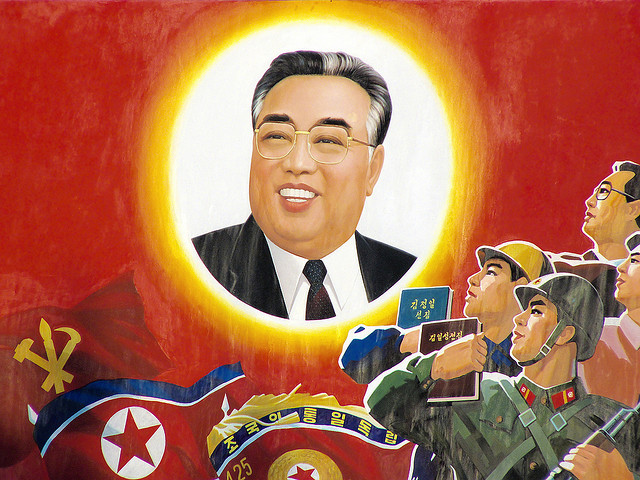
DPRK clearly falls into the latter category, as its millions of citizens are victimized by the brutal regime every day. The Human Rights Council’s Commission of Inquiry (CoI) has found systematic human rights violations, particularly in the form of political prison camps. Hundreds of thousands of inmates in these camps are subjected to starvation, forced labor, execution without trial, torture, rape, forced abortion, and infanticide. Meanwhile, millions of other citizens live in abject poverty, suffering from hunger and malnutrition while the State uses food as a means of control.
A number of international efforts have been made to address the problem. The High Commissioner for Human Rights, for example, has requested a dialogue with DPRK on the matter every year since 2003, while the UN General Assembly has put out annual resolutions condemning the atrocities since 2005. The DPRK government has been largely unresponsive to these actions, other than releasing its own report labeling the United States as the world’s worst human rights violator.
Earlier this year, CGS staffer Josh Spesaison developed several recommendations for addressing the situation in DPRK. The Global Centre’s policy brief concurs with some of his points, suggesting the following as next steps:
- The UN General Assembly should strengthen the text of its annual resolution to condemn crimes against humanity committed by DPRK authorities
- The UNGA should adopt a resolution calling on the UN Security Council to “meaningfully address grave human rights violations” in DPRK
- The UNSC should endorse the recommendation of the CoI and integrate human rights issues into its current work on DPRK
- The UNSC should refer the situation in DPRK to the International Criminal Court (ICC) for investigation
- The UNSC should adopt targeted sanctions against those responsible for mass atrocities, apart from sanctions on nuclear non-proliferation
- China should offer protection to DPRK refugees and end the practice of forcibly repatriating North Koreans
- Countries that have a relationship with DPRK (including donor countries) should work together to develop and enact strategies to promote international human rights law
It is clear that the problem isn’t going to go away on its own; until effective intervention occurs, the human rights abuses will continue. As the Global Centre rightly claims, the international community “has not exhausted all options and can no longer continue to overlook ongoing mass atrocity crimes in DPRK.”
by Christopher Davis | Aug 18, 2014 | Global Justice, United Nations
If you have not yet heard of Brandon Stanton and his photo blog, Humans of New York, you need to check it out here (and here is the Facebook page).
Stanton started HONY in 2010. His goal was to photograph 10,000 New Yorkers and plot the city’s inhabitants on a map; the result is not only photos, but an incredible blog that highlights the human dynamic and diversity of New York.
Now the United Nations has taken notice; with their help, he is taking his project a step further. On August 7th, Stanton embarked on a journey to ten countries with a larger purpose in mind. According to the HONY Facebook page, he hopes to raise awareness for the United Nations Millennium Development Goals.
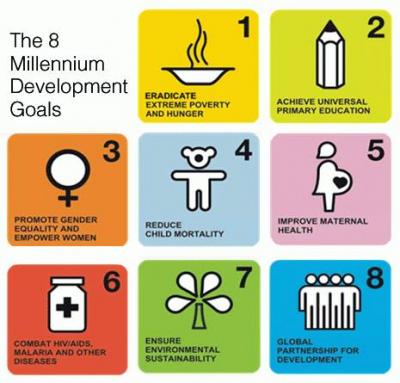
The MDGs are eight humanitarian goals the member countries of the UN set for the world in 2005. The goals range from reducing the spread of HIV/AIDS to alleviating extreme poverty to promoting environmental sustainability; in all, the eight goals are meant to meet the needs of the world’s poorest by 2015.
In the statement released on the HONY website and Facebook page, Stanton hopes his trip will “in some way help to inspire a global perspective, while bringing awareness to the challenges that we all need to tackle together.”
His trip, supported by the Secretary General’s MDG Advocacy Group, will provide a much-needed face and voice to the MDGs and the people impacted. Stanton is giving us human stories that have been ignored while the debates rage on about actions in places such as Syria, Iraq, and Gaza.
As we near the target year of 2015, it is a good time to explore those eight goals and evaluate our progress. Here we will take a look at the first two goals.
The first goal of the MDGs is a bold one: eradicate extreme poverty and hunger. The targets of goal one are halving the number of people whose income is less than $1 per day, reach full and productive employment, and halve the number of people who suffer from hunger.
Despite the immense challenge, we have made significant progress.
According to the UN Report, approximately 700 million fewer people lived in the extreme poverty conditions from 1990 to 2010. More impressively, extreme poverty rates have dropped in every developing region. Unfortunately, even with such astounding progress, 1.2 billion people still live in extreme poverty.
We have also seen progress in reducing the number of people suffering from hunger. The numbers remain high according to the UN, with one in eight people suffering from hunger globally. However, the percentage has dropped from 23 percent to 15 percent, though we have yet to hit the declared goal of a 50 percent reduction.
The second of the eight goals, achieving universal primary education, has stalled after significant progress. Globally, enrollment grew seven percent to 90 percent from 2000 to 2011 and the number of out-of-school children dropped from 102 million to 57 million.
Sadly, this progress has all but stopped in its tracks. Roughly 25 percent of children are likely to drop out before completing primary school. As aid to primary education continues to decrease, we risk not meeting the MDG’s objectives by 2015.
As we continue to highlight the eight MDGs and look ahead to 2015 and beyond, it is important that we keep the principles and foundations of these goals at the forefront. No country is immune to the effects of poverty. With support and guidance from the UN, we must continue to strive to realize the ideals established by the Charter of the UN, the Universal Declarations of Human Rights, and these Millennium Development Goals.
by Logan Cotton | Aug 14, 2014 | Global Cooperation, Global Justice
The Gauntlet of Doha
This summer, Jennifer and I had the chance to conduct independent research on a topic that deeply interested both of us: soccer. With palpable excitement in the US regarding the World Cup, Jennifer and I looked toward the 2022 iteration of the tournament as the legitimacy of FIFA’s decision to award the tournament to Qatar was called into question. Myriad issues sprung forward after Qatar was awarded the tournament, including climate, lack of infrastructure, and the treatment of laborers in Qatar. All of these, only complicated by seemingly dishonest behavior from FIFA in a string of match-fixing scandals, has many observers calling for change.
Jennifer and I were lucky that CGS encouraged us to pursue this lead and try to address the question, “What, if anything, should be done to change the 2022 World Cup?” Each of us had the chance to read through primary documents from FIFA and the Qatari bid committee, as well as dig into the effects previous World Cups have had on their host countries. The findings might counter some commonly-held assumptions about the benefits of stadiums and major tournaments. If you are skeptical of many of these events, you will likely have many of your initial thoughts confirmed.
After researching, Jennifer and I came to the conclusion that moving the World Cup would be advisable. Looking toward the future, Doha needs to construct nine new stadiums and do major renovations to three others. Accomplishing this in eight years is no small feat — and this is without considering the massive infrastructure overhaul that Qatar outlined in its bid. NGOs project that at its current pace, thousands of laborers would die from the hostile working conditions as Doha frantically tries to finish the projects.
Our best suggestion for a new host would be to share the World Cup between the United States in Canada. For the Canadians, this would be their first time hosting. For the US Soccer Federation, this would help them cultivate interest among America’s youth. Interestingly enough, the three most-populous countries on Earth are only casual fans of the world’s most popular sport; therefore, FIFA has much to gain from tapping the American market.
The US and Canada have plenty of stadiums that are prepared to host. Others would only require small renovations and, perhaps, some investment in infrastructure to accommodate a tournament of that scale. We outline in the paper numerous cities that could host the World Cup, but we confess that there are many other options.
All in all, Jennifer and I hoped to provide a paper that was illuminating, that lifted the veil often shrouding bureaucracy. Qatar is by no means the worst choice for a host country. In fact, both of us found their bid proposal rather compelling. We just think that 2026 might be more feasible for the small Gulf state.
We certainly have more questions that we would like to pursue regarding the economics of the World Cup, as well as the political impact, and football’s ability to change social norms. We’re curious fans more than formal scholars, but hope that to have nudged the scholarship forward in some way.
Of course, we thank Citizens for Global Solutions for the opportunity to research this and hope you find it insightful.
READ THE REPORT HERE.
by Josh Spesaison | Aug 4, 2014 | Global Justice
US Congressional attitudes on the International Criminal Court have moved away from the days of open hostility epitomized by the Bilateral Immunity Agreement (BIA) Campaign. Now, there are many US representatives and Senators that support the ICC and its mission – to hold individuals accused of crimes against humanity and war crimes accountable.
Senator Leahy (D-VT) put his opinion on the ICC on record during the Bush administration, saying that
By sitting on the sidelines, the United States is losing out on its ability to influence the structure and culture of this important new institution. Each time we refuse to join another treaty or international organization, which has become a pattern of this Administration, we erode our international leadership.
Senator John McCain (R-AZ) mirrored Leahy’s distaste for sitting on the sidelines in 2005: “I want us in the ICC, but I’m not satisfied that there are enough safeguards.” His concern for safeguards is fine, just so long as they don’t prevent US leadership on the world stage.
In spite of this support for the ICC in Congress, the US is still prohibited from financially supporting the ICC under law. Public Law 106-113, enacted in 1999, forbids any US funds to be directed towards the support of the ICC. The American Servicemembers’ Protection Act (ASPA) also outlaws US cooperation with the ICC in any form unless it is in the US’s national security interests and the President issues a full waiver of the law.
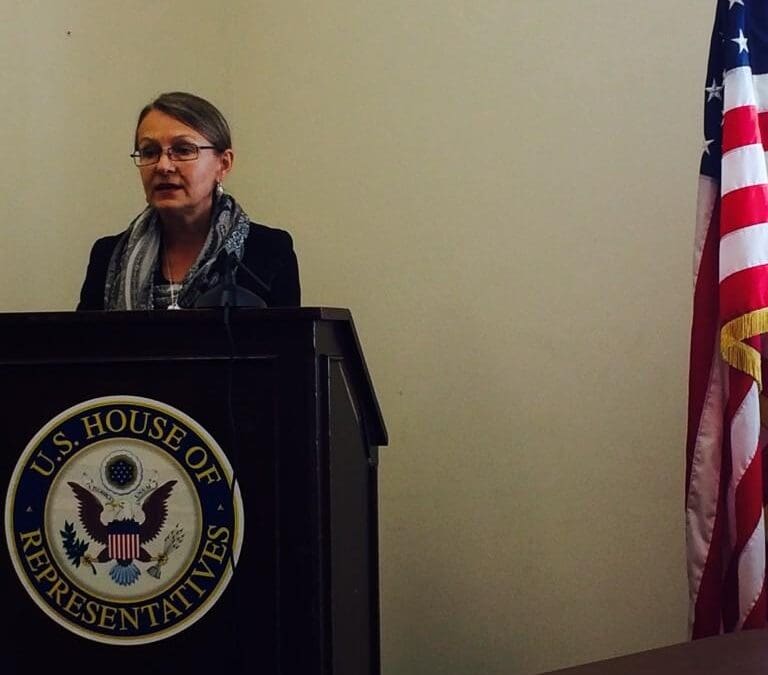
When I attended a recent Congressional briefing on the ICC, I expected to hear more questions regarding these restrictions on US participation in and cooperation with the ICC. Yet there was almost no discussion on the restrictions and zero questions on the US-ICC relationship. Too much time was spent on the history and origins of the ICC and the crafting of its foundational document, the Rome Statute.
Special guest Ambassador Tiina Intelmann did often refer to how important funding is to the ICC. How to raise funds and conduct field work – making the arrests and investigations – were the two major questions facing the ICC on a daily basis, the Ambassador repeated several times. She also suggested that these were two key areas that could be greatly improved if the US played a more cooperative role.
After the meeting she also tweeted a suggestion directed at the Obama administration.
I didn’t think that Ambassador Intelmann would directly advocate for the repeal of specific US laws, but talking in more specific terms regarding US engagement with the ICC would have been more helpful to the Congressional staffers at the briefing. I say this because when it came time to ask questions, the staffers didn’t seem informed enough to do so.
There were some very intriguing questions asked about the ICC, but most did not directly involve the US; there were questions about the ICC in Ukraine and ICC budget use. One question from a staffer for Rep. David Maffei did spark my own intrigue: Considering the criticisms the African Union (AU) has of the ICC, would US ascension to the ICC create problems for US-AU relations?
Ambassador Intelmann did not feel it was her place to speculate on the US-AU relationship. However, this one question represents a much greater Congressional discussion that the ICC deserves. The ICC is a powerful tool for justice around the world which has already made a significant difference, and the need for US global leadership demands that Congress ratify the Rome Statute. Yet too few people know even what the Rome Statute or the ICC is. Let’s start by learning more about the ICC.
by Christopher Davis | Jul 31, 2014 | Global Justice, News, Peace & Disarmament
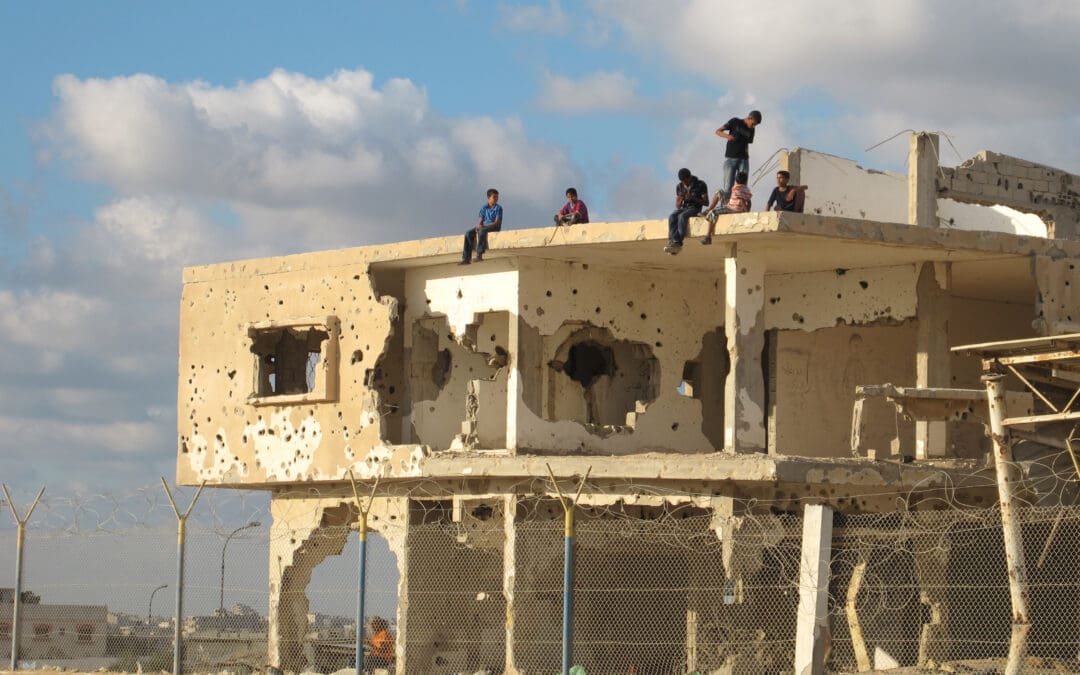
Operation Protective Edge, the name given to the Israeli Defense Force’s ground assault against Hamas’ military arm, is aimed at halting rocket and mortar fire on Israeli territory. In addition to cross border fire, Protective Edge is targeting a network of ground tunnels Hamas’ militants use to infiltrate Israeli territory.
Whatever Israel’s intentions are, one thing is clear; the loss of life has been alarming.
The death toll has passed 1,000 and, according to UN reports, 72 percent of those killed have in fact been civilian, including a larger number of women and children. Last week, an air strike killed five and wounded dozens of others inside a Gaza hospital. Israel’s target was a cache of anti-tank missiles that was identified as being in the “immediate vicinity” of the hospital. More recently, a UN shelter was hit killing 16 and injuring many.
In addition to civilian casualties, more than 100,000 citizens have been displaced by the conflict. The international community is calling for a ceasefire agreement, warning that the war crimes from both sides must end, including UN Secretary-General Ban Ki-moon who stated that Israel’s attack on the densely populated Shejaiya neighborhood of Gaza “an atrocious action“.
A series of humanitarian cease-fires were observed over the weekend however a long term agreement has yet to be achieved.
Unfortunately, a long term deal seems unlikely until Israel has achieved its military goals.
Israel’s Minister of Communications stated “Israel must not agree to any proposal for a cease-fire until the tunnels are eliminated,” referring to the Hamas’ ground tunnels into Israel. Hamas is demanding that Israel and Egypt open their borders and ease travel restrictions; the two sides are all but assuring that there will not be a quick, peaceful end.
As the fighting continues, concerns must shift toward humanitarian efforts.
The US is set to send $47 million in aid to Gaza in an attempt to “alleviate the immediate humanitarian crisis.” Additionally, Secretary of State John Kerry is in Cairo working with Egyptian and Arab League officials in the hopes of achieving a ceasefire.
Secretary-General Ban Ki-moon spoke alongside Israeli Prime Minister Benjamin Netanyahu, urging both sides to open dialogue and end the fighting that left the region in turmoil. Additionally, the Secretary-General urged Israel to exercise restraint; Mr. Netanyahu made it clear that this will be a difficult process, stating, “What grievance can we resolve for Hamas? Their grievance is that we exist.”
The modern Israel-Palestine conflict is one that has raged on since 1947; while a ceasefire may end the violence today, it will not provide a resolution to this longstanding rift between the Jewish and Arab states. Our hope and focus must be directed toward the preventing the unnecessary loss of civilian life.
by Jennifer Welden | Jul 30, 2014 | Climate Justice, Global Justice
Carlos Pascual, the Special Envoy and Coordinator for International Energy Affairs for the State Department, spoke last week on the new geopolitics of energy and what challenges and opportunities this presents for the future. Most notably, he emphasized the need to consider the developing world moving forward, creating policies that are based on an understanding of finance and that foster transparency.
Today, 1.2. billion people do not have access to electricity and 2.8 billion rely on wood or other biomass to cook and heat their homes. To address this, the UN has put forth its Sustainable Energy for All initiative, which seeks to ensure universal access to modern energy services, double the global rate of improvement in energy efficiency, and double the share of renewable energy in the global energy mix by 2030. This is a daunting set of goals; the World Bank estimates that to increase global renewable energy consumption from 13% to 30% or more by 2050 would require an additional “17,000 wind turbines, 215m square meters of solar panels, and 80 solar power plants every year for the next 40 years.”
Meeting the demand for renewable energy, therefore, requires that the cost of this energy decrease. While this can be done partly through investment, it must also be done by reducing the financial barriers placed on this technology. As Peter Brun of the Guardian notes:
Trade in sustainable energy goods and services is currently distorted by tariffs, subsidies, and complicated and conflicting standards – all of which make the products more expensive for consumers.
Even developing countries impose import tariffs, which, combined with high capital costs and the low incomes of many residents, make purchasing and maintaining renewable energy almost impossible.
At times it seems as though the biggest barriers to development are developing countries themselves, as there is, along with the financial challenges, rampant corruption. As Pascual pointed out in his speech, the amount of capital that leaves Africa due to corruption is greater than aid it receives. In fact, many private businesses provide corrupt officials the means to launder large amounts of money. These corrupt deals can have significant impacts on a poor country’s development; through five suspicious mining deals, the Democratic Republic of the Congo lost an amount equivalent to their total health and education budget. This also hurts developed countries, as it renders their aid ineffective and cripples their own ability to invest in renewable energy at home and abroad.
But even if a country is able to overcome trade policies and corruption, the issue of long-term financing still remains. Even developed countries with strong infrastructures are struggling to transition to renewable energy: Germany’s $412 billion Energiewende green energy agenda has resulted in a net increase in costs to consumers and other stakeholders. Consumers have seen a major spike in energy bills, leading many to call electricity a “luxury good.” Will it be possible then to create renewable energy solutions that residents of developing countries can utilize long-term?
Fortunately, renewable energy technologies continue to be invented and improved each day, suggesting that it is possible to bring renewable energy to the developing world. For example, the Waka Waka solar light offers an alternative to the kerosine lamp, providing 80 hours of light after one day of charge. Unfortunately, most of these products have limited funding; they rely on crowdfunding and Kickstarter campaigns to expand production, once again emphasizing the important financial barriers still in place.
Just as Carlos Pascual stressed in his speech last week, transparency and financial incentives are key to spreading renewable energy worldwide. Part of this will come with time: as technologies become more efficient and cheaper to manufacture, they will become more widespread. But part of this must come from policy: we need policies that demand transparency and eliminate the financial barriers (such as tariffs) that make this technology so expensive in the first place.
As we work to create a sustainable world, we must not forget those who do not yet have a developed world. Only then can we reach a truly global solution.