by Benjamin Gross | Jul 25, 2014 | Global Justice, Human Rights
US Border Control officers released Jose Antonio Vargas last Wednesday, after holding him overnight at an airport in McAllen, TX, for failing to provide proper identification. Vargas, 33, is a Pullitzer Prize-winning journalist and the star of the critically-acclaimed film Documented, which chronicles Vargas’ life in the US as an undoucmented migrant.
Vargas’ arrest sparked outrage in the US, where he had lived for more than two decades without a single encounter with law enforcement.
Vargas initially came to the US at the age of 12, with a man who allegedly was his uncle. After successfully crossing the border with this “uncle,” Vargas went to California to live with his grandfather and grandmother, both of whom were naturalized US citizens.
In California, Vargas enrolled in a nearby middle school, where he quickly assimilated into American life and customs. He mastered English, acquired friends, and aspired toward “typical” teenage goals like learning to drive.
Vargas discovered that his Green Card was fake when applying for a driver’s license. He confronted his grandfather, seeking the truth about his citizenship status. His grandfather confessed that Vargas’ supposed “uncle” was really a coyote, hired to bring Vargas over the border illegally.
Vargas’ story is further complicated by the recent passage of Obama’s Dream Act, which provides a legal path to citizenship for those who came to the US as young children, stayed at least five years, and graduated from high school. Vargas is 33, and the Dream Act only applies to persons aged 15-30.
Jose Antonio Vargas’ saga is only one of millions of troubling stories regarding immigrants and our broken immigration system. Indeed, there are many others just like Vargas who have lived in the US since childhood, but due to our current immigration laws, are unable to become citizens.
The Senate recently passed a bill with bipartisan support that would drastically overhaul America’s outdated and ineffectual immigration system. It would help provide legal citizenship to people like Jose Antonio Vargas, who desperately want to be US citizens and have lived in the US nearly all their lives, while also helping to augment America’s border security as it struggles to deal with the biggest influx of refugees it has seen in years.
Despite the clear need and reasonable provisions outlined, the bill is likely to die on Capitol Hill. This is because Speaker of the House John Boehner won’t bring the bill to the House Floor for a vote, even though it has bipartisan support and would likely pass.
Looking ahead, I hope that Speaker Boehner may one day change his mind and allow the House to vote on this critical bill, which will have far-reaching benefits for people like Vargas as well as US border security. I hope that hope that one day the people who have made immeasurable contributions to this country–like Jose Antonio Vargas–may be given the opportunity to fulfill their dream and become legal US citizens.
by Alice Abracen | Jul 18, 2014 | Global Justice, Human Rights
In Canada, Lieutenant-General Roméo Dallaire is a household name. When asked in elementary school to write a composition on a Canadian Hero, students invariably gnash their teeth in frustration as they find themselves presenting eight or nine identical essays on the famed commander of the ill-fated 1994 UNAMIR mission in Rwanda.
In his bestselling Shake Hands with the Devil: The Failure of Humanity in Rwanda, Dallaire recounts his experiences as a witness to the horrific mass murder of 800,000 men, women and children despite his peacekeeping force’s best attempts to prevent the slaughter.
The titled failure of humanity refers not only to the massacres, but also to the murderous passivity of the international community, whose failure to intervene despite Dallaire’s pleas and whose lethal withdrawal of resources and support from UNAMIR depleted Dallaire’s forces, abetting the killing of civilians for months.
Dallaire’s experience in Rwanda left him with devastating PTSD which resulted in a suicide attempt. He has courageously shared his continuing struggle with the public and become an outspoken advocate of veterans suffering from PTSD. He is a celebrated humanitarian and a tireless campaigner for human rights, genocide prevention, and the Responsibility to Protect. He is the founder of the Roméo Dallaire Child Soldiers Initiative and the Lieutenant-General Roméo Dallaire Foundation. A recipient of the Order of Canada and advocate of veterans suffering from PTSD, he has served on the UN Advisory Committee on Genocide Prevention and has testified at the International Criminal Court.
In 2005 Dallaire was named to the Canadian Senate. On June 5th, 2014, he announced his retirement from Parliament, citing a need to dedicate himself more directly to the causes he had championed for years.
Dallaire, long critical of the member states’ unwillingness to move past self-interest for the sake of humanitarian intervention, reaffirmed his calls for action in his final speech as a Senator to his nation.
Dallaire accused Canada of “dancing around the words ‘responsibility to protect‘ and the International Criminal Court, and the term ‘child soldiers’” for fear of needing to turn “principled foreign policy” into “principled action.” Today, he alleged, we have “more empty calls for respect for human rights and less actual engagement with the violators.” He urged Canada to re-assume leadership in resolving international conflicts and preventing atrocities in keeping with its tradition of globally championing human rights.
Dallaire’s words are for Canada, but the United States should heed his calls and his critiques. Dallaire urges the implementation of the Responsibility to Protect doctrine in the Central African Republic via peacekeeping; reinforcing the African Union; issuing sanctions where necessary; holding accountable those who recruit child soldiers as weapons of war; and helping the country rebuild its economic, security and educational institutions.
Readers should also note Dallaire’s chosen date of departure. June 17th was 20 years after he was informed of Operation Turquoise, a belated attempt to intervene in the genocide less for humanitarian purposes than for the national interests of former colonial powers, giving protection to the perpetrators of Rwanda. Dallaire denounces the strategic interests that invariably temper the interventions led by colonial powers and superpowers (the latter a category in which he places the United States). Dallaire’s criticism is well-founded. Superpowers, in tailoring their humanitarian impulse to areas of national interest or in committing colonial-minded interference in vulnerable states, fail in their Responsibility to Protect. The United States must heed the criticism of past interventions; its global leadership in humanitarian intervention should spring not from national interest, but from a true recognition of its responsibility to protect.
As Dallaire leaves politics to focus his energies on the plight of child soldiers, PTSD-affected veterans, and genocide prevention, his speech should be a call to awaken to the Responsibility to Protect in both Canada and the United States; his lifelong dedication to humanitarian causes a model for their citizens and policy-makers.

by Jennifer Welden | Jul 16, 2014 | Climate Justice, Global Justice
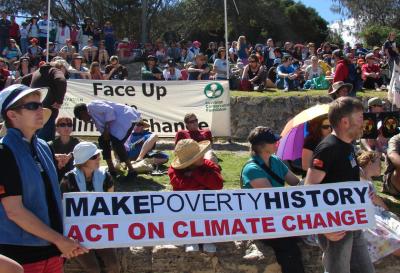
Climate change, and the campaign surrounding it, has evolved significantly over the last decade. Just look at its name: it went from “global warming” to “climate change” and now there are suggestions to call it “global weirding,” “pollution death,” or (my personal favorite) “atmosphere cancer.” The way in which it has been framed has evolved as well. It has gone from an environmental issue to a public health issue to a political issue, a representation of a deep-seated ideological divide between Democrats and Republicans.
And yet, despite all these changes, only 40% of Americans view climate change as a major threat. Clearly, the way in which climate change is being framed is not working to convince the general public. The climate is changing, and so should its messaging.
What may be hurting the climate change campaign the most is the lack of real-world examples. While we are seeing the effects of climate change everywhere in the US – extreme heat or cold, torrential rainfall, drought, etc. – these are not apocalyptic enough to sway the average member of the country. And when the consequences of climate change do verge on apocalyptic – devastation and conflict due to drought, natural disasters, and public health concerns – they are in the third world, too “geographically (and psychologically) distant from the audience being communicated to.” Even if these events occurred in our backyard, fear is often ineffective in inspiring actual change. Focusing on “social norms” that promote sustainable behavior, or providing interactive simulations on the future effects of climate change have both been suggested as ways to generate real concern among Americans.
What the current framing of climate change lacks is a personal touch. Climate change is not just an environmental, economic, or political issue. Climate change predominately affects women – why aren’t more female politicians and feminist organizations pushing this agenda? Low-income residents are more affected by pollution and natural disasters than higher-income groups – why aren’t more news articles connecting this to the ever-popular subject of income inequality? Sports rely on fresh air and healthy, able bodies to fill their massive stadiums – why isn’t ESPN or Sports Illustrated featuring stories about this? Kendrick Lamar gained widespread popularity with his album good kid, m.A.A.d city, on which he raps openly about his experiences growing up in Compton, an area well known for pollution. Why can’t he, or some other influential artist, make a Top-40 hit about climate change?
But the truth is, much of this has been done. Women, low-income people, sports figures, and celebrities have all spoken out against climate change, attempting to appeal to a wider audience. NASA even put out its own rap video. So why isn’t this working? First, there is a lack of mainstream cable network coverage surrounding climate change; with TV still being the dominant way people receive their news, this means many messages just aren’t reaching the people they are meant to sway. And if the usual environmental or political messages aren’t being broadcast, how can we expect these more personal and direct messages to be? Moreover, when climate change is presented in the media, it is often framed as a political issue, a battle of opposing sides. In an age where the news is dominated by sensational stories of conflict, and where bipartisanship is the needle in the proverbial haystack, there doesn’t seem to be room to relate to the average voter across partisan lines.
Second, and more importantly, people are framing the issue in these ways, they just aren’t calling it climate change. They are referring to it by the issues that surround it: pollution, health, job creation, extreme weather, human rights, women’s rights, etc. These issues are relevant, direct concerns of many, and understandable regardless of your stance on climate change. Even conservatives have been motivated to protect the environment when shown that something is a threat “to the ‘purity’ and ‘sanctity’ of [the] Earth and our bodies,” an appeal that goes beyond the climate change debate to a strictly moral ground.
But the fact that we aren’t constantly relating these things back to climate change may be exactly why so many Americans do not consider climate change to be a major threat. Does climate change trump pollution? Your child’s health? Your brother’s career options? In the mind of the average American, probably not.
With this in mind, maybe it’s not the framing that needs to change, but the policy. Crafting policies that address the personal issues of Americans, but also help the environment in the process, may be the key to gaining widespread support, or at least deterring widespread opposition.
Or maybe we should just start calling climate change what it really is: atmosphere cancer.
by Benjamin Gross | Jul 11, 2014 | Global Justice, Peace & Disarmament
“Do you see UN Peacekeeping as a viable option to help solve the humanitarian crises in Syria and Iraq?” I asked Hervé Ladsous, the United Nations Under-Secretary-General for Peacekeeping Operations. Couldn’t UN Peacekeepers help remedy the enormous humanitarian dilemma that has resulted from these two crises– with millions now suffering from a shortage of food and clean water?
“The answer to your question is no,” stated Mr. Ladsous, without even the slightest hesitation. “We wish we could help the people suffering, but the magnitude of the two crises is simply much too large for the UN to handle.”
It was at that point I found myself disagreeing with one of the world’s leaders in peacekeeping. For if we wish to help solve two of the worst humanitarian crises in recent history, UN Peacekeepers must be involved.
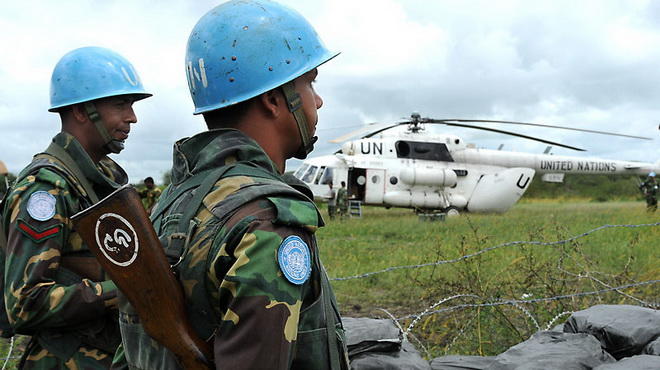
They must be involved because they are undoubtedly the best and most well-trained peacekeeping group in the entire world. They are experts at delivering supplies to those who need them, and quickly. They are adept at helping to mend differences between ethnic groups, often healing situations that many had previously thought were beyond repair. They remain 100 percent committed to their missions no matter the circumstance–some even paying the ultimate price in a concerted effort to help make the world a better place.
Now, I understand that some of you may be looking at me sideways at this point, and are thinking of the various studies that have recently come out declaring that UN Peacekeeping is only marginally effective, if that. You probably want an answer for some of the UN Peacekeeping’s failures–like the Rwanda catastrophe in 1994 or Kosovo’s bloody civil war in 1999, and you deserve one.
And yet, I insist that UN Peacekeepers must go in to Syria and Iraq. They ought to be deployed to those countries in mass numbers, as soon as humanly possible.
This is because although UN Peacekeeping may have made major mistakes in the past, these mistakes actually have little to do with the effectiveness of UN peacekeepers—and much more to do with a severe lack of funding and support.
Take for instance Rwanda. France, the UK, and the US all used their influence to prevent reinforcement peacekeepers from being sent in only a few weeks after the killings had begun. They also refused to label the mass killings occurring as “genocide,” thereby ruling out the possibility of any kind of humanitarian military intervention. Additionally, Belgian peacekeepers, which made up a large portion of the UN peacekeepers in Rwanda, were pulled out of the conflict shortly after it had begun. Furthermore, the remaining peacekeepers had been given orders by the UN not to fire unless fired upon–even if a civilian’s life was at risk.
With adequate funding and support, however, the UN has recently enjoyed a number of successful missions in the last decade. A recent UN Peacekeeping mission in Haiti (MINUSTAH) has helped to reduce the number of internally displaced persons by 77% and has trained over 5,000 Haitian police officers, according to the Better World Campaign. In April, a UN Peacekeeping mission ended in Côte d’Ivoire, which was incredibly successful in helping to resolve the country’s conflicts and build up its infrastructure and government; Côte d’Ivoire’s economy has grown more than 8.5% in the last year and is scheduled to have its first democratic election in years in 2015.
UN Peacekeeping missions, with adequate funding and support, would undoubtedly provide much-needed assistance to the millions of refugees of the crises in Iraq and Syria. They would enable millions of people to get the food, water and resources they would need to survive while their respective countries seek to safely resolve the ongoing conflicts. And, while they might not be able to fully solve two of the most intractable conflicts on earth, they would certainly make an impact.
by Logan Cotton | Jul 10, 2014 | Global Justice, Human Rights
Soccer (football) is the beautiful game. As an American this might sound strange, but I am thoroughly convinced that no sport trumps soccer in its capacity to inspire and connect people from different parts of the world. FIFA, soccer’s international governing body, is tasked with keeping the game vibrant, fair, and accessible so that everyone can enjoy it – their motto being For the Game. For the World.
Their charge is far from simple. FIFA governs 209 national soccer associations, with each member nation assigned to one of FIFA’s six regional confederations. For those keeping count, this means that FIFA has more member states than the United Nations, since FIFA recognizes 23 non-sovereign polities as nations. The fact that football is such a dearly held treasure for humankind – and consequently a lucrative business for the wealthy – means that FIFA’s conduct is felt, scrutinized, and often critiqued.
I feel that FIFA is an organization worth some thought, particularly for its function as a supranational government. It has attracted businessmen from the world over, all of whom look to capitalize on the prestige and profits of club teams. Lastly, and possibly most intriguingly for me, FIFA is very intimately tied to and affected by social currents in every corner of the world – racism, colonialism, homoantagonism, neoliberalism, globalization, and more can all be seen in the history of the teams and the organization.
This summer, I plan to write about FIFA a few times and to explore some of these curiosities. Any posts that don’t fit into the scope of GlobalSolutions.org’s mission, I will likely throw-up on my own blog, Snakes on McCain. That said, I want to begin looking more at the people FIFA affects than the structure of the beast.
Football is a game played by people, groups of people, and those groups of people have distinct histories. Similar to how one would be hard-pressed to avoid the tension of racial segregation if they attended an LA Dodgers game in the 1950s, a football match in Italy in 2012 also carries the potential for nativist and racial tension – especially when one of the star players doesn’t “look Italian,” by the estimation of right-wing groups.
The reference to Italian soccer isn’t fabricated. In 2013, AC Milan’s match against Roma was suspended because of racist chants directed toward Mario Balotelli, a black Italian player featured on Italy’s national team. Also in 2013, AC Milan’s match against Pro Patria was suspended when midfielder, Kevin-Prince Boateng refused to tolerate any more racial abuse by fans in the stadium. His AC Milan teammates followed him off the pitch.
Certainly, there are more incidents than the two identified above and they involved more than AC Milan and Italy. I plan to address the specifics of those incidents in later posts.
Additionally, the targets of abuse include more than simply non-whites at matches in Europe. The 2014 World Cup has already been the stage for anti-LGBT violence in the form of Mexico’s infamous, “Eh… puto!” chant; the unabashed display of neo-Nazism with a fan taking the field to showcase his HH (for “Heil Hitler”) and his Nazi SS markings; and numerous incidents of anti-black racism, including racist chants and the sporting of blackface by fans.
For the purpose of this space, I’m curious to think about FIFA’s role in this. How is the organization complicit and how can FIFA, as the steward of global football, leverage its authority to enact positive culture shifts worldwide?
Is it possible for FIFA to combat hate speech, racism, neo-Nazism, and nativism? It’s quite a pickle for a sport that often facilitates interaction between international – and therefore, “migrant,” superstars – with clubs whose fan base can be rather provincial.
Is it possible for FIFA to advocate for progressive climate action by posting eco-friendly requirements on clubs as part of FIFA’s compensation to the world for the emissions produced by football?
How does FIFA promote the game in a way that makes it loved by every person on Earth and promote the game in a way that makes enjoying the game a safe, affordable, and positive experience for every person on Earth? Can FIFA do this in a way that is not neocolonial or mired in “White Savior” complexes?
What has become increasingly irrefutable over time is the fact that FIFA’s charge to preserve and promote the sport cannot transcend the forces that shape our world. Whatever our insecurities, geopolitical arrangements, and/or particular violence and victimhood might be, they are present in the arenas, in the pubs, and on the pitch.
by Alice Abracen | Jul 8, 2014 | Global Justice, Peace & Disarmament
Last Monday brought a devastating conclusion to the 18-day search for three missing teenagers in Israel with the discovery of the bodies of Naftali Fraenkel, 16; Gilad Shaar, 16; and Eyal Yifrach, 19. Tens of thousands attended the funeral, and the international community echoed the nation’s grief; Barack Obama said that as a father, he could not imagine the pain of the parents. Yet as a world leader, he urged restraint in Israel’s response, encouraging Israel and the Palestinian Authority to work together in pursuing justice and to “refrain from steps that could further destabilize the situation.”
UN Secretary General Ban Ki Moon suggested that “this heinous act by enemies of peace aims to further entrench division […] and to widen the conflict. It must not,” he asserted, “be allowed to succeed.”
Months after American-brokered peace talks broke down, their warnings against provoking escalation went unheeded.
That night, the homes of Marwar Qawasmeh and Amer Abu Aisha, Hamas members suspected of being the kidnappers, were demolished. Air strikes were launched against the Gaza strip in reply to militant rockets. Thousands of homes were searched in the West Bank and 400 Palestinians were arrested, with some killed in confrontation with soldiers. Right-wing extremists mobbed the streets of Jerusalem, shouting anti-Arab slogans and attacking Arabs.
And, in a shocking act of brutality that has inspired mass rioting: the kidnapping and murder of Muhammad Abu Khdeir, age 16.
In the wake of these tragedies, Israel/Palestine has a choice. Governments and citizens may use these deaths as a springboard for retaliation, revenge, and eventual ruin, or they may find in their shared bereavement a new opportunity for reconciliation.
Many have pursued the option for destruction this week. Netanyahu’s denunciation of extralegal retaliation is undermined by the military barrage, the arrests, and the continued establishment of settlements. Defense Minister Ya’alon’s proposal to create new settlements in honor of the boys would use the murder of the innocent as a platform for provocation. Hamas, whose constitution rejects “so-called peaceful solutions,” applauded the kidnappers of the Israelis, vowing revenge for Khdeir in a sure incitement to claim more lives. Rather than using the children’s murder to validate reprisal, their monument should be a pledge to end the conflict.
Others are making courageous strides towards that end.
In the same square where an angry mob attacked Palestinian youth, a rally against anti-Arab violence took place. The Israeli Opposition Leader who attended called for an end to the “circle of blood” which extremists seek to perpetuate against the general will.
Abbas denounced the abduction and assisted in the search for the boys, risking tension in the new coalition–and in his own party–to save lives. Israel arrested six on the suspicion of Khdeir’s murder. Both parties’ willingness to hold their own extremists accountable for violence are necessary for future reconciliation.
The family of Naftali Fraenkel invited that of Muhammad Abu Khdeir into their home to comfort one another, and there is an initiative underway, headed by Jews and Muslims, to make July 15th (17 Tammuz and Ramadan) a joint interreligious fast day against violence. This is a better legacy for the boys: rallies in the name of nonviolence, enforced accountability under the law, empathetic dialogue, and new plans for a shared future to commemorate the youths’ shared fate.
We at Global Solutions hope that these initiatives to choose law over revenge, empathy over extremism, and to interrupt the cycle of violence will yield fruit. We hope that the United States will encourage and sustain the courage of those who, after tragedy, reject the option for destruction and pursue the option for reconciliation.