by Brandon Hooks | Jul 7, 2014 | Global Justice, Human Rights
The international media has a tendency to focus on the news stories that will garner the greatest attention from a given audience. Events such as the ISIS declaration of a caliphate in parts of Iraq and Syria and the ongoing World Cup in Brazil have taken up headlines within recent weeks and are likely to stay in that spot. So what happens to the stories that go unnoticed?
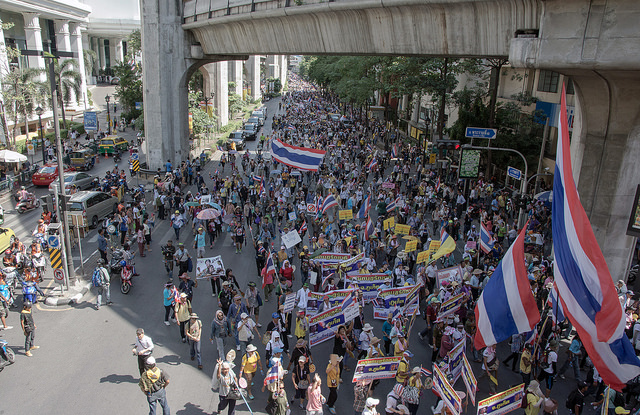
One example of a story that has flown under the radar in recent weeks is the situation in Thailand. On May 22nd the Thai military led a coup after mounting protests against the elected government over accusations of corruption and factional violence. Following the military takeover the international community diverted attention from the issue, afraid of what effects the move could have upon the region and even the world.
Fast-forward six weeks and the military is still in power. The constitution has been thrown out and just recently the military leaders declared a drastic overhaul of the electoral system before the planned October 2015 elections. Nearly 20,000 Cambodians are just now returning to the country for work after fleeing the state due to the increasing tensions between the military leaders and supporters of the former regime. Humans Rights Watch is raising questions as to the whereabouts of disappeared political activists following the coup.
In wake of all these events, one may ask what the international community is doing about the situation in Thailand. The answer: largely nothing. US Ambassador to Thailand Kristie Kenney recently stated that Thailand has been uninvited to the Rim of the Pacific Exercise (RIMPAC), but aside from that has failed to address the issue. The United Nations has taken no action against the coup and has simply suggested that both sides in the conflict work to resolve the issue.
The current situation in Thailand portrays the world’s tendency to overlook what may be deemed as smaller issues in order to focus on more pressing matters. While this may help with quelling immediate threats, it also risks the further escalation of these “small problems.” In the case of Thailand, the threat of escalation is very real.
While the government coup was led by the Thai military, the stability of the regime is still very much at risk. Divisions within the military between those that opposed the old government and those that supported the former prime minster are tearing the leadership at the seams.
Overlooking the Thai coup can also lead to the growth of preexisting problems. Earlier this year Thailand was downgraded to tier three on the US State Department’s 2014 Trafficking in Persons Report. With an unresponsive government in place, the issue of human trafficking in Thailand along with other problems the country faces could go unaddressed and lead to the continued suffering of hundreds of thousands.
As globalization continues to occur, it is important to understand the interconnectedness of all countries and people. Events such as the coup in Thailand cannot be taken for granted and must be acknowledged by the global community. Failing to address international problems and allowing them to escalate risks the stability of the global order and the rights of all individuals involved.
by Jennifer Welden | Jul 2, 2014 | Global Justice, Human Rights
Soccer is a universal sport. It is played around the world in a variety of countries: rich and poor, democratic and nondemocratic, Western and Southern. For millions, it is more than just a game, it is a source of national pride, and competing in the World Cup is one of the highest honors a team can bring to its country.
But while the sport itself may be a unifying force within and among countries, the international governing body that organizes the World Cup, the Fédération Internationale de Football Association (FIFA), is not. In fact, it is the cause of many of the world’s current issues, ranging from corruption to human rights abuses to mass riots. FIFA has gained enough power and influence to become somewhat of a world government, causing it to be dubbed the “United Nations of Football.”
Brazil, the current host of the World Cup, spent $300 million to build just one stadium in a secluded part of the country that does not have a first-class team to play there afterward; it will apparently cost $250,000 per month to maintain. All this comes from a country that suffers from extreme poverty and inequality, a decaying infrastructure, and both healthcare and education programs in need of more funding. The construction has also led to the gentrification of locals, with many enduring rent increases, demolitions, and evictions.
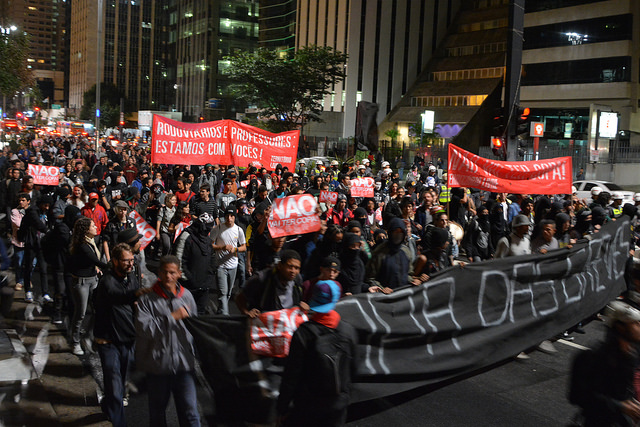
Many Brazilians have taken to the streets to protest these injustices, leading to violent altercations with the police and even death.
But won’t Brazil profit from the World Cup and be able to direct some of that money back to the people? While typically there is an increase in tourism revenue, there has already been less profit than expected, with Moody’s forecasting only a “temporary lift” to Brazil’s economy. This can best be categorized as the “World Cup effect,” in which host countries’ economies are harmed more than they are helped. Moreover, even if there are profits, there is no guarantee that those profits will go toward helping the people who need it most.
FIFA, on the other hand, will make an estimated $4 billion from TV rights and marketing deals related to the event. While this is less than the $13.6 billion Brazil might make, FIFA also profits from licensing deals and corporate partnerships/sponsorships while paying no taxes on World Cup revenues, as it is defined as a not-for-profit association under Swiss law. Additionally, by finding tax exemptions in every host country, FIFA denies these countries a further cut of the profits. How many nonprofits do you know that boast $1 billion in reserve savings?
This is made worse by FIFA’s rampant corruption, most recently seen with Qatar receiving the bid to host the 2022 World Cup. Qatar had already been criticized for its horrific human rights violations in preparation for the World Cup, for which they too are building a brand-new stadium. Already, more than 900 laborers have died since construction began in 2012, with countless others dealing with different forms of abuse, such as being “denied access to free drinking water in the desert heat.”
Without proper reform, FIFA’s World Cup will fail to be a “People’s Cup,” taking away from the camaraderie, celebration, and pride that it so wonderfully creates. And yet many of us largely ignore these issues, understandably, in order to preserve the image of a sport we love. John Oliver put it best when he said:
[Soccer is] an organized religion and FIFA is its church. Just think about it. Its leader is infallible. It compels South American countries to spend money they don’t have building opulent cathedrals, and it may ultimately be responsible for the deaths of shocking numbers of people in the Middle East. But to millions of people like me, it is the guardian of the only thing in their lives that gives them meaning.
by Alice Abracen | Jun 26, 2014 | Global Justice, Human Rights
A few days ago, my mother, who of course reads my blog posts, excitedly notified me over Facebook that Meriam Ibrahim has been released from prison in Sudan. Last week I wrote about how the court’s apostasy accusation against Ibrahim, in addition to being an egregious assault on religious freedom, was also a case study in codified misogyny. This legalized chauvinism had forced a mother to give birth shackled to the floor and had sentenced her to death–but last Monday it seemed she’d been granted a reprieve.
The international outcry against the conviction’s abuse of human rights seemed to have been answered in the Court’s latest ruling. Jehanne Henry of Human Rights watch suggested that the international pressure may have had an influence on the decision. Certainly between Amnesty International, David Cameron, and Hillary Clinton, influential voices had raised a clamour worldwide in an international campaign demanding justice for the imprisoned Ibrahim. Widespread investment and concern for the fate of one woman had transcended borders and yielded a concrete and happy result.
Still, the international community rejoiced cautiously. US Rep. Chris Smith called the release a “huge first step,” but maintained that the next was putting Ibrahim and her family on a plane to the US.
His suggestion that more sanctuary would be required was dead on. Ibrahim and her family were arrested at the airport as they tried to board a plane to the United States, where Ibrahim’s husband is a citizen and where they’d hoped to start a new life.
She had been free for one day.
The latest is that Ibrahim is being held in the airport, where she is being questioned about her travel documents. According to Sudanese authorities, she has not been charged and is safe at present, but the American embassy remains highly involved in the case.
Two days ago I was ready to credit myself and over one million others who formed part of a vast campaign for social justice with the success of Ibrahim’s release. It seemed a victory for world citizenship; the vocal, non-violent intervention of a global community rewarded, injustice curbed and state sovereignty preserved to everyone’s satisfaction.
But in the wake of this recent arrest, frustration is high among those who thought they’d helped to win Ibrahim’s safety. I’ve seen calls in online reader’s comments for Barack Obama to extract Ibrahim–usually answered by the rational observation that he cannot infringe so dramatically on Sudanese sovereignty.
The United States’ opportunities for intervention are limited- it has imposed economic sanctions on Sudan since 1997 and has voiced its strong disapproval of the state’s human rights violations. The barriers of sovereignty continue to discourage further action from the United States, a country who, like Sudan, refuses to ratify international agreements that would protect women like Ibrahim from legally sanctioned misogyny. No lone nation can police human rights violations worldwide in a way that an international court or assembly could- if adequately supported.
While the United Nations laments the treatment of Ibrahim, it cannot do much more. In the absence of an international body whose global jurisdiction to address violations of human rights would be enforced, the international community is left with only one collective recourse: to speak out. We can continue to supply ample international pressure, to raise our voices until Ibrahim and her family are in a place of safety. We can continue to probe the wider meaning behind the accusations against her, which were apparently motivated by her family’s desire to seize her business holdings. We can bring to light this perversion of legislation and of religion for the sake of profit and refuse to let the system that tolerated it go unadmonished.
by Alice Abracen | Jun 26, 2014 | Global Justice, Human Rights
This blog was co-authored with Ben Gross
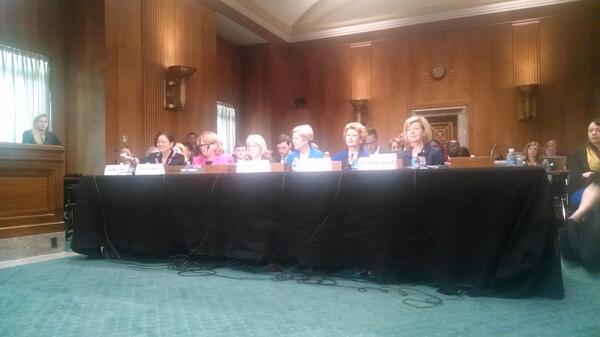
Tuesday marked a monumental day for women around the world as the Senate Subcommittee on International Operations and Organizations, Human Rights, Democracy, and Global Women’s Issues gathered to address the global epidemic of gender-based violence and discrimination. Senator Barbara Boxer, presiding, convened an impressive array of witnesses that included prominent Senators as well as many other leading figures in the struggle for gender equality.
Senator Boxer emphasized in her opening remarks the need for the long-overdue passage of the International Violence Against Women Act (IVAWA) and the ratification of the Women’s Rights Treaty (CEDAW) as vital steps in protecting women’s rights worldwide.
Committee Member Senator Rand Paul criticized the practice of giving aid money to governments that condone gender and religion-based discrimination. Senator Risch manned the panel, Senator Markey affirmed his proud cosponsorship of IVAWA, and Senator Menendez voiced his strong support for both IVAWA and the ratification of CEDAW. Senator Durbin lamented the failure of the US to pass both CEDAW and the Disability Treaty. He quoted Hillary Clinton’s statement that the question “How do you treat your women?” offers more insight than any other on the future of a country, and stated that we must “give the ones who have no voice a voice in Congress.”
Witnesses Senators Warren, Hirono, Klobuchar, Stabenow, Baldwin, Heitcamp, and Murray all shared devastating accounts of women and girls who’d endured and fought gender-based violence and discrimination, from the poorest villages to political pulpits. They called for Senatorial action on IVAWA and other Acts directed at preventing and prosecuting human rights violations in the United States and abroad.
Catherine M. Russell, Ambassador at large for Global Women’s Issues and Ms. Susan Markham, Senior Coordinator for Gender Equality and Women’s Empowerment at the Agency for International Development, explained their offices’ strategies in addressing gender-based violence. Ms. Russell confirmed that the delay in ratifying CEDAW is undermining America’s championship of women’s rights abroad. Hauwa Ibrahim of the Aries Law Firm, engaged by the Nigerian government to investigate the abduction by Boko Haram, also stated the urgent need abroad for the United States to ratify CEDAW.
The need for women to participate directly in war and peace negotiations was emphasized by Jacqueline O’Neill, Director of the Institute for Inclusive Security, who stated, “If we’re not at the table, we’re on the menu.”
The importance of engaging men and boys in reducing violence against women was noted by Gary Barker of Promundo. His message is that “men of quality are not afraid of equality.”
Senator Boxer concluded by asking her audience to write to Senators of both parties to urge them to ratify CEDAW. The failure to ratify, as she said, is both “embarrassing” and “inexplicable.”
We at GlobalSolutions.org are elated that this momentous hearing, one we were privileged to witness, represented such a powerful congregation of voices raised in the name of women’s rights worldwide. As global citizens, we feel it is of the utmost importance that the US takes a leading role in the struggle against gender-based discrimination and violence by passing IVAWA and ratifying CEDAW.
Looking forward, we sincerely hope that this hearing heralds a Senate vote in the near future on both IVAWA and CEDAW. If we continue to slacken in our duties to our citizens and the world community on the subject of women’s rights, we fail not only to address a considerable factor in our own national security, but also to affirm the principles of equality and fairness upon which America was founded.
by Jennifer Welden | Jun 25, 2014 | Global Justice
Last Thursday I took part in GlobalSolutions’ Annual Lobby Day, where I lobbied members of Congress to show their support for International Law (specifically the Women’s Rights and Disability treaties) and to increase funding for the International Criminal Court (ICC). At first this task seemed daunting – how do I, just another member of the public, get my representatives to listen to me? The last time I was at the Capitol I was practically interrogated by officials for trying to drop off a book. How in the world was I going to drop off my two cents?
As it turns out though, it is incredibly easy to meet with your representatives. And by easy, I mean it takes some follow-up time and patience to set up a meeting. And by representatives, I mean representatives’ staffers. (At least, I assumed they were staffers. For all I know, they could have been well-dressed interns who look old for their age).
With that being said, having a meeting did not necessarily mean you were listened to. My last name is not Koch, and I am not in a position to promise anyone a win in their upcoming election. It was not uncommon for staffers to appear disinterested, taking half-hearted notes, promising only to “tell all this to the Senator and let him form his own opinion.”
For every disinterested staffer, however, I found that there were always those who took the time to hear me out, took careful notes, and expressed genuine support for what I was advocating. While they too made limited promises (“we will try our best, but you know how tough things are right now”), they were the kind of promises that made me feel like something had come out of my day on the Hill.
So while it may seem like Capitol Hill is more like Capitol Mountain with no gondola to the top, it is more accessible than you think. While it is easy to feel that we do not belong – especially with the Capitol Hill gift shop reminding us of our tourist tendencies – it is important to remember that these representatives work for us, and we pay for the right to have our opinions be heard. It is just a matter of how we choose to utilize that right.
by Jennifer Welden | Jun 25, 2014 | Global Justice, Human Rights
On Thursday, June 19th, the White House announced that the US will be cutting and redirecting aid to Uganda in response to its harsh anti-homosexuality laws. This comes roughly 3 months after the passage of the law and two weeks after Uganda’s Foreign Minister Sam Kutesa was elected President of the UN General Assembly.
The US’ specific plan includes the following, as outlined on the White House Blog:
- Restricting entry to the United States by implementing a visa ban on Ugandan individuals involved in human rights abuses or corruption
- Ceasing support for Uganda’s community policing program in order to address police abuse related to the anti-homosexuality law
- Redirecting certain financial support for the Ministry of Health (MOH) to other partners by shifting funding to non-governmental organizations, thus untying US aid from the Ugandan government
- Relocating funds for a planned public health institute and other measures relating to health programming to another country within Africa, in addition to relocating the National Institutes for Health genomics meeting to South Africa
The US will not, however, suspend humanitarian support or its commitment to help end the Lord’s Resistance Army.
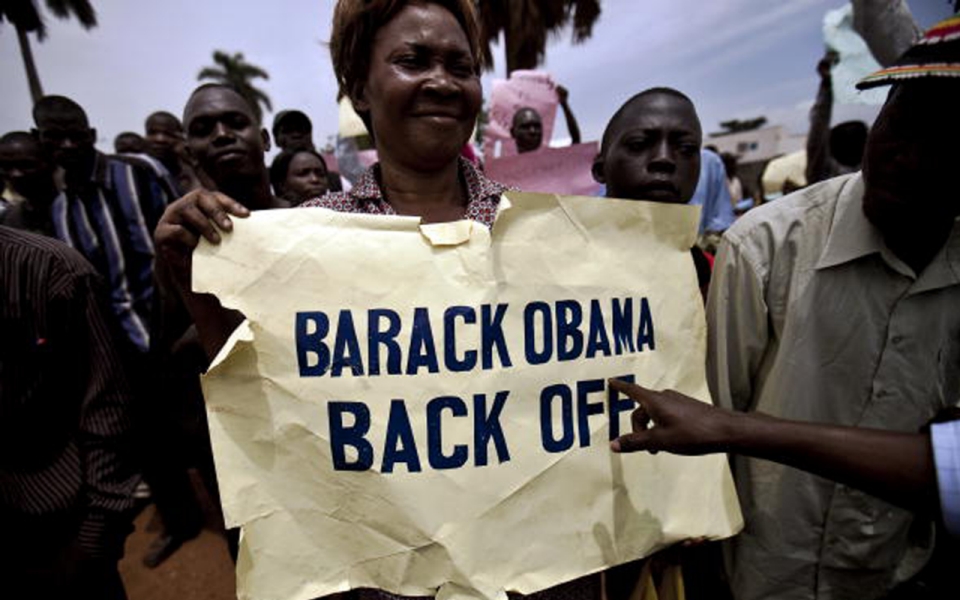
The response of the Obama administration could not come sooner, as many have criticized Obama for his slow response on this issue. But as Uganda’s anti-gay law continues to gain traction, most recently with a court decision solidifying the government’s power to crack down on LGBT and other civil society organizations that promote homosexuality, the question remains: will these actions be effective? While the White House blog post makes it clear it will not be stopping humanitarian aid to Uganda (simply redirecting it through organizations not affiliated with the government), the Ugandan government maintains that this will only hurt the “the most vulnerable people that the US government purports to support and aims to protect.”
Echoing Sam Kutesa’s message of collaboration in his acceptance speech, Uganda’s foreign affairs ministry maintained that relations would not be harmed, as “there are more areas of cooperation between the Uganda and the US, as the two countries continue to share a lot in common on both regional and international issues.”
Uganda continues to prompt the question of what must be sacrificed in the name of international governance. Will the actions being taken by the Obama Administration have any effect on Uganda’s government officials, or will they only hurt those they are trying to protect? Will Uganda remain amicable regarding “areas of cooperation,” with the US? Most importantly, can intervention be effective without the support of the international community? While the US certainly holds a larger amount of influence than most countries, there is still much room for Uganda to survive without it, particulalry if government officials are not bearing the burden of the cuts to US aid. Without a coordinated, unified response from the international community, can Uganda’s anti-human rights agenda be stopped?