
Originally published on the CGS blog on July 7, 2014.
The international media has a tendency to focus on the news stories that will garner the greatest attention from a given audience. Events such as the ISIS declaration of a caliphate in parts of Iraq and Syria and the ongoing World Cup in Brazil have taken up headlines within recent weeks and are likely to stay in that spot. So what happens to the stories that go unnoticed?
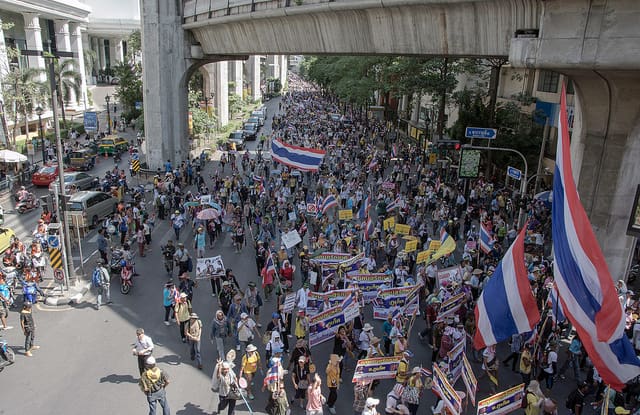
One example of a story that has flown under the radar in recent weeks is the situation in Thailand. On May 22nd the Thai military led a coup after mounting protests against the elected government over accusations of corruption and factional violence. Following the military takeover the international community diverted attention from the issue, afraid of what effects the move could have upon the region and even the world.
Fast-forward six weeks and the military is still in power. The constitution has been thrown out and just recently the military leaders declared a drastic overhaul of the electoral system before the planned October 2015 elections. Nearly 20,000 Cambodians are just now returning to the country for work after fleeing the state due to the increasing tensions between the military leaders and supporters of the former regime. Humans Rights Watch is raising questions as to the whereabouts of disappeared political activists following the coup.
In wake of all these events, one may ask what the international community is doing about the situation in Thailand. The answer: largely nothing. US Ambassador to Thailand Kristie Kenney recently stated that Thailand has been uninvited to the Rim of the Pacific Exercise (RIMPAC), but aside from that has failed to address the issue. The United Nations has taken no action against the coup and has simply suggested that both sides in the conflict work to resolve the issue.
The current situation in Thailand portrays the world’s tendency to overlook what may be deemed as smaller issues in order to focus on more pressing matters. While this may help with quelling immediate threats, it also risks the further escalation of these “small problems.” In the case of Thailand, the threat of escalation is very real.
While the government coup was led by the Thai military, the stability of the regime is still very much at risk. Divisions within the military between those that opposed the old government and those that supported the former prime minster are tearing the leadership at the seams.
Overlooking the Thai coup can also lead to the growth of preexisting problems. Earlier this year Thailand was downgraded to tier three on the US State Department’s 2014 Trafficking in Persons Report. With an unresponsive government in place, the issue of human trafficking in Thailand along with other problems the country faces could go unaddressed and lead to the continued suffering of hundreds of thousands.
As globalization continues to occur, it is important to understand the interconnectedness of all countries and people. Events such as the coup in Thailand cannot be taken for granted and must be acknowledged by the global community. Failing to address international problems and allowing them to escalate risks the stability of the global order and the rights of all individuals involved.


