by Carolyn Blake | Feb 6, 2012 | Global Cooperation, News, Peace & Disarmament
The House Foreign Affairs Committee held a hearing on Iran entitled “Ahmadinejad’s Tour of Tyrants and Iran’s Agenda in the Western Hemisphere” last Thursday. The consensus of the committee was that Iran’s presence in Latin America is too close for comfort. The “Tour of Tyrants,” which spanned Venezuela, Nicaragua, Ecuador, and Cuba, raised questions as to what intentions Iran has for Latin America. Ahmadinejad continues to attempt to reach out to these counties, even recently releasing an Iranian Spanish channel.
Some committee members see Iran’s interest in Latin America as an attempt to gain new ground for plots against the United States. The recent Iranian car bomb assassination attempt of the Saudi Arabian Ambassador to the United States was seen as further evidence that an Iranian attack on U.S. soil is not a stretch of the imagination. In a letter to the Secretary-General of the United Nations, Iran denied any responsibility for this assassination attempt.
The real question is: what do these Latin American countries hope to gain from Iran? Representative Eliot Engel believes that these countries are looking for financial aid from Iran. While this may be true, Iran has not been delivering on its promises of aid. When questioning the intentions of Venezuela, Representative Berman quoted President Obama in saying “it is up to the Venezuelan people to determine what they gain from a relationship with a country that violates universal human rights and is isolated from much of the world.” Other countries in Latin America have turned their backs on the Iranian regime, including Brazil. With the looming threat of a nuclear Iran, it will be important to keep a close watch on the dealings of this country in the Western Hemisphere.
by Julia Strasser | Jan 31, 2012 | Global Cooperation
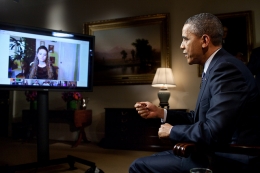
Monday night President Obama participated in the first Presidential virtual interview ever! This Google+ Hangout event was part of the White House’s continued public outreach following the State of the Union Address last Tuesday. Since the president’s address last week, the White House has been requesting that people send in questions via all forms of social media, and has been holding Twitter interviews with many of the senior administration officials. This Hangout was the culmination of that week, and it turned out to be a great moment for foreign policy!
Steve Grove moderated the discussion from Google Headquarters in San Francisco, California, and there were five different people on Google+ in the virtual “room,” with the President, who were able to speak out at any time. The event was broadcast on YouTube and the White House website so those of us who haven’t stepped into the social media realm of Google+ yet could still hear questions asked and answered. You can watch the recording here. Mr. Grove also had some pre-recorded questions that had been sent in via YouTube either by video or comment earlier in the week.
The Hangout began with questions on the economy and jobs. But foreign policy did make its way into the discussion pretty early – and President Obama defended international affairs funding! He was asked by a homeless veteran why we sent so much money abroad to countries like Pakistan that are known to give money to terrorism when there are so many problems here. President Obama said that “aside from it being the right thing to do, it’s also important to make sure this is part of our overall security strategy,” and went on to point out that all international affairs funding is only 1% of our national budget. He described it as an investment -a way of saving money by sending aid before a full-blown conflict occurs, which would wind up costing us much more overall. He even tied it into our economy by saying that, “instead of charity we are helping them [countries we give aid to] to develop so someday they will be consuming our goods.” I couldn’t have said it better myself!
The next foreign policy question, however, was less heartening. The President was asked about drone attacks, citing a New York Times article (read the full article here) from earlier in the week on drone attacks in Iraq. The question and article pointed out that he has authorized more drone attacks in his first year than President Bush did in his entire eight years in office. The President responded that the article may have been overblown and that “we’re not engaging in a bunch of drone attacks in Iraq, there is surveillance there.” He went on to correct misconceptions that civilian causalities are high. “Drones have not caused a huge number of civilian causalities,” he said, and the U.S. has been “very careful in how they have been applied.” He described that the drone attacks were able to pinpoint known terrorists, and that they were extremely “targeted and focused.”
So what are the facts of drone attacks? There isn’t really a consensus, partially because the whole process is so secretive. However, the British Bureau of Investigative Journalism, which conducted interviews in Pakistan’s tribal area, concluded that at least 45 civilians were killed in 10 strikes during the last year. There were “between 2,292 and 2,863 people . . . reported to have died in the attacks – most of them militants.” The civilian casualty rate was calculated at somewhere between 13 percent and 34 percent, which is of course a very large range.
Basically no one really knows, or is saying, the exact damage that drone attacks are doing. It is true they are killing many more militants than civilians; however it is idealistic to believe that there have not been any civilian casualties no matter how “targeted and focused,” the attacks are.
The discussion then moved on to education, and even some personal questions. All in all, it was great to hear foreign policy given so much attention (even if every answer wasn’t the one we wanted to hear) and it was cool to be part of a historic event. Although right now the idea of a “virtual hangout,” may seem futuristic and odd, I think there will come a time, not too far off, when all Presidents hold similar interviews. More and more technology is creating new ways for constituents and grassroots advocates to get in touch with their elected officials, and it was exciting to be tuned into the first of many soon-to-come new political technologies! My Dad remembers the first time his family bought a color-TV, maybe one day I’ll be telling my children that I remember the President’s first ever Google+ Hangout.
by Julia Strasser | Jan 25, 2012 | Global Cooperation, World Citizen
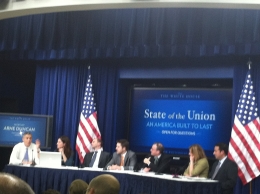
Just six months ago I was not a huge social media user, and never dreamed that Twitter would turn out to be my ticket to the White House. My coworker Julia Bunting and I were invited to watch the State of the Union address at the White House in a room full of advocacy tweeters, and then participated in a live discussion with senior Administration officials afterwards. The live “Tweet-Up” was an amazing experience and I wanted to give you a glimpse of the action.
We had to arrive at White House at 7:45 to allow for enough time to go through security checkpoints. It was an exciting feeling, to be inside a place that is so instrumental in history and current events. We received a mini-tour on the way to the South Court Auditorium, where the Tweet-Up was held. We got to see (from afar) the Vice President’s office, the Situation Room, and the garage that usually holds the motorcade. There was some construction going on inside, which made the whole place feel a bit more normal – even the President has to deal with the hassle of renovations apparently!
We were ushered into the Tweet-Up room, where all the social media reporting was taking place. Check out the pictures of us tweeting and the room set-up. During President Obama’s address, the “enhanced version” of the speech was playing on a large screen, which had statistics and funny graphics to supplement his speech. My favorite visual aid was the Pac-Man styled “maze of job training programs,” that President Obama pledged to get rid of. If you didn’t get a chance to see the enhanced version you can watch it here.
The energy in the room was very high during the address and tweeters were furiously typing away their comments and questions. Immediately after President Obama finished speaking, the lights came on and our room was live on the webcast! If you didn’t get a chance to tune in last night you can watch that webcast here – and look for Julia and me! You can also look back at our tweets from the evening using #SOTU and #WHchat, and let us know what you thought about the speech and Tweet-Up event.
Even though the State of the Union is over, the White House still is engaging with the public on the president’s priorities for this year. The White House will be taking questions via Twitter, Facebook and Goggle+ all week and has a number of live Q&As set up with their staff – check out the full schedule here. Ben Rhodes, Deputy National Security Advisor for Strategic Communications and Speechwriting will be answering your questions on Foreign Policy this Friday at 11 am, so make sure you send in some good ones (@CGS_DC @Whitehouse @WHLive #WHchat). Thank you Twitter for scoring me an invite to an amazing night at the White House!
Look for some more analysis of the State of the Union and the Tweet-Up on Julia B.’s blog.
by Julia Bunting | Jan 20, 2012 | Global Cooperation, News, United Nations
The United States Mission to the United Nations has issued a statement today that lays out how America plans to lead on U.N. reform in 2012. While the global community has long called for such reform, the statement details some progress that the U.S. has already made, reforming the U.N. budget for only the second time in 50 years, saving American taxpayers $100 million. The U.S. has also pushed for increased transparency, especially promoting public disclosure online of all internal audit reports starting in 2012.
The statement outlines how the U.S. Mission believes the U.N. can move forward on further reforms to make the U.N. more effective and efficient. They suggest several recommendations, including steps to make the U.N. more cost-effective, reduce administrative bureaucracy while increasing accountability, address issues of corruption and unfairness, and increase overall efficiency throughout the U.N. system.
The statement underlines the importance of a strong U.N. to global peace and prosperity. It affirms, “The United States has led at the U.N. since its creation because a strong, effective U.N. is among the best tools we have to tackle the world’s most pressing challenges.” Providing food and medicine to the world’s neediest, monitoring and protecting human rights and deploying humanitarian aid following natural disasters are just a small sample of the critical work of the U.N. Strengthening and reforming the institution will hopefully help us to better cooperate and collaborate on these critical global issues. Stay tuned for my blog on Monday with additional in-depth analysis.
by Julia Strasser | Dec 22, 2011 | Global Cooperation, Peace & Disarmament
GlobalSolutions.org Field Organizer in Indiana, Mike Oles, just had a letter to the editor published in the Indianapolis Star! It’s a great piece that points out that Haiti’s Cholera outbreak is not a reason to defund the U.N., but rather why U.N. Peacekeepers need to be better equipped.
Mike writes, “If there is a lesson to be learned from this avoidable disaster, it is the need for well-trained and well-funded U.N. peacekeepers.” Well said Mike. U.N. Peacekeepers are vital to many countries around the world, and they can’t do their job if they aren’t supported by wealthy nations like the U.S.
Click here to read Mike’s whole article.
by Melissa Kaplan | Dec 19, 2011 | Global Cooperation, News, United Nations
In my job, it’s not that often that I look at the results of the congressional appropriations process with satisfaction, especially in the current economic and foreign policy climate. However, Congress has surprised me this year in two welcome ways.
First, the House and Senate passed a large “omnibus” appropriations package, including funding for the State Department, before their Christmas recess without threat of a government shutdown (okay, it’s two and a half months past their original deadline, but why quibble?). Second, the Fiscal Year 2012 budget mostly delivers pretty good results for the international affairs budget. It’s a Christmas/Hanukkah/Kwanzaa miracle!
The final results of the huge appropriations package, which combine funding for departments from nine separate appropriations bills, were about as good as could be hoped for in the current economic and political environment on Capitol Hill. The legislation provided about $1.45 billion for the Contributions to International Organizations (CIO) budget account, which pays our dues to international organizations such as the U.N. and NATO, with about $100 million extra designated for a related account, bringing the total level up to about $1.55 billion. This amount is technically below the level needed to keep the U.S. from falling behind into arrears on its U.N. dues; however, since the U.S. will not be funding UNESCO this year due to the Palestinian membership issue, the amount will hopefully be sufficient to keep us out of arrears at the United Nations.
Congress also provided $1.83 billion for the Contributions to International Peacekeeping Activities (CIPA) budget, which funds U.N. peacekeeping missions around the globe. Another $91 million was provided specifically for peacekeeping in Somalia, bringing the total funding level to $1.92 billion. This actually represents an increase from last year’s level (wow!) and meets the President’s budget request. Due to some unforeseen changes since the President made this request last February, more funding will be needed to keep the U.S. out of arrears on peacekeeping dues at the U.N.; but it appears likely the State Department has enough available “credits” to meet its obligations. Fingers crossed….
All in all, given the difficult climate and budgetary constraints that have become an unfortunate reality these days, I think it’s fair to say that Congress delivered pretty well for the international affairs budget this festive season. I wish them, and you, a happy holiday, and look forward to seeing what 2012 will bring.