by Jack Pearce | Jul 24, 2015 | Global Cooperation, Peace & Disarmament
Let’s look at the field positions of the parties in Iran, the United States, and Israel who seem to want to kill the agreement worked out between Iran and the P5+1 coalition.
First, let me address those in the Republican Party and in Israel who have expressed objections to this deal. I suggest that the basic fact is that you have won—a considerable field position—and if you kill the deal, you will lose.
You can assume that your publicly expressed concerns figured into this negotiation. You demanded a tough deal. You got one, and the international community won in these negotiations because the P5+1 had a strong field position and used it. Iran needed its sanctions lifted, so they needed this deal more than we did. And we made them pay for it.
Yes, you did win. Let’s stop the denial. Many Republican and Israeli objectors seem to have a hard time admitting it, but this agreement is thorough enough to make very difficult any Iranian move toward military use of nuclear technologies for 15-25 years. Beyond the controls on specific sites and techniques of uranium enrichment, the deal provides for comprehensive control of the nuclear supply chain and for IAEA monitoring of Iran’s nuclear technology activities—using very sophisticated means now available—for the foreseeable future.
The degree of surveillance built into this arrangement makes it highly likely that any significant move toward nuclear proliferation will be detected. Such a move would also risk international opposition and the loss of the economic benefits Iran clearly wants. Given its recent economic hardships, why would we expect Iran to repeat the grueling experience that forced it into this negotiation in the first place?
Nothing in this world is guaranteed, but now you have a good field position vis-à-vis Iran and nuclear weaponization.
The rest of the world will not necessarily sign up for maintaining thorough sanctions indefinitely just because that’s what the US wants. Nor can we reasonably expect that our allies in this endeavor, or Iran, would support any US attempt to re-do this grueling negotiation at the unilateral behest of our Congress. Other nations have invested a lot of time and attention in this deal. We would be playing a spoiler role. Our representatives would lose leadership capacity in a variety of ways. Iran would, of course, be outraged and feel it is entitled to “go nuclear.”
What was a contained problem breaks entirely out of the box. You would have lost leverage and peaceful options, which you probably could not regain. If all this ends up in another expensive and unpopular war in the Middle East, you know who would be blamed—within the United States, you. Outside the United States, the United States.
Now let’s look at the situation of the objectors in Iran. If those who fear and distrust “the West” somehow were to veto this opening to the greater prosperity and participation which the world has now on offer, they would be setting themselves up for massive disappointment and distrust from their own population.
Over time, this could be a lever for some form of “regime change,” which many in the west have longed for but have not been able to obtain.
Thus, Iran’s hardliners are also in a box. Iran agreed to this negotiation. It is getting sanctions relief out of it. The Iranian objectors could spin their rejection with all the wit and fervor at their disposal. But the Iranian people would know what they could have had and lost. They would know who lost it. They would not forget, and very well might not forgive.
The Iranians know this. They appear prepared to set their parliamentary vote on the agreement to a point after our congress votes. If we turn down the deal, they and their hard liners do not have to take any responsibility one way or the other. They can say they did the very best they could for peace, and the Great Satan screwed it up. The failure of the deal is entirely on our shoulders.
If the Iranians can figure out whom they want to be the villain in this piece, can’t you?
So what do I suggest for the objectors in the United States and Israel? Make all the noise you want about what you see as potential perils ahead, but turn that energy toward assuring the deal is implemented well—and, if you feel you must, hope the objectors in Iran turn it down.
If Iran takes the deal, you have gained much. If Iran is so foolish as to turn it down, here’s what will happen:
- The sanctions will stay in place.
- We will not see any additional limitation on Iran.
- War will remain an option—though an expensive, unpredictable and dangerous one in the area of the largest oil pool in the world.
- Iran will, at least for now, continue to be economically and politically hobbled by its own reactionary leadership.
We don’t know when the next reform wave might come. World oil markets will not have the benefit of Iran’s full potential oil supply, and you will continue to have a bitter enemy in their regime.
If this is the situation you want, here you will have it. But this way the onus would be on Iran.
So these are my suggestions. Posture if you want. But take these wins and avoid these losses.
by Jack Pearce | Jul 22, 2015 | Global Cooperation, Peace & Disarmament
It’s time for us to act like adults.
President Obama and Secretary of State John Kerry have won an agreement, which has capped nuclear enrichment potentials in Iran and removed the current prospect of war, greater sanctions and hardships for Iranians, or both. The agreement has been praised by most arms control experts and welcomed by almost all (with the exception of Israel) political entities in the world that have spoken on it.
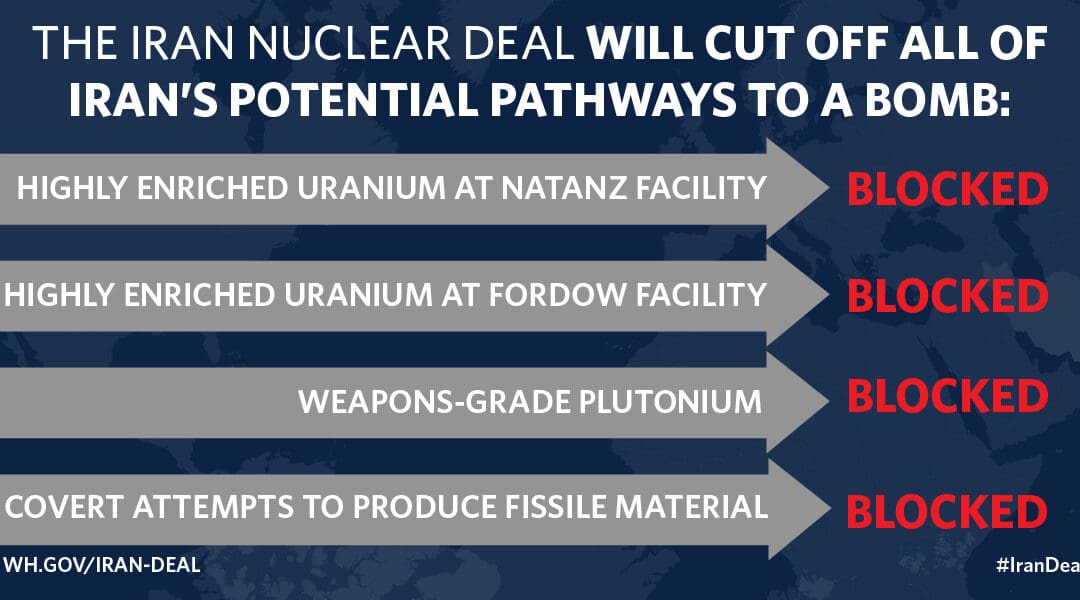
The teams fielded by the P5+1 and the Iranians have crafted a contract which any fair-minded person must concede blocks all visible and probable paths to a nuclear weapon for Iran for eight years and erects substantial, on the ground, deeply entrenched impediments to any Iranian attempt to create nuclear weapons well beyond that point (for example, detailed controls on uranium enrichment and stockpiles for 15 years and IAEA monitoring of all uranium ore concentrate activity for 25 years – see paragraphs 5,7.10.11,12 and 15 of the Joint Comprehensive plan of Action). Also Iran would be subject to the Additional Protocol allowing IAEA investigation of suspicious sites (paragraph 13). Check out this infographic for more detail.
Iranian citizens can now look toward greater engagement with the west in a host of ways and to significantly greater prosperity. Their eagerness to embrace this sort of future is evident. Other countries around the world, including but not limited to the United States, can enjoy greater access to the citizens, markets, resources, and creative capacities of a large nation in an important area.
Reflexive condemnation of this arrangement, notably by members of the Republican Party, is shortsighted. It is about as wise as was the Smoot-Hawley tariff act, passed just before the Great Depression, which triggered a worldwide massive increase in tariffs, depressed international trade, and contributed to the worldwide Great Depression.
Politicians who have roundly condemned the agreement with Iran before reading it carefully and seeing the plain sense of its content have been playing the public fool, and this has been noticed.
This is not the time for an entire political party to oppose an important foreign policy matter based on an short-sighted, belligerent, negotiate-only-with-your-fist approach to the Middle East.
Some who have the integrity and grace to admit that the Joint Comprehensive Plan of Action blocks Iran’s path to nuclear weapons are concerned that Iran would use greater prosperity to support agendas we find troublesome, such as Hezbollah. As President Obama noted, a nuclear-armed Iran is a bigger potential problem than a better-funded Hezbollah.
But the greatest threat to political stability in the area, ISIL, springs not from Iran but directly from the viciously misogynistic doctrines of Wahhabic Islam, based in Saudi Arabia.
Some, such as Saudi Arabia, appear to be concerned that a strengthened Iran would be a tougher competitor for regional primacy. If Saudi Arabia wishes to be an economically stronger entity than Iran, it would do better to focus on improving its education and governance systems. The Saudi rulers tend to hoard oil-based wealth and power and appease their citizens with handouts rather than improve their skills, knowledge and economic productivity. Unlike Iran, they do not even have meaningful elections. Let those who fear greater competition attend to improving their own product.
Israel understandably would like to maintain a nuclear advantage over its neighbors. But the remainder of the world does not seem to think that only one country in the Middle East should be able to have commercial nuclear power. Israel has been able to prevent a state which it sees as an adversary from getting military nuclear power for at least a decade, and probably much longer. That is a significant accomplishment. It cannot expect to dominate the energy options of all its neighbors for its sole interest.
Some fear that allowing Iran to have any significant nuclear energy capability is a bad gamble. This presumes that Iran will prejudice the economic ties and prospects it will gain over a decade and attempt to evade continuing IAEA monitoring. Any future movement toward nuclear weaponization by Iran will, if recent events are any guide, be detected and met with massive and determined resistance.
Some seem to lament that Obama’s recognizing that he must cooperate with other major nations on Iran’s nuclear programs shows “weakness” or betrays a loss of American power. Welcome to the 21st century. Europe embodies about as much economic mass as the United States, India and China have populations three times ours, and Eurasia and the world’s oceans are very large and outside our boundaries. We don’t hold all the marbles.
The position of any responsible politician—or any responsible person—on this agreement should not be about partisan advantage, well funded political backers, ethnic affinities, or some fantasy of unilateral military-based hegemony. This is about a practical arrangement to contain nuclear militarization, de-escalate economic warfare, and improve the economic and cultural opportunities for Iranians and all those who would like to have peaceful economic and cultural relations with them.
It is time for citizens to keep a clear head, and to let their elected representatives know they expect some intellectual integrity and political statesmanship from public officials.
by Rene Wadlow | Jun 22, 2015 | Global Cooperation, World Citizen
Visions of beauty for mankind to see
The Present’s place in the Eternal scheme,
And point which way to turn Life’s undeciding stream.
—”Holyrood,” a 1908 poem by Julian Huxley
Julian Huxley (June 22, 1887 – Feb. 14, 1975) was the founding Director General of the United Nations Educational, Scientific and Cultural Organization (UNESCO). Although he was elected for reasons of geographic balance for only a two-year term (1946-1948), he set in motion a broad intellectual and cultural framework that allowed for future development.
As he wrote,
The fabric of the peaceful co-operative world towards which we are working must be woven of many strands, or it will unravel under strain.
Planning for the creation of UNESCO began in Oxford in 1941 at the initiative of the Council for Education in World Citizenship. The Axis occupation of much of Europe had brought educators, scholars and scientists to England, as well as civil servants who had served in educational ministries. Governments-in-exile were formed, and a Conference of Allied Ministers of Education (CAME) was created at the end of 1942. A leading member of CAME was René Cassin, then serving as National Commissioner for Justice and Education of the Free French Government. Cassin, after the end of the war, became a key participant in writing the Universal Declaration of Human Rights. Many of the educators saw the benefit of war-time cooperation and hoped that such cooperation could be continued for post-war reconstruction.
Among those active in London was Henri Bonnet, who had been the League of Nations Secretariat Director of the International Committee of Intellectual Cooperation. Bonnet was in the US in 1939 and helped to create one of the first global citizen groups—the World Citizens Association. Bonnet brought his League of Nations experience of cooperation among leading intellectuals and served as one of the important founders of UNESCO. Bonnet, as well as the British members of the Council for Education in World Citizenship, insisted on the importance of NGO participation. NGOs have gone on to play an important role in UNESCO’s work.
Julian Huxley was not directly involved in this war-time planning for UNESCO, but as a frequent speaker on science, education and post-war planning on the BBC, his views were well known. Huxley’s essays on post-war reconstruction and the need for cooperation among scientists were collected and published as On Living in a Revolution. Huxley wrote,
We now live in a quite different world. There has been a revolution of thought, both reinforcing and reinforced by the revolution of economic and social fact…From now on we need to think in terms of change. This applies to all the main aspects of life, from central planning to education. Man must become consciously evolutionary, in his individual thinking, in his collective outlook, and in his social machinery.
While Julian Huxley’s writings do not have the spark of his younger brother, the novelist Aldous Huxley, the essays are well written He proposed a vision of a world society as an organic whole within which rights and duties would be balanced deliberately, as they are among the cells of the body.
He had been asked by the government to evaluate education policy and practice in the British African colonies. He had undertaken official field trips to British East Africa in 1929 and again to British West Africa in 1944. Thus in 1945 when plans for UNESCO were largely set, discussions among the government representatives in London turned to the location of the UNESCO headquarters (Paris) and who would be the first Director General (Huxley).
With his wide range of intellectual interests and his vision as a world citizen, Julian Huxley set the groundwork for the many undertakings that have been characteristic of UNESCO, with its emphasis on cooperation in education, science and culture. On leaving UNESCO, Huxley played an important role in the creation of the World Wildlife Fund. He was also a founding member of the International Humanist and Ethical Union, as he felt strongly that the world society had to have some common ethical standards as guidelines.
As his grandfather had been a leading champion of Charles Darwin, Julian Huxley became a champion of the writings of Pierre Teilhard de Chardin. The Jesuit Order of which Teilhard de Chardin was a member had banned the publication of his philosophical writings, which were circulated among a small group of non-Catholic scientists until being published after his death in 1955. Huxley saw in Teilhard a fellow world citizen and one whose philosophy was based on the evolution of both matter and spirit.
by Don Kraus | Jun 19, 2015 | Global Cooperation, World Federation
This article originally appeared in The Huffington Post and is cross-posted with the author’s permission.
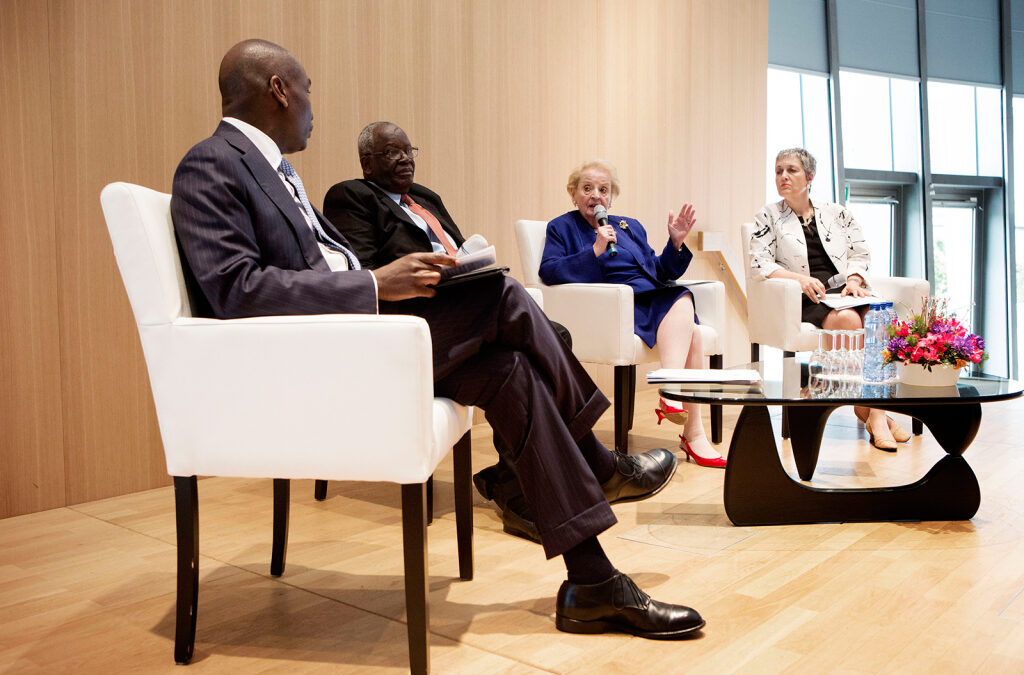
We are in danger of losing the most pressing global security and justice challenges of our times. That’s what motivates a prestigious blue ribbon panel, co-chaired by former U.S. Secretary of State Madeline Albright and Professor Ibrahim Gambari, the former Foreign Minister of Nigeria and UN Under-Secretary-General for Political Affairs.
Fragile or corrupt governments have allowed conflicts to fester and terrorism to run rampant. Climate change is melting ice caps, raising sea-level and changing weather patterns setting off increased conflicts and a rapidly growing population of climate refugees. Internet accelerated globalization has increased our connectivity, but leaves us open to illicit trade, spying and theft.
In response to these threats, the Commission on Global Security, Justice and Governance brought together 14 high level statespersons from around the globe to offer comprehensive recommendations. Their goal is to build an accountable and effective international system that can better safeguard international human rights and promote sustainable peace.
The Commission’s report, Confronting the Crisis of Global Governance, offers a broad menu of recommendations to, according to Secretary Albright, develop “more capable tools of global governance, with different kinds of public, private, and mixed institutions designed for 21st Century challenges.” Co-chair Gambari said at the report’s launch that “much more is needed from the United Nations and, indeed, other global institutions dealing with, for example, security sector reform and the rule of law to economic and social recovery and the promotion of human rights…”
The Commissions’ recommendations include:
- Next-generation UN conflict mediation and peace operations capacity, with a greater proportion of women and increased capacity to deploy civilian, police, and military personnel to meet urgent peacekeeping requirements
- Strengthening the Responsibility to Prevent, Protect, and Rebuild
- Innovate climate governance through more meaningful engagement between government, civil society and business
- A green technology licensing facility within the Green Climate Fund
- Establishing a G20+ within a new framework for global economic cooperation to avert financial shocks and deliver on the Post-2015 Development Agenda
- A global network of cybercrime centers and increase Internet access in the Global South through enhanced capacity-building
- Improving the selection procedure for the next Secretary General with a call for nominations by Member States, parliaments, and civil society organizations, a formal list of selection criteria and a clear timetable for selection
- Expanding UN Security Council membership and nontraditional engagement while restraining the use of the veto
- Creating a UN Peacebuilding Council (to replace a weak Peacebuilding Commission)
- Strengthening the International Court of Justice, International Criminal Court, and the UN Human Rights Council
- A UN Parliamentary Network to “develop a transnational democratic culture”
This is an extremely ambitious report that has been launched in advance of the United Nations’ 70th Anniversary Summit in September. For the last few decades, similar reports have been issued in response to the dramatic global challenges that humanity faces in the 20th and 21st centuries. Our Global Neighborhood was issued in 1995 in conjunction with the UN’s 50th anniversary. In 2004, A more secure world: Our shared responsibility was prepared by then Secretary-General Kofi Annan’s High-level Panel on Threats, Challenges and Change.
While only some of the proposals in these reports came to fruition, each advanced the capacity of an evolving global community to better manage an increasingly interconnected world. For example, the Responsibility to Protect and the Peacebuilding Commission were proposed in Annan’s report. (Confronting the Crisis of Global Governance actually recommends improvements to both of these proposals.)
The authors of this latest report have also learned from their predecessors and have proposed a number of steps to promote the adoption of their recommendations, including marking the UN’s 75th anniversary in 2020 with a “World Conference on Global Institutions,” which would be the culmination of a three-year multilateral negotiation process with every effort made to “engage the voices and ideas of civil society at the most local level, as well as under-represented groups, in the lead-up to the World Conference.”
In the Commission’s “Call to Action” they correctly note that:
In seeking to forge a mutually supportive system of good democratic governance and sustainable peace globally through the intersection of security and justice, just security offers a unique prism for understanding and responding to some of the most pressing global concerns of our time….we must all refuse to accept mediocre solutions that rely on institutions and mindsets from another era. Only when men and women from diverse places and backgrounds rally around a shared, inherent need for security and justice–always felt locally but created at many levels–can these powerful actors be nudged toward what is needed, as well as what is right.
2015 is a year where many global efforts to secure a more livable future are coming to a head. The Sustainable Development Goals will be considered by UN members in September and will shape the future of international development. The UN climate conference, to be held in Paris in December is considered by many to be a make-or-break moment in humanity’s ability to address climate change. Confronting the Crisis of Global Governance should be read, analyzed and acted upon by all who are engaged in these efforts and by all who understand that today’s global challenges–mass violence in fragile states, climate change, and the possibility of devastating cyber attacks initiating global economic shocks–must be addressed by new kinds of tools, networks and institutions.
by Jack Pearce | Jun 15, 2015 | Global Cooperation, World Federation
Over the next 70 years, our children and grandchildren will need to negotiate three major transitions in human civilization. Parts 1 and 2 of this series discussed transitioning to large-scale sustainable energy flows and managing the impact of human civilization on the environment.
This blog addresses the issue of maintaining global governance systems that enable humans to meet these challenges.
It has now been 95 years since the League of Nations was founded after World War I. Its current embodiment, the United Nations, is functioning but has widely recognized limitations. The UN operates in conjunction with the World Bank and the International Monetary fund (often called theBretton Woods institutions). And, of course, there are hosts of bilateral and multilateral treaties which facilitate trade and development.
What needs doing in the next 70 years? Let us address organizational issues and challenges to be managed.
Broadly speaking, the UN needs a better, democratically founded revenue base and development of each of its major functions—in traditional terms, the General Assembly as a legislative body, the Secretariat as an executive body, and judicial bodies like (but not limited to) the International Criminal Court. The challenge can be illustrated by just looking at the UNorganizational chart.
The major practical issue for CGS members is getting the United States into a less imperious mode. The UN can do more only if the US, as a dominant international player, is more willing to cooperate and help lead other nations to agree to international fees or taxation; allow UN bodies greater peacekeeping scope; submit to international judicial bodies like the ICC; agree to treaties that limit our armed forces and arms sales; allow rising nations more say in central functions like theSecurity Council; and the like.
This is not to say we are the most parochial of nations. Every country has axes to grind. We just have a very big axe.
We need to elect Congresspersons and Presidents who have a long view and are willing to shoulder the arduous tasks of negotiating practical arrangements that surrender a bit of autonomy for a more workable world regime—for the global common good.
Substantive challenges include:
In a blog for the International Affairs Forum, I set out someadditional perspectives on necessities for long term success. These include:
- controlling parasitism by elites at both national and international levels,
- maintaining sound and far reaching knowledge systems—facilitated by free international science, other forms of inquiry, speech and debate, and
- maintaining an essential level of continuity in institutions without succumbing to suffocating stagnation.
CGS, allied with other significant civil society organizations like theWorld Federalist Movement, is a window on all this. CGS and others currently are engaged in promoting a United Nations Parliamentary Assembly to increase democratic representation at the UN.
You have an assortment of worthy causes bidding for your attention at all times. Organizations such as these are the essential channels for global citizens to use to shape the future. The foundation of all these possibilities and of solutions to very real problems lies in the global awareness and willingness of citizens like you to help shape the future.
by Jaira Burke | Jun 10, 2015 | Global Cooperation, Human Rights
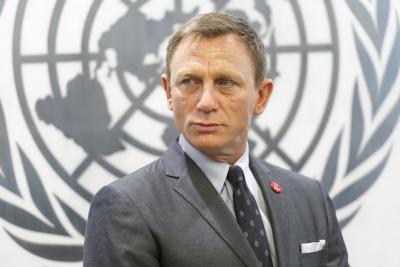
Daniel Craig, most known for his ongoing movie role as James Bond, was recently appointed the first United Nations global advocate for the elimination of mines and explosive hazards. In observance of this appointment and the International Day for Mines Awareness and Assistance in Mine Action, the actor-turned-“advocate” visited the headquarters where UN Secretary-General Ban Ki-moon reportedly commented on the recent appointment, saying, “Along with moviegoers worldwide, I have been on the edge of my seat watching Mr. Craig, as James Bond, defuse ticking time-bombs with seconds to spare.”
While I too clung to my seat at the array of adrenaline rush-worthy stunts performed in the 007 series, I differ from Ki-moon in one way—I am undeniably aware that these stunts are just that: stunts. Explosives in movies versus explosives in real life; there’s a huge difference.
Fame and celebrity status are not prerequisites for advocacy. While I agree that celebrities can easily leverage their popularity to help advocate for special causes, I don’t believe that diffusing mock bombs on the big screen makes you an expert on explosives or the ongoing efforts of the UN to change this very critical threat that actually affects hundreds of thousands of citizens globally.
In the press release issued by the UN regarding this appointment it states, “Mr. Craig’s designation as UN Global Advocate for the Elimination of Mines and Explosive Hazards applies for three years. He narrated two videos for the United Nations Mine Action Service (UNMAS) in 2014, and has been interested in the global campaign to ban landmines and explosive remnants of war for a number of years.”
So maybe I am being a little too critical? Demonstrated experience and knowledge in UNMAS does qualify an individual for the role.
UN celebrity ambassadors span from Emma Watson and her work on the HeForShe campaign to Joel Madden, Salma Hayek, and even Katy Perry; while some celebrities are equipped and have demonstrated commitment to important UN initiatives, others seemingly are given the title with little to no applicable knowledge or experience—what is known as a “vanity title.”
Many students who are passionate about global issues work tirelessly in school, growing deeper and deeper in student loan debt, just to gain an ounce of the knowledge and experience necessary to be considered for a position with the UN. The standards should be the same for celebrities, especially when they are given titles such as “ambassador” and “global advocate.” The role most of these aforementioned “UN Celebrity Ambassadors” serve is closer to that of a spokesperson than the title implies. That said, celebrity endorsements make sense—calling celebrities ambassadors for narrating promotional videos or speaking at an UN fundraising event doesn’t.
By no means am I a “celebrity basher.” Many celebrities have used their fame and wealth for good—serving as philanthropists, volunteering on mission trips, and promoting impactful causes. Angelina Jolie is a great example of just this, working with refugees and notably making over 40 field visits to communities and individuals directly impacted by displacement since 2000.
However, that doesn’t mean that I would vote for Kim Kardashian or Beyoncé for President.
Considering the significant work the UN does, it is paramount that celebrities aren’t just given vanity titles, but actually contribute something.