by Jennifer Welden | Jan 4, 2016 | Climate Justice, Global Cooperation
Last month, 196 countries reached a historic agreement to address climate change. While the agreement does not address everything—such as the affect of climate change on migrants/refugees—it does seek to set strict limits on emissions and to help developing countries create the infrastructure to meet these limits as well.
While there is much to celebrate, there is also room for skepticism. Given the history of UN multilateral agreements, won’t countries just find another way to dodge their commitments? Will the terms of the agreement be enough to curb the effects of climate change? Will rich countries follow through on their promises to poor countries, and how this will affect aid that is typically used for other forms of development?
Though the United States cannot act for everyone, its individual actions can have a big influence on whether these concerns become true in the future. What can we do as citizens to ensure our government supports and builds on the work done in Paris? We must urge our representatives to enact national measures such as providing funds to states to convert dirty industries to renewables; mobilizing American businesses to open new markets for renewable industries and tools around the world; and supporting the development of local, sustainable food markets in poor countries by changing the way we regulate aid.
Let’s make this the one resolution we actually follow through on in the New Year!
by Hiram Helfman | Dec 23, 2015 | Global Cooperation, Peace & Disarmament
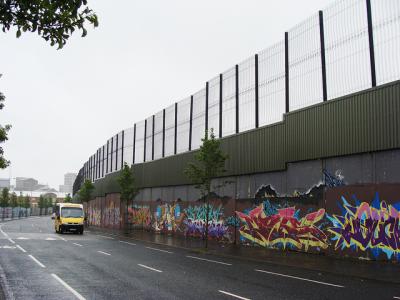
In Northern Ireland, there are barriers known as peace walls separating Irish Catholic and British Protestant neighborhoods from each other. Most of these walls can be found in Belfast, but some were also built in the cities of Londonderry, Lurgan, and Portadown.
They were originally set up during the era known as the Troubles* from the late 1960s to the 1990s, when riots and violent paramilitary activity between Irish Catholics (who wish to join the Republic of Ireland) and British Protestants (who want to stay with the United Kingdom) were rampant.
As peaceful relations between the two national/religious groups continue to evolve and the threat for violence diminishes, the peace walls should come down. They keep Northern Ireland in negative international spotlight, hinder the region’s economic development, and signify one of the world’s longest-lasting conflicts.
The conflict in Northern Ireland that led to these walls being erected has been managed well ever since the Good Friday Agreement of April 10, 1998.** Relations between Irish Catholics and British Protestants are still testy at times, but peace groups have helped young people across the divide establish friendships and engage in peaceful activities together.
There are many views about peace walls inside Northern Ireland. Many residents envision a future without them, but some are concerned that if they’re taken down too fast, wide-scale violence could re-erupt. People living near the walls often consider them important landmarks for remembering loved ones lost during the violence of the Troubles. And some people have lived all their lives around the peace walls and can’t imagine them being brought down, as they fear the violence of the Troubles reoccurring.
Although these walls have managed to reduce the speed at which militants and rioters could cross and cause mayhem in the other group’s neighborhoods, the fact that these walls impede movement has caused extraordinary economic hardship for the areas in which they stand.
Even before peace walls are taken down, economic and social opportunities need to increase for impoverished communities near and around the walls, another issue which several peace groups are addressing. For example, the International Fund for Ireland has sponsored programs to establish small businesses in rundown districts and to remove downtrodden buildings. The Fund has also developed shared park space and has set up peace monuments in places where intercommunity contact happens regularly, such as around certain peace wall sites.
Peace groups and observers from inside and outside of Northern Ireland will also need to continue conducting polls to see over time how peaceful intermingling within young adult populations between Irish Nationalists and British Unionists is taking place. According to this article from the Belfast Telegraph, as of April 2014 about half of the young adult population has been doing so.
And peace groups are still working on turning young people in impoverished areas away from crime and from paramilitary groups, which, although not quite as active as they used to be, are still looking for desperate young people to recruit.
Even if not all the walls are taken down by 2023 as British Officials desire, peace groups in Northern Ireland need to continue working on bringing people from both communities together to engage in peaceful dialogue and activity.
Northern Ireland has to envision a future of peace between all people who call it home, a future where all residents are respected regardless of national or religious identity, and where violence for political objectives is nearly unheard of and condemned. With help from the peace groups, this vision can come true, and with it the removal of the peace walls, economic prosperity for Northern Ireland, and a true end to the conflict.
*For a fuller understanding of the events that led to the current situation in Northern Ireland, please see the following:
http://www.infoplease.com/spot/northireland1.html
http://www.history.co.uk/shows/soldiers-stories/articles/northern-ireland-conflict
**To read the Good Friday Agreement in full, see:
http://news.bbc.co.uk/2/hi/uk_news/northern_ireland/4079267.stm
by Rene Wadlow | Dec 21, 2015 | Global Cooperation, Peace & Disarmament
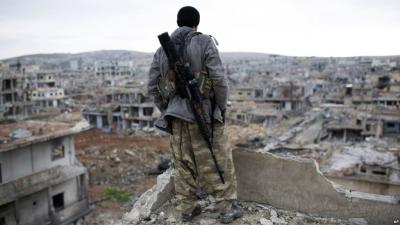
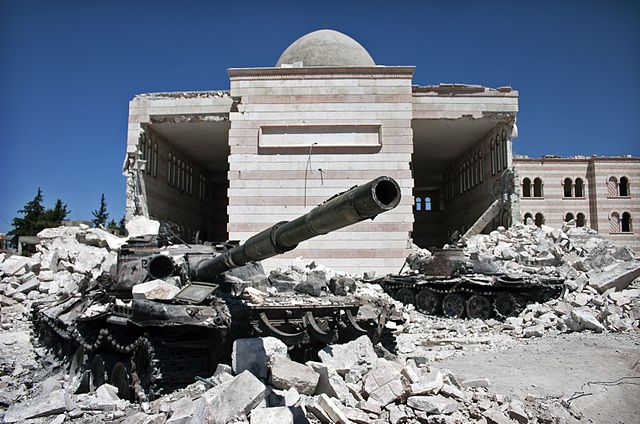
The armed conflict in Iraq and Syria becomes more complex each day, and good faith negotiations seem ever further away. Those of us on the outside who would like to see compromises so that the killing may stop find it difficult, if not impossible, to find those who represent the armed groups. There are, no doubt, people from different intelligence services who have contacts, but good faith negotiations may not be their central aim.
Wisam Elhamoui and Sinan al-Hawat point out in their study “Civilian interaction with armed groups in the Syrian conflict”:
As the Syrian conflict enters its fifth year, it is important not to lose sight of the significant roles played by unarmed, non-state actors to develop structures for promoting local security and peace and to adapt to the constantly changing demands of the conflict. Huge efforts have been invested in maintaining a civilian voice by activists and locals. They have shown courage and resilience and an incredible capacity to sustain their efforts and aspirations despite huge challenges and lack of support.
At the local level, conflict reduction efforts depend on channels of kinship and earlier social relations.
Personal links, such as those deriving from kinship, tribal affiliation, and solidarity between friends and neighbors, play a key role in how communities reach out to armed groups. Whether armed groups and civilians are from the same locality is of particular–often paramount–importance in relation to their interaction, building on existing social capital and encouraging the development of networks for civilians and armed groups to trust each other and work together.
However, as the armed conflict has intensified, many civilian structures have been dismantled. There have been large-scale population displacement and refugee flows. Persons in local leadership positions have been deliberately put in jail, killed and targeted by government or opposition factions.
Personal and competitive agendas can also emerge in conflict contexts, which can undermine social and cultural structures that support community cohesion…The strategic conflict priorities of armed groups can also reduce the influence of personal relations. Where militants possess the upper hand militarily, personal links are superseded in favor of military necessity.
New fighters from different countries have joined government or opposition factions. They have no local or kinship ties and have little or no individual decision-making ability. While at the start of the conflict there were locally negotiated ceasefires, such local initiatives based on local needs and conditions have largely disappeared.
Inevitably, armed groups that have adopted an Islamist ideology are less accountable to the community. An activist from Yarmouk quoted a response he was offered from a local armed group: ‘Our role is to raise the word of God. This is more important than human life.’ Activists that do not conform to the views of Islamist armed groups, such as those who are openly secularist, pro-freedom or pro-democracy, have also been forced to flee.
It is certain that insider mediators can play a key role in informal peace processes if they have “space” for action. Local populations are not just passive actors coerced by armed actors. Yet the violent tactics of armed groups can overwhelm and silence voices for peace. The capacity of conflict to disrupt the social fabric can also allow for new or previously muted social, cultural and political voices to come to the forefront.
It is up to us on the outside to be sensitive to new voices and innovations. For the moment, military options seem to be “the order of the day.” Therefore we must work for formal negotiations among governments with interests in the conflict and with the major armed factions.
However, we must also be sensitive to new voices, some of which call for nonviolence and reason. These new voices may yet be soft, but they will be potentially important currents for the future.
by Rene Wadlow | Dec 15, 2015 | Climate Justice, Global Cooperation
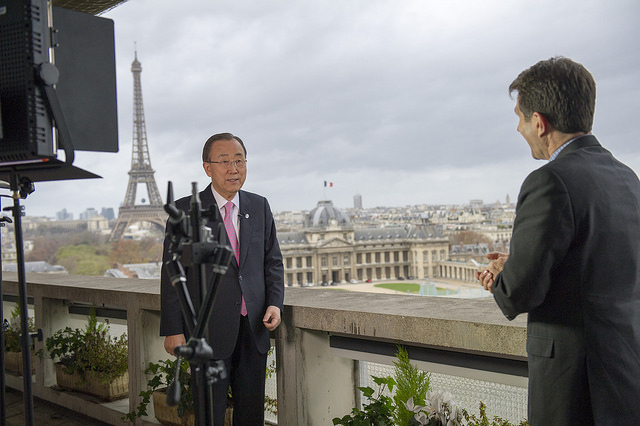
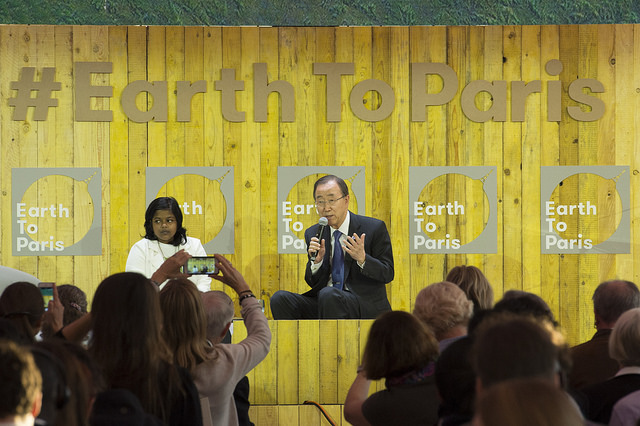
The Paris climate summit known as COP21 came to an end on Saturday afternoon, December 12, 2015. This was a day later than originally planned to allow for last-minute compromises and an agreement with a few States, mainly Saudi Arabia and Venezuela, so that they would not block a consensus agreement.
All 195 States plus the European Union had to agree. A treaty is not something that can be created by a majority vote as can be done in a UN General Assembly resolution. On April 22, 2016, there will be a high-level signature ceremony. The Treaty must be ratified by 55 States and will come into force in 2020.
The treaty arising from COP21 will replace the Kyoto Protocol. The new treaty is relatively short and clear. However, it is the “Preamble” of 140 paragraphs–not legally binding but where all the analysis and aims are set out–that caused difficulties to reach consensus among States with diverse interpretations of “national interest,” of short- and longer-term perspectives, and of differing access to national expertise.
The preamble has been under negotiations for the past two years. Although most points had been agreed upon well before the Paris conference, some crucial aspects had to be negotiated during the two-week session among heads of government and teams of negotiators, often with a Foreign Minister present.
Although it was decided that there would be no mention of migration-refugee flows–refugees of neither climate damage nor terrorism–the November terrorist shootings in Paris required very tight security from the French police outside the conference center and from UN guards inside the building.
Fear was a widespread emotion reflected in the first round of December 6 voting to the French regional assemblies. The National Front, a far-right xenophobic party, received a larger-than-usual number of votes. Fortunately, in the second round of voting on December 13, the National Front was defeated and will lead no regional assembly. Although delegates to UN meetings come with instructions from their government, all feel the atmosphere of the place in which they are meeting.
The Paris agreement can be an important step toward a sustainable world society, especially when seen in the framework of the post-2015 Sustainable Development Goals recently agreed upon by these same States. The effectiveness of the steps toward transformation will depend significantly upon non-governmental efforts at the local and national level.
As could be expected, the agreement is a framework for “country-driven strategies”–not a UN-imposed plan of action. “Common but differentiated responsibilities” is the key concept, with “differentiated” being the key word. The emphasis is on “nationally-determined contributions.” However, after 2020, this “pledge” aspect will have an international review mechanism to see to what extent the national pledges have been met and if the world situation requires new measures.
An important aspect of this review process is the emphasis on transparency so there can be adequate monitoring and verification of emission reductions. This emphasis on transparency and public access to information gives legitimacy to strong NGO monitoring of climate change processes and proposals for improvements. In addition, the Paris preamble recognizes that there are many stakeholders in climate change issues beyond governments: the corporate sector, cities, and academic institutions all have important parts to play.
More than in the past, attention was placed on ecosystems rather than on just one factor at a time, such as forests and the dangers of deforestation. An ecosystem approach requires looking at forests, soil and water protection, housing, transportation, technology and capacity-building for those working on climate and environmental issues.
COP21 has been important for building awareness and encouraging cooperation among UN agencies, national governments and NGOs. Our role as NGO representatives is to build on this positive momentum, to increase our expertise and to network more closely with groups in the most vulnerable zones. Paris was an example of dedication and foresight among all the actors. The road ahead to a sustainable world society with green technology may still be long, but the direction is set.
by Jack Pearce | Dec 11, 2015 | Global Cooperation, Peace & Disarmament
Citizens for Global Solutions addresses a diverse set of global needs. Each deserves attention. But two difficult problems signal possibly severe ruptures to international trade, security, and economic well-being. Both are in the Middle East.
One is the possibility that nation-state jockeying for position in the resolution of the Syria crisis will get out of control and lead to broad physical and economic confrontations.
The other is that the combination of despotic, repressive family rule and archaic, backward-looking Wahhabi Islam in Saudi Arabia may lead to continuous civil unrest in Europe and beyond, as well as a severe disruption of oil supplies from the Persian Gulf region with massive economic consequences worldwide.
Solutions to these challenges are hard to find. This post is not intended to spur rash or emotional action among concerned citizens. But awareness and some attempt at constructive orientation are needed.
This post will deal with the Syrian situation. A follow-up post will address Saudi Arabia.
By recent count, over 230 warplanes from five nations are assigned to Syria. The United States accounts for about 150 of them. Russia has aircraft in the area and has launched cruise missiles from the Caspian Sea. A melange of armed forces backed by various sources divide and devastate Syria.
Syria’s economy has deteriorated badly, as Chatham House has well documented . The nation has lost control of rich agricultural areas and a large portion of its petroleum production facilities. Thus, the energy bases for economic and social performance have been greatly diminished. A recent World Bank report suggests that Syria’s gross domestic economic production has plummeted in recent years, and the government has meager international reserves.
The same report states,
As of September, 2015, 4 million Syrians have registered as refugees with the UNHCR, and are mostly hosted in Syria’s neighboring countries, Iraq, Jordan, Lebanon, Turkey, but also in Egypt and, increasingly, in European countries. More than 12.2 million people in Syria are in need of humanitarian aid, including 5.6 million children (UNOCHA, Syrian Center for Policy Research-SCPR).
It’s plausible that rivalries among other countries, including the United States, have wittingly or unwittingly contributed to the current breakdown in Syria. The authors of a 2014 Foreign Affairs article suggest that “Syria has become a dividing line among rival powers—a twenty-first-century iron curtain of sorts.” This perspective is subject to the interpretation that the “Western” steadfast rejection of Assad has to do not only with that Assad’s bloodthirsty reaction to political challenge, but also with his economic and military alignment with Russia, Iran and China.
Overall, it seems fair to say that the combination of drought, local citizen disenfranchisement and abuse, civil war, ISIL, and Western economic sanctions is what has pushed Syria nearly to the brink of state disintegration. At this time, Syria is economically valuable to just about no other nation. At the same time, ISIL is a menace to all.
The net economic and humanitarian result of this history seems to underlie the current degree of coordination between external State actors, including both Russia and the United States. This suggests the possibility of setting up a political reorganization of Syria through international concord, leading to workable domestic concord over several months or years. The United Nations appears to be playing a constructive role in this process.
But at this time, negotiations are poorly coordinated and the parties at the tables continue to vigorously pursue separate and often opposing objectives, with abundant weapons of regional destruction active in the theatre. This obviously is a classic tinderbox situation. A regional tragedy for over 20 million humans could become a broader confrontation, harmful to economic systems and human welfare on a broader and perhaps global scale.
How do we reconcile these competing objectives? First let us look at our own orientations.
Some counsel support of a “Sunni bloc” against the Shia Muslims, Iran, and Russia. Many seem to imply that in a Russian/Western shoving match, we should further isolate and marginalize Russia.
However, from a global standpoint, it is more important for there to be normal and productive economic and social activity in and near Syria than for any of these State actors to gain advantage over the others. A functional Syria without a hostile agenda toward any of its neighbors should not threaten any of them. Such a functional Syria with adequate agricultural production, petroleum production, banks, utilities, and medical and educational systems could engage in productive economic and social interaction with nearby and global entities—Saudi Arabia, Lebanon, Iran, Russia, Turkey, Europe, the United States, etc.
We know we can expect Russia to continue to seek its own advantage, sometimes aggressively. That is a constant, and Russia’s geopolitical position cannot be ignored. It is highly unlikely that any reintegration of Syria is possible without Russia maintaining its base on the Mediterranean. Given the history of the area, it would probably not be feasible to reconstruct Syria without Iran and Russia having the opportunity to engage in mutually beneficial (though not exclusive) economic arrangements with the population of the reconstructed Syrian State. But these things are not inconsistent with a free standing and a functional Syria. Indeed, they would be implicit in its circumstances.
CGS Senior Fellow Don Kraus’ suggestion that an international trusteeship for Syria during the rebuilding period under United Nations auspices deserves, this author suggests, widespread and receptive attention. Such an arrangement would be a rare and substantial departure from current international practice. It would require a massive organizational effort. Perhaps only a region-threatening breakdown of current international efforts could force action in this direction. But if it could be managed, this could provide structure for a necessary long-term program to restore Syria to stability. Even if a formal trusteeship were not managed, the objectives on which such an arrangement would be focused are the objectives to be addressed in any reconstruction program for Syria. I have articulated such objectives in a recent post.
Citizens of the United States should be advising our government to defuse the tense military standoffs among “partners” in the area and to work toward reconstructing a Syria that is unaligned to sectarian identities or to political blocs in the area or in the world as a whole. In other words, Syrians should own Syria.
by CGS Blog Archive | Dec 11, 2015 | Global Cooperation, World Federation
Greetings from Washington, DC!
As the new Executive Director of Citizens for Global Solutions, I am very excited to be able to tell you about the opportunities opening up for us to advance our organization’s goals. With 22 years of affiliation with CGS, first as Executive Director of the Pittsburgh Chapter, then a stint as the national office Development Director followed by many years as a board member and chair, I felt it was time for me to make the commitment to help guide us into a very new environment for developing stronger institutions of global governance.
Now, follow along with me on this journey as we pass through the wilderness of our chaotic globe, come to new clearings in the forest where the light shines brightly and we renew our energies:
In the first clearing, we find two sparkling jewels nestled in the flowers and grasses, pick them up and discover Citizens for Global Solutions’ new vision and mission statements:
Vision: A democratically governed world. (How cool would that be?)
Mission: To build political will in the United States for international cooperation and democratic global institutions that establish peace, justice and sustainability under the rule of law. (We can do this! You have the power. We will help you.)
Feeling elated, we charge back into the forest, but then hear the footsteps of dark mega-forces heading our way and we wonder “Are we alone in this quest?” Just then another clearing appears and we leap forward to escape the dark forces and on a tree stump find a book entitled: “Confronting the Crisis of Global Governance.”
We regain hope that there are allies afoot when we see it is a report of the Commission on Global Security, Justice and Governance. We are not alone after all!
Indeed, Citizens for Global Solutions has forged a relationship with this Commission* in order to pursue some of our long-held goals, such as making the UN a more democratically-governed institution, strengthening UN Peacekeeping capabilities and many others. More details on our programmatic path forward will be coming out soon.
To see how the story of working our way through the wilderness ends, you’ll have join us on this exciting journey, as it is a work-in-progress and you are an essential part of our organization.
Will you help us create a global coalition in support of a 2020 World Conference on Global Institutions where these UN reform recommendations can gain formal acceptance and go into effect?
Will you help us build political will in the US to support establishment of a UN Parliamentary Network?
We can do this. Together.
Earl James
*Co-Chairs: Madeleine Albright (former US Secretary of State) and Ibrahim Gambari (former Nigerian Foreign Minister and UN Under-Secretary for General Political Affairs).