by Jennifer Welden | Jul 30, 2014 | Climate Justice, Global Justice
Carlos Pascual, the Special Envoy and Coordinator for International Energy Affairs for the State Department, spoke last week on the new geopolitics of energy and what challenges and opportunities this presents for the future. Most notably, he emphasized the need to consider the developing world moving forward, creating policies that are based on an understanding of finance and that foster transparency.
Today, 1.2. billion people do not have access to electricity and 2.8 billion rely on wood or other biomass to cook and heat their homes. To address this, the UN has put forth its Sustainable Energy for All initiative, which seeks to ensure universal access to modern energy services, double the global rate of improvement in energy efficiency, and double the share of renewable energy in the global energy mix by 2030. This is a daunting set of goals; the World Bank estimates that to increase global renewable energy consumption from 13% to 30% or more by 2050 would require an additional “17,000 wind turbines, 215m square meters of solar panels, and 80 solar power plants every year for the next 40 years.”
Meeting the demand for renewable energy, therefore, requires that the cost of this energy decrease. While this can be done partly through investment, it must also be done by reducing the financial barriers placed on this technology. As Peter Brun of the Guardian notes:
Trade in sustainable energy goods and services is currently distorted by tariffs, subsidies, and complicated and conflicting standards – all of which make the products more expensive for consumers.
Even developing countries impose import tariffs, which, combined with high capital costs and the low incomes of many residents, make purchasing and maintaining renewable energy almost impossible.
At times it seems as though the biggest barriers to development are developing countries themselves, as there is, along with the financial challenges, rampant corruption. As Pascual pointed out in his speech, the amount of capital that leaves Africa due to corruption is greater than aid it receives. In fact, many private businesses provide corrupt officials the means to launder large amounts of money. These corrupt deals can have significant impacts on a poor country’s development; through five suspicious mining deals, the Democratic Republic of the Congo lost an amount equivalent to their total health and education budget. This also hurts developed countries, as it renders their aid ineffective and cripples their own ability to invest in renewable energy at home and abroad.
But even if a country is able to overcome trade policies and corruption, the issue of long-term financing still remains. Even developed countries with strong infrastructures are struggling to transition to renewable energy: Germany’s $412 billion Energiewende green energy agenda has resulted in a net increase in costs to consumers and other stakeholders. Consumers have seen a major spike in energy bills, leading many to call electricity a “luxury good.” Will it be possible then to create renewable energy solutions that residents of developing countries can utilize long-term?
Fortunately, renewable energy technologies continue to be invented and improved each day, suggesting that it is possible to bring renewable energy to the developing world. For example, the Waka Waka solar light offers an alternative to the kerosine lamp, providing 80 hours of light after one day of charge. Unfortunately, most of these products have limited funding; they rely on crowdfunding and Kickstarter campaigns to expand production, once again emphasizing the important financial barriers still in place.
Just as Carlos Pascual stressed in his speech last week, transparency and financial incentives are key to spreading renewable energy worldwide. Part of this will come with time: as technologies become more efficient and cheaper to manufacture, they will become more widespread. But part of this must come from policy: we need policies that demand transparency and eliminate the financial barriers (such as tariffs) that make this technology so expensive in the first place.
As we work to create a sustainable world, we must not forget those who do not yet have a developed world. Only then can we reach a truly global solution.
by CGS Blog Archive | Jul 28, 2014 | Climate Justice, Global Cooperation
The United States and the global community currently face a variety of challenges, and it is becoming increasingly clear that no one actor is capable of solving all of our global problems. In particular, issues related to the environment need to be resolved collectively, since many environmental concerns do not respect borders or sovereignty.
These issues range from the preservation of biodiversity to the maintenance of clean watercourses. Many natural resources are labeled as common-pool resources, since single proprietary ownership is not possible and many different groups of people are able to use the same resource simultaneously.1
These resources often face collective action problems due to actors’ inability to work together for a common purpose due to self-interest. Moreover, there are also free-rider issues; it is difficult to force all actors to follow actions beneficial to the group if they can receive benefits without doing so.2 This issue is often conceptualized as the tragedy of the commons, which is defined as “the degradation of the environment to be expected whenever many individuals use a scarce resource in common.”3
However, these results are not inevitable and can be avoided with effective governance strategies. These strategies need to incorporate the wide variety of actors that use the same resources, and in cases of transnational resources (such as trans-boundary river basins), it is important to coordinate actions between state actors.
Additionally, since the type of actors participating in the international system has proliferated beyond states, it is essential to incorporate non-state actors like nongovernmental organizations and multinational corporations. The scales of governance related to these different resources can also vary from local to international, and as a result, connecting these different scales is necessary to maintain effective strategies that hold the different users and uses of a resource accountable.
International regimes can also be useful in resolving issues related to the environment. Krasner defines regimes as “sets of implicit or explicit principles, norms, rules, and decision-making procedures around which actor expectations converge in a given issue-area of international relations.”4 Regimes can also help promote cooperation, which is needed in order to guarantee effective governance and management strategies.
The United States, as a global leader, has a responsibility to promote good environmental governance.
Within the United States, there are nongovernmental organizations that work to connect local, state, and federal actors. The United States has also entered into partnerships with its neighboring countries, particularly Canada. The International Joint Commission, for instance, is a body dedicated to the management of trans-boundary watercourses shared between Canada and the United States, and works to promote cooperation and limit conflict between the two nations.
Governmental bodies, such as the Environmental Protection Agency, also work globally with organizations and other states to promote sustainable development and limit the impact of pollution. However, there is a need for greater cooperation between the United States and other state and non-state actors related to the environment. For instance, the United States should sign international agreements related to limiting carbon emissions in order to legitimize them and demonstrate to the international community our commitment to limiting the effects of climate change.
The United States, along with other international organizations and states, should work with other states (especially developing ones) to help them form effective governance strategies for their common-pool resources. By demonstrating our commitment to environmental issues and helping other states to establish effective governance, the United States will truly become a global leader in the realm of effective environmental governance.
There are a variety of environmental issues that our global community faces. Unilateral action is not enough to solve them, especially the ones that are transnational. Through effective governance and cooperation, we can address these issues, mitigate potential problems in the future, and guarantee that our global habitat is safe for future generations.
1 Elinor Ostrom. Governing the Commons: The Evolution of Institutions for Collective Action. (Cambridge: Cambridge University Press, 1990).
2 Mancur L. Olson. The Logic of Collective Action. (Cambridge: Harvard University Press, 1965).
3 Ostrom, 2.
4 Stephen D. Krasner (Ed.). International Regimes. (Ithaca: Cornell University Press, 1983), 2.
by Jennifer Welden | Jul 23, 2014 | Climate Justice, World Citizen
Selfies, hashtags, and Priuses (or is it Prii?). What do these 3 things have in common? They all have been or still are trends.
Growing up in the Bay Area, I’ve seen first hand how going green – biking, composting, recycling, etc. – can be just as trendy as crop tops and iPhones. Now as a student at UC Berkeley, I’ve also seen the growing demand for organic food and fair-traded products, among other things; many people flock to buy these products though they remain relatively expensive. But are these products trendy because they are expensive or are they expensive because they are trendy?
It should be noted that the main reason these products remain so expensive is their quality. Organic food costs more to produce and fairly traded products pay local farmers a higher fee, which is then passed on to the consumer. That being said, there are also examples of inflation, such as when Whole Foods artificially inflated prices for a wide variety of items.
While many people choose to buy organic, fair trade, and other green products for the obvious environmental, health, and social reasons, the less stated truth is that many people also do it to look good. Social justice is itself a trend – just look at the rise of “sadvertising.” A study by Iman Naderi and David Stratton of Fairfield University in Connecticut found that narcissists tend to buy green products when they see it as beneficial to their image. For example, narcissists were more likely to buy a green laptop than a green desktop because the green laptop is “visible to their audience.” Moreover, they found that narcissists were also more likely to invest in a green product if it was more expensive than the regular alternative:
And the more expensive the backpack, the stronger the signal you can send that they’re doing something socially desirable. So there are three rules if you want to sell pro-green stuff to [a] narcissist. Sell the products in public. Make sure the products can be used in public. And make sure you mark up the price.
It seems the answer to the question, then, is that it’s probably a little bit of both. Sustainable products are initially more expensive because of the cost of production, but prices may be artificially inflated to capitalize on hype.
Though this trend of sustainability is a good thing, it’s plausible that high prices could keep many Americans from taking part. Is it possible to live sustainably without necessarily buying organic, fair trade, and/or other green products? It is, and in fact many of the necessary changes can take place without changing where you shop or how much you spend.
Affordable sustainability is possible in our favorite fast food restaurants. Dunkin’ Donuts recently announced its goal to use only 100% sustainable palm oil in making its donuts. Harvested mainly in Asia, palm oil production is a source of serious deforestation in Malaysia and Indonesia, threatening wildlife and leading to the release of carbon into the atmosphere. While it will be hard to lessen the use of palm oil – which appears in many things, from Oreos to laundry detergent – trying to find sustainable alternatives is a way to start. Moreover, making sustainable changes like this in products that are more financially accessible to a wide array of people will garner the biggest impact.
For those interested in fair trade, Starbucks has committed itself to selling fair-trade coffee; while this may not save many people money, it is saving socially conscious consumers from a change in routine.
The most important change, however, has nothing to do with which products we buy–whether fast food, organic, or fair trade–but how we utilize them. Food waste not only has an effect on climate change, but also on hunger. With the US, China and India collectively throwing out enough food each year to feed over 400 million people, about a third of all food grown around the world never getting eaten, and Americans alone wasting up to about 1,200 calories per person each day, many are pushing for more efficient consumption and disposal around the world.
In France, the grocery chain Intermarché started a campaign called “les fruits et legumes moches,” or “the inglorious fruits and vegetables.” Food waste is partly caused by discarding of “ugly” produce (pretty fruit is trendy too); the campaign, which marks produce down 30 percent along with some advertising, works to reverse this. If something similar were introduced in the US, the impact could be significant.
But it’s not just about what foods we buy; it’s also which ones we choose to dispose of. A study recently published in the journal Science found that not all calories are created equal, particularly when you take into account how each affects the global food chain. Discarding a pound of boneless beef, for example, effectively wastes 24 times more calories than discarding a pound of wheat because the beef also contains the calories in the corn that fed the cow. When it comes to addressing hunger, ecologist Paul West concludes:
At least in terms of calories per person, cutting food waste is more of an immediate opportunity to feed more people than increasing crop yields around the world.
Sometimes the most sustainable actions can be the most affordable. It’s up to us to make them trendy, too.
by Logan Cotton | Jul 18, 2014 | Climate Justice, Global Cooperation, News
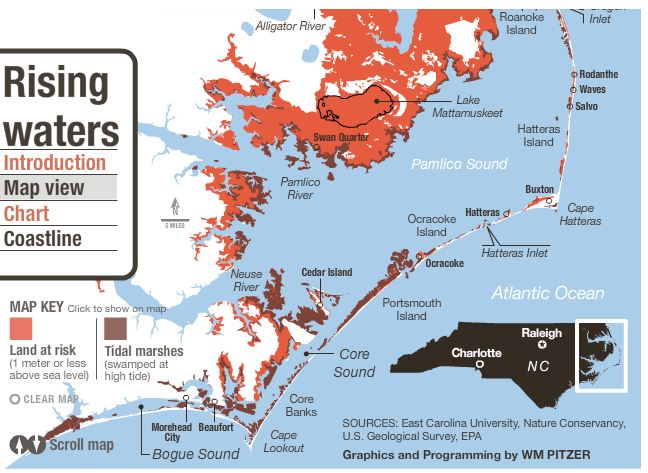
Despite the obvious danger that rising sea levels pose to communities on the Gulf Coast, tensions over climate change are flaring most acutely in the beach towns of North Carolina. In 2010, the North Carolina Department of Environment and Natural Resources (NCDENR) established the North Carolina Coastal Resources Commission (NCRC) to study the effects of rising sea levels by 2100. Lawmakers were dismayed when the report predicted a 39-inch rise in sea level by 2100.
By the summer of 2011, realtors and community members living on North Carolina’s Outer Banks saw the figures and were shocked. Even worse, the state was already developing a website to enable residents to check the vulnerability of their property. In response to this news, realty organizations fought back against the commission’s report, arguing that its scientific methods were questionable, lacking an assessment of economic impact, and devoid of any maps.
As the state produced the maps using Light Detection and Ranging (Lidar) technology, the outlook was increasingly dour for NC residents. Highway 12, Roanoke Island, and Pamlico Sound all faced significant flooding. Homeowners and businesses were understandably outraged at the report. The projections drove many to call for re-zoning of the North Carolina Coast in a manner that would consider much of the populated communities as uninhabitable land, devastating tourism and property values.
Lori Montgomery wrote in the Washington Post that one realty lobbyist, “worries that codifying the 39-inch forecast would crush the local economy, which relies entirely on tourism and the construction, sale and rental of family beach houses. In Dare County alone, the islands’ largest jurisdiction, the state has identified more than 8,500 structures, with an assessed value of nearly $1.4 billion, which would be inundated if the tides were 39 inches higher.”
Montgomery continued to explain that even a more modest forecast would be devastating to North Carolina. There are 414 properties in Dare County, valued at $70 million, which would be underwater. Widespread awareness of this danger would torpedo property values in the area.
North Carolina’s state legislature called for a new study, considering the work of the NCRC into question. Instead of projecting to 2100, the new study will only look 30 years forward – likely hoping to assuage concerns about the viability of NC’s coastline. The move has angered many, particularly environmental advocates. Gov. McCrory has stymied efforts to publish or publicize any sort of climate research.
Decreasing the timetable for the new climate study will help lawmakers avoid another glaringly alarming figure, like the 39-inch prediction. The new study, however, does not evade the urgency of the climate crisis. Short of serious legislation and action on climate change, there is little hope to save much of the United States’ coastal land.
Clearly there is need for civil society to push lawmakers at the state and federal level to honor climate studies instead of simply playing games with numbers. As the United States looks to develop infrastructure in the 21st Century, climate change plays an increasingly significant role. As seasons shift, temperatures rise, and the oceans press above their previous limits, our previous designs grow obsolete. While no one wants to see the worth of homes on North Carolina’s coast sunk, the seemingly-imminent danger of rising sea levels demands a more proactive approach by our governments.
As much as we may like to do so, covering our eyes and fudging the truth will still leave us high and dry – or below sea-level and quite wet, I suppose.
by Jennifer Welden | Jul 16, 2014 | Climate Justice, Global Justice
Climate change, and the campaign surrounding it, has evolved significantly over the last decade. Just look at its name: it went from “global warming” to “climate change” and now there are suggestions to call it “global weirding,” “pollution death,” or (my personal favorite) “atmosphere cancer.” The way in which it has been framed has evolved as well. It has gone from an environmental issue to a public health issue to a political issue, a representation of a deep-seated ideological divide between Democrats and Republicans.
And yet, despite all these changes, only 40% of Americans view climate change as a major threat. Clearly, the way in which climate change is being framed is not working to convince the general public. The climate is changing, and so should its messaging.
What may be hurting the climate change campaign the most is the lack of real-world examples. While we are seeing the effects of climate change everywhere in the US – extreme heat or cold, torrential rainfall, drought, etc. – these are not apocalyptic enough to sway the average member of the country. And when the consequences of climate change do verge on apocalyptic – devastation and conflict due to drought, natural disasters, and public health concerns – they are in the third world, too “geographically (and psychologically) distant from the audience being communicated to.” Even if these events occurred in our backyard, fear is often ineffective in inspiring actual change. Focusing on “social norms” that promote sustainable behavior, or providing interactive simulations on the future effects of climate change have both been suggested as ways to generate real concern among Americans.
What the current framing of climate change lacks is a personal touch. Climate change is not just an environmental, economic, or political issue. Climate change predominately affects women – why aren’t more female politicians and feminist organizations pushing this agenda? Low-income residents are more affected by pollution and natural disasters than higher-income groups – why aren’t more news articles connecting this to the ever-popular subject of income inequality? Sports rely on fresh air and healthy, able bodies to fill their massive stadiums – why isn’t ESPN or Sports Illustrated featuring stories about this? Kendrick Lamar gained widespread popularity with his album good kid, m.A.A.d city, on which he raps openly about his experiences growing up in Compton, an area well known for pollution. Why can’t he, or some other influential artist, make a Top-40 hit about climate change?
But the truth is, much of this has been done. Women, low-income people, sports figures, and celebrities have all spoken out against climate change, attempting to appeal to a wider audience. NASA even put out its own rap video. So why isn’t this working? First, there is a lack of mainstream cable network coverage surrounding climate change; with TV still being the dominant way people receive their news, this means many messages just aren’t reaching the people they are meant to sway. And if the usual environmental or political messages aren’t being broadcast, how can we expect these more personal and direct messages to be? Moreover, when climate change is presented in the media, it is often framed as a political issue, a battle of opposing sides. In an age where the news is dominated by sensational stories of conflict, and where bipartisanship is the needle in the proverbial haystack, there doesn’t seem to be room to relate to the average voter across partisan lines.
Second, and more importantly, people are framing the issue in these ways, they just aren’t calling it climate change. They are referring to it by the issues that surround it: pollution, health, job creation, extreme weather, human rights, women’s rights, etc. These issues are relevant, direct concerns of many, and understandable regardless of your stance on climate change. Even conservatives have been motivated to protect the environment when shown that something is a threat “to the ‘purity’ and ‘sanctity’ of [the] Earth and our bodies,” an appeal that goes beyond the climate change debate to a strictly moral ground.
But the fact that we aren’t constantly relating these things back to climate change may be exactly why so many Americans do not consider climate change to be a major threat. Does climate change trump pollution? Your child’s health? Your brother’s career options? In the mind of the average American, probably not.
With this in mind, maybe it’s not the framing that needs to change, but the policy. Crafting policies that address the personal issues of Americans, but also help the environment in the process, may be the key to gaining widespread support, or at least deterring widespread opposition.
Or maybe we should just start calling climate change what it really is: atmosphere cancer.
by Benjamin Gross | Jul 4, 2014 | Climate Justice, Global Cooperation
“Plastic is everywhere in the ocean.”
“87% of the world’s marine fish stocks are fully exploited, overexploited or depleted.”
These are just two of a number of very troubling statements concerning our world’s oceans, as outlined in a report released last Tuesday by the Global Ocean Commission. The report, which comprehensively details the issues that pose a threat to the health of our oceans, asks that countries cease turning a blind eye to the immeasurable harm that they inflict regularly. It demands that countries make the rectification of our oceans’ health an immediate priority, or else face the risk of causing irreversible damage.
The report cites a rising demand for resources, new technological advances, the depletion of fish stocks, climate change, and weak high seas governance as the most prominent reasons for the decline in the health of our oceans. It explains that the world’s immense growth in population– reaching 7 billion people in November 2011– has driven the demand for the ocean’s treasure trove of resources to naturally unsustainable levels. It warns that a failure to address climate change would have a calamitous effect on the world’s oceans, potentially wiping out as much as 60% of ocean species by 2050.
The report goes further than simply identifying the root causes of the ocean’s demise; it offers up a series of important steps, most notably Proposals 1 and 2, which would help remedy many of the ocean’s issues.
Proposal 1 advocates for the creation of a UN Sustainable Development Goal (SDG) as a means to help put the issue of our ocean’s health at the forefront of the post-2015 UN Development agenda. This action is vital to helping fix the ocean’s issues, as it would not only increase visibility and trigger resources to act, but also help the world to recognize that the “global ocean is an Earth system that needs to be addressed and managed as a single entity.”
Proposal 2 urges the strengthening of global governance in order to sufficiently protect the biological diversity of the high seas and to ensure sustainable usage of marine living resources. The proposal advocates the universal ratification of international treaties like the UN Convention on Law of the Sea (UNCLOS), which helps to define the rights and responsibilities of nations in their use of the world’s oceans and helps to protect the conservation of marine natural resources.
As a staunch supporter of using international cooperation to solve issues that affect the global community, I fully support and agree with the Global Ocean Commission’s report and its recommendations for the future. Nations must implement the commission’s proposals as they are able–particularly Proposals 1 and 2.
For if the world fails to address the rapid decline of the ocean’s health, the consequences of our inaction will be felt not only in the present, but for many years to come.