by Jennifer Welden | Nov 3, 2014 | Climate Justice, Global Cooperation
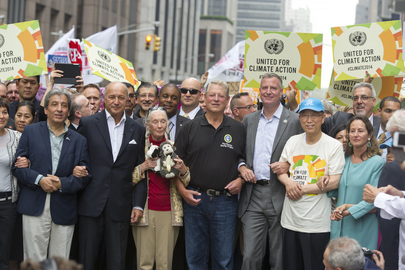
Climate change is one of the bigger global issues of our time; just last month, over 400,000 people marched in New York City during the Climate Summit to call for immediate action. Despite the very real effects of climate change, and the various ways in which the issue has been framed, 71 percent of people say they “are less likely to take action on climate change because they’re unsure of the difference their actions will make.” As it turns out, skepticism over the solutions to climate change is just as big a barrier to action as skepticism over the science behind it.
That is one of the main issues with climate change messaging: it tends to focus on the problem rather than the solution(s). This has a direct impact on the public’s opinion regarding climate change; polling showed that two out of three people would be more inclined to support climate action if they heard more about the solutions.
The current messaging isn’t just depressing, it’s misleading – climate change solutions can be found all over the world! From something as simple as a bike-sharing app in Canada to something as novel as solar-powered school boats in Bangladesh, solutions are everywhere. We just have to be aware of them.
This is the goal of the #itshappening project: to create “a call to celebrate how far we’ve come and, to step up our ambition for the future.” By sharing examples of climate change progress from around the world using pictures and social media, #itshappening tries to “[fight] fatalism with hope, and [counter] apathy with agency.”
But it isn’t just about showing that there are solutions, it’s about showing that they aren’t all high-tech achievements. Take the Nigerian initiative Wecyclers: by providing recycling pick-up via bicycles, the program allows participating families to exchange garbage for consumer goods using an SMS-based point system. With an estimated only 46 percent of all municipal solid waste in Africa being collected, this program could have big implications for the future. Currently, more than 5,000 households in the start-up city have signed up, and there are plans to expand the program to other cities throughout Nigeria. A simple answer to a critical program, Wecyclers shows that solutions do not have to be hi-tech to be effective:
Initiatives might be low-tech in innovation, but high-impact when it comes to create sustainable change for entire communities.
And yet there are still barriers that make climate action seem daunting. With the current market design making something as simple as using a 90 percent recycled drink can unappealing to big brands such as Coca-Cola or PepsiCo, it would appear that widespread sustainability is still a ways off. How then do we make climate action something people rally behind rather than question? Following the lead of #itshappening, we need to make climate change solutions well known and widely publicized; moreover, we need to acknowledge the simple innovations that could be implemented easily on a larger scale. People need to see not only that solutions are possible, but also that they already exist. Finally, we need an international call to action and a consensus on what we each can do to better our planet and make the most of our resources.
As Mal Chadwick, the creator and curator of #itshappening notes,
The biggest threat to progress is cynicism – resigning ourselves to climate change because we don’t think we’re up to the task of fixing it.

by Ezra Douglas | Oct 22, 2014 | Climate Justice, Global Justice
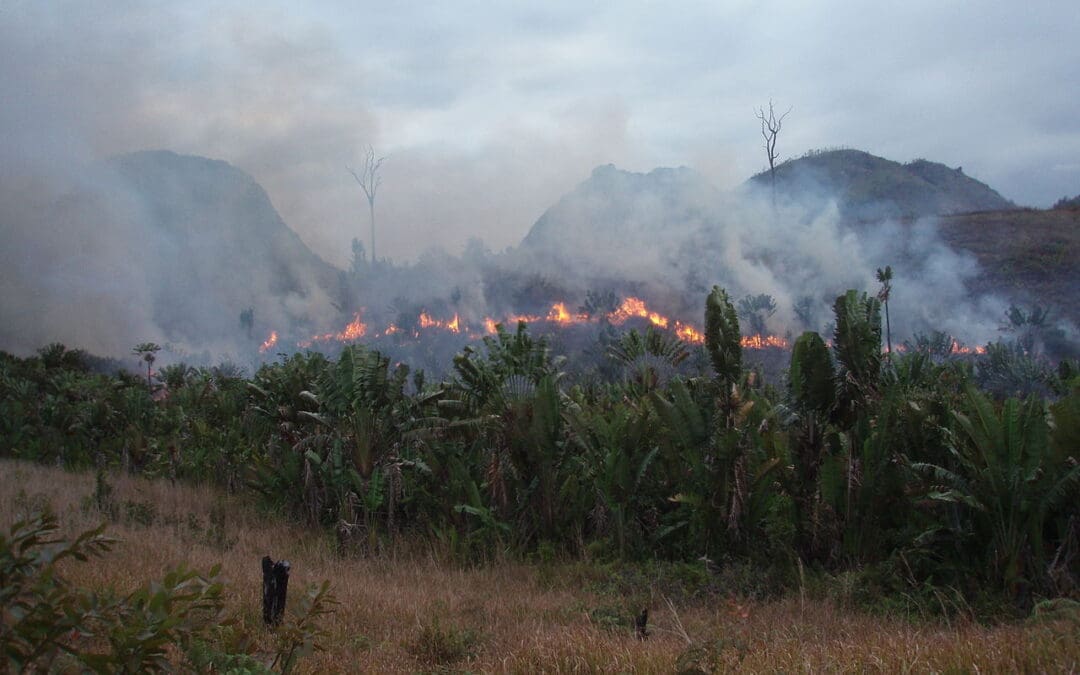
When we think of forests, we think of those in the Amazon, China, Congo, Canada and many more places throughout the world. People throughout history have been drawn to forests, intrigued by the mysteries, adventures, and animals hidden within them. Forests today cover about 30 percent of the earth’s surface, but each year we lose an area equivalent to the size of Panama.
Deforestation is the driving force behind the loss of our forests. According to the Environmental Protection Agency, deforestation can be defined as the “permanent removal of standing forests.” There are numerous reasons this occurs. These reasons do vary but deforestation can intentionally or accidently occur.
So how does this affect you? Deforestation has a tremendous impact on everything around us. The effects are plentiful and include loss of habitats, increased greenhouse gases, soil erosion, and the destruction of homeland for natives.
It estimated that in 100 years, there will be no more forests on our planet if we continue at the current rate. The benefits from these forests are irreplaceable and essential to our survival. For example, 20 percent of our oxygen comes from the Amazon, and these forests help regulate the water cycle and keep the soil rich with nutrients. The removal of forests caused by deforestation accounts for 12-17 percent of global annual greenhouse gases emitted into our atmosphere.
Human activities are the main cause of deforestation. With the exception of natural events such as disease and fire, protection of our forests is attainable. Despite this, our forests continue to shrink rather than grow.
There are many factors in the unjustifiable deforestation that occurs on our planet. Most forests are cut for agricultural purposes. In fact, most of the countries that suffer from deforestation are poor. As they clear for farms or fuel, they get richer–until “alarm bells ring and they attempt to recover their loses”. Other reasons include clearance for cities, firewood, and, most notably, paper. The fact that deforestation occurs in a lot of poor countries creates further challenges, as laws are not enforced or applied to curtail deforestation.
The need to keep our forests clearly outweighs the benefits of destroying them. Even though a lot of forests are cut down for agricultural use, the removal of trees causes the ground to lose its nutrients, thus defeating the purpose of growing healthy crops and increasing the likelihood of flooding. Deforestation also is a leading cause of climate change because with fewer trees on our planet, there is a greater abundance of CO2 in our atmosphere. It is important to defend our forests because 70 percent of Earth’s land animals and plants live in forests, and many cannot survive when deforestation destroys their homes.
Many forests in the world are home to indigenous groups that have lived in them for thousands of years. In South America, there are over 400 indigenous groups that thrive in these forests, and if deforestation continues, this could jeopardize and threaten their livelihoods. Deforestation will increase conflict as native tribes will try to defend their homelands, threatening peace and security in some countries.
Overall, deforestation is an issue that will have disastrous global implications if governments don’t act to prevent it. With the prospect of no forests in the near future, the effects are far too significant to ignore. There are already organizations and laws that limit the loss of forests, but more can still be done to ensure that our beautiful forests are not destroyed.
by Ezra Douglas | Sep 27, 2014 | Climate Justice, Global Cooperation
Marked with enthusiasm and high expectations, the United Nations kicked off its long anticipated Climate Summit in New York City on September 23rd. Geared towards finding solutions and methods to combat climate change, nations converged at the summit while enormous marches in support took place globally. In New York City, over 400,000 people marched to express their grievances toward climate change and iterate the need to act immediately.
Met with optimism, the summit allowed nations to collaborate and address, for the first time in five years, the challenges that they must confront. Attendees included world leaders and celebrities such as Leonardo Dicaprio, an actor and a UN Message of Peace ambassador, who gave a thunderous and monumental speech. He emphasized the importance of our planet, acknowledging the existence of global warming and stressing, “You can make history…or be vilified by it.”
Cities, companies from many sectors, and national governments announced new actions to shift away from fossil fuels to a low-carbon, climate-resilient economy. Even the biggest economies signaled that they are ready to shift to a low-carbon growth path. The US announced that it will give the World Bank $15 million to help finance a program aimed at reining in methane pollution.
French President Francois Hollande announced that France will set aside 750 million euros, or approximately $1 billion, for the Green Climate Fund, which intends to help developing countries limit air pollution. China aims to reduce its carbon emissions by 40% by the year 2020. Meanwhile, other nations like Ireland have vowed to reduce their carbon emissions to 80% by 2050, and India has committed to doubling its clean energy production by 2020.
To see a full list of country commitments, visit “Here’s What Major Nations Pledged at the Climate Summit.”
With commitments and goals in hand, it was hard not to notice the business community partaking in the climate change fight. The words of the day, “divesting” and “investing,” highlighted the business community’s participation and efforts towards this issue. Their leaders are sending a clear message to the world that climate change is a risk that cannot be ignored, and, most importantly, that they are ready to work together to bring down emissions.
A global solution will take a global effort to address climate change, with companies and countries collaborating and tackling the problem. We cannot let this global solution be swindled and manipulated by the climate change deniers. Adamant deniers such as the Koch brothers are some of the most notorious polluters in our country and have put millions into lobbying Congress. Organizations like ALEC continue to lie about the issue, resulting in Google pulling the plug in funding. With certain industries and organizations denying the threat, they prove to be the ones hindering our efforts and serving their own interest.
The Summit was successful in re-energizing the climate movement. And with several first-time speeches on climate change and new policy commitments by many nations, the Summit was indeed a step toward establishing new climate targets ahead of the 2015 Paris negotiations ,where an agreement is hoped to be made.
Here’s a snapshot of commitments made by companies:
- Google has invested over $1 billion towards renewable energy and plans to power all of its data centers with clean energy.
- The Rockefeller Foundation, founded on oil money, is divesting from fossil fuel companies and plans to invest money in clean energy instead. The foundation stated, “as an astute businessman looking out to the future, [John D. Rockefeller] would be moving out of fossil fuels and investing in clean, renewable energy” if alive today.
- The 6 biggest oil companies in the world have vowed to reduce methane leaks.
- IKEA and a dozen other companies made the ambitious pledge to source 100 percent of their power from clean energy. The effort, though, is designed to recruit a total of 100 companies to make similar commitments by 2020.
- Many other big companies like General Mills, Mars, and Apple have made commitments, resulting in new investments and over $50 billion divested from the fossil fuel industry.
- The World Bank announced that 1,042 companies signaled their support for putting a price on carbon pollution. According to the World Resource Institute, 25 of those companies, including Nestlé, Unilever, and Philips committed to price carbon internally to accelerate investments that reduce their own greenhouse gas emissions. Not only will they advocate publicly for policies that price carbon in their markets around the world, they will be reporting back on progress towards meeting those commitments.
- A major initiative was announced to cut the rate of deforestation in half by 2020 and end it by 2030. The declaration on forests was signed by 27 governments, including the governments of the US, UK, Germany, Indonesia and the Congo, as well as more than 100 companies, civil societies and indigenous peoples. The declaration was backed by commitments from food companies, including palm oil giants, to deforestation-free sourcing policies of palm oil. Krispy Kreme and Dunkin Donuts joined 19 other major food companies to make zero-deforestation pledges.
by Ezra Douglas | Sep 17, 2014 | Climate Justice, Global Cooperation
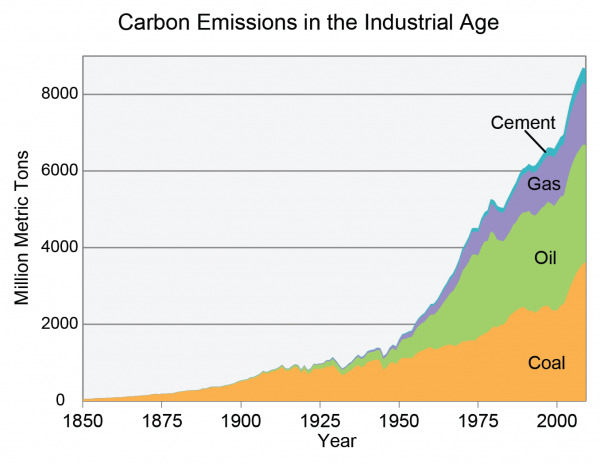
In our world, there has never been a greater threat to humanity since the emergence of climate change. Last week, the UN Meteorological Organization released a report that CO2 levels on our planet are rising at an uncontrollable rate. If that’s not concerning enough, most of the major greenhouse gases emitted into our atmosphere reached an all-time high level in the year 2013.
Eventually, these gases will become more catastrophic and inflict widespread devastation to the point where the planet can no longer cope. In fact, the rise of these gases on earth are the leading cause of climate change, resulting in changes in the earth’s atmosphere and temperature as well as widespread drought, flooding, and devastating storms. And while one may think that CO2 only affects the atmosphere, that’s wrong too! Higher CO2 levels drastically change our oceans and raise the acidity of the water. With a greater output in the amount of greenhouse gases in our atmosphere, our planet will not have the ability to convert these gases back into the air that we breathe. Although invisible, the effects from these gases will eventually force animals to migrate or go extinct, increase the probability of war, cause drought and famine, and ultimately threaten our very existence as a species.
While this report is alarming, it is critical that world leaders react to these changes to mitigate the effects of climate change. We have all heard of the effects of climate change through the accounts of scientists, reports, news articles, and even in some blockbuster hits like The Day After Tomorrow. World leaders must act at the upcoming UN Climate Summit, scheduled to be held on September 23rd.
It is at this Climate Summit that world leaders will discuss methods and solutions towards combating climate change. With these talks, we hope that they take action and consider the seriousness of an altered environment due to changes in the climate. With this recent UN report discussing the rise of CO2 and other greenhouse gases, I hope world leaders wake up to reality, take the initiative, and understand that our planet cannot sustain the current output of CO2 and other gases.
It is imperative that this summit galvanizes world leaders and countries to sign an agreement by 2015 to combat climate change. In fact, we must invest heavily into sources of renewable energy and change our habits as a people. Climate change is not going to wait for us to change, and if we wait too long, we will reach a point of no return where we can do nothing to save the planet. So let’s try to reduce our carbon footprint in an effort to limit the emission of these gases. The golden rule states that you should “treat others as you want to be treated.” Well, why shouldn’t we also treat the earth as we want to be treated?
by Jennifer Welden | Aug 13, 2014 | Climate Justice, Global Cooperation
In the age of world hunger, endangered species, and a crippled environment, we are constantly looking for new sources of food to take the pressure off our currently over-tapped resources. Insects have been increasingly pointed to as a more sustainable source of protein, as they have “a far smaller carbon footprint than most livestock.” The UN’s own Food and Agriculture Organization has even promoted this practice as a healthy and environmentally friendly alternative to meat in its 2013 report.
2 billion people worldwide have no qualms about eating insects – why are Americans totally buggin?
Many small companies have begun trying to market bug-filled products in cute and innovative ways as an attempt to overcome the inevitable “ick-factor”; my personal favorites are chips with a cricket base called “Chirps” and the movement to rename locusts “sky prawns.” There are also more subtle ways to consume insects, such as through the use of cricket flour, keeping these creepy crawlers out of sight and (hopefully) out of mind.
Some fast facts for why we should all start eating bugs include:
- They’re a great source of protein
- Crickets have as much calcium as milk (if you eat enough)
- Insects are not that biologically different from shellfish
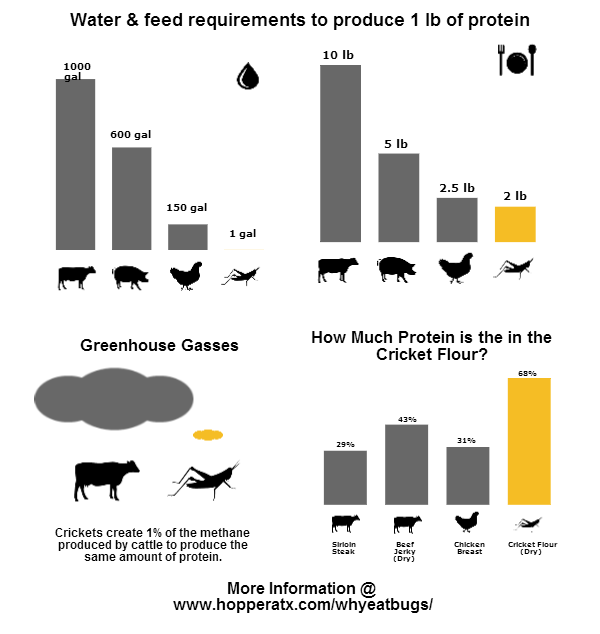
- They emit considerably less greenhouse gases and waste than other animals
- They require little to no land to cultivate
- Insects use about 2 pounds of feed to produce 1 pound of meat. Cattle, on the other hand, need 8 pounds of feed to produce 1 pound of beef
- In fact, many insects can consume waste products like animal blood, eliminating the need for feed made especially for them (i.e. soybeans or corn)
The consumption of insects also has huge implications for the developing world. “Insect-rearing is less capital-intensive than other animal husbandry, giving poorer farmers a method of entry”; this is extremely relevant in a time when many poor fisherman are competing with corporations for over-harvested populations of fish. Moreover, their feed-efficiency makes them perfect feed alternatives for farm animals (for those leery to stray from traditional protein sources). Insects could even prove beneficial to emergency relief efforts, with some working to make “Grow Your Own Locust” kits for African Refugees.
Disgust factor aside, there are still some regulatory barriers to widespread insect consumption. Currently, many countries do not have insect-product regulations; the US in particular has a lack of federal regulation, as there have been few studies regarding the use of insects as animal feed or main meals.
While it seems unlikely that “cricket crackers” or “French flies” will be a trend anytime soon, the entomophagy movement seems like a step in the right direction toward a more sustainable–and definitely more creative–world.
by Jennifer Welden | Aug 6, 2014 | Climate Justice, Global Cooperation
For approximately 3 billion people in the world, both wild-caught and farmed seafood are their primary source of protein. Moreover, an estimated 85 percent of marine fish stocks are either overfished or fully exploited. But the problem of overfishing is not just an issue of consumption; the types of fish we choose to eat and the way in which we catch these fish are related to many other issues–namely food waste, environmental destruction, corruption, and even human rights.
Bycatching, or the portion of a commercial fishing catch that consists of marine life caught unintentionally, is a persistent problem. Some estimate that the global bycatch may make up 40% of the world’s overall catch, which totals 63 billion pounds per year. This has a significant effect on sea life, with many fisheries discarding more fish at sea than they bring in, while also “injuring and killing thousands of whales, dolphins, seals, sea turtles, and sharks each year.”
Its not just about the way fish are harvested, though, but rather the types of fish being harvested. Some of the most popular fish, such as Bluefin Tuna, have the biggest appetites. The Bluefin’s natural diet consists of a lot of other, smaller fish; farmed tuna are fed up to 15 pounds of other fish such as sardines and mackerel for each pound of tuna that can be sold.
But these small fish can, in fact, be used as much more than a tuna’s meal. Small fatty fish (i.e., mackerel, herring, sardines and anchovies) are high in omega-3s, vitamin D, and low on the food chain; and the fisheries that produce them are “among the most energy and carbon-efficient forms of protein production.” This has caused many to point to small fish as sustainable and healthy alternatives to popular seafood such as shrimp, particularly as a way to reduce the carbon footprint created by food production and waste. However, due to their typically unappealing taste, they have yet to reach widespread appeal.
In the face of illegal fishing, however, these arguments about best practices become pointless. “Ocean-grabbing” – the practice of pirating fish from the shores of developing countries – has become increasingly problematic, and represents between 24 to 26 billion pounds of fish. This not only negatively impacts fish populations (i.e., overfishing), but also has a profound impact on local fisherman in developing countries. Today, 12 million small-scale fisherman around the world rely on fishing as their main source of income. As Issa Fall, member of the Fisherman Committee in Senegal notes:
Families have lived off fish for generations … we used to be able to save a bit for our children’s education or to fix our boats but it has now become harder to make ends meet.
Many blame corruption between governments and the private sector for the recent trend, pointing to “shady access agreements, unreported catch, incursions into protected waters, and the diversion of resources away from local population.” As Max Jarrett, deputy executive director of the Africa Progress Panel, points out:
This is a global issue: 60% of the vessels which are carrying out these practices have been traced to east Asia, south Korea and Russia, among others. What’s particularly disturbing is that many of these countries are giving aid to African fisheries while also pirating fish illegally on a large scale.
In response to declines in fish populations and threatened livelihoods, many local fisheries (as well as big corporations) have turned to exploitative practices. A study by ecologists at the University of California, Berkeley found that “as fish and fauna are wiped out, more children around the world are forced to work, and more people are forced into indentured servitude.” The increased time and energy it now takes to find a decreased amount of food has forced many to turn to cheaper forms of labor, specifically child labor or slavery.
How do we address these issues? Justin Brashares, who led the study, argues that current policies focus on stopping traffickers rather than the source of the problem. He states:
The government’s strategy of tracking down key traffickers and arresting them is missing the scale of the problem and the underlying issues driving them: the rapid destruction of wildlife. We need to target areas where we know reliance on wildlife is the largest. Then local communities need to have tenure rights to these animals. This strategy may be working against the U.S. economically in the short term, but in the long term, it’s a no-brainer for the world.
There is clearly a need for increased international regulation, such as through the Law of the Sea Treaty, as well as improved fishing practices at the local and commercial levels. It’s also important, however, to encourage more sustainable consumption of fish on the consumer level; we must continue to discuss the effect our own purchases have on those seemingly a world away.