
Originally published on the CGS blog on September 27, 2014.
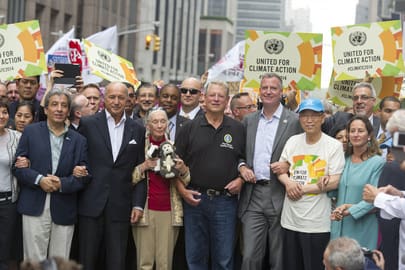
Marked with enthusiasm and high expectations, the United Nations kicked off its long anticipated Climate Summit in New York City on September 23rd. Geared towards finding solutions and methods to combat climate change, nations converged at the summit while enormous marches in support took place globally. In New York City, over 400,000 people marched to express their grievances toward climate change and iterate the need to act immediately.
Met with optimism, the summit allowed nations to collaborate and address, for the first time in five years, the challenges that they must confront. Attendees included world leaders and celebrities such as Leonardo Dicaprio, an actor and a UN Message of Peace ambassador, who gave a thunderous and monumental speech. He emphasized the importance of our planet, acknowledging the existence of global warming and stressing, “You can make history…or be vilified by it.”
Cities, companies from many sectors, and national governments announced new actions to shift away from fossil fuels to a low-carbon, climate-resilient economy. Even the biggest economies signaled that they are ready to shift to a low-carbon growth path. The US announced that it will give the World Bank $15 million to help finance a program aimed at reining in methane pollution.
French President Francois Hollande announced that France will set aside 750 million euros, or approximately $1 billion, for the Green Climate Fund, which intends to help developing countries limit air pollution. China aims to reduce its carbon emissions by 40% by the year 2020. Meanwhile, other nations like Ireland have vowed to reduce their carbon emissions to 80% by 2050, and India has committed to doubling its clean energy production by 2020.
To see a full list of country commitments, visit “Here’s What Major Nations Pledged at the Climate Summit.”
With commitments and goals in hand, it was hard not to notice the business community partaking in the climate change fight. The words of the day, “divesting” and “investing,” highlighted the business community’s participation and efforts towards this issue. Their leaders are sending a clear message to the world that climate change is a risk that cannot be ignored, and, most importantly, that they are ready to work together to bring down emissions.
A global solution will take a global effort to address climate change, with companies and countries collaborating and tackling the problem. We cannot let this global solution be swindled and manipulated by the climate change deniers. Adamant deniers such as the Koch brothers are some of the most notorious polluters in our country and have put millions into lobbying Congress. Organizations like ALEC continue to lie about the issue, resulting in Google pulling the plug in funding. With certain industries and organizations denying the threat, they prove to be the ones hindering our efforts and serving their own interest.
The Summit was successful in re-energizing the climate movement. And with several first-time speeches on climate change and new policy commitments by many nations, the Summit was indeed a step toward establishing new climate targets ahead of the 2015 Paris negotiations ,where an agreement is hoped to be made.
Here’s a snapshot of commitments made by companies:
- Google has invested over $1 billion towards renewable energy and plans to power all of its data centers with clean energy.
- The Rockefeller Foundation, founded on oil money, is divesting from fossil fuel companies and plans to invest money in clean energy instead. The foundation stated, “as an astute businessman looking out to the future, [John D. Rockefeller] would be moving out of fossil fuels and investing in clean, renewable energy” if alive today.
- The 6 biggest oil companies in the world have vowed to reduce methane leaks.
- IKEA and a dozen other companies made the ambitious pledge to source 100 percent of their power from clean energy. The effort, though, is designed to recruit a total of 100 companies to make similar commitments by 2020.
- Many other big companies like General Mills, Mars, and Apple have made commitments, resulting in new investments and over $50 billion divested from the fossil fuel industry.
- The World Bank announced that 1,042 companies signaled their support for putting a price on carbon pollution. According to the World Resource Institute, 25 of those companies, including Nestlé, Unilever, and Philips committed to price carbon internally to accelerate investments that reduce their own greenhouse gas emissions. Not only will they advocate publicly for policies that price carbon in their markets around the world, they will be reporting back on progress towards meeting those commitments.
- A major initiative was announced to cut the rate of deforestation in half by 2020 and end it by 2030. The declaration on forests was signed by 27 governments, including the governments of the US, UK, Germany, Indonesia and the Congo, as well as more than 100 companies, civil societies and indigenous peoples. The declaration was backed by commitments from food companies, including palm oil giants, to deforestation-free sourcing policies of palm oil. Krispy Kreme and Dunkin Donuts joined 19 other major food companies to make zero-deforestation pledges.


