by Ronald Glossop | Nov 8, 2013 | Peace & Disarmament, World Federation
Congratulations to the UN General Assembly for once again calling on countries to observe a world-wide ceasefire starting in February 2014 and lasting until March.
This period of symbolic truce starts a week before and continues through a week after the 11th Paralympic Winter Games in Sochi, Russia. Wilfried Lemke, Special Adviser to the UN Secretary-General on Sport for Development and Peace, urged all countries to honor the truce in accord with the ancient Greek tradition born in the 8th century BCE. He said, “if this could save just one life, it would be a wonderful resolution and not only a paper.”
After more than 10,000 years it seems that humanity should be able to do better than saving one or just a few lives by stopping wars for a few weeks. Why only temporary truce rather than peace for good?
Many countries have shown us how to create enduring peace within their boundaries. The key is the creation of a democratic government where rulers are selected periodically by the people and where human rights and the rule of law are respected. Of course some conflicts occur, but they can be worked out by political and judicial means rather than by the violence of wars. The European Union is in the process demonstrating how we can also create peace internationally in a region of the world once notorious for starting wars. Again, the solution is creating a democratic government that respects human rights and the rule of law. The African Union and other regional organizations are also showing surely but slowly how peace can be established.
At the global level the United Nations could try to do the same thing at the global level, maybe starting with creating a UN Parliamentary Assembly as is being advocated by those working for a world of peace with justice. The United States was a champion of the founding of the United Nations in 1945, and this country is still a powerful influence in the United Nations. Why aren’t we doing more to move the UN toward fulfilling its mission, “to save succeeding generations from the scourge of war” and “to reaffirm faith in fundamental human rights”?
by Donna Park | Nov 5, 2013 | Peace & Disarmament, World Federation
Letters to Jake Series, Letter #2
Dear Jake,
At the wonderful age of 2, you are now a big brother! I can’t believe you have twin sisters! Annette and Clair are lucky to have a big brother like you to love, support and protect them. Perhaps with two little sisters you’ll treasure even more the idea of ending war on planet earth.
In my first letter I explained the idea that the way to peace is through establishing global law with justice so that conflicts between nations can be resolved in a court of law and bad people will be held accountable for their actions if they break the law by invading or attacking others.
Now I want to point out how the current situation of eliminating chemical weapons in Syria is an example of how this can work. Our U.S. President Obama was threatening to use military force to protest Syria’s use of chemical weapons. There was an amazing outcry from U.S. citizens that we didn’t want to use our military might in this situation. Russia suggested that the Syrian government turn over its chemical weapons to a UN agency, and the U.S. agreed to give this option a chance to work before using our own weapons of destruction. So far it seems to be working. There is still much to be worked out, but this is an example of how there are other ways of solving problems, ways that don’t involve killing people. It also shows there is tremendous power when the nations of the world work together.
There is much to be done to turn the United Nations into a strong, democratic, federation of nations. But this is one example of how that effort can move the planet towards peace through world law with justice. Help your mommy and daddy take good care of your babies.
Love,
Gram
by Ronald Glossop | Oct 11, 2013 | Peace & Disarmament, World Federation
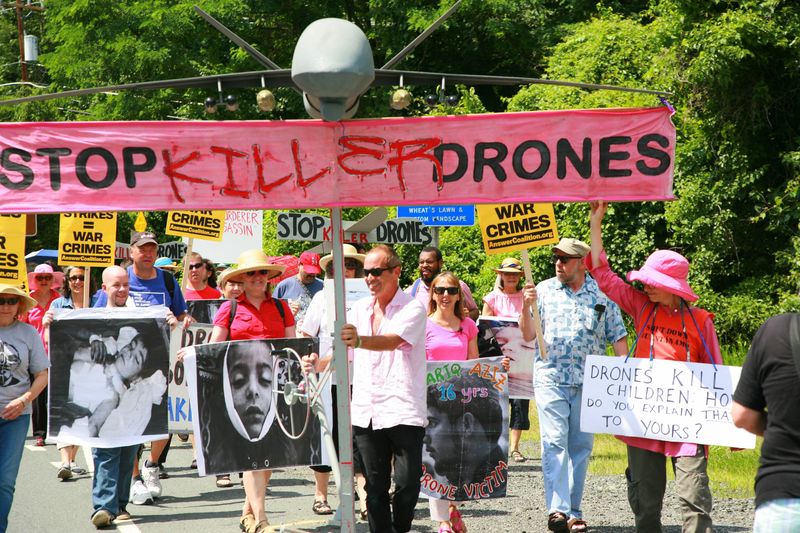
Something new and revolutionary is happening. U.S. citizens are appealing to the United Nations to take action to stop their own national government from using drones by demonstrating support for Pakistan’s call for the U.N to act to stop all weaponized drone attacks, including U.S. drone attacks on Pakistan.
Nick Mottern of KnowDrones.org writes:
“This is a preliminary report on last week’s six–day (Sept. 23-28) street witness that was organized at some of the busiest locations in New York City by the Granny Peace Brigade (GPB) to call for an international ban on weaponized drones and drone surveillance. . . . [It] was timed to coincide with the annual meeting of the UN General Assembly, and it turned out to coincide with the plea before the General Assembly by Pakistan’s Prime Minister, Nawaz Sharif, for a halt to US drone strikes against Pakistan. . . .The GPB witness involved at least 20 volunteers from New York City, New Jersey, Westchester County, NY and even Rochester, NY, and was supported by KnowDrones.org, World Can’t Wait, New York Peace Action, Brooklyn for Peace, CodePink NYC and the War Resisters League, all joining the GPB in the No Drones Coalition.”
Mottern’s report goes on to say, “The action was preceded by letters from the GPB to Ban Ki Moon, UN General Secretary, to appropriate UN agencies and to consulates of nations that are believed to be sympathetic to a ban on weaponized drones and drone surveillance.”
This event reflects a new view on how to act to influence public policy: protest against the violent actions of your national government by seeking to prevent counter-productive interpretations of the law at the international level. It is very much like appealing to the U.S. federal government to stop something that your state government is doing like supporting school segregation or preventing same-sex marriages.
One might argue that this effort won’t work because the U.N. can’t make laws and international law doesn’t apply to any nation that won’t ratify the relevant treaty. But such a view is just arguing about what the situation happens to be at the moment, not what it will be or should be in the future. National governments should be morally obliged to conform to a higher law of humanity just as the governments of U.S. states conforms to the U.S. Constitution and U.S. federal law.
We need a world ruled by a constitution and world law made by a parliament. The U.N. and international law are steps in the right direction, but we need to have world law in order to outlaw all violence and wars within the global community just as has already been accomplished within many democratic national communities. More and more members of the global community are coming to realize that truth.
Ronald J. Glossop is a Professor Emeritus at Southern Illinois University-Edwardsville and a board member of GlobalSolutions.org
by Father Ben Urmston | Sep 10, 2013 | Global Cooperation, World Federation
I don’t remember when or how, but one day it dawned on me what our world would be like if we had a democratic world federation. Ever since, when I read a newspaper or watch the news, I imagine how a democratic world federation could help global climate change, the global economy, and the suffering of war and violence.
Wouldn’t we be more secure, more open to other cultures and peoples, with better communication with other nations? I invite you to do your own visioning (and commenting). Not that there wouldn’t be challenges and difficulties. Nothing will work if we don’t work at it. But wouldn’t it be “easier to be good” as the mentor of Dorothy Day, Peter Maurin used to say? Even if we went more in that direction toward a sharing world community, wouldn’t that be a better world? Happy envisioning!!
A different way to look at our world is presented in a readable way by Deb Reich in No More Enemies. She invites us to change enemies into partners by envisioning alternatives. Trees take in carbon dioxide and emit oxygen. We can be inundated by the violence in our world and give out love which unites us.
I also suggest my article in Tikkun on Ersatz Security.
by Ronald Glossop | Aug 30, 2013 | Global Justice, World Federation
Much attention is now focused on the crisis in Syria. Should the United States and its allies use military force to punish Syria for using chemical weapons against its own citizens in violation of the Responsibility to Protect (R2P) principle supported by both the U.N. General Assembly and the U.N. Security Council? Is it the responsibility of the United States and its allies to enforce this somewhat imprecise “international law,” and if so, why?
One important lesson to learn from this situation is that the war problem, the use of military force by some nations against other nations, requires some serious thought and possibly unprecedented action. It is evident that our 20th-century inter-national political institutions are totally inadequate for our 21st-century global community. A second lesson is that we are more likely to be able to deal successfully with this war problem if we focus on it when war isn’t imminent or already happening. If and when this crisis in Syria passes, let’s remember both of these important lessons.
The key to what should be done can be found in history. Little by little in Western-style democracies humanity has learned that we can work out our conflicts nonviolently through elections and the rule of law rather than by the violence of war. We now know that the alternative to war within countries is a democratic political system where conflicts about public policy are resolved at the ballot box and in the courts.
That same basic principle applies to wars between nations. After two World Wars the nations of Europe have learned that to stop wars they need not only democracy within nations but also a democratic European Union to deal nonviolently with conflicts between nations.
Those two World Wars also led to the creation of the League of Nations and then the United Nations, moves in the right direction but not far enough. Both still preserved unlimited national sovereignty and failed to create a democratic global government that could use political and judicial procedures to resolve conflicts between countries. Consequently, we still have wars and arms races and drones and cyber warfare and crises such as this one about what to do in Syria.
It won’t be easy to develop a democratic global government, but it is a task that must be tackled in order to put an end to wars and armies and increasingly horrible weapons. The history of our own country shows how it can be done. Fortunately, the first step of creating the United Nations has already been taken. The next step is to convert the United Nations, a political organization in which each country has unlimited sovereignty (a confederation), into a democratic world federal government, a political organization in which the sovereignty of each member nation-state is limited to some extent for the good of all (a federation).
The United States began that conversion at the Constitutional Convention in Philadelphia in 1787. There this country started its crucial transition from the Articles of Confederation where each of the 13 colonies had its unlimited sovereign government, its own money, and its own militia to the new federal United States of America. George Washington was elected the first U.S. President in 1789. The slogan for that change was “E pluribus unum,” “Out of many, one,” and the proponents of that political conversion were called the Federalists. Our world community now needs some World Federalist leaders who will lead the way in creating a democratic world federation that puts an end to wars.
by Zoey Krulick | Aug 1, 2013 | Global Cooperation, News, World Federation
Last weekend I had the opportunity to attend the Annual Conference for GlobalSolutions.org at Hofstra University in New York. The conference focused largely on skills that can be used to become more engaged in our campaigns and to help build the GlobalSolutions.org movement. The staff at the conference certainly accomplished that, teaching many invaluable skills such as building community networks, fundraising, and using social media. Overall, I left the conference with an abundance of knowledge on how to build our movement effectively, and I hope other conference participants feel the same.
Of course, the most inspiring part of the conference was not the information itself, but the energy in the room. While the mood changed several times over the course of the day, sometimes serious, sometimes less so, the overall atmosphere was inspiring. Some of the participants hadn’t seen their old friends in years, yet still spoke as if it were yesterday. And of course, many new friendships were made. Overall, the room was filled with exciting discussion and intense energy – you could tell that everyone there had a passion to change the world.
If you didn’t get to attend the conference, don’t worry! We have a page with a summary of everything covered, including the information we handed out at the conference and helpful tutorials so you can learn these skills from home. Also, you can still let us know what you think we should work on and how you’d like to be engaged by filling out our survey. Until next year, GlobalSolutions.org’ers!


 Now I want to point out how the current situation of eliminating chemical weapons in Syria is an example of how this can work. Our U.S. President Obama was threatening to use military force to protest Syria’s use of chemical weapons. There was an amazing outcry from U.S. citizens that we didn’t want to use our military might in this situation. Russia suggested that the Syrian government turn over its chemical weapons to a UN agency, and the U.S. agreed to give this option a chance to work before using our own weapons of destruction. So far it seems to be working. There is still much to be worked out, but this is an example of how there are other ways of solving problems, ways that don’t involve killing people. It also shows there is tremendous power when the nations of the world work together.