by Sean Langberg | Jul 1, 2013 | Global Justice, World Federation
France, the United States, the United Kingdom, Russia, Germany, Japan, Italy, and Canada.
These countries comprise, in whole or part, the Group of 8 (G8), over 40% of global gross domestic product (GDP), the United Nations Security Council (UNSC), and the top position at the International Atomic Energy Agency, World Health Organization, World Trade Organization, International Monetary Fund, World Bank, Interpol, and European Central Bank. In other words, a huge percentage of the world’s money as well as almost all of the major international institutions are controlled by only eight of the 196 countries on earth, a mere 4%. If examined more closely, the power in these organizations is even more centralized with only France, the United States, the United Kingdom, and Germany controlling many of the leadership positions.
This is a different kind of 1%. The Occupy Wall Street movement popularized the phrase in reference to the super rich in the United States that control political and economic systems. The global 1%, or 4% in this case, is made up of states rather than individuals and concentrated groups of decision-makers in those states. Just like the United States’s 1%, the global elite are failing the world’s poor and pushing them to the margins through infantilization, uneven globalization, and disingenuous development.
Moreover, economically marginalized states have few ways to affect global economic and political systems because they are largely excluded from decision-making structures at international organizations. The G8 countries, the world’s super-rich, control arguably the four most important institutions – the United Nations Security Council, World Bank, International Monetary Fund, and World Trade Organization. This means that the bulk of multinational economic and diplomatic policy is set by countries that are typically not the recipients of aid, peacekeepers, “development” projects, and so on. This leaves economically marginalized states to fend for themselves in small-scale, bilateral, or regional agreements.
In 2009, the G8 somewhat admirably ceded control over the the G20 as the main economic council of rich states. Astonishly, this body accounts for over 80% of the world’s GDP despite having only two-thirds of the world’s population. But even this liberalized structure excludes most of central and southwest Asia, eastern South America, and all of Africa except for South Africa which means that a third of the world is left out of important conversations about climate change, international human security, trade policy, and development, despite being most affected.
Proposed solutions – expanding from eight countries to twenty, relying on BRICS to be the torchbearers of the future, adding Germany to UNSC business (P5+1), or ad hoc working groups (e.g. Friends of Syria) – are unlikely to be successful and largely maintain the status quo. Any solution that continues to concentrate power in the hands of a few rich countries is doomed to fail by any measure that accounts for inclusiveness, the voices of the marginalized, a more egalitarian global economy, and a just future for oppressed people in the Global South. President Obama’s recent trip to Belfast that yielded few results and his unilateral, modest plan for action on climate change are evidence that our international institutions need to change if we hope to solve big problems like the atrocities in Syria or rising sea levels. A careful examination of neoliberal policies created and maintained by the G8, broader participation from the Global South, and a push for bold long-term strategizing rather than short-term, banal solutions are a few potential starting points for reform.
by Sean Langberg | Jun 26, 2012 | Global Cooperation, World Federation
The Rio+20 summit, intended to develop a global sustainable development agenda, concluded last week. In the words of author Gwynne Dyer, “rarely has such a large elephant laboured so long to give birth to such a small mouse.” 150 world leaders were unwilling and incapable of creating substantive reforms to reduce greenhouse gas emissions because of a lack of political will and competing economic interests. The United Nations, the G-8, G-20, and other major multinational conferences suffer from many of the same ills. This begs the question, what is the alternative?
Nonetheless, the past few months were busy for the world’s major international institutions. The International Criminal Court, which is about to celebrate its tenth anniversary, convicted Thomas Lubanga in March marking a major milestone for the international justice community. However, others have not been so successful. The United Nations is struggling to resolve the fifteen-month long crisis in Syria that has killed more than 10,000 people. The most recent G-20 summit also recently concluded in Mexico producing piecemeal economic recovery efforts and meaningless statements about violence in Syria.
Clearly these institutions, in their current form, are largely incapable or unwilling to solve some of the world’s most pressing global issues. Climate change hurts marginalized populations and ecosystems, nuclear proliferation threatens to shatter fragile international peace agreements, small arms flow through violent transnational networks, and massive debt forces central governments to adopt crippling austerity measures. There are a multitude of successes that go largely unnoticed, however, such as the UN World Food Program’s extensive distribution network and the gradual eradication of some infectious diseases.
However, at a time when technology facilitates instant communication across borders and information is more readily available than ever before, the international community finds itself at a crossroads. It could maintain traditional power structures in our international institutions or it could adjust to accommodate more modern theories of cooperation. Sovereign states could continue to act on the basis of short-term national interests or adopt more progressive thinking that prioritizes global well-being. Heads of state could refrain from joining treaties such as the Rome Statute and respecting norms such as the Responsibility to Protect or they could aid in developing cooperative policy. The challenge is pushing our policy makers, public intellectuals, and fellow citizens to choose the latter (or as close as possible).
A primary concern of those advocating for institutional reform is inclusiveness. The UN Security Council only prioritizes the five world powers who dominated international relations at the conclusion of World War II. The G-8 and G-20 forums exclude dozens of countries whose economies disqualify their voices. Even at summits such as Rio+20, where a majority of the world’s states participate, the interests of the largest economies are prioritized and determine the policy of smaller countries through a trickle-down or paternal relationship. However, meaningful reform is unlikely without serious engagement with world powers who dominate existing institutions. The United States and others who controlled the international system during the Cold War need to adapt to include emerging states and a multipolar power structure.
What type of forum will facilitate meaningful dialogue and solutions to pressing global issues? How should we judge the effectiveness of sweeping international agreements and norms? What role should regional bodies play? Should we focus on reforming existing institutions or creating new ones? How does the international community best incorporate marginalized voices? Overall, how do we create a new global system that works for the benefit of all rather than those within strict national borders?
These questions do not have singular or easy answers. However, the human rights community should always be thinking of new ways to facilitate international cooperation and promote peace. An honest conversation about our successes and failures is a step in the right direction. Making changes to the UN Security Council, expanding the G-20 to be the G-30 or G-40, and promoting ambiguous “localized solutions,” are go-to reforms often cited as most feasible. However, thinking about why the institutions even exist and who they are supposed to serve might spark some unconventional ideas that radically transform the status quo.
We welcome thoughts in the comments section below about these questions and any other issues you feel should be considered.
by CGS Blog Archive | Jun 4, 2012 | Global Cooperation, News, World Federation

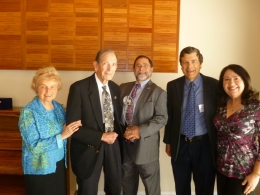
Last month, Wendell and Madelyn Harter were presented with Citizens for Global Solutions’ Edward Rawson Global Citizen Award, an award dedicated to honoring a lifetime of energy, service, and financial contribution to Citizens for Global Solutions. Together, the couple has helped shaped the organization and supported international institutions for over 60 years.
Don Kraus, CEO of Citizens for Global Solutions, said, “Wendell and Madelyn’s support has been crucial to building the organization to where it is today. Their dedication is an inspiration to all of us to keep striving for a better, more peaceful, and more just world. Their efforts will live on as our organization and our movement continues to grow and build.”
Citizens for Global Solutions is extremely grateful for the Harters’ enthusiasm and support throughout the years and we are proud to honor their commitment through this award.
by Arielle Weaver | Mar 19, 2012 | Global Cooperation, News, World Federation
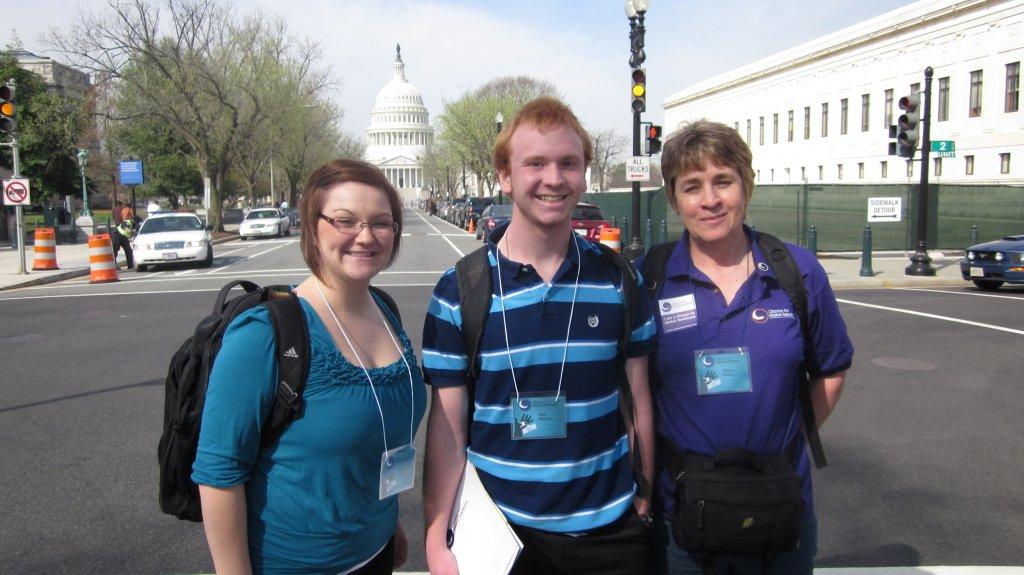
Last week GlobalSolutions.org held its Annual Conference, which included a day of lobbying senators and representatives and a visit to the White House. Lobby day was filled with discussions of global problems, how to lobby your representative in government, and the role and the importance of social media in grassroots movements.
The most important message I got out of the Annual Conference is that no matter who you are, you have a voice. You can use that voice to talk to your government and advocate for global issues that you want to put on the national agenda. It is too often argued that because of the financial crisis in the United States, foreign relations should be put on the back burner of national policy. But after seeing the excitement at this conference and the many people who feel as strongly on global issues as CGS does, it is clear that the United States needs to stay present in the global scene.
If the United States loses its influence abroad and ceases to work with international organizations, then we will lose the respect of other nations. Whether you call up your senator, tweet an article about the violence in Syria, or attend a protest, just remember: you have a voice and you should always use it. Stay tuned for more information and reactions to CGS’s Annual Conference. More blog posts and photos to come!
by Anu Joshi | Sep 2, 2011 | Global Cooperation, News, World Federation
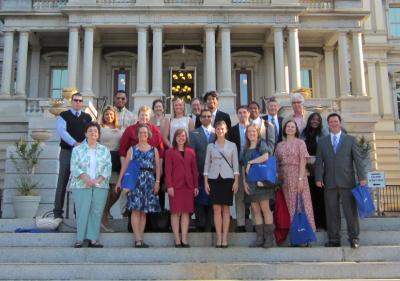
The White House Briefing and Training brought 50 people from 23 states to Washington DC to experience a day of briefings at the White House and a full day training at the GlobalSolutions.org National Office. Everyone involved found the event exhilarating, useful and energizing to continue their activism after they left the nation’s capitol.
One participant remarked: “I am honored to have been able to attend this event and feel it will definitely help me continue to lobby much more effectively, with more coverage and with a better understanding of the facts. Thank you. Also, a very diverse group – that is a big priority for me personally.”
For many visiting the East Wing of the White House was a once in a lifetime experience: “The only place more impressive to have met would be the Oval Office!”
GlobalSolutions.org partnered with Resolve for this event – bringing together people of different ages from different parts of the country to participate in the briefing with high level speakers at the White House, but also for the training the following day. People were able to learn from each other’s experiences and insights. “It was a good idea to coordinate with Resolve. We can only win with collaboration with all interested parties.”
Activists left Saturday reinvigorated to get back to work to promote the ideals we had been talking about all weekend and armed with the skills and information they needed to be successful.
by CGS Blog Archive | Jun 3, 2011 | Global Justice, News, World Federation
Citizens for Global Solutions will be at this year’s Bonnaroo Music and Arts Festival in Manchester, TN, from June 9th to 12th. This is our first ever appearance at Bonnaroo and we are greatly anticipating four days of fun and learning with great people and music!
Bonnaroo is an opportunity for us to share our mission and educate others in a setting that celebrates music and life. Citizens for Global Solutions envisions a future where we embrace our interconnectedness as individuals and nations, cooperating domestically and internationally to end war and to recognize and protect our most basic and fundamental human rights. Bonnaroo is a place of interconnection. It is a unique opportunity for people of different backgrounds to come together to celebrate a common interest: great music by talented artists. The festival presents an opportunity to learn from musicians, one another, as well as the many non-profit organizations that will be present at information booths open to the public.
Citizens for Global Solutions will be one of those booths, open from 9:30am to 2am Thursday the 9th through Sunday the 12th. We will be easily recognizable by our images of UN peacekeepers, a stickered map of the world, a UN flag, and hanging handmade paper cranes. We hope Bonnaroo attendees will help us reach our goal of 1000 handmade paper cranes by the end of the festival. Our goal of 1000 cranes is inspired by Sadako Sasaki, a Japanese girl who sought to make 1000 paper cranes before her death so she may be granted one wish: to live. This year at Bonnaroo, Citizens for Global Solutions hopes to have attendees make 1000 paper cranes so that we may all be granted the wish to end genocide in our world.
Genocide prevention and International Organizations (IO) Funding are our two campaigns that will be highlighted at Bonnaroo. There will be letters to sign and information sheets to better understand the importance of genocide prevention and reliable, sufficient funding to international organizations, such as the United Nations.
Come to Centeroo at Bonnaroo – where you will be sure to find us! Learn about the importance of genocide prevention and IO Funding and how all forms of grassroots advocacy are vital to the success of these two campaigns. Pick up a free popsicle, make a paper crane, and let us know where you’ve been in the world on the map!
We will be featuring live updates on Facebook and Twitter over the course of Bonnaroo so you can meet us in person as well as find us online. We are excited to raise awareness about the importance of US actions in the world, meet new people, and listen to great music – and we hope you are too!