by Tony Fleming | May 28, 2014 | Global Cooperation, World Federation
Counting his birthdays by the number of friends, not years, friends and colleagues of Global Solutions’ “head cook and chief bottle washer” Don Kraus celebrated his 60th birthday and 20 years of service to the organization this past week.
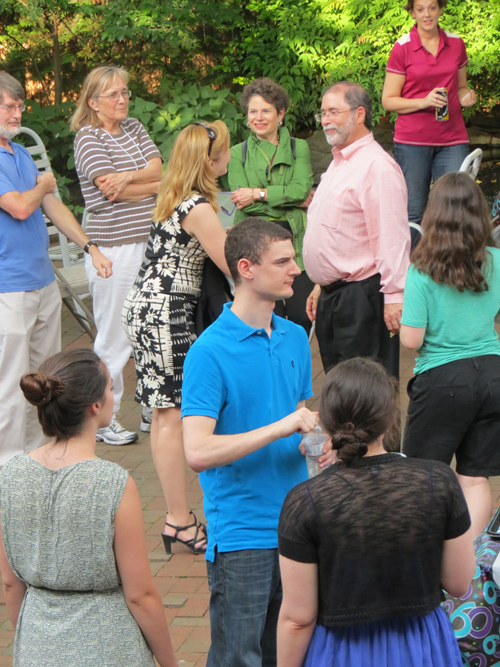
The backyard patio at the national headquarters was filled with friends and supporters whom Don has worked with over the years. The event includes food, wine, music and great company.
Formerly a paper distribution business owner, Don came to Washington in the early 1990s after deciding he much preferred “selling peace to selling paper.” Over the last twenty years, his role with the organization changed and he has been quick to evolve right along with the opportunities presented.
He was the Partners Program director for Global Solutions’ predecessor organization the World Federalist Association, before moving sideways and up to take on the CEO mantle at its sister organization, the Campaign for UN Reform. He returned “home” in 2004 when the two organizations merged to form Citizens for Global Solutions, becoming the new organization’s first Executive Vice President. In the summer of 2008, he stepped up to his current role as President & CEO of Global Solutions.
Don shared his thoughts at being with Global Solutions for so long.
“I want to thank you for celebrating with me this wonderful milestone in my life. I’m deeply appreciative of those who have honored me by supporting the cause that is my passion. We really do need a better-governed world where nations work together to solve the global problems that they cannot solve on their own. It’s hard to believe that for the last 20 years, one-third of my life, I have been blessed by the opportunity to work for a world where the law of force is replaced by the force of law. And I feel so incredibly fortunate to have labored in the trenches with all of you who have also dedicated your lives to peace, human rights and a sustainable future. Thank you for all that you do.”
Don is well known to global policy leaders inside the Beltway and to our membership across the country. He has helped create and steer many continuing efforts to promote our global vision both on Capitol Hill and across the United States. These include the Partnership for Effective Peacekeeping, the CEDAW working group, the Washington Working Group on the ICC and most recently, the Treaty Principals working group pushing back against a dangerous war on international law.
From grassroots campaign manager to CEO, he has helped build coalitions and fought for women’s rights, peacekeeping reform, and support for the International Criminal Court. As friends and supporters noted in wishing him congratulations on his two decades of service, he’s a global citizen and activist par excellence.
In lieu of gifts, friends made tax-deductible donations to support the efforts to which Don has devoted his career. In addition, many who were unable to join us at the national office–former and current colleagues, chapter leaders and fellow activists–sent well-wishes and congratulations.
To view more photos from the event or to leave a comment for Don, visit our Facebook album.
by Chuck Woolery | May 17, 2014 | Peace & Disarmament, World Federation
Nearly 300 young girls are still missing in Nigeria where they were kidnapped nearly a month ago by a murderous group of extremists calling themselves Boko Haram. They have claimed credit for this crime and intend to sell the young girls as sex slaves to help pay for future murders and crimes.
There are many contributing factors to this mass kidnapping, but the primary reason these girls were not rescued immediately or shortly thereafter is the world’s persistence acceptance of “national sovereignty” as the dominant paradigm of global governance.
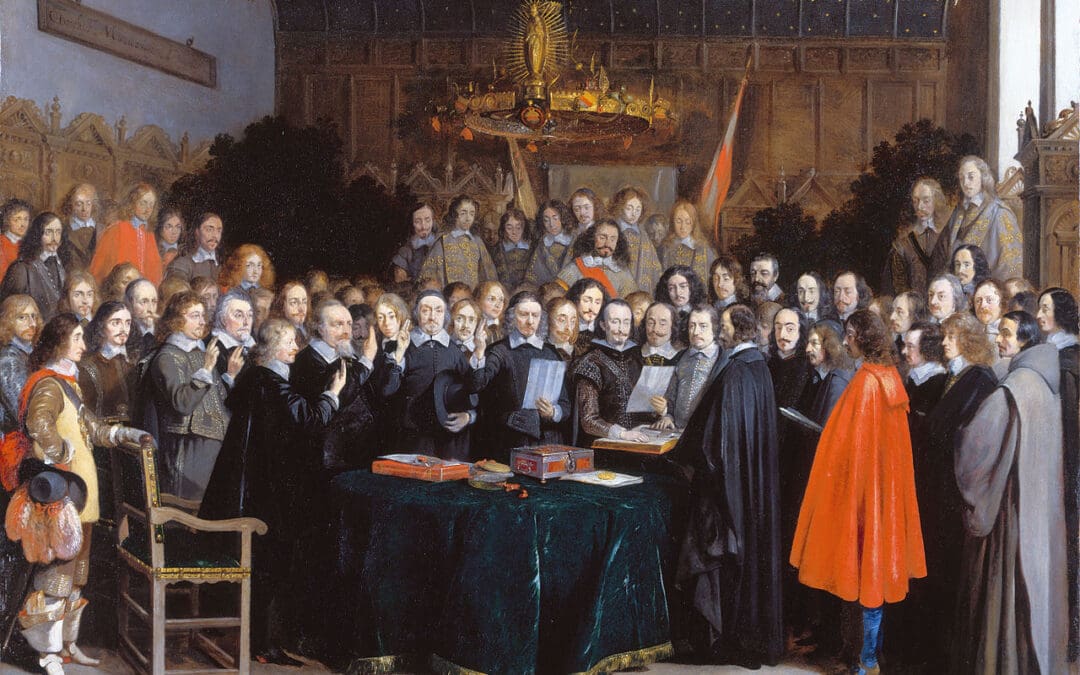
In other words, humanity still accepts the right of every national government to do whatever it wants, whenever it wants, to whomever it wants within its own borders. This barbaric paradigm was established nearly 400 years ago by the Treaty of Westphalia and remains today as the primary agreement between nations.
President Obama recently claimed there is nothing we can do about this crime against humanity because Nigeria is a Sovereign state. We offered some help once that government responded to our diplomatic cries, but that took weeks. Now it will be infinitely harder to find these girls and return those that are still alive to their grieving mothers.
The mind-numbing reality is that even if the UN had decided to take action immediately, it couldn’t have done so without first getting a decision by the UN Security Council. And, even with it, the UN has no established police force or SWAT team with a mandate or the capacity to protect innocent lives on short notice. National governments, including the US, has made sure of that. That is how strongly we still believe in the supremacy of nations’ sovereignty.
The government of Syria murders thousands using conventional weapons and even internationally “outlawed” chemical weapons, and all we or the world can do is draw red lines and ask that the mass murdering stop. Which it hasn’t now for nearly three years. The Rwanda Genocide, the most efficient mass murder in human history, was essentially the same story.
Protecting the rights of nations is more important than protecting the lives of innocent people. Similar or worse mass atrocities will continue until “we the people” of the world organize and demand a world constitution with a bill of rights that effectively puts the protection of human beings above the rights of national governments to do as they please.
We have a long way to go.
by Donna Park | Mar 25, 2014 | Peace & Disarmament, World Federation
Dear Jake,
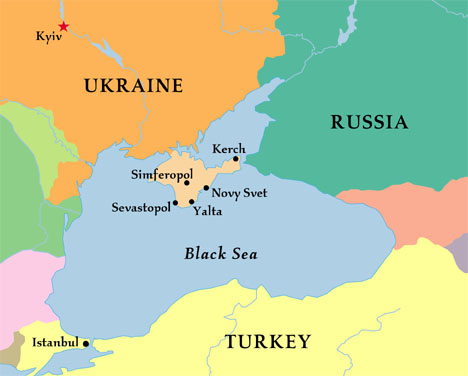
It was great fun seeing you and the twins on Skype this weekend. Every time I see you I can tell that you are bigger, stronger and smarter than the time before. You might be a little young for a history lesson, but I know you are not too young to appreciate a map, especially a map that looks like a puzzle.
In this letter I want to address the current crisis of Ukraine, Crimea and Russia and explain that I see a better way to solve crises like this one. As is often the case in understanding the problems of the world, it is good to start with a map and a history lesson.
In this map Crimea is the little peninsula hanging below Ukraine and to the left of Russia. It has had a tumultuous history, with many different governments over the past 100 years. Two events in the past are interesting to me. (1) In 1954 the Premier of the Soviet Union, Nikita Khrushchev, transferred Crimea from the Soviet Union to Ukraine. From the research I have done, It does not appear that the people of Crimea had any choice in this transfer; (2) In 1991 with the collapse of the Soviet Union, 54% of the Crimean voters supported independence from Russia with a 60% turnout. Although Crimea initially claimed independence, later that year they agreed to be part of Ukraine.
Now in 2014 the Crimean people have voted to reverse these steps and return to Russia. The problem with this vote is that it was not in accordance with international law and was done very hastily with Russian troops in the area sent by Russian President Vladimir Putin. International law prohibits one country from sending its troops to another country without an invitation. It also requires that before a referendum can be held to split apart a nation state, the current government, in this case the government of Ukraine, must agree to the referendum. Furthermore, steps should be taken to ensure the voting takes place in a fair and democratic process. None of that happened here. Putin is saying that what Russia did in Crimea was nothing more than follow the example set by the US and its NATO allies in 1999 to help Kosovo separate from Serbia. Although the US did not annex Kosovo the way Russia has annexed Crimea, it is true NATO used military force to help Kosovo separate from Serbia.
I think there is a better way to solve these kinds of problems in the world. I believe we need to transform the UN to be a strong, democratic, federal union of nations that can deal with problems such as these. We need strong international laws with individual accountability so that anyone who violates international law can be stopped and the case tried in a court of law. When there was disagreement about the referendum in Crimea, the world needed a bench of judges to stop the election and then decide how to proceed in a way that is consistent with international law. We need an international court of law to solve these problems, just the way the states of the US solve their problems in court.
In my next letter I plan to return to explaining my friend Joe’s book about transforming the UN system, unless there is another world crisis that needs to be addressed.
In the meantime, may you continue to grow in wisdom and strength.
Love,
Gram
by Ronald Glossop | Mar 8, 2014 | Climate Justice, World Federation
Books can provide us with valuable insights about our global problems and how to deal with them. A good example is Glen Martin’s The Anatomy of a Sustainable World: Our Choice between Climate Change or System Change and How You Can Make a Difference.
Martin is the Professor of Philosophy and Religious Studies at Radford University in Virginia. In this book, he asks us to recognize “the deep connections between our collapsing global ecosystem and our current world system of militarized nation-states and globalized corporate capitalism,” and examines the root causes of our current situation and argues for the specific changes which are needed to move beyond them.
Focusing on the link between ecology and sustainability, Martin notes that economic theorists can no longer continue “as if investment, production, and consumption were self-contained without thought of the immense negative external consequences that production and consumption have on society and the planetary ecosystem.” A new holism is taking place which will mean a transformation of institutions. It will mean the end of militarism and widespread use and waste of non-renewable resources. There are two prominent global institutions that will need to be transformed as we move to a holistic planetary outlook–global corporate capitalism and the system of independent “sovereign” nation-states. The existing system of voluntary treaties among nation-states and voluntary cooperation among international corporations “are all hopelessly inadequate forms of action in the face of our global climate crisis.”
Martin argues that we need to shift from the idea of negative freedom linked to the liberalism of the past to the new idea of positive freedom based on the quality of life in the community. Democratic government is then seen as an instrument to promote the “common good of the social whole,” a situation which requires “reasonable economic equality.” But few thinkers see that the global community needs “planetary democracy.“
“Our global situation today requires the vision to create a constitutionally mandated planetary community of positive freedom in which human beings are empowered to deal with the global crises that threaten our existence and future generations . . . . The ‘common good of all’ needs to be the product of a global positive freedom that is only possible under a democratic Earth Constitution. . . . [T]he creation of government alone will not suffice. However, government as the mainspring of positive freedom . . . remains the necessary prerequisite for a truly transformed world order.”
The second chapter provides the long-term historical background for the changes now taking place followed by the recent development of the Constitution for the Federation of the Earth. The third chapter gives a detailed explanation of and argumentation for the Earth Federation which incorporates specific measures to maintain the environmental sustainability of the Planet. The Earth Constitution is a totally ‘green’ constitution. In the fourth chapter Martin indicates why a revolutionary approach such as adopting the Constitution for the Federation of the Earth is required. “At the dawn of the twenty-first century, we are . . . in a position to self-consciously found a just, democratic, peaceful, and enduring planetary society.”
“Resistance and criticism to the present system, while appropriate, are not enough. We need a concrete, positive blueprint that we can envision, work for, and actualize. The Earth Constitution provides the best possible blueprint for system change-for founding a truly sustainable and democratic world civilization.”
A more complete review as well as reviews of other books related to solving global problems is available at http://GlobalSolutions.org/books.
by Donna Park | Mar 3, 2014 | Global Cooperation, World Federation
Dear Jake,
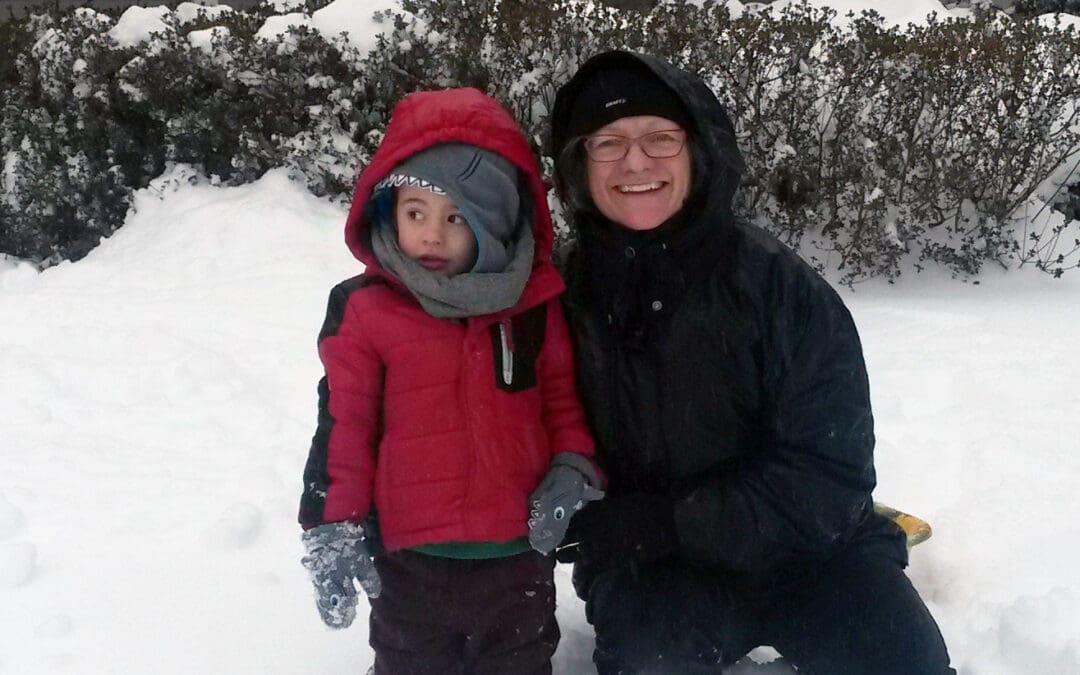
Now you are 3 years old! It is a delight to watch you grow up and I admire the way you “keep an eye on” your twin sisters Annette and Clair. I’m so proud of the way you can put together your jigsaw puzzle map of the world all by yourself. I want to transform our world so that children everywhere can be healthy, happy, and caring towards others.
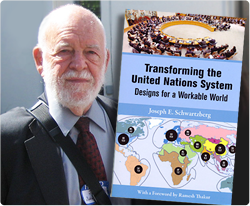
My last letter concluded with a sentence “There is much to be done to turn the United Nations into a strong, democratic, federation of nations.” I am reading a new book about this by a friend of mine, Professor Joe Schwartzberg, Professor Emeritus from the University of Minnesota. (Transforming the United Nations System: Designs for a Workable World.) Joe has done a lot of work creating a comprehensive plan to transform the United Nations so that it works better to solve the global problems facing planet earth. Joe shares my vision that we need systems in place to create and maintain world peace through world law with freedom and justice for all.
Joe’s first two suggestions involve what could be described as a legislative branch of a United Nations system. First he describes how the existing General Assembly (GA) should modify its voting so that the vote of each nation is weighted to take into account the size of its population, the amount of money it contributes to the United Nations budget, and the sovereign equality of nations. With weighted voting, Joe proposes that the GA could pass binding resolutions which are needed to move us towards the establishment of law for global issues like world peace and security.
Joe’s 2nd suggestion is to create a World Parliamentary Assembly (WPA) as part of the UN system in which the people of the world would be represented rather than the nations (as is the case in the GA). This would create a 2 house legislative branch for the UN similar to the way the United States has 2 Houses in our Congress. Joe has a very comprehensive plan for “baby stepping” our way towards a WPA. You’ll understand “baby steps” better when Clair & Annette start walking later this year!
Joe suggests that the number of seats in the WPA would be determined by a formula similar to the weighted voting described earlier for the GA. The number of seats for each nation would take into account the size of the population, the amount of money they contribute to the UN budget, and the sovereign equality of nations. Joe suggests that the seats be filled by representatives of political parties reflecting the parties in each country so that, for example, the USA would have both Republicans and Democrats seated in the WPA. In baby step 1 Joe suggests that the Nations appoint representatives to the WPA and they have only an advisory role. In step 2 there would be popular, fair, democratic elections within each nation and increasing legislative authority so that working together with the GA, the WPA would form binding global legislation in important matters of global concern. Joe has a vision for step 3 of a maximally democratic system in which national boundaries are often ignored and the number of people represented by each WPA member is relatively similar everywhere. This step might not happen even in your lifetime, if at all.
There are many exciting possibilities that could come out of these changes in the UN. It could lay the foundation for the establishment of global laws to help bring peace to our world. It also will help promote democracy in nations where it is lacking, by exposing all nations to democratic processes and elections.
Lots of good things for us to think about while you put together your jigsaw puzzle map of the world.
Love,
Gram
by CGS Blog Archive | Feb 26, 2014 | Global Cooperation, World Federation
The day he died, my organization got a hand-written letter from Pete Seeger, the 94-year-old iconic folksinger who departed last month after decades of inspiring us onward with his peace and justice ballads.
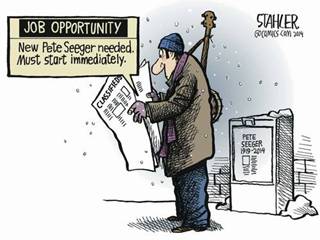
Now with his loss, we realize it is quite a gap to fill. Indeed, one political cartoon showed a hapless banjo player reading his paper’s page: “JOB OPPORTUNITY: New Pete Seeger needed. Must start immediately.”
What were his final messages to us? In an article last week entitled, “I’m Through With Big Things,” Seeger was quoted as saying, “Be wary of great leaders. Hope that there are many, many small leaders.” We know of his work to clean up the Hudson River, as well as his call for all of us to get involved at the local level. If he was disappointed in greater things, it was perhaps no wonder—for decades he suffered severe disappointments on the larger scene—a country which blacklisted him, record companies and television stations that marginalized him, and a youth culture and civil rights movement that passed him over when they became enamored by cooler music and more strident activism.
Yet Seeger never did falter from his dream of a united world. This visionary yet practical man understood that probably the one way to make sure all of the 193 countries on the planet would cooperate was through global rules with enforcement power, through a democratic, empowered and more fairly structured United Nations. With me, he was on the Board of Advisors for the Center for War/Peace Studies in New York which received his last letter on the day he died, though it was written October 5, 2013. In it Seeger expressed support for a proposal to reform the United Nations voting structure to make it more representative of the people through a proposal called the Binding Triad.
“The Binding Triad is such a great idea I’d like to do all I can while I’m on this earth to get it adopted by the United Nations,” Seeger wrote in his letter and he included ideas on how to better sell the idea to the public.
Seeger loved the earth and all life on it. He was always seeking solutions. As he recently sang with Tomorrow’s Children in Solartopia:
Now we’re fighting wars over oil and gas, no matter who wins it will not last.
The earth is scarred, the planet is warming. Don’t you think that all of it’s a great big warning?
Don’t you know we’re gonna need a Solartopia all over God’s green earth?
It is a testament to Seeger’s struggle, tenacity and final emergence into redemption that his vision decades ago holds just as true today. With the melting arctic, leaking nuclear reactors, collapsing world economy, continued wars over oil and broken political systems, we know that time is quickly running out. Instead of doom and gloom, however, Seeger inspired optimism with his own joyful sound. He realized there is even an answer to the largest catastrophes awaiting us – by organizing countries to work together at the global level.
“Participation – that’s what’s gonna save the human race,” was a slogan Seeger was fond of using. Fellow World Citizens, let’s all pick up our banjos and march our world into its brave new future.
This article originally appeared in Common Dreams.


 He was the Partners Program director for Global Solutions’ predecessor organization the World Federalist Association, before moving sideways and up to take on the CEO mantle at its sister organization, the Campaign for UN Reform. He returned “home” in 2004 when the two organizations merged to form Citizens for Global Solutions, becoming the new organization’s first Executive Vice President. In the summer of 2008, he stepped up to his current role as President & CEO of Global Solutions.
 From grassroots campaign manager to CEO, he has helped build coalitions and fought for women’s rights, peacekeeping reform, and support for the International Criminal Court. As friends and supporters noted in wishing him congratulations on his two decades of service, he’s a global citizen and activist par excellence.