by Donna Park | Sep 11, 2014 | Global Cooperation, World Federation
Letters to Jake Series, Letter #5
Dear Jake,
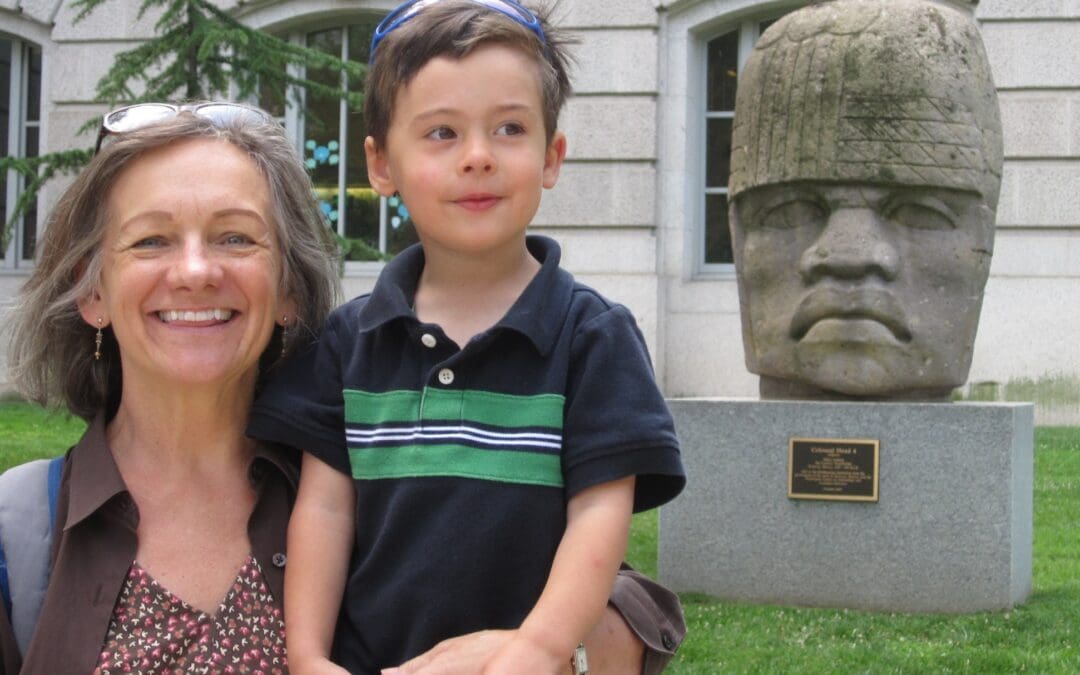
Our recent visit to the Natural History Museum was so much fun. Papa and I were very glad that you insisted on seeing the movie in the “Origin of Man” exhibit. “We Are All One Species” was a fascinating movie for children and adults alike. It was interesting to learn that the other human species died out 17,000 years ago, at about the same time that our species, Homo sapiens, migrated across the entire planet. It was good to see the images of men and women as a rainbow of one species from light- to dark-skinned and everything in between. Our differences are very minor compared to the commonalities that unite us.
This is at the heart of my desire to create a United Federation of Nations, to unite all human beings across the earth into a global community. I don’t want to eliminate the nations. Indeed, I want to be a proud American who can also say I’m a proud citizen of the world. I want the nations to deal with national issues and a federation of nations to deal with global issues that affect all Homo sapiens, like the environment, the oceans, war, and the world’s food supply and health threats.
Right now the world has so many problem areas, where adults and children are being killed or are fleeing their homes in an attempt to find safety. I believe that the best way to address these problems is with a strong, democratic united federation of nations to bring about the force of law rather than the law of force. We do need a strong peacekeeping force ready to go into problem areas to protect children and their communities. This force should include peacekeepers from multiple countries, not just from the US.
Although there is much to do to transform the United Nations into a strong, healthy, democratic United Federation of Nations, it is time for all Homo sapiens to demand that this be done. I believe the future of our species requires that we unite together.
Papa and I didn’t plan on taking you to the “Origin of Man” exhibit at the museum because we thought you were too young to appreciate it. But you definitely appreciated the fact that “we are all one species.” If a three-year-old can understand that, I have hope for the world.
I want a healthy, democratic and truly safe world for you, your twin sisters and all children of the world.
Love,
Gram
by Rene Wadlow | Jul 2, 2014 | Global Cooperation, World Federation
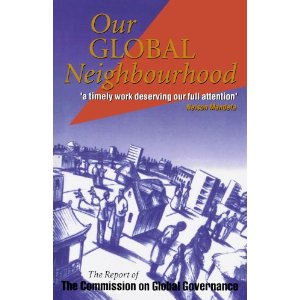
2014 marks the anniversary of the presentation in Geneva of the report of the Commission on Global Governance to an audience of UN Secretariat, diplomats, NGO representatives and academics. The secretariat for the Commission had been in Geneva just across the street from the Graduate Institute of Development Studies where I used to teach. I knew some of the secretariat, and we would discuss how the report was being drafted as the 28 Commission members were all busy with their professional tasks and spread out over the world.
In a pre-email world, the commissioners met four times in Geneva for several days; worked on drafts prepared by the secretariat led by a senior Swedish diplomat, Hans Dallgren; and then made additional suggestions. The report was published as a book in 1995.1
The Commission followed the footsteps of earlier commissions, often known by the name of its chairman: Willy Brandt on development, Olof Palme on disarmament and arms control, Gro Brundtland on the environment, Julius Nyrarre on North-South relations, and Sadruddin Aga Khan on humanitarian issues. The book’s name comes from one of the hopes of the UN Charter: “And for These Ends…to practice tolerance and live together in peace with one another as good neighbours.” It is unlikely that many of the Charter drafters or the Commission members ever lived in neighbourhoods in which people hate their neighbours and try to avoid them as much as possible.
Our global neighbourhood may not be that different!
As non-governmental organizations have been most active in the follow-up to the different reports of commissions − much more so than most governments − the Commission on Global Governance was the most open to receiving suggestions from NGO representatives, academics and government officials. I was part of a Geneva-based group of NGO representatives to the UN that prepared a joint statement for the Commission. I am not convinced that group efforts are more productive than a single individual writing on the same issue, but group proposals have the advantage of “balance” and geographic range that a single author does not.2
The book was written during an optimistic time period. The Cold War had ended formally in 1990, and the impact of local conflicts related to the breakup of Yugoslavia and the USSR had not yet sunk into broad consciousness.
Although the report makes no mention of “the end of history,” it is colored by the forces of democratic institutions, a market economy, and a strong trans-national civil society.
The Commission put forward a number of useful suggestions for restructuring UN bodies, especially to coordinate better economic and social policies and programs.
One of the innovations of Our Global Neighbourhood in contrast to the reports of other independent commissions was the emphasis on values and attitudes. The Report of the Commission concluded, “We also believe that the world’s arrangements for the conduct of its affairs must be underpinned by certain common values. Ultimately no organization will work and no law will be upheld unless they rest on a foundation made strong by shared values. These values must be informed by a sense of common responsibility for both present and future generations.”
Since relatively little has been done in terms of follow-up on the recommendations of the Commission, the book is worth re-reading today in the spirit of “Can it be done now, and if not, why not?”
Notes
1Our Global Neighbourhood (New York: Oxford University Press, 1995)
2 Ramesh Thakur, Andrew Cooper, John English (Eds.) International Commissions and the Power of Ideas (Tokyo: United Nations University Press, 2005)
by Don Kraus | Jul 1, 2014 | World Federation
I’ve sent you many messages over the last 20 years as a staff member and leader at Global Solutions. This will be my last as president & CEO. I love Global Solutions, and I’ll remain affiliated with the organization as a Senior Fellow while I pursue other projects. However, 20 years is a long time for anyone to work anywhere. Before I step down on July 10th I wanted to share some thoughts with you on the challenges our organization faces and some suggestions as well. It has been an honor to serve you and an honor to lead. I look forward to my new role and to continuing to work alongside of you. Thank you for all that you do.
by Logan Cotton | Jun 27, 2014 | Global Cooperation, World Federation
At the Citizens for Global Solutions Conference last week, there was no shortage of arguments that made the case for strong international norms and institutions. Clearly the planet benefits when we have a framework through which to peacefully resolve disputes, establish equitable access to resources, and prosecute crimes.
I spent the weekend thinking a bit about the approach we take toward achieving an “Earthling Peace” – pax terrana, perhaps? (I confess that I have never known Latin).
From the individuals present at the Conference last week, I consistently heard the argument for global government as a means to achieve world peace. When pressed on what constituted “world peace,” most articulated the removal of various obstacles to strife or calamity on earth. Examples might be the eradication of nuclear weapons or the adoption of sustainable lifestyles around the world.
These ideas, like this organization, were birthed at a particular historical moment. That moment, the aftermath of WWII, capitalized on the citizens’ disgust with the consequences of world war and their belief in the power of democracy to provide the most equitable conditions for the greatest number of people on the planet. Regrettably, the Cold War quickly tore into these optimistic perspectives, though many individuals – some of whom led the push for World Federalism and eventually established GlobalSolutions.org – held on to the ideal of global governance as humankind’s salvation.
I wondered if perhaps the route toward global governance would be the inverse of what these trailblazers initially advocated. Perhaps instead of global government facilitating denuclearization, the end of poverty, expansion of trade and so forth — perhaps countries will denuclearize, work against poverty, and expand trade before a “United Government of Earth” is formally established.
As wrong as it may seem, multilateralism is still very sexy, very “in,” around the world.
Mercosur is one example. The South American trade bloc, while certainly not without its problems, is the fifth-largest economy in the world and the fourth-largest trade bloc. Combined with the other South American trading bloc, the Andean Community of Nations (CAN), the prospect of full South American integration seems like a tangible goal. Cooperation within Mercosur and between Mercosur and the CAN countries has enhanced trade, movement of people, and coordination on education policy. And, if anything, countries seem to be committed to working through their problems in Mercosur and CAN as opposed to withdrawing their membership from either.
Another example is the Proliferation Security Initiative (PSI). The PSI’s purpose is to interdict and seize nuclear contraband as it travels the high seas. The PSI currently boasts the endorsement of 103 nations around the world – including the US, UK, Russia, and South Korea. The PSI, as a cooperative effort, has been successful at keeping nuclear materials from reaching Myanmar, Yemen, and Libya, among others. While in no way perfect, the PSI is providing added teeth to the disarmament norms that have continued among the nuclear powers.
As much as observers, myself included, thought we were witnessing the end of the European Union, the EU has held strong. Spending and austerity continue to frustrate the leadership of respective EU member states. However, the European community seems committed to further tying their fortunes together. The UK and France are sharing aircraft carriers and the Spanish, Italians, Portuguese, and Greeks still spend the Euro. International banking certainly deserves some credit (or “blame” depending on whom you ask) for keeping the EU tied together, but the role of banks doesn’t negate the fact that European continental identity is strengthened by the existence of the European Union.
So the landscape from my vantage point seems to be moving toward global governance without the need for global government as a pre-requisite. Regional blocs exist on every continent, and they are only increasing the pace of integration; states see opportunities abound as barriers to trade and movement are reduced. Flexible and innovative military accords are providing order to the global commons – most notably the seaways – as governments seek to monitor the activities of rogue actors. And perhaps we could even be so bold as to assert that if not for the irresponsible do-nothingness of this Congress, that US climate legislation would be far more progressive than it has been at Kyoto or Durban.
I’m not arguing against the utility of international law or global governance, only considering the possibility that we are on our way. There seem to be more trade blocs, regional cooperative agreements, and interest in regulating shared resources. Maybe the internal mechanisms of global governance will be birthed well before any decision is made about the name, title, and electoral processes of a global government.
I’m no expert — just someone fortunate enough to have the opportunity to muse on different ideas.
by Don Kraus | Jun 24, 2014 | Global Cooperation, World Federation
Earlier this month we lost a great friend and leader, Kermit Rohde. He passed away on June 2 in Austin, Texas, where he had been living with his daughter and son-in-law. Kermit was a dedicated World Federalist and a key supporter of GlobalSolutions.org.
Serving in the navy during WWII led Kermit to believe that international peace must be achieved through international law, and he became actively involved in organizations dedicated to this mission. He served as chapter chair in Lincoln, Nebraska; in Columbus, Ohio; and in the state of Oregon for the World Federalist Organization. He was a board member for Citizens for Global Solutions and the national president for the Federalist Caucus and the Campaign for United Nations Reform. Kermit was also a chair and active supporter of the Global Solutions Political Action Committee. He understood that if we wanted members of Congress to seriously engage in solving global challenges, then we needed to get serious about electing lawmakers who shared our values.
Kermit earned a doctoral degree in psychology from Northwestern University. In 1956, he moved to Corvallis, Oregon to teach in the psychology department at OSU, and taught there until his retirement in 1984. While there he served as president of the Oregon Psychological Association and as chair of the Oregon Board of Psychologist Examiners.
Kermit, along with his wife Barbara, raised four children in Corvallis and was well known for his activism on behalf of many political issues and candidates. Along with serving on the national board of Citizens for Global Solutions, he served on the board for the Wayne Morse Historical Park. The Rohdes also supported many arts and civic organizations and were active in their church. Kermit was a devoted husband and father, and he was delighted to have been able to celebrate his 50th anniversary with his wife Barbara before her death in 2001.
Kermit is survived by his daughter Kate Rohde and son-in-law David Cohen of Austin, Texas; by his daughter Gale Rohde of St. Paul, Minnesota; by his son Scott Rohde and daughter-in-law Sybelle Timberlake of Urbana, Illinois; by his son Rory Rohde and daughter-in-law Marianne Bernhard of Hamilton, Virginia; and by his three grandchildren, Zak, Alex, and Sarah Rohde.
A gathering in Corvallis for a service honoring Kermit will be held on August 16 (time and location to be announced). In lieu of flowers, the family suggests donations to a charity, including GlobalSolutions.org.
by Don Kraus | Jun 6, 2014 | Peace & Disarmament, World Federation
Today on this 70th anniversary of D-Day, we pay tribute to those who served and those who sacrificed their lives. We remember, in the words of President Obama speaking on Omaha Beach in Normandy, France, “the more than 150,000 souls set off towards this tiny sliver of sand upon which hung more than the fate of a war, but the course of human history.” He said, “These men waged war so that we might know peace. They sacrificed so that we might be free. They fought in hopes of a day when we’d no longer need to.”
This was the hope and vision of so many veterans who returned from WWII. A world where the law of force was supplanted by the force of law. Today we not only honor those who fell, but those who came home and said, “We must never do that again” and worked for world peace through world law.
I think of men like Hamilton Kean, who served in a tank in the war, and whom we will honor with the Global Citizens award in a few weeks at our annual conference. Ham has committed his life to education and advocacy for a world in which nations work together to abolish war, protect our rights and freedoms, and solve the problems facing humanity that no nation can solve alone.
I think of men like Ben Ferencz, who liberated Nazi concentration camps, returned to Europe as a prosecutor in the Nuremberg tribunals and then went on to successfully work for the creation of the International Criminal Court. Ben is an inspiration for so many.
I remember my dad, Bob Kraus, who served in the Army Air Corp and would have been 93 today. I thank him for his vision of a peaceful world that helped to shape my path and mission.
And I think of all of those other returning WWII vets who came together to found the United World Federalist in 1947. Today we stand on their shoulders. They created the foundation and vision of a world where humanity will know war no more.