by Melissa Kaplan | Mar 19, 2012 | Global Justice, News, United Nations
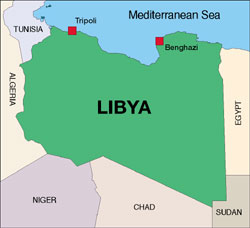
Abdullah el-Senussi, former Libyan intelligence chief and brother-in-law of Muammar Gaddafi, was arrested this weekend in Mauritania. The big question now is, where and by whom will he be tried for his crimes?
Senussi was indicted by the International Criminal Court (ICC) on charges of crimes against humanity stemming from the government’s attacks on civilians last year prior to Gaddafi’s fall from power. However, the ICC is not the only body that wants to bring Senussi to justice-France has also sentenced him in absentia to life in prison for his involvement in the 1989 bombing of a plane over Niger in which 170 passengers, many of them French, were killed. And Libya wants to punish him for a crackdown on a prison riot in Tripoli in 1996 that left 1200 dead.
So who gets Senussi now? It’s not entirely clear. The ICC, France, and Libya have all expressed the desire to take him into custody and try him for his various crimes, and it is not certain what Mauritania will do with him.
“We insist that Senussi is extradited to Libya,” stated Mohammed al-Harizy, a spokesman for Libya’s National Transitional Council. “There are demands from the ICC and France to get Senussi, but the priority is to deliver Senussi to Libya.”
However, given the current state of its judicial system after years of Gaddafi’s rule, it is unclear what kind of trial the Libyan government can provide for Senussi. The ICC has said it will work with Mauritania to get the country to turn Senussi over to the Court. Mauritania is not an ICC member, but since the situation in Libya was referred to the ICC by the U.N. Security Council, it has an obligation to cooperate with the Court.
We will keep you informed as events unfold further.
by Melissa Kaplan | Feb 13, 2012 | News, Peace & Disarmament, United Nations
Tomorrow may be Valentine’s Day, but for those of us who care about international affairs funding (or federal funding of any kind, for that matter), today was a day which has long been almost as breathlessly anticipated: the release of the President’s annual budget request for the upcoming Fiscal Year 2013. (I know, not as delightful as Valentine’s Day, but still important.)
President Obama stressed that his overall budget aims to balance many different priorities, such as spurring job growth while reigning in the deficit. But stepping away from that bigger picture, what does the President’s budget request mean for funding for international affairs in the next year?
President Obama has requested $51.6 billion for the Department of State and the U.S. Agency for International Development (USAID). Within that, budget priorities include funding for the “frontline states” (Afghanistan, Pakistan, and Iraq); human and economic security; support for embassies and the U.S. global presence; and support for U.S. allies and contributions to multilateral organizations.
When it comes to U.S. support for the United Nations, the funding outlook is actually pretty good. The President has requested $1.57 billion for the Contributions to International Organizations (or CIO) account, which pays U.S. dues to the United Nations and many other international organizations in which we participate, including NATO and the International Atomic Energy Agency (IAEA). This is an increase of $19 million over last year’s funding level. The President also asks for approximately $2.1 billion for the Contributions for International Peacekeeping Activities (CIPA) budget account, which funds peacekeeping missions in countries around the globe including Darfur, Haiti, and the Democratic Republic of Congo. The request for CIPA is $270 million higher than last year’s total.
The Obama Administration took the opportunity of the budget release to express strong support for both multilateral institutions such as the U.N., and for U.N. peacekeeping, asserting that:
“The Administration will advance the President’s vision of robust multilateral engagement as a crucial tool in advancing U.S. national interests, accomplished through our contributions to the United Nations, peacekeeping operations and international organizations. Our contributions enable U.S. participation in over 40 international organizations that maintain peace and security, promote economic growth, and advance human rights around the world. Peacekeeping assessments fund peacekeeping activities directed to the maintenance or restoration of international peace and security, and promote the peaceful resolution of conflict.”
Overall, it looks like a pretty good picture for the international affairs budget. I appreciate President Obama and Secretary Clinton’s strong support for the U.N. and peacekeeping, in particular. Now I hope that when the House of Representatives and Senate sit down to craft their annual appropriations bills, they will echo the President’s support for robust funding for the small sliver (roughly 1 percent) of the federal budget that funds America’s relations with rest of the world.
by Julia Bunting | Jan 20, 2012 | Global Cooperation, News, United Nations
The United States Mission to the United Nations has issued a statement today that lays out how America plans to lead on U.N. reform in 2012. While the global community has long called for such reform, the statement details some progress that the U.S. has already made, reforming the U.N. budget for only the second time in 50 years, saving American taxpayers $100 million. The U.S. has also pushed for increased transparency, especially promoting public disclosure online of all internal audit reports starting in 2012.
The statement outlines how the U.S. Mission believes the U.N. can move forward on further reforms to make the U.N. more effective and efficient. They suggest several recommendations, including steps to make the U.N. more cost-effective, reduce administrative bureaucracy while increasing accountability, address issues of corruption and unfairness, and increase overall efficiency throughout the U.N. system.
The statement underlines the importance of a strong U.N. to global peace and prosperity. It affirms, “The United States has led at the U.N. since its creation because a strong, effective U.N. is among the best tools we have to tackle the world’s most pressing challenges.” Providing food and medicine to the world’s neediest, monitoring and protecting human rights and deploying humanitarian aid following natural disasters are just a small sample of the critical work of the U.N. Strengthening and reforming the institution will hopefully help us to better cooperate and collaborate on these critical global issues. Stay tuned for my blog on Monday with additional in-depth analysis.
by Melissa Kaplan | Dec 19, 2011 | Global Cooperation, News, United Nations
In my job, it’s not that often that I look at the results of the congressional appropriations process with satisfaction, especially in the current economic and foreign policy climate. However, Congress has surprised me this year in two welcome ways.
First, the House and Senate passed a large “omnibus” appropriations package, including funding for the State Department, before their Christmas recess without threat of a government shutdown (okay, it’s two and a half months past their original deadline, but why quibble?). Second, the Fiscal Year 2012 budget mostly delivers pretty good results for the international affairs budget. It’s a Christmas/Hanukkah/Kwanzaa miracle!
The final results of the huge appropriations package, which combine funding for departments from nine separate appropriations bills, were about as good as could be hoped for in the current economic and political environment on Capitol Hill. The legislation provided about $1.45 billion for the Contributions to International Organizations (CIO) budget account, which pays our dues to international organizations such as the U.N. and NATO, with about $100 million extra designated for a related account, bringing the total level up to about $1.55 billion. This amount is technically below the level needed to keep the U.S. from falling behind into arrears on its U.N. dues; however, since the U.S. will not be funding UNESCO this year due to the Palestinian membership issue, the amount will hopefully be sufficient to keep us out of arrears at the United Nations.
Congress also provided $1.83 billion for the Contributions to International Peacekeeping Activities (CIPA) budget, which funds U.N. peacekeeping missions around the globe. Another $91 million was provided specifically for peacekeeping in Somalia, bringing the total funding level to $1.92 billion. This actually represents an increase from last year’s level (wow!) and meets the President’s budget request. Due to some unforeseen changes since the President made this request last February, more funding will be needed to keep the U.S. out of arrears on peacekeeping dues at the U.N.; but it appears likely the State Department has enough available “credits” to meet its obligations. Fingers crossed….
All in all, given the difficult climate and budgetary constraints that have become an unfortunate reality these days, I think it’s fair to say that Congress delivered pretty well for the international affairs budget this festive season. I wish them, and you, a happy holiday, and look forward to seeing what 2012 will bring.
by Melissa Kaplan | Dec 12, 2011 | Global Justice, News, United Nations
Today, I attended the opening session of the Tenth Assembly of States Parties meeting of the International Criminal Court (ICC) in New York City. As I walked into the United Nations building this morning to collect my badge, I was excited to see what the day would bring at my first ASP meeting. It turned out to be quite an interesting and eventful morning. Some highlights:
–Ambassador Tiina Intelmann of Estonia was elected as President of the Assembly of States Parties, and presided over the day’s session;
–The President of Botswana gave an outstanding speech urging African state parties to cooperate with the ICC, for the mutual benefit of the Court and Africa, and called out UN Security Council members who have vetoed important resolutions due to “politics;”
–UN High Commissioner for Human Rights Navi Pillay spoke about how the ICC has helped to deter tyrants, and that the Libya trials–wherever they are ultimately held–will be a victory for the Rome Statute;
–ICC Prosecutor Luis Moreno-Ocampo spoke about the Court’s work since its inception in 2002, and how the “shadow of the Court” has served as a deterrent to those who would commit heinous crimes;
–And finally, the ASP elected, by acclamation, Fatou Bensouda as its new Prosecutor-Elect. She is currently the ICC Deputy Prosecutor. She will take over from Ocampo when his term ends in June 2012. Bensouda is the second Prosecutor in the Court’s history, and the first woman and first African to hold this critical position. I also got a chance to shake hands with and congratulate Bensouda on her election–the highlight of the day for me!
I will be at ASP for a few more days, and I’ll provide updates on the goings-on in the next few days. It’s been a fascinating experience so far!
by Melissa Kaplan | Nov 29, 2011 | Global Justice, News, United Nations
International Criminal Court (ICC) Prosecutor Luis Moreno-Ocampo has said that Libya’s transitional government has agreed to work with the ICC and the United Nations to investigate alleged crimes committed by Saif Gaddafi, the recently captured son of the late Libyan dictator Muammar Gaddafi.
The subject of where Saif would be tried – either at the ICC or in Libya – has provoked much debate since his capture. The ICC had issued arrest warrants for Saif, his father, and Gaddafi’s former intelligence chief Abdullah al-Senoussi for crimes against humanity stemming from their involvement in the violent crackdown on civilians which took place in Libya for several months this year. Because the UN Security Council referred the situation in Libya to the ICC, the Court has jurisdiction over the case, even though Libya is not an ICC state party. However, some in Libya had expressed the desire to hold Saif accountable in their own country rather than handing him over to the Hague for trial.
Prosecutor Ocampo seems satisfied with the Libyan government’s vow of cooperation on the Saif Gaddafi case. It is now critically important that the country’s National Transitional Council fulfill this pledge. Even as Libya begins to pick up the pieces and rebuild a post-Gaddafi nation, those responsible for crimes against civilians, including Saif Gaddafi, must be held accountable and brought to justice.