by Kevin Burke | Apr 15, 2014 | Global Justice, United Nations
In recent years, we’ve come to recognize that the world is interconnected, perhaps in ways and on a scale that it never has been before. We live together and affect each other on the same small planet and we are all fundamentally equal regardless of where we are born. Global justice is about deciding how the institutions those interactions create, formal and informal, social, political, and economic, should be managed in a just, equitable way, where everyone is treated fairly and no one is abused.
New international institutions were born in the last century to cope with the consequences of depression and devastating wars in a globalizing world. The United Nations was designed to pursue diplomacy on a variety of issues, and its Security Council in particular was designed to prevent great power war. The International Monetary Fund and the World Bank were designed to rebuild the global economy and keep it stable, so that every state can participate and so that no single state could make a mistake with its economy so terrible that it dooms us all. Institutions keep being birthed, too: a World Trade Organization has formed to help states better manage the flow of goods and services, an International Criminal Court started work just a decade ago to hold violators of human rights to account for their crimes, and more institutions have been created, including regional courts, issue-focused IGOs, and others.
These international institutions do much good, bringing food and shelter to refugees, helping us understand human rights violations, and helping keep the world stable in ways it may not be otherwise.
But if global justice is an institutional concern, then our hopes were for better institutions than these. From the standpoint of justice, institutions that favor certain classes, become corrupt, or fail to treat people fairly must be reformed. Global problems require global solutions, and while these institutions are nearly global in their scope, they are not global in their constituencies: they are international. States have different interests than people do and, in particular, the most powerful states have much of the influence over these institutions. Because Russia has a veto over the UN Security Council’s decisions, Syria remains in flames; because the U.S. refuses to hold a ratification vote, the IMF has its funds restricted and cannot have its vote structure reformed; North Korea is allowed to continue committing atrocities against its citizens because China is an ally. The list goes on. And issues like the 2008 financial crisis, where billions were affected by policies in just a few countries, are not managed in a way that is meaningfully accountable on a global scale.
And yet all the people affected by these issues, whose rights may be deprived by power politics or the simple failure of institutions, have little opportunity to demand reform. The great powers designed the institutions and get to decide when and if they reform; they often decide what actions they take and when they take them. We must reform these institutions in the name of justice.
International institutions changed the world in the 20th century. From setting up the international human rights regime to providing relief supplies and peacekeepers in crises to funding governments and their citizens when in desperate need, these institutions have become a necessary part of daily life. But international institutions are severely flawed: they are not truly global and fail to meet their missions because they are too deeply entrenched in the politics of states. We need a 21st century solution to global problems; let’s reform international institutions to make them more fundamentally global.
by Josh Spesaison | Apr 14, 2014 | Global Cooperation, United Nations
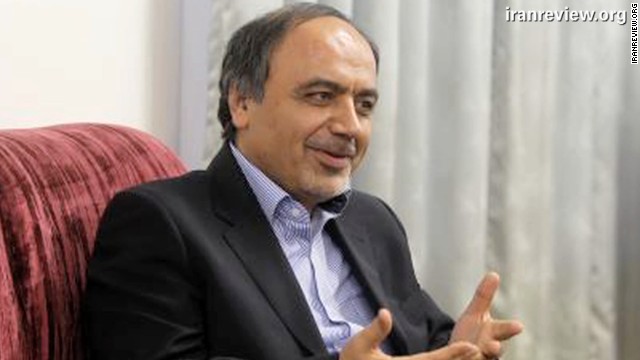
The recent move by the Obama administration to bar Hamid Aboutalebi, nominated to be the Iranian ambassador to the UN, from entering the U.S. weakens the United Nations. By denying Aboutalebi a visa to access UN Headquarters in New York City, the United States is effectively commandeering UN policy and forcing the world organization’s proceedings to bow before U.S. national security interests.
The denial ignores the 1947 U.S./UN agreement that the U.S. will not interfere with diplomatic rights, the only exception being if the diplomat’s visit raises national security concerns.
The administration and Congress has overreacted to Aboutalebi’s role as a translator in the 1978-61 Iran Hostage Crisis. Aboutalebi, 22 during the crisis, has since lived the life of a career diplomat. He’s been the ambassador to Italy, Australia, Belgium, and the European Union. If he were a “terrorist”, as Senator Cruz labels him, then these countries and the EU would certainly never had allowed him to enter their territory.
Our leadership, in favor of negotiating nuclear capabilities with Iran or not, is still trapped by the perception of Iran as the enemy. I do not believe Aboutalebi is an enemy of the United States. However, what’s more concerning is the willingness of the U.S. to use its position as host of the UN headquarters to unilaterally satisfy national interests. The United States has no right to interfere with Iran’s choice for UN ambassador. No other nation in the world has this unique power over UN member states, given the location of UN Headquarters. The U.S. must restrain its policy to allow the world organization operate naturally.
by Josh Spesaison | Mar 10, 2014 | Global Justice, United Nations
The UN Security Council has been called out by its own the Human Rights Council’s Commission on Inquiry in Syria as enabling the continued human rights violations taking place. The ineffectiveness and unreliability of the world body in resolving the crisis led to the Commission’s harsh assessment.
“The absolute impunity that pervades the conflict, now entering its fourth year, is utterly unacceptable. The leadership of each party must be held responsible for the violations of its members, and must take action to curb these violations,” says Paulo Sérgio Pinheiro, Chair of the Commission. “Such inaction [by the Security Council] has provided the space for the proliferation of actors in Syria, each pursuing its own agenda and contributing to the radicalization and escalation of violence.”
While barrel bombs continue to drop onto civilian homes and people die from starvation, the Security Council members continue to bicker. Their inability to view the Syrian crisis as humanitarian, and not as your-ally-versus-mine, is preventing the necessary action to stop the violence.
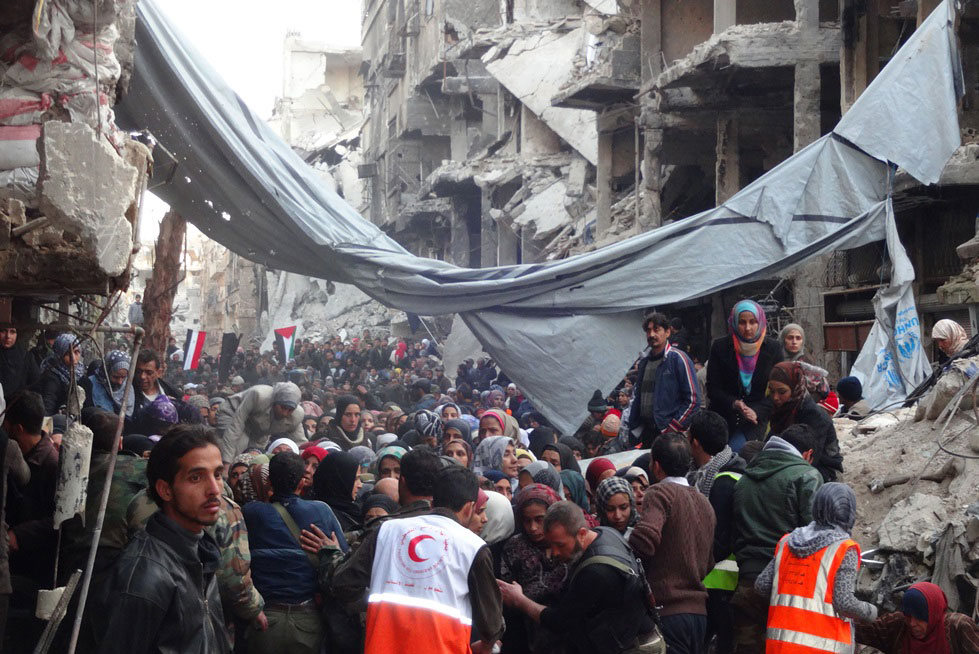
There has been a great deal of fighting around the Yarmouk refugee camp which is preventing the supply of humanitarian assistance. Without the aid provided through the UN the people are subjected to mass starvation. The situation described at the Yarmouk camp is reflective of the other refugee camps which together host an estimated 2.5 million people.
The Security Council initially found itself deadlocked because Russia was standing behind Bashar al-Assad. But due in part to the Council’s inaction, this is no longer just a fight between pro-democracy rebels versus a “legitimate” authoritarian government. The Commission of Inquiry has cited both pro-government and non-state actors as perpetrators against human rights.
In light of this assessment and other recent developments, I believe the United States should make another push for a Security Council resolution that reframes their view of the crisis and aims to end the combat between all factions in Syria. This is not East vs. West, it’s not Shia vs. Sunni, this is humans killing humans on a grand scale. The permanent members should actually try to provide security for the world, as the name of the Council suggests they might do.
by Don Kraus | Oct 29, 2013 | Global Justice, United Nations
What if you could help prevent the next Rwanda, Darfur or Syria? Would you?
Time and time again as atrocities unfold, the United Nations Security Council is called upon to act but cannot due to the threat of a veto by one of the permanent members. It’s time for that to change.
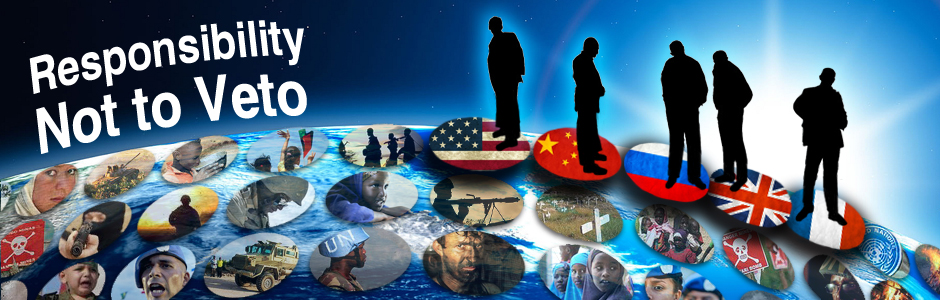
It’s time for countries to agree that permanent Security Council members have a “Responsibility Not to Veto” when it comes to genocide and other mass atrocities.
GlobalSolutions.org has just launched a petition to asking President Obama to be part of a discussion about the responsible use of the veto at the Security Council.
We envision a Security Council that works. Imagine a Security Council that pledged not to use the veto in situations of genocide and other mass atrocities. That’s a world we want to live in. Unfortunately, permanent Security Council members have used (or threatened to use) their veto power far too often. The veto power stopped immediate life-saving action in the Rwandan genocide, Darfur, and Syria.
No leader should ever use helicopter gunships, artillery, chemical weapons or even machetes on unarmed women and children and get away with it. 800,000 people were killed in Rwanda, 300,000 so far in Darfur, and close to 115,000 in Syrian. Actions to stop each of these genocides and mass atrocities were slowed by vetoes or the threat of a veto at the Security Council. We cannot stand for inaction in the face of senseless killings.
Our vision isn’t just a pipe dream. It’s serious. France’s Foreign Minister is calling for the Security Council to “voluntarily regulate their right to exercise their veto.” And he isn’t alone. He’s joined by U.N. Secretary General’s Ban Ki Moon and Kofi Annan as well as former Secretaries of State and Defense Madeline Albright and William Cohen and many other dignataries. Check out my post with links to resources and history for more info.
The world needs to stop the violence in Syria, but we also need to focus on how to prevent these situations in the future. That’s why we’re asking the Obama administration to be part of a discussion on the responsibility not to veto.
Join me in saying no to another Syria, Darfur or Rwanda
by Don Kraus | Oct 24, 2013 | Global Justice, United Nations
It’s United Nations Day! Sixty-eight years ago, the U.N.’s charter came into being “to save succeeding generations from the scourge of war… to reaffirm faith in fundamental human rights… and to promote social progress and better standards of life in larger freedom.”
But this is not just a day to celebrate what the U.N. has accomplished. It is also a time to recommit to working for a U.N. that can actually accomplish its visionary goals.
What if you could help to prevent the next Rwanda, Darfur or Syria? Would you? GlobalSolutions.org is pushing for the P5 – the United States, Great Britain, France, Russia and China – to agree not use their veto in the Security Council when dealing with genocide and other mass atrocities. It has happened too often:
- In 1994, while the savage genocide in Rwanda raged, France, Great Britain and the U.S. used their power to prevent the deployment of a reinforced peacekeeping operation in the first few weeks after the killing began. Over 800,000 lost their lives.
- From 2003 to 2006, at the height of the killing in Darfur, Sudan, China and Russia threatened to veto any Security Council decision to authorize military force, or even serious economic sanctions. More than 300,000 died and the killing still continues.
- Since 2011, Russia and China have vetoed three separate resolutions to stop the killing in Syria. Russia even blocked statements expressing concern over the lives lost and the use of chemical weapons. Close to 115,000 Syrians have been slaughtered – with no end to the fighting in sight.
This is a serious proposal. France’s minister of foreign affairs, Laurent Fabius, in the New York Times just called for the P5 to “voluntarily regulate their right to exercise their veto.” Bill Clinton’s Secretaries of State and Defense, Madeline Albright and William Cohen, support limiting the veto, as has U.N. Secretary General Ban Ki Moon and his predecessor Kofi Annan.
However, right now GlobalSolutions.org is the only U.S.-based organization focused on this important proposal.
We are calling this the “Responsibility Not to Veto.” Why? In 2005, all U.N. member states agreed they have a responsibility to protect their populations from genocide, major war crimes, crimes against humanity and ethnic cleansing. If P5 members use or threaten to use the veto power to protect the leaders of their client states who are perpetrating these crimes, they are not fulfilling this responsibility.
In a speech before the U.N. General Assembly, President Obama said, “sovereignty cannot be a shield for tyrants to commit wanton murder, or an excuse for the international community to turn a blind eye to slaughter… should we really accept the notion that the world is powerless in the face of a Rwanda or Srebrenica?”
However, the fact is that until we rein in the veto, the Security Council the world needs is not the Security Council we have.
This United Nations day, please join with me and support the vision of the U.N.’s founders. Let us work together and take a bold step towards a world where we have truly tamed the scourge of war.
by Kevin Burke | Oct 22, 2013 | Global Cooperation, United Nations
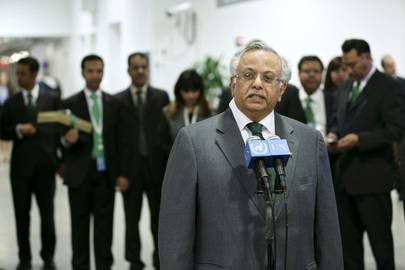
Last week, Saudi Arabia was one of five states elected to the UN Security Council for a two-year term. In a surprise move, they released a statement to the press the next day rejecting their seat. In what follows, I’m going to explore their decision and why the hierarchical nature of the Security Council is frustratingly difficult to overcome. That hierarchy has a real effect on smaller, less powerful, or historically disadvantaged states, and the Saudis’ frustration is the latest sign that Security Council reform has a long way to go.
So here’s what happened:
Over the past few years, Saudi Arabia has actively pursued membership on the UN Security Council – they’ve lobbied for a seat, trained staff, even celebrated their election to the Security Council on the floor of the General Assembly. This was a big deal to them.
Then Friday, the Saudi Foreign Ministry issued a press release denouncing the UNSC for its failures on the Israel-Palestine issue, Syria, and “work mechanisms and double-standards on the Security Council” that make it ineffective. Why the sudden change of heart?
As we can assume all states do, Saudi Arabia is seeking its rational self-interest in international affairs (we may not always agree what that is or how to achieve it, but that’s the idea). The Saudis’ conception of their self-interest is primarily focused on their regional rivalry with Iran, which they see through the lenses of sectarian difference (Sunni Saudi Arabia vs. Shi’ite Iran), military power (Iran’s nuclear program is a big concern), and economics (sanctions against Iran have an effect on Iran’s ability to export oil and compete in other economic arenas).
Now consider Saudi Arabia’s self-interest in Syria as it relates to Iran. The Assad regime is backed by Iran, and remains one of Iran’s primary allies so long as it remains in power. The majority of the population in Syria is Sunni; whether Saudi Arabia’s support for the rebels is religious or purely self-interested is less certain than the fact that they benefit both from a prominent role in ending the war and from regime change. They can remove a major ally of Iran and possibly gain one of their own, even if this takes time and effort. Certainly the UN Security Council’s feet-shuffling on this issue must have been maddening for a state seeking to influence the regional balance of power.
Note also that Iran is now in a series of negotiations regarding its nuclear programs. Negotiations with whom? The five permanent members (P5) of the Security Council plus Germany. Not the full Security Council as an ad hoc negotiating group or Informal Council. Just the P5(+1). We’ll come back to the implications of those states’ membership in a bit.
Add in a little flavor, namely that Saudi Arabia’s relationship with the United States has become more distant over Middle East issues like Egypt, where Saudi Arabia has chosen to support the military even after the US has withdrawn support, and you can see how a royal family might feel like its overtures to power were being…stymied, perhaps by other states, but perhaps also by institutional design. It’s also likely that Saudi Arabia had some concerns about taking public stances on particular issues and that the differences with the US over Egypt drew this concern into stark relief.
Does this mean Saudi Arabia did the right thing for their self interest? It’s hard to say. Analysts have mostly been baffled by the decision, noting that Security Council members, even the elected non-permanent ones, have important roles in agenda setting and crafting the non-binding Press Statements that come from the Council. But this is bold! No one’s ever done this before! Is this actually going to result in some kind of reform?
That last question is the most interesting to me. Because even though it’s true that a UN Member State who is on the Security Council has more power on security issues than one who isn’t, Saudi Arabia has pointed out one of the biggest problems with the Security Council: it is fundamentally hierarchical, the power structure in that hierarchy is very asymmetrical, and that hierarchy is the aspect of the UNSC that is most difficult to change.
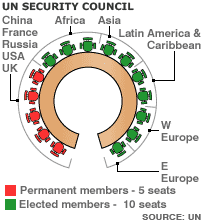
What do I mean by a hierarchy? Here’s the deal: each state in the UN is not created equal when it comes to matters of security. In the General Assembly, everybody gets one vote, and while it’d be a stretch to call it a democracy, at least all the states are treated as roughly equal. In the Security Council, the great powers who won World War II (the US, UK, France, Russia, and China) set themselves up with permanent seats that have a veto over any of the binding (potentially backed by sanctions or force) resolutions that the Security Council issues. In other words, any one of those five states can, by their disagreement alone, prevent the resolution of any issue that comes before the Council, at any time. The veto makes these members immensely powerful on the Security Council. The elected, non-permanent members have the ability to vote on binding resolutions (these votes do matter – if the P5 all voted for a measure and were outvoted by the elected members, their will would be overturned; in practice this never happens), and they serve rotating terms on the Council’s presidency; since the Council does much of its work by consensus, elected members get substantial say in the agenda, work, and output of the Council.
But their influence isn’t nearly the same as the permanent members. Because any state can come before the Security Council when its interests are directly affected by an issue before the Council, all UN members have some presence on the Council. But many have never held a seat on the Council, and have much less experience of its procedures and standards. So the hierarchy goes something like this:
(1) Permanent members (always Russia, France, the UK, China, and the US)
(2) Elected, non-permanent members with two-year terms
(3) UN member states not currently on the Council who’ve been there before
(4) All other UN member states
(5) Everybody else (non-member states, regional organizations, NGOs, individuals affected by an issue before the council, etc.)
And as you go down the hierarchy you have less power.
But the most important thing, the thing Saudi Arabia’s trying to draw our attention to, isn’t that they were trying to jump from number 4 to number 2 on that hierarchy. It’s that the five states in bucket number 1 have such a great amount of power as to nearly make buckets 2 through 5 insignificant by comparison. Moving anywhere along the rest of the hierarchy, we might interpret Saudi Arabia to be saying, is a waste of resources. The permanent members of the Security Council have a substantially larger amount of power that affects everything about the way the council works, and it’s in the UN Charter itself!
Think back to Syria. Saudi Arabia has put endless diplomatic hours into the issue. They’re actively supporting rebel groups financially, militarily, the whole deal. But when the US threatened to attack Syria over chemical weapons, a relative non-issue for the Saudis (they’re certainly not angels on the issue of human rights, as its pummeling at the UN Human Rights Council on Monday made clear), and Russia worked with the US to craft a new Security Council resolution that neither resolved the conflict nor met the Saudis’ interest, it suddenly became clear that the Security Council was not nearly so influential a body as they had hoped. Two states suddenly decided to take action where fifteen working allegedly in concert did nothing. And none of the elected, non-permanent members had a substantive say in that process.
So while we can see the Saudis’ announcement through their eyes now, we can also see it as a clear demand for reform on the UN Security Council. Because all the permanent members were decided upon when the UN Charter was originally agreed to in 1945, its membership is an historical anachronism. Because the council has an asymmetrical hierarchy, reform is a matter of justice: the imbalance of power affects small states substantially, and even though their issues may be pressing, they can be ignored or marginalized if their interests don’t align with a P5 member. Even heavily populated states like India and Brazil or economically powerful states like Germany and Japan get left out of the all-important veto. What about the have-nots? Security issues could come up for just about anybody, and do, frequently, all over the globe.
So it’s not just about Saudi Arabia. Reform affects everybody. How’s that going, anyway?
UN Security Council reform focuses on three key issues:
A) Expansion of the number of states with the veto*;
B) Membership of the UNSC itself, expanding from 15 to (e.g.) 24 members, or adding regional bodies like the EU to the council, etc.;
C) Modification of working methods within the council, to improve results, accountability, and the perceived legitimacy of council actions.
The more substantive or specific the reform, though, the harder the pushback from the P5. They have all this power: why give it up? For instance, in 2005, a group nicknamed the “small five” (S5, consisting of Costa Rica, Jordan, Liechtenstein, Singapore, and Switzerland), frustrated with the 2005 World Summit and its weak attempts at UN reform, made a political push to at least change the way the Security Council did its business. Theoretically, this is the easiest kind of reform, since it doesn’t require changes to the UN Charter. But push back the P5 did, eventually bullying the S5 from introducing a draft resolution on the subject in 2012.
Saudi Arabia’s rejection of the Security Council is a whole new kind of challenge to the institutional order. We might call it civil disobedience, even, since it’s more than just an angry letter: this will (likely) require a new election on the Security Council or could end up causing the council to be one member short (less likely), depending on the formal language used in the notification sent to the President of the General Assembly: either way, this is going to be disruptive to the actual day-to-day work of the United Nations itself in addition to all the controversy.
And it could be the rallying cry for a new kind of unity on Security Council Reform. At least 100 states reportedly supported the S5’s attempts at changing working methods; can Saudi Arabia start a new working group with supporting states?
Or is this the sort of banner that other states will take up? Or the sort of thing that’s better left to NGOs and think tanks, so that we can design and lobby for institutional changes that make sense to the P5 and to the wider UN?
The answer isn’t obvious, but we should all care about this issue. Even if we care more about the humanitarian situation in Syria than Saudi Arabia does, UN reform, and especially UN Security Council reform, doesn’t happen by accident or by magic. The weight of the issues before the UN Security Council requires people taking thoughtful advantage of political opportunities like this one. Let’s do that, shall we?
***
* I would be remiss if I didn’t mention the Responsibility Not to Veto, a proposal for reform that encourages the P5 to adopt a standard that they will not use (or threaten) a veto in cases of genocide and mass atrocity. As proposed by GlobalSolutions.org, this need only be a voluntary step, a standard operating procedure. If this were the norm in the Security Council, we may not be in this situation at all, as Russia would likely have agreed to resolutions on Syria that satisfied the human rights community, which might have affected the Saudis’ decision on Friday.


 What do I mean by a hierarchy? Here’s the deal: each state in the UN is not created equal when it comes to matters of security.