
Originally published on the CGS blog on September 24, 2013.
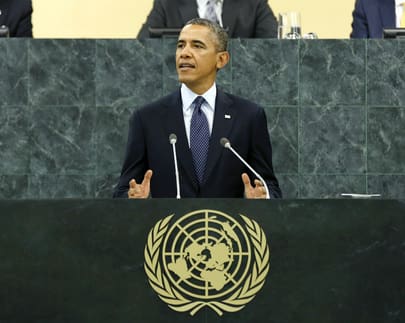
As delegates have been meeting for the 68th plenary sessions and General Debate (“UN Week”) at the UN General Assembly this week, September 23rd to October 1st, at UN Headquarters in New York City, it’s worth taking a moment to focus on the General Assembly as an institution and not just as an annual headline-generating device. It’s a great reminder of how far humanity has come these past 68 years in improving diplomacy, collaboration, and peace-building, and yet we still have far to go.
The UN General Assembly is the main deliberative, policymaking, and representative body of the United Nations; it is a deliberative body but not a legislative body in that it has the ability to offer non-binding resolutions to its member states, but it does not make laws. It makes policies for itself and the UN system but does not have the power to compel its member states. Its representation is equal among states: each state has one vote regardless of population, land area, or GDP. The General Assembly does have the power of the purse, as it passes the annual budget for the United Nations and determines how much each member state owes; it also elects the UN Secretary General, the non-permanent (and non-veto-bearing) members of the UN Security Council, the fifteen judges of the International Court of Justice, the fifty-four members of the Economic and Social Council, and new members of the United Nations itself.
What good does this deliberative body do?
Quite a bit.
At the moment, the General Assembly is the only true forum for world opinion – it calls itself the “parliament of nations,” and with 193 members as of September 2013, it admits more opportunities for input than any other international organization: people from every corner of the planet have at least a small voice at the General Assembly. It may not seem like much, but providing marginalized states and people a permanent, institutionalized forum to explain how global problems – or the actions of other states – are affecting them can be an invaluable tool for working out better solutions to those problems.
Furthermore, the General Assembly is a major source of knowledge for policymakers and non-governmental organizations around the world when it commissions reports and gathers conferences on a variety of topics. Subjects discussed this year include progress on HIV/AIDS, road safety, peace and security, human rights, macroeconomic policy, climate change, globalization, poverty, the advancement of women, and much, much more. Just a glance at the agenda for this year’s General Assembly showcases the vast amounts of knowledge manufactured at the request or through the funding of the General Assembly.
And despite the much more involved bureaucracy of the UN Secretariat and the Economic and Social Council, the UN General Assembly has some important bureaucratic roles of its own. The UN Human Rights Council, the UN Disarmament Commission, and the UN Peacebuilding Commission are just a few of the subsidiary organs within the UNGA that work to keep member states informed, cooperating, and actively working toward the lofty goals of the San Francisco conference of 1945. Of course, these councils and commissions are not without controversy – mere membership on the Human Rights Council comes with great responsibility – but the day-to-day work of diplomacy on these issues is an important end in itself.
Criticism of the UN General Assembly (including that of former UN Secretary General Kofi Annan) has focused on its tendency to seek consensus resolutions that meet the approval of all members rather than to try to pass stronger, more meaningful resolutions. The General Assembly also has a reputation for being excessively tedious with resolutions that are not only ineffective but often repetitive in nature. And these are non-binding resolutions!
It’s also worth noting that the UNGA is not a truly representative body. Each member state gets equal representation at the General Assembly, but India and Mauritius are treated equally: India has 1,000 times as many people and 1,600 times as much land area, as one example. States are an important part of how people solve political problems, but global problems may require that individuals get more input into how they are affected by global phenomena. Potential solutions may include weighted voting (cf. The Schwartzberg System of GlobalSolutions.org member Dr. Joseph Schwartzberg) or a parliamentary assembly (a UNPA, so to speak) of elected representatives.
Don’t forget, though, that while the UN General Assembly is a flawed organization that both succeeds and fails in supporting the aims set forth in the UN Charter, it’s also a daily, ongoing diplomatic process. The UNGA today isn’t the UNGA of a year ago, ten years ago, 68 years ago, or the one envisioned by its founders, and it will change tomorrow, next year, and decades into the future – it may have a different name or even be replaced by a different organization altogether. This process of change is good: as we get better at working together on global problems, we change our institutions to better suit our needs. So as you read another news story about a meeting or a speech from the UN this week, remember that the strengths and weaknesses of the UN, and its General Assembly, are ours to use for the good and to change the future.


