by Kimberly Mills | Jun 7, 2010 | Global Justice, United Nations
By: Ariela Blätter
The prelude to the conference was on Sunday, with a soccer game [European ‘football’] between teams ‘dignity’ and ‘justice.’ Survivors and family members of victims brought from Northern Uganda, who watched the game from the sidelines of the Nelson Mandela Stadium, were treated to a very unusual sight. Dressed from head to toe in different color but matching shorts and Jerseys, UN Secretary General Ban Ki Moon and Ugandan President Museveni arrived and took their place on opposing teams. Having heard that Ban Ki moon was very fit before I left DC by those in the ‘know’, I watched him zip around the field like a dapper dancer. I can’t say the same about President Museveni, who looks like he has enjoyed quite a few state dinners in his time. During the 10 minutes both men were out on the field, the Ugandan leader fell over twice, and clumsily missed two goals that were obviously set up for him by members of his team. Members of the United States delegation were invited to play but declined to do so. I imagine they realized that this was the safest option- not to play- given the impolitic possibility of either tackling the UNSG, a survivor from the northern violence, or the Ugandan President on the field. This was a photo-op they felt they could do without.
by Melissa Kaplan | Apr 16, 2010 | United Nations
When most Americans think of Franklin Delano Roosevelt, the 32nd president of the United States – whether they remember him personally or simply learned about him in their U.S. history classes – they are likely to recall a few key things about him: he was our country’s longest-serving president (in office for twelve years); was elected more times than any other American president (four); created the New Deal; and served as Commander-in-Chief during World War Two. However, in addition to these noteworthy achievements, FDR, who died sixty-five years ago this week on April 12, 1945, has another enduring legacy – his role in the creation of the United Nations.
Even as the Second World War was raging across Europe and the Pacific, FDR played the role of “global statesman” by looking not simply to ensure that the Allies won the conflict, but that after the war was over, there would be an international venue for nations to resolve their differences without resorting to war. A previous attempt to create such a body – the League of Nations – after World War One had proven a failure, in part because the United States never agreed to join the League despite the efforts of then – President Woodrow Wilson. President Wilson had championed the League but was unable to get U.S. membership ratified by the Senate once the war was over and American attitudes had grown more isolationist.
Determined to avoid a similar outcome, FDR worked throughout the final years of his life to create the United Nations and ensure that the U.S. would play an active role in the organization. On October 24, 1945, six months after FDR’s death, the U.N. officially came into existence once the U.N. Charter was signed by China, France, the Soviet Union, the United Kingdom, the United States and a majority of other signatories. FDR’s wife, Eleanor Roosevelt, also played a large role in the creation of the U.N. and served as U.S. delegate to the United Nations General Assembly.
From 51 original members, the U.N.’s membership has grown today to include 192 member states. The United Nations today is actively involved in a wide range of areas including peacekeeping, peacebuilding, conflict prevention and humanitarian assistance.
On the 65th anniversary of Franklin Roosevelt’s death, GlobalSolutions.org acknowledges his key role as a “global statesman” in helping to create the United Nations…a legacy which, six and a half decades later, still endures.
by Ariela Blätter | Mar 26, 2010 | Global Justice, United Nations
Part III: This is the third post from Ariela Blatter, Director of Policy and Programs for Citizens for Global Solutions. Ariela is attending the 8th Resumed Session of the Assembly of States Parties in New York City this week.
Did the US delegation get unfairly singled out today, as the only country that feels that haste makes waste when it comes to the dash to finalize the crime of aggression? Not according to the UK, who stood up in the ICC Assembly to agree with the US concerns on the inclusion of the crime. The US remained silent in the session as the UK took on the Venezuelan delegation’s constant attempts to prove that the US stands alone. Today’s colorful closing session on the crime of aggression at the UN became an interminable he-said-she-said debate over the language used in the Chair’s summary report of the Assembly of States Parties. All of the fuss arose when the states parties were asked to approve the aggression working group report, drafted by Prince Zeid, which stated that “some [countries] cautioned the assembly that in so far as the Rome Statute, the crime of aggression should not be concluded hastily, and should be built on consensus.” So in the end, at least in diplomatic “speak,” the US may not be in good company with “some” countries in its position on aggression, but it can now return to DC knowing that that the final text reflects that it stands with “a few” countries. Phew- that was a close one!
TAKE ACTION to support the ICC
by Veronica Glick | Mar 23, 2010 | Global Justice, News, United Nations
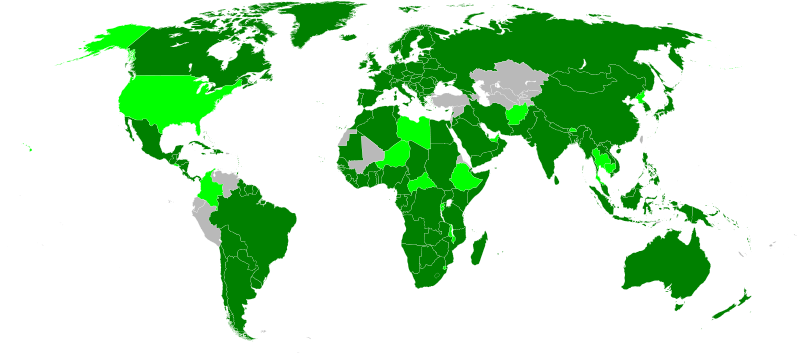
Bangladesh ratified the Rome Statute today, becoming the 111th State to do so. The Rome Statute was adopted by the international community on July 17, 1998 and Bangladesh signed it on September 16, 1999. This leaves twenty-eight states that have signed but not ratified the treaty. As a State Party to the Rome Statute, Bangladesh now has a vote in the Review Conference which will begin in May in Kampala, Uganda. The Asian Human Rights Commission forwarded a Statement from Odhikar, a human rights organization, congratulating the government of Bangladesh for ratifying the Rome Statute: “Bangladesh has demonstrated its commitment to international justice.”
ICC President, Judge Sang-Hyun Song, noted that “By ratifying the Rome Statute, Bangladesh will become the first State Party in South Asia. I applaud its decision to join the growing commitment of states to end impunity for war crimes, crimes against humanity and genocide.”
CLICK HERE to see Citizens for Global Solution’s interactive ICC flash module.
CLICK HERE to act in support of the ICC.
by Veronica Glick | Mar 16, 2010 | Global Cooperation, United Nations
The Council on Foreign Relations (CFR) had a meeting about U.S. Ocean Governance on March 8, 2010. The meeting, which began as a general ocean governance discussion, quickly became focused on the Law of the Sea Treaty. Moderator, Scott Borgerson of CFR at one point said “this wasn’t intended originally to be the Law of the Sea party, but as the author of the report outside the door titled The National Interests and the Law of the Sea, I can’t lie that it doesn’t warm my heart a little bit.”
The meeting began with a showing of the Council on Foreign Relation new interactive Web Oceans Governance Monitor. CLICK HERE to watch the remarkable video.
Senator Sheldon Whitehouse from Rhode Island stated: “As the wonderful video said, the oceans really are the dominant resource of our planet, and we’ve paid far too little attention to it. The economic theory of the tragedy of the commons is being worked out on the ocean at a massive scale, and we see it in the changes that the ocean is undergoing. It’s rising. It’s warming. It’s enduring biological changes as it rises and warms. It is continuing to be bombarded with pollution, and it’s facing chemical changes. That’s a lot all at once for this resource”
Admiral Thad Allen, the 23rd Commandant of the United States Coast Guard, emphasized that “rules of conduct and how we interact with each other on the water” are “incrementally changed every time there is a new convention that is ratified through IMO, every time a piece of domestic legislation is passed in any country or a time a new set of regulations is issued in the United States. We have a lot of pending work. [we] should start first with ratifying the Law of the Sea treaty.”
When asked about the reality of ratifying the Law of the Sea Treaty, Senator Whitehouse said “among the scarce natural resources that we have to deal with is the scarce natural resource of Senate floor time. So the notion of bringing up this treaty and having to go through all of the debate, go through the cloture on the motion to proceed, go through cloture on the ratification itself – you’re giving up a solid week of Senate floor time. And if you look out at our economy, … health care … the Law of the Sea, frankly, doesn’t rise very high. So I’ll be optimistic. I think the only way that it changes is when enough of the Arctic opens up that the oil and gas industries start to see . our failure to [accede] to that treaty as a very significant competitor disadvantage, and some of those senators . begin to respond to those forces. It’s as simple, I think, as that.”
Tom Fry, who served as the president of the National Ocean Industries Association since 2000, said that “The oil and gas industry got involved in this issue at the very beginning, has been supportive of Law of the Sea ratification, continue to support it in part of a large coalition of people that’s everything from the environmental community to the Garden Club of America, who supports ratification of the Law of the Sea Treaty… Countries now are making applications to take over some [areas such as the Atlantic and the Arctic that can be part of our economic zone]… and we’re not there, and we can’t say a thing about it, and so we need to get Law of the Sea done.”
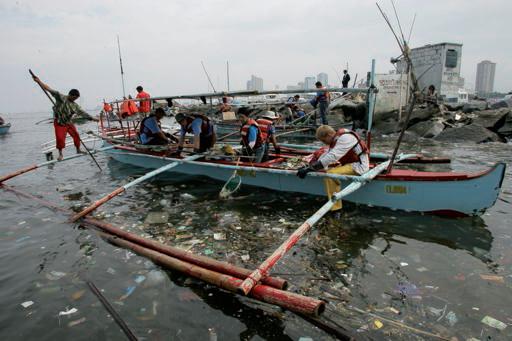
David Rockefeller, Jr., A CFR member and active in the council’s Ocean Governance Roundtable Series stated that “whatever one may feel about the pace and direction of climate change and global warming, the fact is that the oceans are challenged by factors that are not just about temperature, and I’ve named them: declining fish stocks, coastal pollution, acidification, and the need for international oversight of all of the above. So if you’re having a conversation with someone who starts as a climate skeptic, you need to remember that those issues are not warming-dependent. Others certainly are. It is vital that advocates for ocean health emphasize that rapid changes in ocean conditions worldwide are challenging the viability of the ocean’s living systems, and we must work together locally, regionally, nationally, and certainly internationally to ensure that ocean health is high on the public agenda for reasons of social, economic, environmental and human health.”
“Law of the Sea — simply put, it’s time to take our seat at the table, ladies and gentlemen, especially in light of the summer opening of the northwest and northeast passages due to melting sea ice. So why not, and why not this year?”
CLICK HERE to support the Law of the Sea Treaty by sending an email to your elected official.
by Veronica Glick | Mar 5, 2010 | Human Rights, News, United Nations
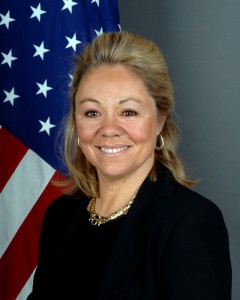
Yesterday afternoon Eileen Chamberlain Donahoe was confirmed as the first ever United States Ambassador to the Council.
We want to thank Citizens for Global Solutions activists who sent over 1200 letters to 94% of the Senate demanding that Eileen Chamberlain Donahoe be confirmed as the United States Ambassador to the United Nations Human Rights Council.
Eileen Chamberlain Donahoe is an Affiliated Scholar at the Center for International Security and Cooperation at Stanford University. Her research has focused on norms on use of force, UN reform, and the international rule of law. Previously, Ms. Donahoe was a litigation associate at Fenwick & West in Silicon Valley. Prior to that, she was a teaching fellow at Stanford Law School and law clerk to the Honorable William H. Orrick. Ms. Donahoe has also worked with various human rights organizations.
The U.S. recognises the controversial history of the Human Rights Council, but hopes to see the Council follow its goals of protecting human rights. Under Secretary for Democracy and Global Affairs Maria Otero stated on Monday that: “the Human Rights Council was established to strengthen the promotion and protection of human rights around the globe. Our expectations should be nothing less and the United States will continue to strongly advocate that the Council meet these expectations.”
International Women’s Day is next Monday (March 8th); here are some events for those of you in the DC area:
The International Center for Research on Women is hosting the 2010 Champions for Change: Innovation Empowers Women Awards Cocktail Reception. For more information CLICK HERE
The Sewall-Belmont House and Museum is hosting a partnership evening event with Women’s Information Network (WIN) and Emerge Global, featuring a short program, networking reception, and artisan bazaar. For more information CLICK HERE
The Washington D.C. Independent Film Festival is showing a series of films by or about women. For more information CLICK HERE
Enough is organizing a peace march across the Arlington Bridge to support Congo’s women in particular as they continue to face violence related to the conflict mineral trade. For more information CLICK HERE
An event will be held at Café Citron from 4-8 p.m. on Thursday March 11. This event is cosponsored by AIUSA (Amnesty International USA Mid-Atlantic Region) and UNA-NCA (United Nations Association of the National Capital Area).
For those of you in New York:
CEDAW and the Beijing Platform for Action – Empowering Women March 11, 2010 will be held at 777 UN Plaza from 2:00-3:30 PM.
International Association of Women Judges and the National Association of Women will host a reception, and screening of the film “Courting Justice”. For more information CLICK HERE




 When asked about the reality of ratifying the Law of the Sea Treaty, Senator Whitehouse said “among the scarce natural resources that we have to deal with is the scarce natural resource of Senate floor time. So the notion of bringing up this treaty and having to go through all of the debate, go through the cloture on the motion to proceed, go through cloture on the ratification itself – you’re giving up a solid week of Senate floor time. And if you look out at our economy, … health care … the Law of the Sea, frankly, doesn’t rise very high. So I’ll be optimistic. I think the only way that it changes is when enough of the Arctic opens up that the oil and gas industries start to see . our failure to [accede] to that treaty as a very significant competitor disadvantage, and some of those senators . begin to respond to those forces. It’s as simple, I think, as that.”
 David Rockefeller, Jr., A CFR member and active in the council’s Ocean Governance Roundtable Series stated that “whatever one may feel about the pace and direction of climate change and global warming, the fact is that the oceans are challenged by factors that are not just about temperature, and I’ve named them: declining fish stocks, coastal pollution, acidification, and the need for international oversight of all of the above. So if you’re having a conversation with someone who starts as a climate skeptic, you need to remember that those issues are not warming-dependent. Others certainly are. It is vital that advocates for ocean health emphasize that rapid changes in ocean conditions worldwide are challenging the viability of the ocean’s living systems, and we must work together locally, regionally, nationally, and certainly internationally to ensure that ocean health is high on the public agenda for reasons of social, economic, environmental and human health.”