by Ariela Blätter | Dec 6, 2010 | Global Justice, News, United Nations
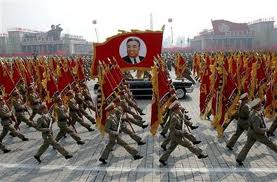
The International Criminal Court (ICC) Prosecutor Ocampo made a surprising announcement this morning at the United Nations. He announced that he has begun an investigation of North Korea’s recent attack on the South Korean island of Yeonpyeong and the sinking of a South Korean warship last March, for possible war crimes. Four people, including two civilians, died in the Yeonpyeong shelling on November 23rd; forty-six people were killed when the warship Cheonan was sunk by a torpedo alleged to have been fired by a North Korean submarine.
Since South Korea is a party to the Rome Statute the Court has jurisdiction over attacks which take place on South Korean soil. North Korea is not a member of the ICC and does not recognize its authority.
Citizens for Global Solutions welcomes the ICC’s decision to investigate the attacks on South Korea. We will continue to monitor and provide updates on the investigation as it proceeds as well as the proceedings of the Assembly of State Parties in New York this week.
by CGS Blog Archive | Nov 15, 2010 | Global Cooperation, United Nations
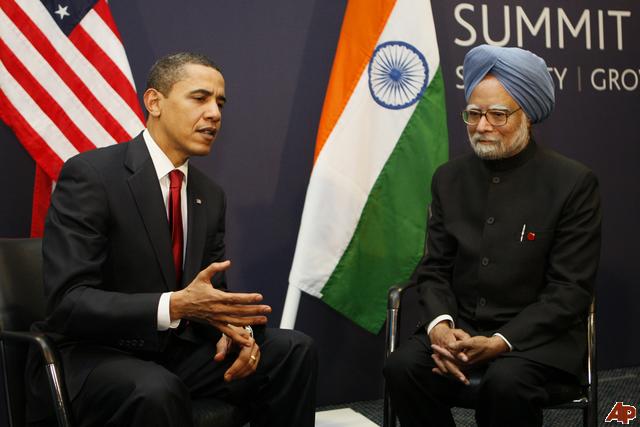
In a recent visit to India, President Obama announced U.S. support for India taking a seat on the United Nations Security Council. A second announcement centered on U.S. backing of India’s membership in the Nuclear Suppliers Group. While these developments indicate a stronger tie between the world’s two largest democracies, they open up questions about Obama’s other initiatives as well as what this will mean for next steps in ensuring reform.
By publicly announcing U.S. support for entrance into the Security Council, President Obama has made clear that his administration looks favorably upon reform of the Council beyond the current makeup 5 permanent and 10 non-permanent members. Almost since its inception, calls have been made to reform the structure of the Council to better reflect the balance of power in the world. But changing power dynamics over the past two decades have ramped up the demand for a more representative council. This reform includes the addition of India to the Council, as India is the second most populated country in the world, and as Obama put it “India is not simply emerging, India has emerged,” as a major power in Asia as well as throughout the globe. While reform of the Security Council won’t take place overnight, the U.S. example can help garner international support for change.
President Obama also announced the U.S. decision to support India’s membership in multilateral export control regimes, such as the Nuclear Suppliers Group (NSG). The NSG is a group comprised of 46 supplier states who aim to prevent nuclear exports for commercial and peaceful purposes (such as nuclear energy) from being used to make nuclear weapons. Also, The NSG guidelines require that importing states provide assurances to NSG members that proposed deals will not contribute to the creation of nuclear weapons.
This visit indicates Obama’s intention to improve the U.S. international reputation as well as to expand international relations by acting inclusively towards other major powers. However, questions about domestic initiatives are raised by these actions. Is Obama actually undermining his own nuclear nonproliferation plans by inviting India into the NSG? A requirement of membership to the group is signing of the Nuclear Nonproliferation Treaty, which India has not done, and it seems that Obama is willing to make India the exception. This could ultimately anger other countries, especially Pakistan and China, and delegitimize Obama’s claims to be working towards a nuclear weapon free world. In addition, it’s great that Obama is publicly calling for Security Council reform and endorsing India is a smart platform for this. However, Obama didn’t provide an answer of how this will actually be achieved. What steps will have to be taken to initiate reform and include countries that deserve a say in the decisions of the Council?
by Don Kraus | Oct 22, 2010 | Global Cooperation, United Nations
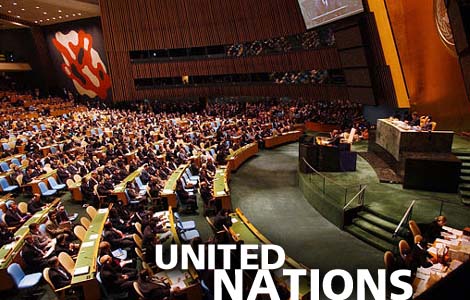
Today we recognize the 65th anniversary of the founding of the United Nations. The world has changed dramatically since October 24th, 1945 when 51 nations banded together “to save succeeding generations from the scourge of war.” Those intervening 65 years were perhaps the most consequential in the entire history of humanity and the UN has played a vital role.
In 1945 the world’s population was about 2.5 billion. Europe was in disarray. Ethiopia, Egypt, and Liberia were the only independent nations in Africa. Today, there are close to 7 billion people in the world and 192 UN member nations. Revolutions in communications, agriculture, health-care, transportation and governance have fueled an increasingly interdependent world.
When the UN was established, the word “genocide” had not even been invented. There were very few international laws and organizations. Today the UN has negotiated over 510 multilateral treaties on human rights, terrorism, global crime, refugees, disarmament, trade, commodities, the oceans and many other matters. UN member states have built a global web of institutions, laws, and norms to manage everything from international flights to world economics and genocide prevention.
Built on the ashes of World War II, the UN’s primary goal was to prevent a similar atrocity from happening ever again. Today the UN is recognized as the world’s best peacekeeper with close to 100,000 blue helmets deployed to 16 global hotspots, like Darfur, DR Congo, and South Lebanon; places where the U.S. cannot or should not send its forces, and where international peacekeepers perform a vital stabilizing role.
The United States has been a generous host to the organization, providing crucial financial and political support. The benefits have exceeded the costs. According to Peter Yeo of the Better World Campaign, “for every $1 the U.S. invests in the UN, our nation receives $1.50 in return.” Providing services from peacekeeping to smallpox vaccinations, the UN is of unquestionable value, functioning on a core budget smaller than New York City’s Police Department.
But as we recognize the UN’s accomplishments on this important anniversary, it is important to acknowledge the work that has yet to be done. UN Secretary-General Ban Ki-Moon believes that “UN Day is a day on which we resolve to do more. More to protect those caught up in armed conflict, to fight climate change and avert nuclear catastrophe; more to expand opportunities for women and girls, and to combat injustice and impunity; more to meet the Millennium Development Goals”.
The organization’s ability to achieve Ban Ki-Moon’s resolution depends in large part upon the United States’ leadership role in shaping the UN.’s future. The Security Council still reflects a post WWII power structure. Its membership and the all-powerful nature of the veto must be addressed. The UN’s ability to protect civilians needs improvement. Our nation can and should play a key role in determining how these needs are addressed.
There is strong support within the U.S. to play this role. Despite recent cries of some Tea Party candidates for the U.S. to pull out of the UN, a new UN Foundation/Better World Campaign poll has found that 59 percent of Americans rate the UN favorably. A majority of Republicans and Democrats recognize that the UN is a good investment and support paying our dues to the UN on time and in full.
Most Americans understand the UN’s important role in creating a better and safer world. When you cast your vote, expand your thinking beyond domestic jobs. Determine if your Senator or Representative shares your values and beliefs when it comes to tackling problems that no nation can resolve alone. Nations can work together at the UN to find solutions. Good global policy and an effective UN begins at home in your congressional district.
Happy UN Day!
Don Kraus
by Melissa Kaplan | Jun 16, 2010 | Global Justice, News, United Nations
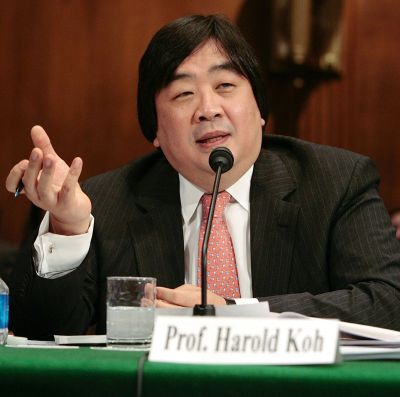
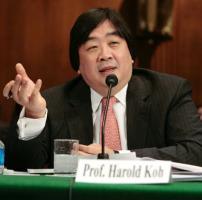
On Tuesday, June 15, 2010 Legal Advisor for the U.S. State Department, Harold H. Koh, and Ambassador-at-Large for War Crime Issues, Stephen J. Rapp engaged in a press briefing to discuss their visit to Kampala, Uganda for the International Criminal Court Review Conference. Koh addressed any concerns regarding the U.S. relationship with the Court when he said, “[T]o paraphrase Churchill, this is not the end, it was not the beginning of the end, but it did feel like the end of the beginning of the U.S’s 12-year relationship with this court. After 12 years, I think we have reset the default on the U.S. relationship with the court from hostility to positive engagement. In this case, principled engagement worked to protect our interest, to improve the outcome, and to bring us renewed international goodwill. As one delegate put it to me, the U.S. was once again seen, with respect to the ICC, as part of the solution and not the problem. The outcome in Kampala demonstrates again principled engagement can protect and advance our interests, it can help the states parties to find better solutions, and make for a better court, better protection of our interests, and a better relationship going forward between the U.S. and the ICC.”
Koh did not hold back in further complimenting themselves and the rest of the U.S. delegation for their hard work “to resume engagement with the court, states parties, observer nations, and many private organizations involved in international criminal law”. The U.S. delegation should be praised for their hard work at this conference. Rapp made sure to highlight that “one of the main aspects of [the] conference in which…[U.S.] principled engagement was so positive was working with the court in stocktaking exercises, which looked at issues like complementarity, which is this idea that you should have justice at the national level in preference to justice at the international level”.
Click HERE for the full transcript of the press conference.
by Melissa Kaplan | Jun 11, 2010 | Global Justice, News, United Nations
On Thursday, June 10th, the U.N.’s war crime tribunal on the Balkan wars handed down sentences of life in prison for two former high-ranking officers in the Bosnian Serb army, Vujadin Popovic and Ljubisa Beara. Popovic and Beara were convicted of genocide, a charge stemming from the massacre of 8,000 Muslims in Srebrenica in 1995. The Srebrenica massacre was the largest mass killing in Europe since World War Two.
Additionally, another Bosnian Serb, former brigade security commander Drago Nikolic, was convicted and sentenced to a 35-year prison term for the crime of aiding and abetting genocide. Others on trial were acquitted of genocide but convicted for extermination, murder, and persecution.
Meanwhile, former Bosnian Serb leader Radovan Karadzic is also on trial for genocide due to the Srebrenica massacre, following his arrest in 2008. Former Bosnian Serb commander Ratko Mladic, under whom the convicted officers served, remains at large as a fugitive 15 years after his own indictment.
Citizens for Global Solutions believes strongly in the need for those individuals responsible for genocide to be brought to justice under international law. We applaud the U.N. tribunal’s decision as an important step in this direction. For more information on genocide prevention, visit http://www.globalsolutions.org/genprev. To take action on genocide prevention and other related issues, visit http://www.globalsolutions.org/action/home.
by Ariela Blätter | Jun 11, 2010 | Global Justice, United Nations
By: Ariela Blatter
The delegation from the United Kingdom (UK) states that any future action by state parties in prosecuting crime of aggression must respect the PRIMACY of the UN Security Council. Citing Article 39 of the UN Charter, the UK delegation re-asserts that it is the UNSC that has the expertise to determine an act of aggression. In a momet of levity the head of the English delegation calls the opening text, or preamble of the adopted text the most boring thing he has ever read, and asks that the official record reflects this text.
Is this a prelude of a fight to come? Did the UK put a line in the sand that the UN Security Council is the EXCLUSIVE body to decide aggression? Will they object in seven years to the ability of the Court to act independently of the UN Security Council? Will the UK and other members of the UN Security Council roll back the progress that was made only 10 minutes ago when a standing ovation at Kampala welcomed the decision to announce the ICC as first permanent international court that would have jurisdiction over the crime of aggression?
Only time will tell at this point….