by Matt Woodford | Nov 20, 2013 | Global Justice, News, Peace & Disarmament
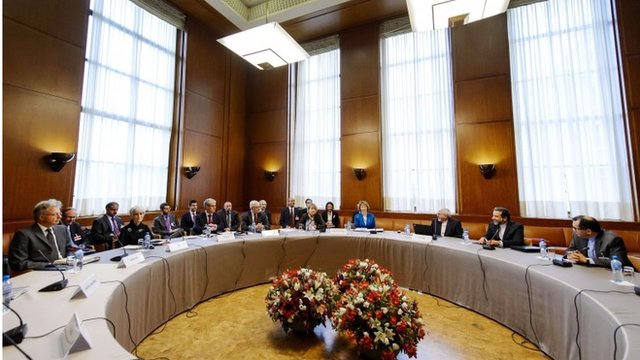
The talks about Iran’s nuclear program started up again today in Geneva. Britain and Russia seem optimistic that a deal that will work for all parties will be reached, but the United State and France remain skeptical about whether Iran truly wants nuclear energy or actually desires nuclear weapons. Israeli Prime Minister Netanyahu has been insisting that Iran is not to be trusted, the negotiating table should be abandoned, and sanction should be increased.
Ayatollah Khamenei told hardliners in Tehran that Iran will not give up its right to peaceful applications of nuclear energy. He claimed that Iran wants peaceful relations with all countries but heavily criticized Netanyahu, France and the U.S. for being overly cautious and unwilling to believe the Iranian government. President Obama said it was not clear whether the negotiation will bear any results at this point in time. U.S. lawmakers have been urging the administration to take a tougher line with Iran, agreeing with Netanyahu that Iran is seeking nuclear weapons and presents a threat to the region.
A UN report states that, since President Rouhani took office this year, Iran has stopped uranium enrichment and has not added any more components to the Arak reactor. This may indicate that Iran genuinely wants to come to an agreement to end sanctions, but keep a nuclear energy program in place.
This is a very delicate period of time for all involved in the negotiations and great care must be taken to avoid letting extremists and spoilers ruin chances to resolve the question of Iran’s nuclear program peacefully. A peaceful, constructive agreement would be the best possible outcome for addressing Iran’s nuclear ambitions. No one really wants war – an end to sanctions would boost Iran’s economy and an increase in oil exports will aid the regional and global economy as well. An Iran that is more open to the world is preferable to one that is ostracized and isolated.
by Matt Woodford | Nov 13, 2013 | Human Rights, News, Peace & Disarmament
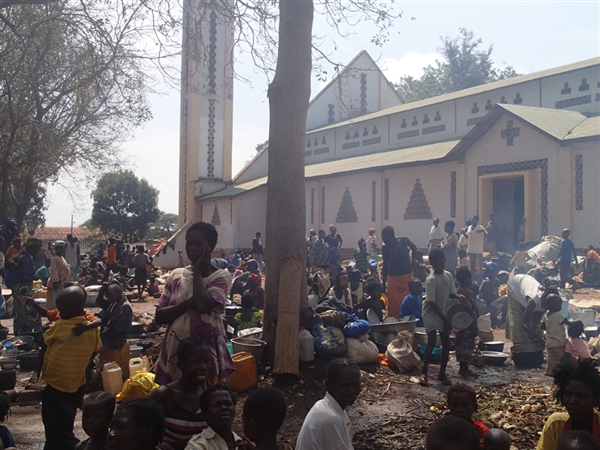
The current situation in the Central African Republic is beyond terrible. Following the rebel overthrow of President Francois Bozize in March of this year, thousands have been displaced and are facing starvation and malnutrition. Almost 70,000 refugees have fled the country, putting strain on unstable and poor neighboring countries like Chad. The countryside is almost completely lawless with armed gangs attacking civilians and villages. It is almost impossible for humanitarian aid to reach those suffering and two UN officials have been attacked.
Two groups are responsible for the majority of the violence and terrorism, the Seleka rebels and self defense militias known as anti-Balaka. People affiliated with the groups terrorize the civilian populace, conducting nighttime raids and attacks on houses and even entire villages. 18 women and children were massacred in late October by Seleka fighters. The clashes between the rebels and the militias have deepened cleavages along sectarian and ethnic lines in the population.
Last week the UN Security Council approved a 250-strong ‘Protection Force’ to provide security for humanitarian aid workers and UN officials in the country. This force could be increased to 560 soldiers if necessary. The UNSC has condemned what is going on in the CAR, but beyond the Protection Force, not much has been done.
The CAR needs a full scale peacekeeping force like the one in the Democratic Republic of Congo or Mali. The UN has also called for an increase in humanitarian aid, but if that aid cannot reach those suffering, it will not be very useful. The situation in CAR is not in the headlines either; many people do not know about the humanitarian crisis or the atrocities being committed.
The Central African Republic is in dire need of international help, both humanitarian and peacekeeping, but international funding and political will may not exist to facilitate help. Hopefully, the Protection Force will be expanded and eventually become an actual mission once more reports by officials and members of the force make their way to the Security Council and General Assembly.
by Matt Woodford | Oct 18, 2013 | Global Cooperation, News, Peace & Disarmament
New negotiations concerning Iran’s nuclear program occurred this week in Geneva. Iran met with the P5+1 countries, the permanent members of the UN Security Council plus Germany. During the meeting, Iran officials said they proposed a plan to ease back Iran’s nuclear program. The plan focused on specific aspects of the program which EU officials found encouraging. The participants hope to meet again in Geneva in the near future to continue the discussion that. These are the first nuclear talks that have occurred since Rouhani was elected President of Iran.
The results of this meeting will hopefully lead to better relations between Iran and the United States. If Iran opens up about its nuclear program more can be done to ensure that it is in fact a nuclear energy project and will lead to more trust. Eventually both sides can open up formal diplomatic relations with one another, leaving the past in the past and moving on.
The actions and speeches from Netanyahu’s Israel are very concerning. Netanyahu is loudly proclaiming that Rouhani is deceitful, and nothing has really changed. Netanyahu is acting as a spoiler to moving forward in diplomacy; he obviously does not want anyone to have any relations with Iran beyond hostile ones. In global politics there can never be complete trust but there is a difference between being reasonable and laying one’s cards on the table for all to see. A little trust is required for negotiations to go anywhere, –not blind or unreasonable trust, just a small amount of good faith. If Iran is not consulted, and not treated like an important player in the region why should they not develop nuclear weapons?
The outcome of this initial meeting was very positive and hopefully will lead to further negotiations. The international community can then verify Iran is not developing nuclear weapons, in which case diplomatic relations may improve and economic sanctions can be loosened.
by Don Kraus | Sep 25, 2013 | Global Justice, News, Peace & Disarmament
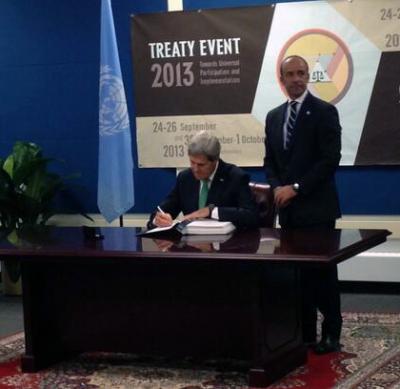
Secretary of State John Kerry has now added the United States’ signature to the Arms Trade Treaty. This treaty is a great step forward in dealing with the unregulated and illicit global trade in conventional weapons and ammunition, which fuels wars and human rights abuses worldwide. I am so proud of thousands of GlobalSolutions.org members who emailed, petitioned and called the White House. Your efforts paid off!
GlobalSolutions.org also was one of 33 national organizations who urged President Obama to sign the treaty, saying it, “…would be a powerful step demonstrating the United States’ commitment to preventing mass atrocities and protecting civilians from armed conflict around the globe.”
Not only is it good for our nation to have all countries operating from the same rule book, it’s also our responsibility. Without the treaty, warlords and terrorists will continue to get weapons which are used to force child soldiers to kill their parents, to attack American soldiers and missionaries, and to rape refugee women and girls.
As the world’s largest arms dealer, the US signature will put pressure on other major buyers and sellers such as Russia, China and India to join the treaty. US signature will add momentum to efforts to get at least 50 nations to join or ratify the agreement so it can go into force. So far, eighty-six other nations have signed the treaty and four have ratified it.
The US has the world’s gold standard in national arms export trade controls. Kerry’s signature now paves the way for the US to provide assistance and cooperation with other states on how to create good export control systems for themselves.
The United States played a positive role in negotiating the Treaty, which is designed to help prevent more than 500,000 deaths worldwide that happen because of armed violence. Firearms are used in armed conflicts and to carry out human rights violations, including genocide and gang rapes. More than 250,000 children have been forced into combat as under-aged child soldiers.
The Treaty will address these heinous crimes by bringing foreign governments up to U.S. export standards and moving black markets out of the shadows. This is a legacy issue for President Obama, who has made genocide and atrocity prevention a priority. The Arms Trade Treaty explicitly prohibits arms transfers when a country “has the knowledge at the time of authorization that the arms or items would be used in the commission of genocide, crimes against humanity… “
The agreement is also a win for women’s rights. Before agreeing to an arms sale, it specifically calls for countries to assess the risk of weapons being used “to commit or facilitate serious acts of gender-based violence or serious acts of violence against women and children.”
This Treaty is in America’s security, business and moral interests. Because of the diligent negotiations led by U.S. Assistant Secretary of State Thomas Countryman, the treaty is consistent with current U.S. practices and laws.
Unfortunately, here in Washington the conservative Heritage Foundation and the NRA have dreamed up dark visions of how any limits on conventional arms sales would deprive Americans of their 2nd amendment right — a big lie: The Obama administration made sure the treaty excluded domestic sales. The American Bar Association’s Center for Human Rights confirmed the treaty did not infringe on Americans’ Second Amendment Rights.
Tomorrow we can begin to plan on how to get this important treaty through the Senate, along with the Women’s’ Equality Treaty, the Law of the Sea, the Disability Treaty and too many others. But today we can take a moment to dance, to cheer and to celebrate a win. Please join me and thank President Obama and Secretary Kerry too.
by Citizens for Global Solutions | Sep 13, 2013 | Global Justice, News, Peace & Disarmament
Citizens for Global Solutions Supports the International Rule of Law and Cautions Against Unauthorized Use of Force
Citizens for Global Solutions supports the Obama Administration’s push to have Syrian chemical weapons placed under the jurisdiction of the United Nations. We also caution against a unilateral, unauthorized military action to punish Syrian President Assad and his regime for the apparent use of chemical weapons. While the use of chemical and other weapons of mass destruction is abhorrent and offends our collective conscience, we believe the United States must work within the U.N. charter in order to protect the Syrian people and advance international peace and security through the international rule of law.
The goals of U.S. and international action regarding Syria should be to:
- Protect the Syrian people by ending this humanitarian crisis that has already cost over 100,000 lives and spawned over 2 million refugees;
- Create space for a political settlement of the conflict;
- Hold accountable individuals who authorized and implemented the use of chemical weapons and other war crimes and crimes against humanity; and
- Strengthen the international system’s capacity to respond to similar crises in the future.
The unauthorized, unilateral use of force against Syrian chemical weapons facilities will not help to achieve these goals.
Mr. Obama has said the threat of military action is, in part, “about our resolve to stand up to others who flout fundamental international rules.” This is a noble aim. But we cannot demonstrate this resolve if, by engaging in unilateral military action for non-defensive purposes, we ourselves flout one of international law’s most fundamental rules.
The President, supported by Congress, should immediately:
- Promote a U.N. Security Council resolution to place Syria’s chemical weapons under U.N. control;
- Promote the work of U.N. weapons inspectors to complete their task in Syria and report to the Security Council;
- Utilize all of the United States considerable diplomatic resources to catalyze the international community to bring the Syrian conflict to an immediate halt;
- Failing that, redouble efforts at the U.N. to promote a robust international intervention authorized by the Security Council to halt the fighting, secure the chemical weapons, allow free access for humanitarian aid and workers, and create the space for a political settlement of the conflict;
- Increase the flow of humanitarian aid to Jordan, Turkey and other nations who are sheltering Syrian refugees;
- Work with other nations to pursue a Security Council referral of the situation in Syria to the International Criminal Court to hold accountable those on either side of the conflict who have inflicted atrocities upon the Syrian people; and
- Sign the Arms Trade Treaty to demonstrate the United State’s resolve to limit the sale of conventional weapons to nations engaged in massive violations of human rights.
- Initiate a dialogue to limit the use of the veto in the Security Council when addressing mass atrocities.
While we are concerned by the Administration’s proposed military action, we simultaneously affirm that sovereignty comes with responsibility. The member states of the United Nations have agreed that it is the responsibility of national governments to protect populations from genocide, war crimes, crimes against humanity and ethnic cleansing. When Syrian President Bashar al-Assad chose to use massive military force including artillery, helicopter gunships and snipers on unarmed peaceful protesters in Syria and precipitated the current civil war, he failed to meet his responsibility to protect. We agree with Mr. Obama that Mr. Assad’s government no longer possesses the moral credibility to act as the legitimate representative of the Syrian people. We disagree, however, that any one country has the authority to decide unilaterally when foreign governments have ceded the privileges of sovereignty. The United Nations must possess this authority — as well as the capacity and support to exercise it.
We believe the United States, as the world’s leading economic and military power, is facing these decisions because until now, powerful states have been all too content with a United Nations incapable of enforcing international law and protecting civilians in armed conflict. The use of the veto in the Security Council, the lack of a capacity to rapidly deploy a standing force of well-armed and trained peacekeepers and, most of all, the general democratic deficit within the U.N.’s General Assembly and Security Council contribute to the weakness of the U.N. system. We envision a future in which fair and effective international institutions address those challenges that no one state or group of states, however powerful or esteemed, can address alone. Until international institutions are developed that can credibly regulate weapons of mass destruction, protect civilians from atrocities and ensure that the privilege of sovereignty is not abused, impossible choices like the one currently facing the United States will continue to arise.
U.S. leadership is needed to address the current tragedy in Syria, as well as to strengthen the U.N. system and the international rule of law. Mr. Obama recently noted: “Out of the ashes of world war, we built an international order and enforced the rules that gave it meaning. And we did so because we believe that the rights of individuals to live in peace and dignity depends on the responsibilities of nations.” We call on the President and Congress to give real significance to those words by pursuing a sustainable peace in Syria ensuring that the next tyrant intent on committing mass atrocities is met by a united international community that is unwavering in its commitment to the rule of law.
For more information, contact Don Kraus at 202-330-4103 or by email.
by Zoey Krulick | Aug 1, 2013 | Global Cooperation, News, World Federation
Last weekend I had the opportunity to attend the Annual Conference for GlobalSolutions.org at Hofstra University in New York. The conference focused largely on skills that can be used to become more engaged in our campaigns and to help build the GlobalSolutions.org movement. The staff at the conference certainly accomplished that, teaching many invaluable skills such as building community networks, fundraising, and using social media. Overall, I left the conference with an abundance of knowledge on how to build our movement effectively, and I hope other conference participants feel the same.
Of course, the most inspiring part of the conference was not the information itself, but the energy in the room. While the mood changed several times over the course of the day, sometimes serious, sometimes less so, the overall atmosphere was inspiring. Some of the participants hadn’t seen their old friends in years, yet still spoke as if it were yesterday. And of course, many new friendships were made. Overall, the room was filled with exciting discussion and intense energy – you could tell that everyone there had a passion to change the world.
If you didn’t get to attend the conference, don’t worry! We have a page with a summary of everything covered, including the information we handed out at the conference and helpful tutorials so you can learn these skills from home. Also, you can still let us know what you think we should work on and how you’d like to be engaged by filling out our survey. Until next year, GlobalSolutions.org’ers!