by Rene Wadlow | Jul 27, 2015 | Global Justice
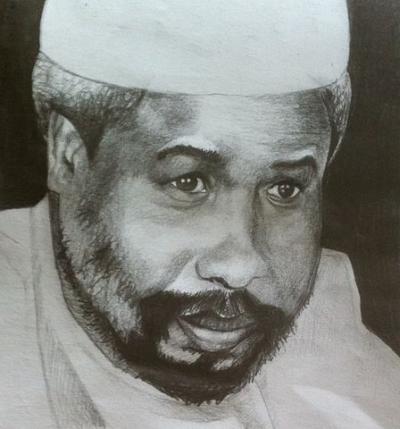
The trial of Hissène Habré, former President of Chad, which opened in Dakar, Senegal, on July 20 marks a new step in trans-national law. Habré will be tried in a specially constituted court created by a treaty between the African Union and the State of Senegal. The court is modeled on the statues of the International Criminal Court (ICC), but is to deal only with cases concerning Africans. It will be important to see if this new African court will be a one-time institution for the Habré trial or if it becomes a permanent institution of world law.
The ICC has been criticized by some African leaders as being overly focused on Africans. Arrests and arrest warrants have been issued nearly exclusively against Africans. However, Africa is the only continent where state institutions have totally disappeared (Somalia, Central African Republic, Libya) or where vast areas of a State are not under the control of the central government (the eastern provinces of the Democratic Republic of Congo and the northeast areas of Nigeria). In addition, there are a good number of African States where the court system is so under the control of the executive that “fair trials” are out of question.
Thus, if African leaders were reluctant to see the ICC take on new African cases, an “all-African” alternative had to be created, even if it is nearly identical in the types of crimes to be judged and the way that evidence is to be collected. The judges in Dakar have already interviewed some 2,500 persons even before the trial started.
Hissène Habré is a sad case of an intelligent man blinded by his quest for power and then for holding on to power. In this process, he destroyed large segments of ethnic groups he suspected of wanting power. He also had killed any potential rivals, even those who had shown no opposition. It is estimated that in his eight years of power, some 40,000 persons were killed, some in the military campaigns against ethnic groups, but also some 4,000 political figures killed individually in jails and specially-designed torture centers.
In his very last days in power in December 1990 as the forces of his general Idriss Deby were moving to overthrow him, he had 300 persons in jail killed as a last gesture. His very last gesture, however, was to take all the money available in the Treasury with him into exile in Senegal—money which has allowed him to live well and to contribute to the well being of Senegal political figures.
By 1990, one of Habré’s generals, Idriss Deby said, “Why not me?” and with some troops loyal to him overthrew Hissène Habré. Deby is still President of Chad and his troops are the most battle-tested of African armies, now busy helping the Nigerian army against Boko Haram on the Nigeria-Chad frontier.
Since 1990, Habré has lived a comfortable but low-profile life in Dakar. However, victims and their families from his years of rule have cried for revenge (or at least justice). Different avenues to bring Habré to trial have been used, especially a universal jurisdiction law of Belgium, which held that persons accused of certain crimes such as crimes against humanity, war crimes, systematic torture—no matter where committed—could be tried in a Belgium court. This Belgium law has since been revoked, but not before evidence on the Chadian case could be presented to the Belgium judges.
Evidence concerning torture and the killing of potential opponents by Habré’s security forces was carefully collected under the driving energy of Reed Brody of Human Rights Watch. Habré had friends among the governing elite of then President of Senegal Abdoulaye Wade, who protected him so that no trial could take place. However, with new President Macky Sall in power and the accumulation of evidence, the African Union and Senegal felt that something had to be done. Thus the special court was created and the trial began.
It is unlikely that new facts will be uncovered. Habré’s government was fairly open in its repression. The degree of active support of France and the US will probably be pushed under the rug. Nevertheless, the trial merits watching. There are other African dictators, some retired, some still in power. What impact will the trial and the court have on the rule of world law?
by Jennifer Welden | Jul 20, 2015 | Global Justice, Peace & Disarmament
Having just crossed the border from Italy to France, my train stops at the next station for longer than the usual five-minute interval. Police board the train; I take out my passport, which has become habit at this point. The woman sitting next to me, a French native who has lived in Italy in for the last 20 years, leans over.
“They are checking for illegal migrants,” she says. “Sometimes they hide in the bathrooms.”
With our passports verified and the train cleared, we begin moving again.
“Look,” my seatmate points out the window. “They’re arresting one now.”
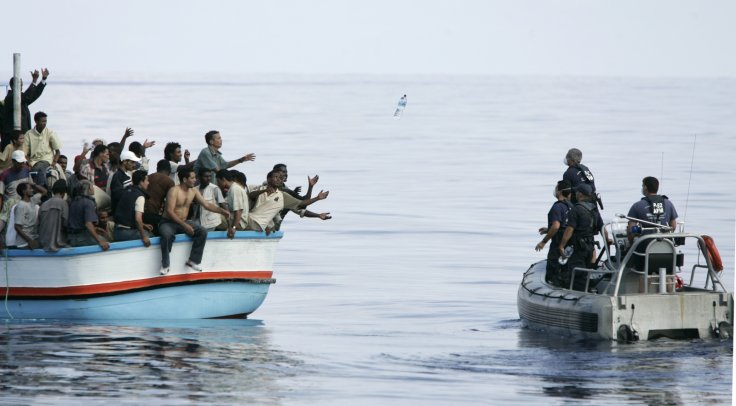
While I knew about the current migrant crisis as I left for Europe this summer, I never expected to come into contact with it as much as I did over the last two months of my trip. Despite having our own immigration crisis back in the U.S., the issue seemed even more visible while in the Eurozone; from migrants on the street trying to sell me a selfie stick to camp sites to scenes like this on the train, it was quickly apparent how serious this crisis has become.
Currently, “the number of migrants arriving at the EU’s external borders has risen by a factor of 2.5 this year compared with 2014, from 61,500 to 153,000.” Italy and Greece have been burdened the most, with almost 60,000 migrants coming to Southern Italy this year, and nearly 80,000 coming to Greece. Though both countries have called for their EU counterparts to help with the sudden influx, many have been reluctant, with some countries threatening to close their borders; France and Switzerland have already begun refusing entry from Italy, with police-led passport checks that disregard the “passport-free travel rules governing Europe’s Schengen area.” (This is exactly what I witnessed that day on the train.)
Though Italy has threatened to act with or without the EU—“If Europe chooses solidarity, good. If it doesn’t, we have Plan B ready. But it would first and foremost hurt Europe,” warned Prime Minister Renzi—many member states have continued to shirk responsibility. While a deal was reached at the end of last month to resettle around 60,000 asylum seekers throughout Europe, participation in this plan was made voluntary rather than mandatory, with many states choosing to focus more on deterrence and deportation rather than assistance. For example, Hungary has plans to build a four-meter high fence along the Serbian border, while, as already mentioned, states like France have become much stricter with cross border travel.
Ultimately, this is not only part of the broader debate of immigration, but also about the EU in general. While all member nations joined the EU for its obvious benefits—travel, tourism, and trade—many have shied away from the consequences—immigration, crime, and financial crisis. Moving forward, the EU (and other large international organizations such as the UN) will have to figure out how to develop the political capital to hold states accountable and actually reach solutions.
This in itself is a large task: it involves not only enabling all nations (regardless of economic power and size) to have a voice, but also changing states’ perception of what they owe refugees, economically or politically. With so many EU states facing their own crises, many fail to sympathize with these refugees or recognize their own advantages. How many refugees would gladly trade their violent battles back home for the diplomatic ones in Europe? Many already have.
And yet, it’s hard to expect an entire country’s perspective to change when other able countries fail to pick up the slack. How can we expect the EU to help migrants when member states won’t help each other? As the woman sitting next me on the train said, “I feel bad, but we just can’t support them all.”
by Jaira Burke | Jul 15, 2015 | Global Justice, Human Rights
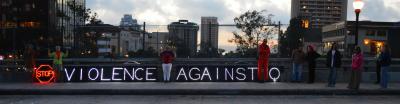
One in three women will be physically, sexually or otherwise abused during her lifetime, with rates reaching 70 percent in some countries. This ongoing crisis permeates socioeconomic classes, races, creeds, and geographical regions, threatening human rights on a global scale. In light of increasing political will to address this injustice through the International Violence Against Women Act (IVAWA) and the Women’s Rights Treaty (CEDAW) , here are 10 facts you may not know about violence against women.
1) The “R” Word
Over 22 million women in the United States have been raped in their lifetime.
2) Intimate Partner Violence
The World Health Organization reports that 35% of women worldwide have experienced either intimate partner violence or non-partner sexual violence in their lifetime.
3) Reproductive Health
A woman dies every 90 seconds in pregnancy or childbirth – more than 350,000 women each year.
4) Child Brides
If present trends continue, 150 million girls will be married before their 18th birthday over the next decade.
5) Sexual Exploitation & Trafficking
Women and girls represent 55% of the estimated 21 million victims of forced labour worldwide and 98% of the estimated five million forced into sexual exploitation.
6) Genital Mutilation
More than 133 million girls and women have experienced some form of female genital mutilation (FGM) in Africa and the Middle East where the harmful practice is most common.
7) Sexual Harassment
In the United States, 83 percent of girls aged 12 to 16 experienced some form of sexual harassment in public schools.
8) Femicide
There are an estimated 5,000 ‘honour-killings’ each year worldwide involve a girl or woman being killed by a male or female family member for an actual or assumed sexual or behavioural transgression, including adultery, sexual intercourse or pregnancy outside marriage – or even for being raped.
9) Armed Conflict & Women
Conservative estimates suggest that 20,000 to 50,000 women were raped during the 1990s war in Bosnia and Herzegovina and 10 times as many were targeted in the 1994 Rwandan genocide.
10) Political & Governmental Reinforcement
Marital rape is now a crime in 104 States and 90 States have some form of legislative provision against sexual harassment, but over 100 states and territories still have no specific legal provisions against domestic violence and many others were legal loopholses allow perpetrators to avoid prosecution.
by Ronald Glossop | Jul 13, 2015 | Global Justice
There are two important dates in July for globally minded Americans. The 4th of July is an important date for our country, and the 17th of July is an important day for our whole world community.
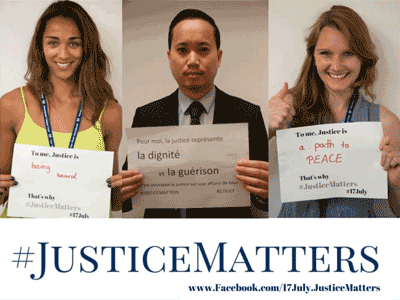
The Rome Statute establishing the International Criminal Court (ICC) was adopted on July 17, 1998. Five years ago the UN designated July 17th as “International Criminal Justice Day.” The day will be celebrated by advocates for justice around the world, many of whom will post on social media using a hashtag #JusticeMatters to draw attention to this rather new world holiday.
The International Criminal Court is a permanent court with jurisdiction over individuals who commit genocide, war crimes, or crimes against humanity (enumerated in the Rome Statute) when they are not held accountable by their own government. The word “criminal” in the name of the Court and the holiday is crucial. In contrast to the International Court of Justice (or “World Court”), the International Criminal Court focuses on holding individuals accountable for violating international law. The ICJ deals only with national governments. Its rulings are non-binding. Furthermore trying to punish a country requires fighting a war such as the Korean War in 1950-1953 and First Gulf War in 1991.
The precedent of holding individuals accountable for violating international law emerged after World War II with the Nuremberg and Tokyo Trials. It continued with the creation of ad hoc international tribunals by the UN Security Council in the 1990s to prosecute individual perpetrators of genocide and war crimes in the former Yugoslavia and Rwanda.
The Rome Statute has now been ratified by 123 countries, with the notable exceptions of China, Russia, and the United States.
Despite criticism from some corners, the Court is succeeding. Individual criminals are being prosecuted. Two individuals have been found guilty and are now in the ICC’s jail in The Hague. Eight others are in custody awaiting trial.
After several years of opposing the Court as a vital institution, the United States is now cooperating with the ICC, sending observers to meetings of its governing body, and has even supported a resolution in the UN Security Council to refer the situation in Libya to the ICC.
The ICC is exactly what the world community needs to establish the rule of law and thus put an end to war. This year, almost a quarter of all UN member states have ratified amendments to the Rome Statute that will make aggression a prosecutable criminal act. For this reason alone, every American and every globally minded world citizen should celebrate International Criminal Justice Day this Friday.
by Melanie Pino-Elliott | Jul 6, 2015 | Climate Justice, Global Justice
I’ll never forget the time in eighth-grade religion class when one of my classmates asked why our school didn’t participate in neighborhood cleanup days. My teacher replied, “It’s not fair to worry about things like that when souls are going to Hell every day.”
She elaborated, “The earth can save itself.”
Seriously. A human being actually uttered that sentence without irony.
This teacher would also frequently stress the importance of following everything the Catholic Church teaches without question. (You can’t just pick and choose!)
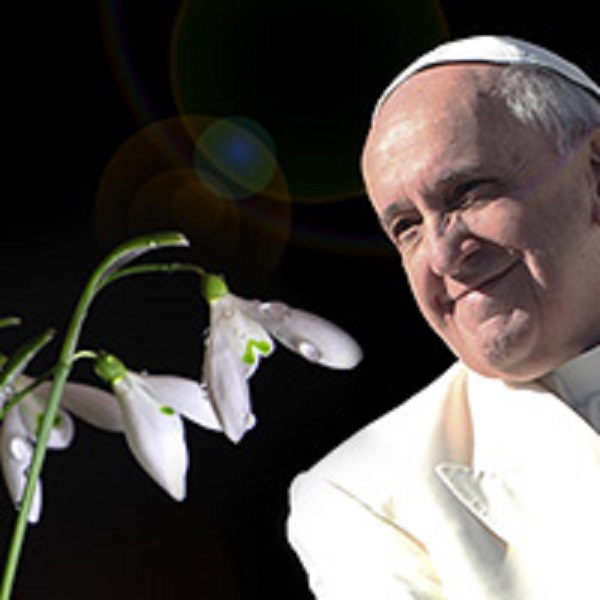
Which, of course, begs the question of how she and others from this line of thinking are responding to Pope Francis’s new encyclical on ecology and climate change.
Entitled Laudato Si: On Care for Our Common Home, the official statement of church teaching calls on all of humanity to do their part to stop environmental deterioration; to “recognize the need for changes of lifestyle, production and consumption in order to combat this warming” and protect our shared home.
However, protecting the environment and acting as stewards of the earth are not new concepts for the Church. In 1981, the U.S. Catholic Conference even issued a statement that recognized the threat of climate change and the need for clean energy.
So while the encyclical may be increasing global consciousness and moving the sympathetic to act, it’s probably not troubling the deniers as much as you’d think.
I also remember back when Pope John Paul II changed the order of the Mass so that the congregation would stand up before the offertory prayer instead of after. My school promptly implemented this change in their daily Mass. It was around the time JPII also spoke out against the U.S. invasion of Iraq. This went unacknowledged; however, teachers and students alike rallied around George W. Bush’s 2004 reelection, enthusiastically endorsing his foreign policy.
On the encyclical, we’re already seeing a huge backlash from U.S. politicians, including Catholics.
“I don’t get economic policy from my bishops or my cardinals or my pope,” said Jeb Bush. “I think religion ought to be about making us better as people and less about things that end up getting in the political realm.”
Republican energy lobbyist and political consultant Michael McKenna declared,
This pope is selling a line of Latin American-style socialism. This guy is not in sync with the American Catholic Church. Guys like Jeb and Rubio are more in line with the American Catholic Church than the pope.
Couple of important points here:
- Climate change cannot be written off as a political issue; in fact, it constitutes a moral crisis. The world’s poorest countries—the ones who have contributed the least to climate change—are the ones being hit hardest by emissions from big polluters. Serving the poor and caring for the most vulnerable among us is a pretty key part of the Catholic faith. One I think would fall under the category of “things that make us better as people.”
- Even if a slight majority of American Catholics disagree that climate change is dangerous and human caused, guess what? Catholic doctrine doesn’t depend on public opinion. If a poll found that a majority of Catholics didn’t believe in helping the poor, that wouldn’t change Church teaching either. The “American Catholic Church” is not somehow exempt from papal authority.
Denouncing the Pope for promoting environmental responsibility is not bolstering anyone’s credibility—religiously, politically, or morally.
Tell your members of Congress to stand with Pope Francis and support U.S. climate leadership.
Originally published July 6, 2015.
by CGS Blog Archive | Jul 1, 2015 | Global Justice, World Citizen
I consider myself a pretty culturally diverse person. I was raised as Serbian-American, and I remain highly involved in this community today. You can ask my friends. I have always been playfully teased about my “obsession” with being a Serb, inviting them to “crazy Serb” events, and forcing them to try my mother’s food.
My connection to my ethnicity inspired me to love and appreciate learning about others. I chose to major in Global and International Studies with the regional focus on Latin America and a specialization in comparative politics. Throw in a Spanish minor and a semester abroad, and there you have it: culturally diverse.
My fascination with global affairs also led me to apply for an internship with Global Solutions Pittsburgh. Nevertheless, when I read their Spring Fundraiser program last week during the event, they had a section about “Global Engagement” that caught my attention:
“What does it mean to be globally engaged?”
I had always associated the word “global” with international; over there; foreign and exotic lands different than my own. But is that always the case? What does it really mean to be globally engaged? Can you be globally engaged in your own backyard?
Merriam Webster defines global as “involving the entire world.” Although that can mean abroad, it doesn’t always have to. The entire world includes the United States. It includes your state, your city, and your home. How is it possible to be globally engaged in your own neighborhood, though? Can you make a global impact without a passport?
The amount of injustice around the world is absurd. How many times have your parents told you to eat your dinner because there are starving kids in Africa? Well, they are correct. Seventy-five percent of the world’s poorest countries are located in Africa, and a sickening one in three people living in sub-Saharan Africa are malnourished. That being said, were you aware that one in every six Americans lives in poverty, and that the population of Americans living in poverty is equal to the population of Texas, New Mexico, Oklahoma, Kansas, Colorado, Arizona, Utah, Wyoming, Nevada and Nebraska combined? Poverty is not a far-away problem; a distant or foreign concept solely stereotyped with abandoned African children. Poverty is global.
Another issue that affects all humans living on this earth is climate change. Environmental affairs are often seen as a domestic issue. However, the environment is a concept that affects every single one of us, whether we agree with certain ideologies or not.
Just this week, Pope Francis addressed climate change in his 183-page encyclical. In this document, the Pope states that humans are the main cause of global warming and climate change. He then analyzes the science behind global warming and provides suggestions for curbing the problem. Francis advises all humans to not cook more than they can eat, to wear an extra sweater instead of turning on the heat, and to carpool or walk to work if possible.
Pope Francis marked a turning point in focusing on this controversial topic. Many conservative Catholics are climate change skeptics, which makes the encyclical that much more significant. The Pope is an important Catholic figure that represents over 1 billion individuals around the world. His goal is to awaken the people and involve the entire world in taking action.
In today’s global society, there are many aspects that connect people from different backgrounds all around the world—including injustice. We need to come together and fight for what is right. The best thing the whole world has in common right now is our dream for improving it—for ourselves and for generations to come.
Whether you travel to a third-world country, study abroad, or participate in a mission trip is up to you. While I am not diminishing any of the problems that exist in these foreign countries, it is important to be aware that injustice is a threat everywhere. Be a global citizen, but don’t think that you can’t change the world only ten minutes away from where you live.
I still consider myself multicultural. I will always feel the need to travel, live in foreign destinations, and explore different ethnicities. I encourage everyone to do the same. However, the next time you want to engage yourself on a global level, put your passport away for a while. I think you’ll be surprised to find how much of an impact you can make right outside your front door.
The full version of this article was originally published by Global Solutions Pittsburgh. It has been cross-posted with the author’s permission. To read the original, click here.