by Samuel Kane | Jun 4, 2012 | Global Cooperation, Peace & Disarmament

No one will blame Kofi Annan for a lack of effort. Over the past few months, the former UN Secretary-General has worked tirelessly to peacefully resolve the ongoing turmoil in Syria. And yet, with the bloodshed continuing to escalate, Annan’s peace plan has not come to pass.
The Syrian government’s continued defiance of Annan’s six-point peace plan, coupled with its ongoing brutality towards its enemies at home, clearly indicates that this regime values power above all else, even if it comes at the expense of its own people. In light of this reality, it is time for the United States and the international community to take firm steps to bring about the end of violence in Syria and secure a transfer of power from the Assad regime before the violence in Syria truly spirals out of control.
In theory, the most straightforward way for the international community to stop this violence, of course, would be to remove Assad from power through a secure transfer of leadership through an internationally supported agreement. However, in order for such an action to take place, it would need to have the backing of the UN Security Council. Obtaining this authorization would be problematic, as Russia and China have consistently blocked the Security Council from adopting meaningful measures to deal with the Assad regime. Russia, in particular, has described itself as being “categorically against” any sort of foreign intervention in the Syrian crisis. This stance should come as no surprise to those familiar with the nature of the Russia-Syria relationship, in which Syria provides Russia with a market for Russian-made arms, and naval access to the Mediterranean Sea. Nevertheless, the United States should continue to apply diplomatic pressure on the Russian government, as Russian support would allow the international community to consider a broader range of actions in response to the Syrian regime’s atrocities.
With UN-backed solution currently off the table, the US must consider alternative methods of undermining the Assad regime and alleviating the suffering of the Syrian people. Several commentators have suggested that the US should spearhead the construction of so-called “safe zones” in the countries neighboring Syria, namely Turkey and Jordan. These zones, which, ideally, would be protected by a US or multinational force, could serve a dual purpose of providing sanctuary for refugees and acting as a staging area for the Syrian opposition. Furthermore, since these zones would be constructed outside Syrian borders, the Syrian government, and its Russian backers, would be hard-pressed to claim a violation of Syrian sovereignty (though one could certainly make the argument that, in light of the atrocities that it has inflicted against its own people, the Syrian government has forfeited any such claim).
Beyond the construction of safe zones, US options with regards to Syria move into a murkier legal territory. As Russia and Iran continue to provide arms to the Assad regime, some have suggested the need to bring an end to the flow of weapons into the conflict zone. This could be a tricky proposition, however, if Russia and Iran refuse to comply voluntarily. In Foreign Policy, Andrew Tabler proposes a novel solution:
“The United States and its allies could establish a naval quarantine along Syria’s coastline similar to the international patrols that intercept arms shipments to Lebanon destined for Hezbollah. This, however, would seem to require a U.N. Security Council resolution — which Russia would likely veto. A possible way around that could be to establish a naval and/or air quarantine of Syria with legal support from the Arab League, akin to the legitimacy given by the Organization of American States to a similar measure during the Cuban Missile Crisis. The question, however, is what happens when Russia and Iran challenges it.”
Similarly, other potential solutions, such as the US directly arming the Syrian rebels or establishing safe zones within Syrian territory, could be challenged on grounds of violating Syrian sovereignty, and thus would lack the firm legitimacy of an UN-backed action.
For now, the United States should adopt a two-pronged approach to the Syrian conflict. First, it should construct safe zones in Turkey and Jordan, in order to provide an outlet for Syrian refugees and a staging area for the Syrian opposition. Second, the US should shift its focus from pressuring Syria directly, to pressuring Russia to support UN-backed action against the Assad regime, as being able to craft a solution through the UN would allow the US and its allies to take the truly decisive actions needed to bring a transfer of power to Syria and end the violence in the country.
by CGS Blog Archive | Jun 4, 2012 | Global Cooperation, News, World Federation
Last month, Wendell and Madelyn Harter were presented with Citizens for Global Solutions’ Edward Rawson Global Citizen Award, an award dedicated to honoring a lifetime of energy, service, and financial contribution to Citizens for Global Solutions. Together, the couple has helped shaped the organization and supported international institutions for over 60 years.
Don Kraus, CEO of Citizens for Global Solutions, said, “Wendell and Madelyn’s support has been crucial to building the organization to where it is today. Their dedication is an inspiration to all of us to keep striving for a better, more peaceful, and more just world. Their efforts will live on as our organization and our movement continues to grow and build.”
Citizens for Global Solutions is extremely grateful for the Harters’ enthusiasm and support throughout the years and we are proud to honor their commitment through this award.
by Arielle Weaver | May 25, 2012 | Global Cooperation
Yesterday, the Senate Appropriations Subcommittee on State and Foreign Operations resumed a markup of the State and Foreign Operations Appropriations bill, setting their priorities for spending on Foreign Affairs for the 2013 fiscal year. This was an important and revealing moment for the Senate because what they designate money for in the international affairs budget shows where their foreign policy priorities lay. The Senate showed a much stronger commitment to international development and human rights than the House did, and we applaud them for that.
Fortunately, the Senate bill provides $1.6 billion for Contributions to International Organizations (CIO), which is slightly above the level requested by the President. However, for contributions to International Peacekeeping Activities (CIPA), the bill provides $2 billion for UN peacekeeping, which is $100 million less than the President’s request.
One glaring issue with the Senate bill is the question of funding for UNESCO. Due to an almost 20-year-old law, the United States is barred from contributing to UNESCO because of the recent vote that made Palestine its newest member.
This law sends a negative message to the world that the U.S. is willing to disengage from the international community under such circumstances when in fact our presence and seat at the table helps both promote our own foreign policy and shore up support for our allies. The U.S. needs to keep a seat at the table when it comes to UNESCO, and we can only do that by paying our dues.
The reason why any funding was originally appropriated to UNESCO in the Senate markup was the hope that Congress will pass a waiver to this law that will allow the United States to contribute funds to UNESCO. The House bill, in contrast, did not allocate any funds for UNESCO. Unfortunately, at the markup the Senate decided to lower the level of UNESCO funding. We are glad to see the Senate did appropriate some funds for UNESCO however. We hope that the final version of the State and Foreign Operations bill will include strong funding for CIO, CIPA, and UNESCO.
by Amanda Bowen | May 21, 2012 | Climate Justice, Global Cooperation, News
Today’s Washington Post featured a story about an organizational letter that GlobalSolutions.org, along with nearly two dozen other groups, sent to President Obama that urged him to attend the Rio+20 Earth Summit this June.
The letter read in part,”Your presence at this Summit would signal its critical importance to all Americans, demonstrate our country’s deep concern over urgent global issues that will inevitably affect our security and well-being, and highlight our nation’s determination to be a contender in the race to a low-carbon green economy.” To read the full letter, click here.
GlobalSolutions.org believes strong U.S. leadership at Rio+20 will spur other nations to commit to taking concrete action in preserving our planet for future generations.
If you think President Obama be a leader on sustainable development and attend Rio+20, sign our petition here.
by Melissa Kaplan | Apr 17, 2012 | Global Cooperation
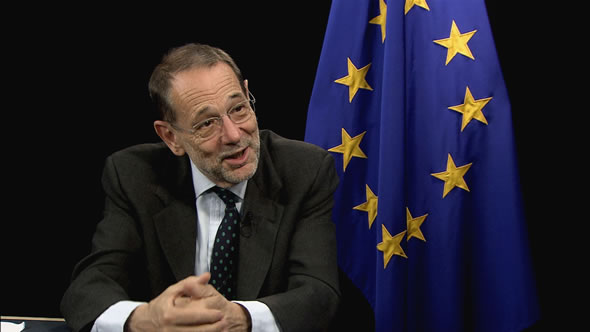
Last week, I attended an event at the Brookings Institution, “Europe’s Eastern Frontiers: A Conversation with Javier Solana.” The former NATO Secretary-General and EU foreign policy chief discoursed on the European Union’s relationship with its neighbors to the East, and also touched on a few other topics of significance in international affairs today.
Solana began by talking about how after the enormous tragedy of World War Two, European nations tried to pull together to work on difficult issues. Once the EU was formed, it was later able to absorb many formerly Communist countries from Eastern Europe. Solana spoke about a few specific cases in regards to the EU’s “eastern neighborhood.” He stressed that Turkey is an important country which would bring “vitality” to the EU if admitted as a member. In Russia, where former president Vladimir Putin was recently elected to a new six-year presidential term after serving as prime minister instead for the past four years, Solana said that while Putin may not have changed in the time since he left the presidency, Russia itself has, as recent protests against Putin’s return to power reveal. Russia’s recent entry into the World Trade Organization (WTO) in 2011 shows that, like China before them, they are at least attempting to play by international rules. Turning to Georgia, which fought a brief war with Russia in 2008 over the breakaway territory of South Ossetia, Solana emphasized that the EU and Georgia have a “close” relationship and an association agreement.
Finally, Solana described the situation in Ukraine, once a bright spot for emerging democracy in the region, as one of “great frustration.” The hopeful time after the Orange Revolution in 2004 did not last, and democracy and justice have backslid recently in the country, as evidenced by the trial and imprisonment of former Prime Minister Yulia Timoshenko. Solana lamented that Ukraine could have done much better in many respects. However, his attitude towards the Eastern European region remains one of “realistic optimism.” As he pointed out, things are still much better in this part of the world than they were 10 years ago.
During a question-and-answer period, one participant asked how Russia would react if a war breaks out with Iran in the near future. Solana replied that while such a scenario has not happened at this time, he believes that Russia would stand with the other P-5 members of the U.N. Security Council should war involving Iran occur, as they don’t want a nuclear-armed Iran any more than other nations do. Syria, however, is a more complicated situation (as evidenced by Russia and China’s repeated vetoes of Security Council resolutions on the government’s crackdowns and violence against its own civilians). Solana said it is necessary to find a common position with Russia on this matter. He said that he’d prefer to solve problems with Iran with Russia’s help, but if that is to occur, other nations would most likely have to give something to Russia in other areas, most likely on missile defense.
Finally, speaking about Asia, Solana noted that in a way the region is copying the EU’s example through the creation of ASEAN (Association of South East Asian Nations). He used this point to underline the ways in which regions around the world are beginning to work together more closely, sharing sovereignty, and as a result, making the idea of global governance easier for the future.
by Ian Campbell | Apr 11, 2012 | Global Cooperation, News, Peace & Disarmament
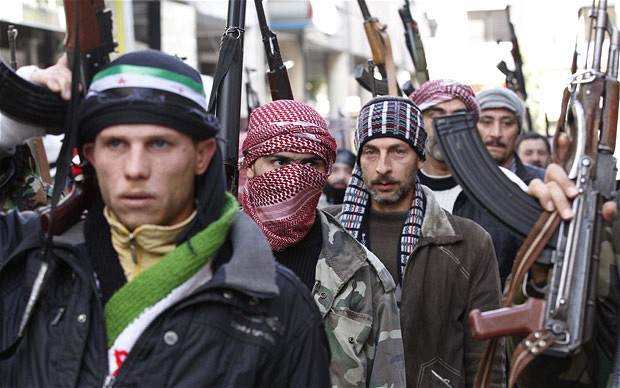
What began as a day of potential peace for the Syrian people quickly turned into continual despair. Both the Syrian government and anti-government demonstrators agreed to a peace plan, drafted by international envoy Kofi Annan and endorsed by the United Nations, which called for a ceasefire by tomorrow. In order for this plan to be effective, the Syrian government initially agreed to begin withdrawing its troops from Syrian cities, but Syrian President Bashar al-Assad demanded written guarantees that the demonstrators would disarm themselves before troops were removed from the city. Not only must demonstrators be forced to lay down their weapons, but the Syrian government also demanded that foreign states promise to cease all funding to the anti-government demonstrators. The Free Syrian Army (FSA), the primary anti-government resistance force, denied these unacceptable terms, which the government has used as an excuse to not withdraw their troops. On April 10th, when the ceasefire should’ve begun to take effect, Syrian activists report heavy artillery has not stopped and that at least 23 people have died. For now, the strongest possibility for peace is failing to resolve the Syrian conflict.
Assad’s reluctance to withdraw troops from Syrian cities implies a dangerous reluctance to negotiate. These new demands, which were denied by the FSA, serve as a way for Assad to support the claim that he’s defending his nation from “terrorists” and gives him an excuse to prolong the effects of the peace plan. Foreign representatives such as Bernardo Valero, spokesman for the French foreign ministry; William Hague, the British foreign secretary; and Jay Carney, the spokesman for the White House believe the Syrian government is only using these new demands as a cover in order to continue violence, and also advocate considering future plans if Damascus fails to meet its commitment. Syrian allies, such as Russia and China, believe that Syria will adhere to their commitment to the peace plan, but also agree the government must take a more direct role to implement the peace plan. The Syrian government stated that it’s begun to withdraw its troops from cities and towns, but Annan says that those troops are instead being relocated to new areas of conflict. The procrastination of implementing the peace plan will increase the total death toll of Syrian civilians and military alike, as well as create more difficulties for humanitarian aid to assist victims of the conflict.
Even though the Syrian government has prolonged implementing the peace plan, Annan still has faith that the plan will work by the agreement’s deadline. Today, Annan travelled to Iran to speak with Ali Akbar Salehi, the Iranian foreign minister, with hopes that Iran will help advocate the importance of implementing the peace plan. Iran is one of Syria’s most important regional allies and if Annan can convince the foreign minister to support the peace plan, then it may convince Syria to begin implementing the peace plan as soon as possible. So far, Annan has received assurances that the deadline will be honored and Salehi has stated Iran’s support for Annan’s plan. Annan and Salehi also state that interference from other countries would be disastrous to peacemaking efforts within Syria.
Unfortunately, we won’t know if Assad will honor these commitments until tomorrow. The peace plan is the greatest opportunity to end the Syrian conflict and must be implemented as soon as possible. Any further procrastination by the Syrian government will indicate unwillingness to negotiate. However, diplomacy is the best solution to end the conflict and must be attempted in all aspects before any further action is considered. Basma Kodmani, spokesman for the Syrian National Council, has stated that if Assad does not honor his commitment to the peace plan, then the U.N. Security Council must set an ultimatum for the Syrian government to implement the peace plan with the will to enforce by power. This would be an unfortunate circumstance, but Assad and the Syrian government need to realize the importance of ending the conflict as soon as possible before more drastic measures are taken by the international community. Hopefully we will see an improvement when the agreement deadline expires tomorrow, but for now, time is running out and thousands of lives are at stake.