by Stefanie Cook | Jan 17, 2013 | Global Cooperation, United Nations
As crises continue in Mali and Syria, Better World Campaign (BWC) released the latest bipartisan poll of American perceptions of the United Nations.
According to BWC’s findings, “Eight in 10 voters say it is important for the U.S. to maintain an active role in the United Nations, and further that it is in America’s best interest to continue to actively support the UN.”
In addition, 93 percent of Americans believe it is important that the U.S. be a member of the World Health Organization (WHO). WHO is the global health authority for the United Nations providing leadership on setting health standards, research, monitoring health situations and preventing disease outbreak. The United States’ funding for the WHO is in danger. The U.S. is legally required to cut funds to any UN agency that recognizes a Palestinian state and Palestine is expected to bid for membership in May at the World Health Assembly in Geneva. “While the Obama Administration has no flexibility to waive the law, Congress has the power to grant the President waiver authority,” says BWC.
Both Democrats and Independents strongly believe that the United Nations is supportive of America’s objectives around the world. The poll showed that Republicans are evenly split on the issue. Forty-eight percent believe that the UN is supportive of America’s objectives and 48 percent believe that it is not.
Knowledge of American favorability towards international cooperation is especially important as Congress considers cuts to spending on foreign aid this session.

by Stefanie Cook | Jan 14, 2013 | Global Cooperation, Peace & Disarmament
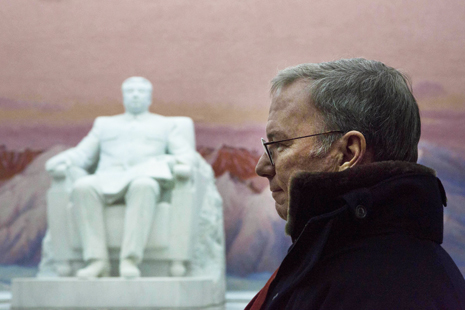
Some may call it “hopelessly naïve” but no one can say that Google Chariman Eric Schmidt’s four day trip to North Korea, where he was photographed walking through the streets surrounded by North Korean people, did not have an impact on the mindsets of people ordinarily closed off to the outside world. For more than half a century, North Korea has maintained its tightly state-controlled system and built up its nuclear weapons program, keeping foreign invaders at bay, while millions of its citizens are at the same time dying from food shortages. The United States government has, understandably, hesitated to act; however, it is about time we let somebody else try to negotiate with the Kim dynasty.
Even though it is gutsy of Schmidt to dabble in diplomacy with North Korea, I have to applaud him for giving it a shot. Last week, BBC News reported that Schmidt and a delegation that includes former New Mexico governor and US envoy to the United Nations Bill Richardson visited North Korea in order to urge the country to take down some of its restrictions and to allow its citizens to use the internet. It also pushed for North Korea to end its nuclear weapons and missile tests and discussed the case of the Korean-American detainee, Kenneth Bae, who has been held in the country on arrest since November.
Commenting on the trip, which was made in an unofficial capacity and unaccompanied by any U.S. officials, State Department spokeswoman Victoria Nuland said that the trip was “ill-advised”. She also added that the State Department does not consider the timing of the trip to be particularly good because it follows a satellite launch using a long-range rocket made by North Korea in December. The launch was a violation of U.N. Security Council resolutions and the Security Council has not yet decided whether to take action.
I would not advise any ordinary American citizen to try something similar to this delegation, and Schmidt is stepping on some toes by doing so, but I am excited to see a private citizen actively pushing for better relations with North Korea. Economics, not military force, are how relations with North Korea are going to improve. I still believe that we should pursue North Korean disarmament but, we are far more likely to live peacefully with North Korea if we are bound by strong economic interests.
Fox News noted that the trip came days after ruler Kim Jong Un spoke of expanding science and technology as part of the country’s goals for improving its economy in 2013. In 2012, we saw North Korea introduce small-scale agricultural reforms that provided a hint at the rhetoric shifting from its focus on the military to focusing on the economy. Now is the time to embrace investment-oriented diplomacy.
We still have reason to be concerned that North Korea is violating international norms and could fire a missile at South Korea; but, it might be best now to pursue a multipronged approach in which capitalism takes the lead in urging North Korea to liberalize. Furthermore, allowing a nation to keep hundreds of thousands of political prisoners and to torture its citizens is also a violation of international norms. The United States and North Korea can’t just dance around each other forever. For nearly 50 years, the totalitarian county has shown that it doesn’t want to listen to the U.S. government so, why not let private enterprise take a stab at diplomacy?
by Andrew Hess | Dec 5, 2012 | Global Cooperation, Peace & Disarmament
We’ve all heard about sequestration, a mandatory cutting of federal expenditures on apocalyptic levels if a budget deal is not struck in Congress before the New Year. However, does anyone really know what it will mean for international affairs budgeting if sequestration takes effect?
The short answer is: it doesn’t look good.
To begin, let’s run through what would happen on the macro level if sequestration kicks in. If sequestration is not avoided, the Office of Management and Budget will cancel $110 billion in spending for fiscal year 2013, with a grand total of $1.2 trillion in savings through fiscal year 2021. The amount of money saved by sequestration will be split 50/50 between Defense programs and non-Defense programs, with Social Security, Medicaid, and the majority of Medicare escaping unscathed.
Using fiscal year 2013 as a model and assuming percentage cuts between seven and ten percent, that would mean that Defense spending would drop by $55 billion and non-Defense discretionary spending would be cut, again, by $55 billion, which includes the International Affairs Budget.
What does this mean for the International Affairs Budget? If everything goes according to projections, the post-sequestration International Affairs budget in fiscal year 2013 would be approximately $47.7 billion. This total is $7.2 billion less than the fiscal year 2012 enacted amount ($54.9 bn) and $8.7 billion less than the fiscal year 2013 request ($56.2 bn). What does this kind of cut mean in terms of what will be impacted? The U.S. Global Leadership Coalition, a network of experts, businesses, and NGOs, has put together a fantastic little chart on what some of the cuts would be:
- Global Health programs would be cut $670 million from FY12 levels;
- State Department operating expenses (DCP) would lose $1.084 billion;
- USAID’s development programs would fall $207 million;
- Refugee relief would be cut $154 million; and
- Foreign Military Financing would fall by $518 million.
Clearly, sequestration would have a hugely damaging impact on soft power influence around the world; the damage would take many years and billions of dollars to repair. In this era of fiscal limitations and highly complex and varied international issues, we cannot afford to let one of our best modes of interaction with the international community fall by the wayside. Congress must reach an agreement, if not for the myriad of other potentially devastating results of sequestration, for the huge setbacks in international affairs funding that would come as a result of this type of spending cut.
If you are interested in following this issue, USGLC has put together a calendar of important events to keep in mind:
|
December 31
|
Expiration of Bush tax cuts
|
|
January 2
|
Sequestration Applied
|
|
January 3
|
113th Congress Swearing-In
|
|
January TBD
|
Freshman Orientation, House Retreats
|
|
January 21
|
Presidential Inauguration
|
|
February 5
|
FY14 Budget Submission to Congress
|
|
March 27
|
FY13 CR expires
|
Also, if you are interested in learning more, USGLC has a number of great resources on the issue of sequestration:
http://www.usglc.org/2012/11/01/21720/
http://www.usglc.org/2012/07/30/budget-watch-july-30-2012/
http://www.usglc.org/2012/10/03/international-affairs-budget-update-10-2-12/
by CGS Blog Archive | Nov 13, 2012 | Global Cooperation, Peace & Disarmament
A significant amount of the world’s resources and minerals are in countries on the African continent. From diamonds to oil reserves, you would think these resource-rich nations would be some of the most economically advantaged. Instead, the presence of resources, like oil, in countries such as Sudan and South Sudan, has only created more problems and turmoil in the region.
Disagreement over oil reserves and how the profits should be dispersed throughout the country is a major reason for Sudan’s ongoing civil war (arguably the longest in history) and the eventual secession of South Sudan.
Countries rich in resources are actually more prone to conflict, as these resources can be used to finance war or rebellion efforts that otherwise wouldn’t be sustainable. The profits can be used by corrupt governments to finance their own needs without any need for input from civilians, leaving them less accountable to their people. However, these are the same resources that have helped African nations to develop some of the fastest growing economies in the world.
According to the IMF’s 2012 World Economic Outlook, of the 20 fastest growing economies in the world, 10 are located in Sub-Saharan Africa. South Sudan ranks # 2 in the world. Others who make the list include the Republic of Congo, Zambia, Ghana and Mozambique.
While the growth of these economies is strong overall, how are the citizens of these countries affected? Ghana for example, has developed an economic system that has enabled its oil profits to be dispersed broadly across the country and it has actually had positive effects in alleviating poverty. Botswana, and its diamond economy, has grown from one of the poorest nations in the world to a now “middle-income country,”. But other resource-rich countries, like Mozambique, are struggling to see similar results.
In Cateme, Mozambique, the site of a new coal mine (currently the biggest in the world), many residents had expectations of new wealth and prosperity as a result of the new coal industry there. Instead, many were disappointed when they displaced from their homes and their farms, and relocated to an area 25 miles away, “living in crumbling, leaky houses, farming barren plots of land, [and] far from any kind of jobs that the mines might create,”.
Large coal mining companies are investing billions of dollars into operations in Mozambique, but who is actually seeing that money? Also rich in natural gas reserves, Mozambique has gas projects that have been estimated by the World Bank to be capable of bringing in as much as $70 billion.
Yet millions of people are still living below the poverty line, and some economists feel that they will continue to do so. According to the U.S. Agency for International Development, these megaprojects based on oil, gas, and minerals, rarely create a significant number of new jobs in these countries and do not encourage local entrepreneurship.
Most Mozambique citizens live in rural agricultural areas and less than 1% of these farmers are commercial farmers. Over 99% are small-scale and family-based sustenance farmers. Left in this isolated position, most of Mozambique’s rural citizens “languish even as the country surges.” Furthermore, those villagers who were forced to move from their homes located on top of the coal reserves were left with false promises of new and improved housing, public services, and new fields to farm.
How can countries with some of the fastest growing economies in the world ignore the needs of their poorer citizens or even leave them worse off? One Mozambique farmer, who was displaced from his home, observed this when he commented: “The rich get richer and the poor get poorer… That is what is happening here.”
As evident from places like Ghana and Botswana, it is possible to produce real positive and widespread economic results and increase the overall standard of living in countries that are able to utilize their access to resources in a productive way. But we have to address the questions: what’s stopping this from happening in every country with a resource boom and what can be done to ensure that the citizens of these countries see the effects of this economic growth?
by Don Kraus | Nov 2, 2012 | Climate Justice, Global Cooperation
Sandy did what Candy didn’t: Kick start a full blown conversation on climate change.
GlobalSolutions.org was part of an effort to insert this critical topic into the presidential debates. But despite 160,000 petition signatures, press releases and winning Google moderator votes; Candy Crowley, Bob Schieffer and Jim Lehrer refused to bring up the topic, the first time climate or the environment was left out of presidential debates since 1978.
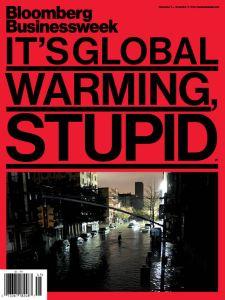
Now Superstorm Sandy has changed all of that. Finally the main stream media and politicians are once again taking this seriously. The Bloomberg Business Week cover says it all: “It’s Global Warming, STUPID.”
The Washington Post columnist Eugene Robinson points out, “The traditional dodge – that no single weather event can definitively be attributed to global warming – doesn’t work anymore. If something looks, walks and quacks like a duck, it’s a duck. Especially if the waterfowl in question is floating through your living room.” Too true, but unfortunately Robinson winds up a strong column saying that”
Climate change is a national challenge. Ignoring it is not a solution. Pretending it isn’t happening will not make it stop.
Wrong. It’s not a national problem. It’s a local, national, and global problem, and will take people and nations around the world working together to solve it. The U.S. conversation must do more than focus on hardening its infrastructure. In addition we must talk about hardening our resolve to hammer out a global agreement that truly address the green house gas emissions that fueled Sandy. And this will take presidential leadership.
Whether or not the next president will take this on comes down to a key question just asked by CBS News: “Will the dialogue on extreme weather and climate that has emerged in Sandy’s wake alter the national conversation (or lack thereof) on climate change? Or will that discussion recede with Sandy’s floodwaters and the week’s news cycle?”
I believe the media itself must take some responsibility in making sure this growing emergency remains in the public eye. Wen Stephenson, was a former editor at The Atlantic and The Boston Globe and, most recently, the senior producer of NPR’s On Point who has become a climate change activist. In a moving article titled “A Convenient Excuse“, Stephenson lays out a powerful call to his former media colleagues to treat climate change like the emergency that it is. He says that:
Failure is repeated across the mainstream media landscape – the product of a mindset in which climate change is simply another environmental problem, albeit a particularly complex one for which we’ll eventually find a technical fix, mainly by doing more or less the same things we’re doing now, only more efficiently and with better technology.
Sandy is our wakeup call. Now it’s up to all of us – politicians, the media and you — to stay awake. Many of us feel burnt out and disillusioned. The failure of the 2009 Copenhagen climate talk took a lot of wind out of our sails. But Sandy’s message is clear, “Too bad. Dealing with climate change is not optiontional.”
Wen Stephenson puts it more bluntly: “Silence, and near silence, is no longer acceptable. To use a phrase from the heroic struggle for AIDS awareness in the ’80s and ’90s: silence equals death. For countless millions of people, climate silence equals death.”
by Andrew Hess | Oct 31, 2012 | Global Cooperation, Human Rights
Have you ever wondered what you would do in a zombie apocalypse? If you have, you are not alone. It seems like zombies are kind of the “in” thing right now; The Walking Dead is a wildly popular show on AMC and zombie themed shows are all over a number of other networks. At this point you may be asking yourself, “Why are we talking about zombie hordes right now, wasn’t the Republican National Convention in August?” Well, it was. But seeing as how it is Halloween, I thought it would be interesting to look at this phenomenon through a critical lens.
There is no doubt that there is a psychological basis to this phenomenon. Being overrun by a horde plays on a fundamental fear that humans have. Combine that with the age-old fear of unknown repercussions of scientific discovery, which dates back to the myth of Icarus at the earliest, and you have an instant classic.
While there is certainly a gross-out horror factor that tends to bring in viewers, the questions that follow from a hypothetical zombie apocalypse are more interesting, and in my opinion, the main reason why zombies are so popular.
This fascination with zombies has not escaped the government. In fact, the CDC has a fair amount of blog material on how to prepare for the zombie apocalypse. It does make sense after all; telling people how to be prepared for a natural disaster in a fun presentation is a good way to change up the pace.
Even though all of this is really interesting stuff and it deserves its own attention, it is a fun mental exercise to think about how the international community would respond to something like a zombie apocalypse. While humanity has never encountered anything like zombies, we have had a fair amount of experience with pandemics and other international health issues. HIV, H1N1, and SARS have all been in the international spotlight in recent years and have reminded us of the possibility of a deadly pandemic.
The outbreak of SARS centered mainly in China in 2003 is an interesting example to ponder and could provide an example of how a future outbreak could play out. At the beginning of the outbreak, the Chinese government moved to cover up the severity of the virus, thus resulting in SARS being spread to other countries. This occurrence shows the need for easy and rapid communication between nations regarding the true nature of outbreaks. If each member of the international community does not adhere to this policy of transparency with respect to the outbreak of infectious diseases, the ability to properly address pandemics is severely limited. Unsurprisingly, the advantages of multilateral solutions and an engaged foreign policy on the part of the United States are obvious.
After all, while a large number of Americans, including myself, do have a zombie outbreak plan, I don’t think that any of us actually want to have to use it.