by CGS Blog Archive | Feb 26, 2014 | Global Cooperation, World Federation
The day he died, my organization got a hand-written letter from Pete Seeger, the 94-year-old iconic folksinger who departed last month after decades of inspiring us onward with his peace and justice ballads.
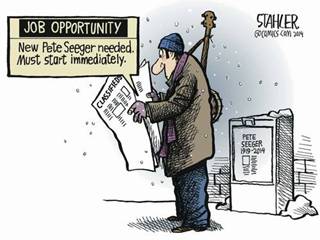
Now with his loss, we realize it is quite a gap to fill. Indeed, one political cartoon showed a hapless banjo player reading his paper’s page: “JOB OPPORTUNITY: New Pete Seeger needed. Must start immediately.”
What were his final messages to us? In an article last week entitled, “I’m Through With Big Things,” Seeger was quoted as saying, “Be wary of great leaders. Hope that there are many, many small leaders.” We know of his work to clean up the Hudson River, as well as his call for all of us to get involved at the local level. If he was disappointed in greater things, it was perhaps no wonder—for decades he suffered severe disappointments on the larger scene—a country which blacklisted him, record companies and television stations that marginalized him, and a youth culture and civil rights movement that passed him over when they became enamored by cooler music and more strident activism.
Yet Seeger never did falter from his dream of a united world. This visionary yet practical man understood that probably the one way to make sure all of the 193 countries on the planet would cooperate was through global rules with enforcement power, through a democratic, empowered and more fairly structured United Nations. With me, he was on the Board of Advisors for the Center for War/Peace Studies in New York which received his last letter on the day he died, though it was written October 5, 2013. In it Seeger expressed support for a proposal to reform the United Nations voting structure to make it more representative of the people through a proposal called the Binding Triad.
“The Binding Triad is such a great idea I’d like to do all I can while I’m on this earth to get it adopted by the United Nations,” Seeger wrote in his letter and he included ideas on how to better sell the idea to the public.
Seeger loved the earth and all life on it. He was always seeking solutions. As he recently sang with Tomorrow’s Children in Solartopia:
Now we’re fighting wars over oil and gas, no matter who wins it will not last.
The earth is scarred, the planet is warming. Don’t you think that all of it’s a great big warning?
Don’t you know we’re gonna need a Solartopia all over God’s green earth?
It is a testament to Seeger’s struggle, tenacity and final emergence into redemption that his vision decades ago holds just as true today. With the melting arctic, leaking nuclear reactors, collapsing world economy, continued wars over oil and broken political systems, we know that time is quickly running out. Instead of doom and gloom, however, Seeger inspired optimism with his own joyful sound. He realized there is even an answer to the largest catastrophes awaiting us – by organizing countries to work together at the global level.
“Participation – that’s what’s gonna save the human race,” was a slogan Seeger was fond of using. Fellow World Citizens, let’s all pick up our banjos and march our world into its brave new future.
This article originally appeared in Common Dreams.
by CGS Blog Archive | Feb 12, 2014 | Climate Justice, Global Cooperation
We welcome the following contribution to The Global Citizen by Aric Caplan, President of Caplan Communications. His fuller analysis on the intersection of climate denialism and Congressional campaign contributions can be found here.
Voters are coming to grips with our many elected officials beholden to the fossil fuel industry that finances their reelections. The Center for American Progress recently reported that 160 members of the 113th Congress have taken over $55.5 million from the industry that drives carbon pollution, which also causes climate change.
The latest climate-denying diversions peddled by lobbyists and the anti-science crowd in Congress would leave news junkies and even casual political observers skeptical or uninterested altogether in finding cleaner energy alternatives. I would argue that this response is the result of learned behavior. After all, 97% of scientists worldwide subscribe to the fact that “climate-warming trends over the past century are very likely due to human activities.” Nevertheless, most scientists are impartial considering science is independent of ideology. The only disagreement in their ranks is among scientists with financial obligations to the fossil fuel industry.
Two years ago, one of the most outspoken, polarizing and climate-denying extremists, U.S. Senator Jim Inhofe (R-OK) a ranking member of the Senate Armed Services Committee and former Chairman of the Senate Environment and Public Works Committee, published “The Greatest Hoax: How the Global Warming Conspiracy Threatens Your Future.”
In his bias against science, Inhofe brazenly claims: “With all of the hysteria, all of the fear, all of the phony science, could it be that man-made global warming is the greatest hoax ever perpetrated on the American people? It sure sounds like it.”
Inhofe relies on superficial rhetoric involving regulations that amount to higher taxes and an array of misleading talking points that play well to his supporters and con funders by hyping how “We the People” and businesses, especially, are overburdened by government. Accordingly, Inhofe maintains that “. . . for the alarmists, global warming has nothing to do with science or scientific inquiry. Science is not about the inquiry to discover truth, but a mask to achieve an ideological agenda. For some, this issue has become a secular religion, pure and simple.”
Miles Grant, a Senior Communications Manager at the National Wildlife Federation, observed at the blog TheGreenMiles that Inhofe recently slipped up and admitted the real reason why he pretends climate change doesn’t exist. By effectively manufacturing headlines for himself, Inhofe argued, “I find fewer and fewer members of the United States Senate that are sympathetic to this whole cause,” and admitted to WABC-AM’s Aaron Klein that he only denies climate science because he doesn’t like the solutions being offered. Miles astutely pointed to conservatives’ bogus academic culpability that accepting the “science” would admit that climate poses a real problem, which would lead one to discussing the need to solve it. Next, you become stuck debating the science in a seemingly “endless loop” of disinformation, opinion-as-fact and other baseless conspiracy theories.
Rallying behind a common cause would seem reasonable — and an obvious answer to solving America’s problems — but instead it appears the voters are getting what they deserved. Meanwhile, the voices of Americans besieged by climate change are drowning out the bullhorn of special interests, be it from organized labor, farmers, small and sustainable business owners, or state visitor and tourism bureaus, who have described severe drought and other burdens they’ve faced as a result of climate change, reiterating the importance in finding common sense solutions to cut carbon pollution, protect future generations from climate change, spur the economy and create jobs.
by Don Kraus | Feb 12, 2014 | Climate Justice, Global Cooperation
Are we witnessing the last Winter Olympics held in Sochi? The Russian games are already relying primarily on manmade snow. SMI Snowmakers, a Michigan-based company, has spent the last 4 years designing and installing a system that has blown the equivalent of 920 football fields of snow onto Sochi’s slopes.
Will other winter games sites including Squaw Valley, Vancouver and Grenoble also fall victim to climate change induced weather patterns that are literally melting down the list of available host venues? The answer, according to a recent study, is a resounding yes. In all but the lowest greenhouse gas emissions estimates, the goal of limiting global temperature increase to 2° C will not be met. And as a result warmer winters will mean less snow.
However, unless global climate solutions are rapidly agreed to and implemented, the damage done to winter sports will only be (pardon the pun) the tip of the iceberg. We’ll skip the doomsday scenarios for now, but in the words of President Obama at his State of the Union address, “the debate is settled. Climate change is a fact.”
Obama is the latest world leader to connect a changing climate to “communities struggling with drought and coastal cities dealing with floods.” He and his administration deserve a huge amount of credit for the work they have done to address this problem. However, despite his good news that since 2006 the U.S. reduced its “total carbon pollution more than any other nation on Earth,” Obama is leaving out an important fact which Americans and the world need to hear: It doesn’t matter how much the U.S. reduces its greenhouse gasses, if other nations do not also cut theirs.
Some facts: Between 2000 and 2010, China’s emissions grew by about 57% while the US was able to limit its growth to about one half of a percent (and actually showed a 2% decrease by 2011). India’s emissions grew by 33%. The European Union decreased its output by about 1%. The rest of the world’s carbon emissions grew by almost 20%, already pumping out 80% of the combined total of China, the US, the EU and India. The bottom line is that the modest reductions that the U.S. and the EU have managed are not making a significant dent in global greenhouse gas reductions.
Obama and other well-meaning U.S. policy makers continue to talk about energy independence and U.S. greenhouse gas reduction as if that is all we need to do to solve this looming problem. But it’s not! No nation can solve this problem alone. Unless the United States and its lead spokesperson get serious about leading an effort for all nations to pitch in and work together, we will all suffer the consequences together.
Current UN sponsored climate negotiations have had limited success. Developed nations like the U.S. want all nations to share in the cost of combating climate change. Developing nations believe that they should not have to pay for consequences of carbon pollution from wealthy nations. There seems to be a consensus that if a global agreement is not ready-to-go by the UN’s 2015 meeting in Paris it is likely that we will reach a tipping point and risk going beyond a point of no return. Some say we have already passed that point.
But the 2013 UN climate meeting in Warsaw, Poland determined that countries individual commitments to reducing greenhouse gas emissions will be “nationally determined.” In other words, it seems like diplomats are crafting a weak global agreement with few rules or consequences. How can this possibly save the day?
It is past time for a new, U.S. led, coordinated approach. We propose that Obama dust off and update an old idea: a greenhouse gas tax. The concept behind this is simple. Get all nations to agree to tax carbon and other greenhouse gases at a common rate. Increasing the cost of carbon pollution will push the global market to adopt less expensive and less destructive sources of energy.
In the past this has been proposed as a global carbon tax, collected by a global entity. This will never be approved in Washington. Instead, each country or state would collect its own taxes and use most of the funds as needed: to reduce other taxes, retrain workers displaced by a changing economy, update their infrastructure, fortify coastal cities threatened by rising sea levels, or any other way they wanted to.
However, a small percentage of revenue, adjusted on a sliding scale, would go into the new Green Climate Fund to support developing countries ability to limit or reduce their greenhouse gas emissions and to adapt to the impacts of climate change.
This is a simple solution where everyone pays and everyone benefits. Humanity is facing a crisis and we either pay now, or pay much more later. The cost of a carbon pollution tax is small when compared to the amount we will pay to adapt to rising sea levels, new deserts, food shortages, resource wars and the other horrors associated with out-of-control climate change. The United States is the only nation with the capacity and resources to lead this effort.
President Obama has already laid out the challenge saying “when our children’s children look us in the eye and ask if we did all we could to leave them a safer, more stable world, with new sources of energy, I want us to be able to say yes, we did.” And, we want to be able to say to them, “let the winter games begin.”
Co-authored by Mona Funiciello, an independent consultant who specializes in climate change policy and strategy
by Kevin Burke | Feb 11, 2014 | Global Cooperation, Global Justice
The U.S. Congress is holding up a key reform of the International Monetary Fund and, in the process, is both reducing the IMF’s capacity to do business and diminishing the power and reputation of the U.S. when it comes to brokering multilateral agreements and working in international institutions. The end result is bad for the global economy, people around the world, and US economic security.
At the 2010 meeting of the G-20, the Obama administration agreed to a rebalancing of the IMF after a protracted negotiation. The IMF’s role in the global economy has shifted in recent decades to stabilizing the international financial system and acting as a lender of last resort to struggling states. However, the states who depend on the IMF’s guidance and funds, emerging economies in Latin America, Asia, and Africa, have soured on its leadership after its advice – often interpreted as demands because desperate economies are forced to accept its conditions – has sometimes exacerbated crises rather than alleviating them. This advice has often included demands to open trade and to liberalize capital markets, advice that comes from an institution dominated by advanced Western economies that pursued those policies only after nurturing their own economies behind selective protectionism.
To regain trust, the IMF reform agreed to in 2010 was designed to put just a bit more power in the hands of those emerging economies. If voices other than those who had historically held power might control some of the say in the funds’ dispersal, states might be more trusting of the Fund’s conditions when they needed its help. Further, the reform increased total funds available to soften the blow in the event of future financial crises.
Instead, three years later, that reform still hasn’t passed, despite ratification of all the other states who agreed to the reform. The holdup is that the U.S. has a de facto veto over any change in the IMF’s allocation of votes owing to the fact that constitutional change requires 85% approval and the U.S. has a 17% share. Without ratification by Congress, there is no reform.
The recent budget agreement by Congress was a fantastic opportunity to ratify the IMF agreement: the first time in recent memory that the House and Senate had come together to work out all the details of a fully funded U.S. budget, including our commitments abroad.
Instead, we’re stuck with an IMF that lacks the trust of its clients for the foreseeable future; further, the United States is losing even more credibility in the eyes of the world. While the BRICS fund proposed and being slowly developed by Brazil, Russia, India, and China, hasn’t been treated as a serious aid or development fund by observers, continued intransigence by the U.S. may spur that institution’s development not out of the vanity of its sponsors but out of the desperation of its prospective clients.
While the IMF has a spotty track record, that record will only improve with cooperation and buy-in from both those countries leading the bank and those who occasionally have to take funds in desperate times: the whole point of the IMF is that it prevent the damage in one economy from overtaking the entire global economy as it did in the Great Depression. By allowing its intransigence to translate to the world stage on yet another matter, Congress is not only embarrassing itself – it’s threatening global economic stability and by extension the welfare of the American people. If it couldn’t pass reform during the budget agreement, Congress must take the first opportunity to pass these stabilizing reforms.
by Colleen Chiochetti | Feb 8, 2014 | Global Cooperation, News, Peace & Disarmament
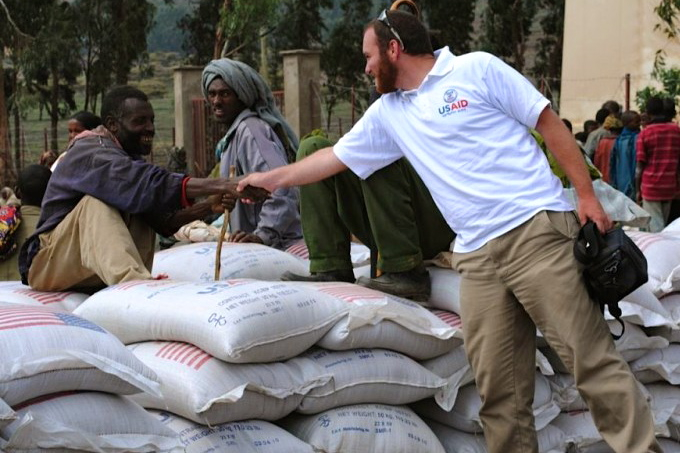
Last Tuesday, Congress finally passed the 2014 Farm Bill that was three years in the making. And after a long wait, the bill is a win for food aid and security around the world. The nearly $1 trillion bill allots $2.5 billion for the Food for Peace Act that sends food aid overseas in the form of not only food but also community development programs. The bill also increases funding to nonprofits and international organizations that are providing aid abroad to $10 million and adds new provisions to improve the nutrition and quality of food the US gives as aid.
The biggest win for food security advocates, however, comes from the program that provides $80 million annually for global emergency food aid programs. This program allows managers to buy food supplies closer to the recipient rather than exclusively from the US, allowing food to be delivered faster and in a more cost-efficiently. The program builds on a 2008 pilot effort carried out in part by the UN’s World Food Program that showed that we could provide aid at half the cost and delivery time in both emergency and non-emergency settings.
For GlobalSolutions.org this outcome is particularly important because of the campaign we put out last year, Buy Local, Feed Global, championing this issue. Our members lobbied for this change, sending messages to over 168 Members of Congress, asking that they support lifting food aid restrictions that have limited our capacity to feed millions and support sustainable local food markets.
While this bill is a big step in the right direction, overall, food aid reform is still a work in progress. As we celebrate this victory, we need to continue fighting to keep this momentum going with the ultimate goal of feeding millions more around the world.
by Josh Spesaison | Feb 4, 2014 | Global Cooperation, Peace & Disarmament
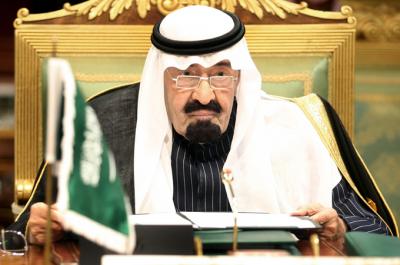
Saudi Arabia is taking steps to reduce its footprint in Syria. Al Jazerra reported this morning that a royal decree makes it punishable for Saudi citizens to participate in foreign conflicts. I believe many will wholeheartedly support this announcement as, in the context of the Syrian civil war, it could promote regional stability and sovereignty.
If other surrounding nations follow suit, we may see greater progress on the ground and in Geneva. The Syrian civil war is complicated in large part due to the foreign fighters from extremist groups setting up operations. These groups cloud the view of the opposition by United States and other negotiators as a whole. Fewer factions and divisive groups contending within the Syria conflict increases the potential for a lasting settlement as there will be fewer parties to satisfy. It may also facilitate access to for relief aid to those most in need.
While my initial reaction to the announcement of this decree is optimistic, we should remain wary and watch closely on how Saudi Arabia enforces it.