Originally published on the CGS blog on May 30, 2008.
Last Tuesday, during my second week at GlobalSolutions.org, I attended the Partnership for Effective Peacekeeping (PEP) May Forum which focused on UNEPS, a proposed U.N. emergency peacekeeping force. CGS has released a new whitepaper on the issue – United Nations Emergency Peace Service: One Step Towards Effective Genocide Prevention.
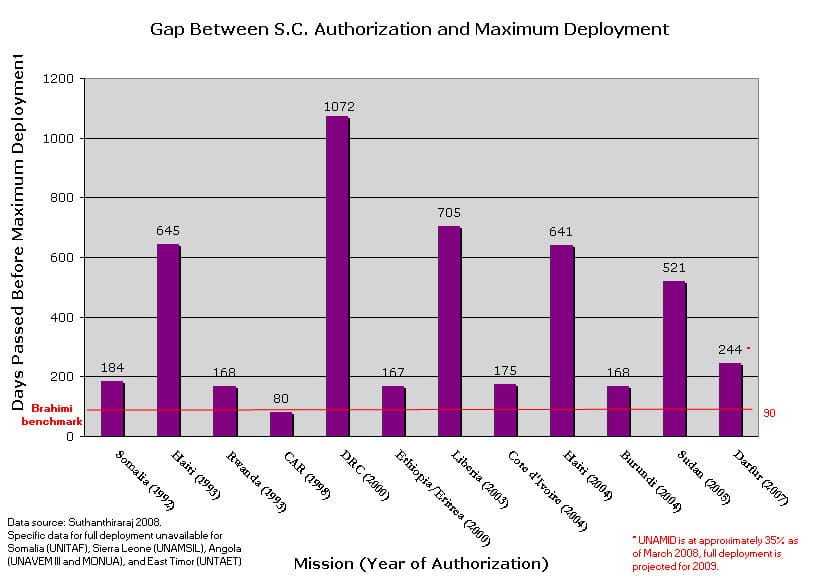
The paper focuses on the necessity of a standing, international peacekeeping service and recommends that it is in the interests of the United States to support – both financially and diplomatically – the establishment of a permanent integrated mission capacity within the U.N. Over the last 15 years, the U.N. has taken, on average, 46 days to begin the deployment of peacekeepers and 13 months to fully staff missions involving rapid deployment or crisis response. The proposed United Nations Emergency Peace Service could fill the gap between the Security Council’s authorization of a peace operation and the actual deployment of a conventional peacekeeping mission.
The paper was presented in detail by CGS Executive Vice President Don Kraus, after which UNEPS Secretariat Dr. Robert Zuber and Mark Malan of Refugees International led a debate on the proposed peacekeeping force. The consensus was that the need for such a force is clear, but there were differing perspectives on how to move the proposal forward as well as what parameters are necessary to make it politically viable.
A common theme in discussions on a possible standing U.N. peacekeeping force is disagreement over its size. If the deployment is too small the mission will not be effective, but if it is too big there may not be the will, politically as well as financially, to create such a force. What’s more, the force needed to effectively avert genocide is undoubtedly tied to the complexity and size of the conflict.
In my graduate studies in the Peace Operations program at George Mason’s School of Public Policy, we have analyzed the strengths and shortcomings of the current U.N. system, and tried to arrive at reasons for the success of some missions and the failure of others. One common criticism is that peacekeepers are sometimes deployed where “there is no peace to keep”, undermining their effectiveness and sometimes exacerbating the conflict. Some have argued that this is an important reason for UNAMID’s relative ineffectiveness in Darfur to date, although under-deployment and lack of cooperation by the Sudanese government are also to blame. One argument for a force such as UNEPS is that it could quell the violence as U.N. or regional negotiators simultaneously work towards a political solution, creating a more stable environment for the longer-term mission to enter – in other words, creating “a peace to keep.”