Skip to content
An Aging UN in 2015. But How About a New UN in 2020?

An Aging UN in 2015. But How About a New UN in 2020?

The new report from the Commission on Global Security, Justice, and Governance, co-chaired by former U.S. Secretary of State Madeleine Albright, suggests that the 75th anniversary year in 2020 might be the moment to reinvent the United Nations.

What kind of United Nations would we invent if we were designing it from scratch today? The UN Charter was signed by President Harry S. Truman and other world leaders in San Francisco on June 26th, 1945, and came into force three months later on October 24th. A long seven decades later, our world seems smaller, our fates more intertwined, and our challenges drastically different from those confronting the generation that emerged from the rubble of the Second World War. Is it time to begin devising architectures of global governance not “to avoid the mistakes of the 1930s,” but instead intended for our own unfolding 21st Century?

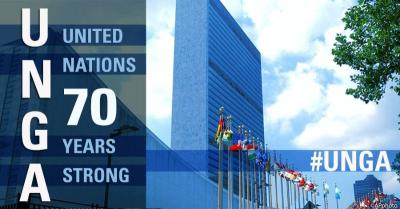
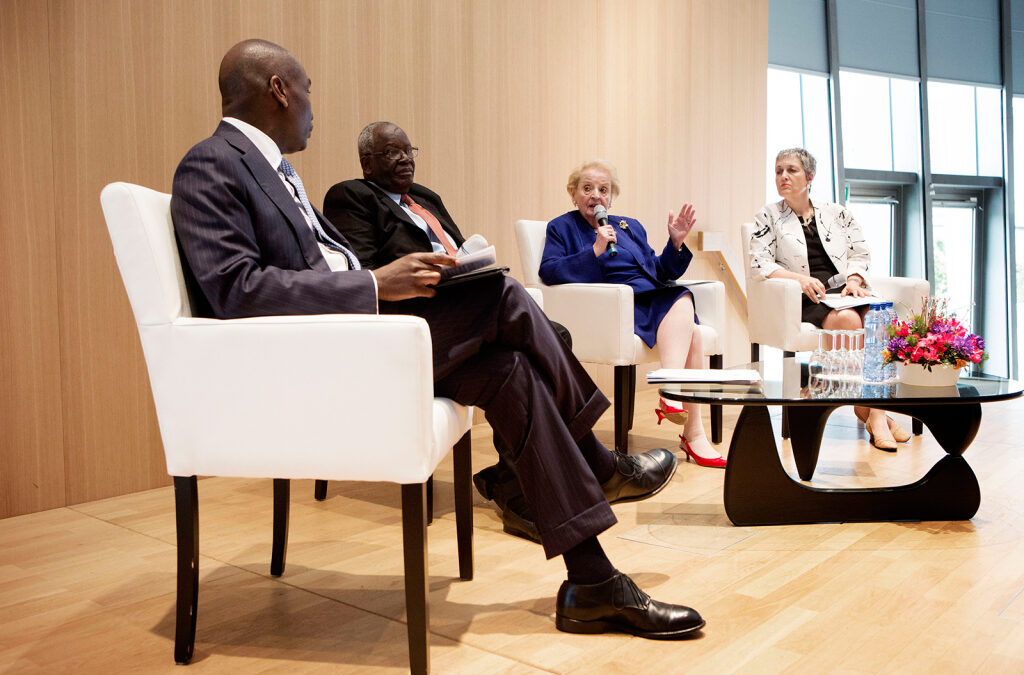
If so, we have a guide to start the journey. It’s the Commission on Global Security, Justice, and Governance, chaired by former U.S. Secretary of State and UN Ambassador Madeleine Albright and former Nigerian Foreign Minister and UN Under-Secretary-General Ibrahim Gambari. They have released a report for the UN’s upcoming 70th Anniversary Summit in September, called Confronting the Crisis of Global Governance. Their recommendations, issued at public launch events in The Hague on June 16th and again in Washington D.C. on July 9th, focus on three broad areas: climate change, the intersection between “cross-border economic shocks” and an array of possible cyber cataclysms, and intrastate violence “in fragile states.” (The Commission steers clear of the possibility of interstate military clashes–also known as wars–in places like the former Soviet Union or the South China Sea or the Indian subcontinent today, and who knows where tomorrow.)

There is much to applaud in this report. In the climate realm, the Commission’s suggestions include forming an “International Carbon Monitoring Entity” and a “Climate Engineering Advisory Board,” and it devotes welcome attention to atmospheric modification and climate adaptation rather than concentrating exclusively on emissions reduction. In the realm of a “hyperconnected global economy,” it declares that vastly increasing Internet access and cybersecurity in the Global South will both help to prevent cybercrime worldwide, and promote a renewed focus on the UN’s Sustainable Development Goals. And in the intrastate violence realm, its suggestions include “peacebuilding audits” focused on atrocity prevention, investments in early-warning capabilities and rapid-response UN mediation teams, and “particular attention to inclusion of women in peace processes.” Most of these proposals, one might say, focus less on addressing these transnational challenges in the short term than on creating new tools of global governance to surmount them over the long term.

On three particular points, the Commission offered strong and stirring recommendations, but unfortunately failed to take the next step, to spell out the logical conclusion, and to openly state the eventual historical goal.

VETO THE VETO

First, with regard to the UN Security Council, the Commission calls for increasing its “representative legitimacy” by adding new members, creating a new kind of “dissenting vote … (that would) not block passage of a resolution,” and “restraint in the use of the veto.” But if the United Nations is ever to become both democratic and consistently effective, the veto doesn’t need to be “restrained.” The veto needs to be eliminated.

Under Article 27 of the 1945 UN Charter, the representatives of Britain, France, America, Russia, and China can “veto” Security Council action. On an issue before the Council, the government of one single country can prevent all other countries from any kind of collective action at all. One of the most blatant examples came in 1996, when the vote to retain Boutros Boutros-Ghali as Secretary-General was 14-1 … but the one won. (It was the United States, and soon thereafter Mr. Boutros-Ghali was gone.) Even when the veto is not overtly wielded, it dominates Council decision-making. The only initiatives that even get discussed are ones which could conceivably pass muster with all five of the permanent members. It’s the most extreme possible case of what the eminent political scientist Walter Dean Burnham calls “the politics of excluded alternatives.”

Imagine if any action by the U.S. Congress could be blocked by the governor of, oh, California, Texas, New York, Wisconsin or Florida. To make the analogy even more apt, there would be no direct election to the US Congress–all representatives would simply be appointed and instructed by those same governors. Would that be democratic? Would that be effective? Could the U.S. government could get anything done at all if that was its design?

But that is the UN’s design, and it has prevailed and prevented collaborative action for 70 long years. No wonder people consider the UN to be ineffectual or irrelevant. The problem with the UN is not “Council deadlock” or “absence of political will.” The problem with the UN is the design of the UN.

THE GENERAL ASSEMBLY – ONE NATION, ONE VOTE, NO POWER

Second, with regard to the UN General Assembly, the Commission recommends the creation of a “UN Parliamentary Network,” which it describes as an “advisory body … to raise greater awareness and participation in UN governance.” That’s an idea that has gained much steam in recent years, perhaps most notably through the work of the Campaign for a UN Parliamentary Assembly. The core concept is that individuals already elected to national legislatures–the Japanese Diet, the Kenyan Parliament, the U.S. Congress – could be somehow selected to serve in such an international body, and then indeed both advise the General Assembly and generate for the UN much greater public attention and involvement.

But the hope of many is that this new forum could someday evolve into a body directly elected by voters. That’s not so far-fetched. An American woman living in Los Angeles elects particular individuals to represent her in the LA City Council, the California state legislature, and the U.S. Congress. Why shouldn’t she be able to directly choose someone–at the ballot box — to serve as her voice at the global level as well?

The Commission did not make that point. Nor did it recommend many other hypothetical forms of more democratic global decision-making. Today’s General Assembly has three fundamental flaws. First, it represents only states, not people. Second, its basic operating principle of one nation one vote — Bhutan and Gambia wielding the same authority as India and Brazil — could hardly be more undemocratic (or absurd). Third, its decisions serve only as entreaties, supplications, pleas — it has no power to make actual laws. While a “UN Parliamentary Network” would be a small step toward mitigating the first, it would do nothing about the second and third.

The obvious solution to those defects in the UN’s design, proposed many times over since 1945, is the establishment of some kind of weighted voting system — to provide each member state with a voting power that reflects its actual influence in today’s world. One, invented in the 1970s by the late founder of the Center for War/Peace Studies Richard Hudson and known as the “Binding Triad,” would enable resolutions to gain the force of international law if the vote represented a majority of the states, a majority of the people, and a majority of the financial contributions to the UN. Another more elaborate system was put forth by Professor Joseph Schwartzberg of the University of Minnesota in his superb 2013 book Transforming the United Nations System: Designs for a Workable World. “One nation one vote” (and no power) is surely not the one and only concept we can ever envisage to legislate for and govern one world.

AN ARMY OF HUMANITY TO FIGHT CRIMES AGAINST HUMANITY

Finally, with regard to the intersection of justice and security, the Commission chose not to put forth arguably the single most promising idea to prevent genocide and crimes against humanity – a permanent all-volunteer UN rapid deployment force (UNRDF). To bring an end to eruptions of violence when national governments are unwilling to deploy their own national militaries because the fight in question does not engage their own national interests, the world needs a UN army.

This idea was first put forward in 1948, when the first UN Secretary-General, Trygve Lie, called in a speech at Harvard for establishing a “United Nations Legion.” More than half a century later, his successor Kofi Annan observed with some exasperation that the UN is the only fire brigade in the world that cannot obtain a fire engine until after the fire has broken out.

Rwanda stands as the quintessential prototype. The genocide there erupted almost overnight in the spring of 1994. The UN Secretary General, Mr. Boutros-Ghali, implored developed states to send just a few thousand troops – which most experts believe could have quickly established safe corridors and safe havens, and provided a safe refuge for hundreds of thousands of innocents. Most Americans were appalled and sickened by the horror in Rwanda. But no one could credibly argue that America was directly threatened by the horror in Rwanda. The same was true for virtually every other country in the world. So for ten long weeks, no outside country did send troops. (Except to evacuate their own citizens – that’s a vital national interest.)

The Srebrenica massacre, 20 years ago this week, stands as one of countless other examples. And the answer to the conundrum is a UNRDF. (Many civil society organizations call it instead a “UN Emergency Peace Service” to emphasize that it could do much more than just deal military defeat to the bad guys.) Its purpose, its raison d’être, would be to defend not the national interests of any particular state, but the common human interest we all share in creating a human future where genocide has been relegated to the dustbin of history.

Such a UNRDF could be dispatched into situations where horrifying violent infernos don’t happen to threaten to set our own houses on fire. It could bring a quick and decisive end to ghastly crimes. It could bring the perpetrators to justice. It could deter them from ever committing their crimes in the first place. And it could free the American president in particular from the excruciating dilemma of dispatching “the most powerful military in the world” to stop crimes that have little to do with us, or doing nothing while the nightmare continues to unfold.

Perhaps most importantly, such a UNRDF would give individuals all around the world an opportunity to do more than just “serve their country.” It would give them an opportunity to serve humanity. Consider Dylan, an average 25-year-old American dude, channel surfing on his couch one night in April of 2014. CNN is talking about some group called “Boko Haram.” Apparently they have kidnapped some 276 schoolgirls in Nigeria, straight out of their own government secondary school. Pretty outrageous. The Nigerian military seems unable to respond. Dylan takes a look at his phone, and sees a rapidly trending hashtag — #bringbackourgirls. He starts to get more interested, and starts wondering what he can do about it.

Then a commercial comes on. It’s a recruiting commercial for the U.S. Navy. And it ends with the tagline “a global force for good.” That’s it! Dylan can volunteer for the U.S. Navy. Maybe even become a Navy SEAL. Yes, it’s probably too late for him to get into action in time to rescue those schoolgirls. But bringing an end to that kind of atrocity, by serving in a “global force,” that’s constituted “for good” — that’s what Dylan wants to do.

Except he can’t.

Because the U.S. military is a national military force. It exists to protect our national security and national interests. Has anyone even suggested that U.S. Navy SEALS, however brave and skilled and lethal, might be dispatched to retrieve the girls kidnapped by Boko Haram or to bring an end to the long list of other atrocities the group has committed since then?

Of course not. Because the villains who comprise Boko Haram do not present a direct threat to America. And however willing Dylan might be to put his life on the line to put a stop to the ongoing barbarities of Boko Haram (their latest innovation seems to be forcing schoolgirls to become suicide bombers and cutthroat executioners), there is literally no place for him to volunteer to do so.

No vehicle for him to hear the phrase, not just from his fellow Americans but from his fellow Earthlings, “Thank you for your service.”

And no force outside Nigeria, anywhere on Earth, tasked with the mission of bringing Boko Haram to an end.

2020 VISION

Why did the Commission fail to articulate these logical next steps, these game-changing global governance inventions? Undoubtedly, because few of them can be considered “politically realistic” in the near term. To choose just one example, when talk of getting rid of the veto was very much in the air during the 50th anniversary year in 1995, The Economist magazine tossed a cold bucket of water on the enthusiasts when it reminded everyone that “the vetoers can veto a veto of the veto.”

But how will we ever get rid of the veto if no one ever even says that we ought to get rid of the veto? We profoundly constrain our ability to imagine alternative, brighter futures if we insist that every single proposal be weighed down by the heavy ball and chain of “PPP”: present political possibility. Nothing will ever become politically realistic unless someone first declares it to be politically desirable and proclaims it, however distantly, as an eventual historical goal. If politics, as every freshman knows, is the art of the possible, then political change ought to be about expanding the boundaries of future possibility.

Fortunately, however, the Commission atones for these reluctances with perhaps its single most important recommendation. It calls for five-year process culminating in 2020–the 75th anniversary of the end of WWII, the dawn of the atomic age, and the birth of the United Nations — in a formal meeting which they call a “World Conference on Global Institutions.” Such a gathering might be simply another “summit” of world leaders. Or, perhaps instead, says the Commission, “consideration could be given to UN Charter Articles 108 or 109 for pursuing specific amendments to the Charter.”

The framers in San Francisco clearly did not intend for their Charter to stand forever as the end of history. That is why they included Article 108 to enact particular Charter revisions, and also Article 109 – a provision for convening “A General Conference of the Members of the United Nations for the purpose of reviewing the present Charter.” Indeed, Article 109(3) indicates that the framers hoped that such a conference would be summoned no later than “the tenth annual session” — 1955! But more than 2/3 of a century after the UN’s founding, no such gathering to examine the basic structure of its Charter has ever been convened.

If civil society activists, on environment and human rights and women’s rights and inequality and peace and justice, start right now getting behind the Commission’s recommendation for such a World Conference, it could become a tremendous engine for international progress. In the nongovernmental realm, such a call to action could produce a broad coalition of actors who might possess many different issue priorities and global governance visions, but who could all come together behind a formal process to discern the most appropriate vision for the historical conditions of our advancing 21st Century. (The Commission to its credit urges nongovernmental participation and civil society agitation on nearly every page.) And in the intergovernmental realm – especially if a bit of a buzz begins about assembling their “World Conference” under the authority of the Charter itself–all sorts of fascinating scenarios arise when one realizes that Article 109 is one of the few things that is not, repeat not, subject to the veto. Even if Britain, France, China, Russia and America all stand opposed, if 2/3 of the General Assembly and 3/5 of the Security Council vote in favor, a “General Conference … for the purpose of reviewing the present Charter” willbe called to order.

After signing the UN Charter in San Francisco, President Truman returned to Washington D.C. by train. And when he stopped off in Kansas City, he chose to emphasize that the new United Nations was a step on a journey, rather than the end of the road. “Now when Kansas and Colorado have a quarrel over the water in the Arkansas River,” he said, “they don’t call out the National Guard and go to war over it. They bring a suit in the Supreme Court and abide by the decision … It will be just as easy for nations to get along in a republic of the world as it is for you to get along in the republic of the United States.”

Strobe Talbott, the Brookings Institution president already on everyone’s short list for Secretary of State in a Hilary Clinton administration, tells us in his 2008 book The Great Experiment: The Story of Ancient Empires, Modern States, and the Quest for a Global Nation that Mr. Truman kept in his wallet for most of his life — recopied dozens of times by his own hand — these verses from the 19th Century British poet laureate Alfred, Lord Tennyson.

“For I dipt into the future, far as human eye could see
Saw the Vision of the world, and all the wonders that would be
Till the war-drum throbbed no longer, and the battle-flags were furl’d
In the Parliament of Man, the Federation of the World.”

Surely, we could pay no greater tribute to Harry S. Truman, and Franklin D. Roosevelt, and the other architects of the 1945 UN Charter than to begin to imagine the contours–with the League of Nations the first and the United Nations the second–of what we might call our “Third Generation World Organization.” Such a repurposed and renewed body might even tackle not just bloody intrastate upheavals but interstate military confrontations–and actually find a way to save succeeding generations from the scourge of war. Perhaps in that way, we might someday bring about the next step in the political and social evolution of our human species.

A Call for Just Security

A Call for Just Security

This article originally appeared in The Huffington Post and is cross-posted with the author’s permission.

We are in danger of losing the most pressing global security and justice challenges of our times. That’s what motivates a prestigious blue ribbon panel, co-chaired by former U.S. Secretary of State Madeline Albright and Professor Ibrahim Gambari, the former Foreign Minister of Nigeria and UN Under-Secretary-General for Political Affairs.

Fragile or corrupt governments have allowed conflicts to fester and terrorism to run rampant. Climate change is melting ice caps, raising sea-level and changing weather patterns setting off increased conflicts and a rapidly growing population of climate refugees. Internet accelerated globalization has increased our connectivity, but leaves us open to illicit trade, spying and theft.

In response to these threats, the Commission on Global Security, Justice and Governance brought together 14 high level statespersons from around the globe to offer comprehensive recommendations. Their goal is to build an accountable and effective international system that can better safeguard international human rights and promote sustainable peace.

The Commission’s report, Confronting the Crisis of Global Governance, offers a broad menu of recommendations to, according to Secretary Albright, develop “more capable tools of global governance, with different kinds of public, private, and mixed institutions designed for 21st Century challenges.” Co-chair Gambari said at the report’s launch that “much more is needed from the United Nations and, indeed, other global institutions dealing with, for example, security sector reform and the rule of law to economic and social recovery and the promotion of human rights…”

The Commissions’ recommendations include:

    • Next-generation UN conflict mediation and peace operations capacity, with a greater proportion of women and increased capacity to deploy civilian, police, and military personnel to meet urgent peacekeeping requirements
    • Strengthening the Responsibility to Prevent, Protect, and Rebuild
    • Innovate climate governance through more meaningful engagement between government, civil society and business
    • A green technology licensing facility within the Green Climate Fund
    • Establishing a G20+ within a new framework for global economic cooperation to avert financial shocks and deliver on the Post-2015 Development Agenda
    • A global network of cybercrime centers and increase Internet access in the Global South through enhanced capacity-building
    • Improving the selection procedure for the next Secretary General with a call for nominations by Member States, parliaments, and civil society organizations, a formal list of selection criteria and a clear timetable for selection
    • Expanding UN Security Council membership and nontraditional engagement while restraining the use of the veto
    • Creating a UN Peacebuilding Council (to replace a weak Peacebuilding Commission)
    • Strengthening the International Court of Justice, International Criminal Court, and the UN Human Rights Council
    • A UN Parliamentary Network to “develop a transnational democratic culture”

This is an extremely ambitious report that has been launched in advance of the United Nations’ 70th Anniversary Summit in September. For the last few decades, similar reports have been issued in response to the dramatic global challenges that humanity faces in the 20th and 21st centuries. Our Global Neighborhood was issued in 1995 in conjunction with the UN’s 50th anniversary. In 2004, A more secure world: Our shared responsibility was prepared by then Secretary-General Kofi Annan’s High-level Panel on Threats, Challenges and Change.

While only some of the proposals in these reports came to fruition, each advanced the capacity of an evolving global community to better manage an increasingly interconnected world. For example, the Responsibility to Protect and the Peacebuilding Commission were proposed in Annan’s report. (Confronting the Crisis of Global Governance actually recommends improvements to both of these proposals.)

The authors of this latest report have also learned from their predecessors and have proposed a number of steps to promote the adoption of their recommendations, including marking the UN’s 75th anniversary in 2020 with a “World Conference on Global Institutions,” which would be the culmination of a three-year multilateral negotiation process with every effort made to “engage the voices and ideas of civil society at the most local level, as well as under-represented groups, in the lead-up to the World Conference.”

In the Commission’s “Call to Action” they correctly note that:

In seeking to forge a mutually supportive system of good democratic governance and sustainable peace globally through the intersection of security and justice, just security offers a unique prism for understanding and responding to some of the most pressing global concerns of our time….we must all refuse to accept mediocre solutions that rely on institutions and mindsets from another era. Only when men and women from diverse places and backgrounds rally around a shared, inherent need for security and justice–always felt locally but created at many levels–can these powerful actors be nudged toward what is needed, as well as what is right.

2015 is a year where many global efforts to secure a more livable future are coming to a head. The Sustainable Development Goals will be considered by UN members in September and will shape the future of international development. The UN climate conference, to be held in Paris in December is considered by many to be a make-or-break moment in humanity’s ability to address climate change. Confronting the Crisis of Global Governance should be read, analyzed and acted upon by all who are engaged in these efforts and by all who understand that today’s global challenges–mass violence in fragile states, climate change, and the possibility of devastating cyber attacks initiating global economic shocks–must be addressed by new kinds of tools, networks and institutions.

Seventy-Year Solutions, Part 3

Seventy-Year Solutions, Part 3

Over the next 70 years, our children and grandchildren will need to negotiate three major transitions in human civilization. Parts 1 and 2 of this series discussed transitioning to large-scale sustainable energy flows and managing the impact of human civilization on the environment.

This blog addresses the issue of maintaining global governance systems that enable humans to meet these challenges.

It has now been 95 years since the League of Nations was founded after World War I. Its current embodiment, the United Nations, is functioning but has widely recognized limitations. The UN operates in conjunction with the World Bank and the International Monetary fund (often called theBretton Woods institutions). And, of course, there are hosts of bilateral and multilateral treaties which facilitate trade and development.

What needs doing in the next 70 years? Let us address organizational issues and challenges to be managed.

Broadly speaking, the UN needs a better, democratically founded revenue base and development of each of its major functions—in traditional terms, the General Assembly as a legislative body, the Secretariat as an executive body, and judicial bodies like (but not limited to) the International Criminal Court. The challenge can be illustrated by just looking at the UNorganizational chart.

The major practical issue for CGS members is getting the United States into a less imperious mode. The UN can do more only if the US, as a dominant international player, is more willing to cooperate and help lead other nations to agree to international fees or taxation; allow UN bodies greater peacekeeping scope; submit to international judicial bodies like the ICC; agree to treaties that limit our armed forces and arms sales; allow rising nations more say in central functions like theSecurity Council; and the like.

This is not to say we are the most parochial of nations. Every country has axes to grind. We just have a very big axe.

We need to elect Congresspersons and Presidents who have a long view and are willing to shoulder the arduous tasks of negotiating practical arrangements that surrender a bit of autonomy for a more workable world regime—for the global common good.

Substantive challenges include:

In a blog for the International Affairs Forum, I set out someadditional perspectives on necessities for long term success. These include:

  • controlling parasitism by elites at both national and international levels,
  • maintaining sound and far reaching knowledge systems—facilitated by free international science, other forms of inquiry, speech and debate, and
  • maintaining an essential level of continuity in institutions without succumbing to suffocating stagnation.

CGS, allied with other significant civil society organizations like theWorld Federalist Movement, is a window on all this. CGS and others currently are engaged in promoting a United Nations Parliamentary Assembly to increase democratic representation at the UN.

You have an assortment of worthy causes bidding for your attention at all times. Organizations such as these are the essential channels for global citizens to use to shape the future. The foundation of all these possibilities and of solutions to very real problems lies in the global awareness and willingness of citizens like you to help shape the future.

Common Oceans: The Vision of Elisabeth Mann Borgese

Common Oceans: The Vision of Elisabeth Mann Borgese

The people of the earth [have] agreed that the advancement of man in spiritual excellence and physical welfare is the common goal of mankind…that therefore the age of nations must end, and the era of humanity begin.

—Preamble to the Preliminary Draft of a World Constitution

Elisabeth Mann Borgese (24 April 1918 – 8 February 2002) was a strong-willed woman. She had to come out from under the shadow of both her father, the German writer and Nobel laureate Thomas Mann, and her husband, Italian literary critic and political analyst Giuseppe Antonio Borgese.

Thomas Mann’s novel The Magic Mountain was a monument of world literature between the two World Wars, and Mann felt that he represented the best of German culture against the uncultured hordes of the Nazis. He took himself and his role very seriously, believing that his family existed basically to facilitate his thinking and writing.

G.A. Borgese regularly lectured at various universities on the evils of Mussolini. A leading literary critic and professor in Milan, he left Italy for the United States in 1931 when Mussolini announced that an oath of allegiance to the Fascist State would be required of all Italian professors. For Borgese, with a vast culture including the classic Greeks, the Renaissance Italians, and the 19th-century nationalist writers, Mussolini was an evil caricature which too few Americans recognized as a destructive force in his own right, and not just as the fifth wheel of Hitler’s armed car.

G.A. Borgese met Elisabeth Mann on a lecture tour at Princeton, and despite being close to Thomas Mann in age, the couple married very quickly. Elisabeth moved to the University of Chicago and was soon caught up in Borgese’s efforts to help the transition from the Age of Nations to the Age of Humanity.

For Borgese, the world was at a watershed period. The Age of Nations—with nationalism that could be a liberating force in the 19th century, as with the unification of Italy—had come to a close with the First World War. From then on, nationalism became only the symbol of death. However, the Age of Humanity, which was the next step in human evolution, had not yet come into being, in part because too many people were still caught in the shadows of the previous age.

Since University of Chicago scientists had played an important role in the coming of the Atomic Age, G.A. Borgese and Richard McKeon, a cultural anthropologist and Dean of the University felt that the University should take a major role in drafting a world constitution for the Atomic Age. Thus, the Committee to Frame a World Constitution was created in 1946. To re-capture the hopes and fears of this period, it is useful to read Rexford Tugwell’s A Chronicle of Jeopardy. The book contains Tugwell’s reflections on the years 1946-1954, written each year in August to mark the A-bombing of Hiroshima.

Elisabeth had become the secretary of the Committee and the editor of its journal Common Cause. G.A. Borgese published a commentary on the Constitution, dealing especially with his ideas on the nature of justice. It was the last thing he wrote, and the book Foundations of the World Republic was published shortly after his death. In 1950, the Korean War started. Hope for a radical transformation of the UN faded. Weary and disappointed, Borgese and his wife went to live in Florence, where he died in 1952.

The drafters of the World Constitution went on to other tasks. Robert Hutchins left the University of Chicao to head a “think tank”—Center for the Study of Democratic Institutions—taking some of the drafters, including Elisabeth, with him. She edited a booklet on the Preliminary Draft with a useful introduction, A Constitution for the World. However, much of the energy of the Center went into the protection of freedom of thought and expression in the US, at the time under attack by the primitive anti-communism of then-Senator Joe McCarthy.

In the mid-1950s, from world federalists and world citizens came various proposals for UN control of areas not under national control. Elisabeth Mann Borgese thus turned her attention and energy to the law of the sea.

In 1967, Ambassador Arvid Pardo of Malta proposed at the UN General Assembly that the seabed be internationalized as the Common Heritage of Mankind, so as to put it outside the control of the technologically-advanced States. The seabed was to be exploited for the benefit of the entire world, the common heritage requiring a system of autonomous management. The Malta proposal led to the 1974 start of the Law of the Sea conference.

As the UN Law of the Sea Conference continued through the 1970s (sometimes in New York, sometimes in Geneva), Elisabeth was active in seminars and conferences with the delegates, showing that a strong treaty on the law of the sea would be a big step forward for humanity. Many of the issues raised during the negotiations leading to the Convention, especially the concept of the Exclusive Economic Zone—fought by Elisabeth but championed by Ambassador Alan Beesley of Canada—are with us today in the China sea disputes.

While the resulting Convention on the Law of the Sea has not revolutionized world politics as some of us hoped in the early 1970s, it is an important building block in the development of world law. We are grateful for the values and the energy that Elisabeth Mann Borgese embodied.

One Country. One Constitution. One Destiny.

One Country. One Constitution. One Destiny.

Today, April 15, 2015, is the 150th anniversary of the death of Abraham Lincoln. He was shot shortly after 10 PM on the night of April 14th, 1865, inside Ford’s Theatre, then was carried across the street: 10th Street, between E and F, NW, to the Petersen boarding house, where he expired at 7:22 AM the next morning.

Since I live in Washington, DC, and since I am usually a bit of a night owl, I spent some time there last night and into this morning. The solemnity of the candlelight vigil in the middle of 10th Street in the middle of the night, commemorating the hours when the president lay dying, was quite moving to me — and, it seemed, to virtually all the participants.

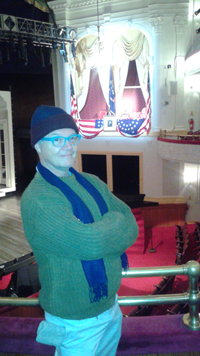
Tad Daley inside Ford's Theatre at 11:15 pm EDT on the night of April 14th, 2015, directly across from the box where U. S. President Abraham Lincoln was assassinated exactly 150 years earlierI spent some time touring the museum in the Ford’s Theatre basement, and the recently-opened “Center for Education and Leadership” immediately adjacent to the Petersen House. I have done this before and will undoubtedly do it again.
But this time, I noticed something new.

Daniel Webster, in a famous 1837 speech, said of our United States of America: “One country, one constitution, one destiny.” The first and last of those clauses was apparently embroidered into the lining of the “great coat” that Abraham Lincoln wore to Ford’s Theater on the night of April 14, 1865. Whether this was the choice of the client, or instead of a tailor particularly well-attuned to the particular sympathies of this particular client, appears to be historically unclear.

But the very delicate remaining fabric of the lining is now on display at the Center, and you can see the four words quite clearly. “One Country One Destiny,” it states, in delicate thread, a century and a half later still quite vivid.

So there I am, back in the middle of 10th street in the middle of the night, surrounded by people mostly thinking about the unity of our one country, the United States of America forged in the crucible of civil war.

But for me, I suspect alone in the street last night, it set me to wondering. To speculating about the future. To dreaming.

Would it be too much to suggest that the sentiment embroidered inside Lincoln’s great coat might someday apply not just to the United States of America, but to the single family of humankind?

One Country. One Constitution. One Destiny.

Open Letter #7 To My Grandson Jake

Open Letter #7 To My Grandson Jake

Letters to Jake Series, Letter #7

Dear Jake,

I am proud to say that words my Cincinnati team wrote to share at the 2014 Greater Cincinnati World Peace Festival have been posted on the Globalsolutions.org website. The title is Embracing a United Federation of Nations and you can find it here.

The text begins with our vision of a world at peace, where all people have the Right to Life, Liberty, and the Pursuit of Happiness. Many great thinkers, including Socrates, Alfred Lord Tennyson, Albert Einstein, and Martin Luther King have pointed the way. The web-pages that unfold when you follow the red prompts explain why this is a good idea, what it includes (and excludes), and what are the benefits. They also provide answers to frequently asked questions.

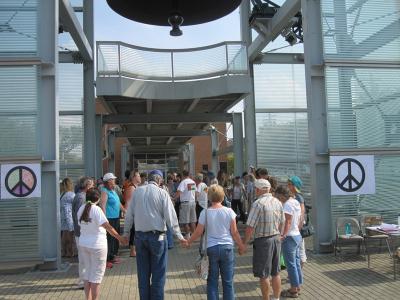
At our World Peace Festival which took place at the World Peace Bell in Northern Kentucky, I gave a brief speech entitled “We are citizens of the world.” I also introduced Father Ben Urmston, SJ, who had his 89th birthday on the day of the festival. It was so fitting to be able to honor Father Ben at the peace festival. He is a World War II veteran who has been working for peace ever since. He is the one who introduced me to the concept of a democratic federation of nations and the need for global citizenship. Ben firmly believes that war would not be needed if we establish world laws in a democratic manner and used them to protect universal human rights. We could use world courts to solve disagreements instead of bombs and guns. The laws would apply to every individual on the planet, and the leaders who made the decision to go to war are the ones who would be brought to court. That certainly would be a better way to govern the world.

I wish you were there with me to sing “Happy Birthday” to Father Ben. You would have enjoyed that. We could have used your good voice.

I am including some pictures of the festival for you to share with your little sisters. Looking forward to my next visit with all of you.

Love,

Gram