by Tad Daley | Jul 5, 2016 | Global Cooperation, World Federation
This essay is a revised and updated version of the cover story for the Fall/Winter 2015 issue of DISARMAMENT TIMES, the journal of the United Nations NGO Committee on Disarmament, Peace, and Security.
+++++++++++++
“Does the United Nations Still Matter?” It often seems so irrelevant to the problems of the modern age that those words appeared last year on the front page of The New Republic magazine. More than seven decades after the UN’s invention in 1945, our multiple planetary crises seem dramatically different from those confronting the generation that emerged from the rubble of the Second World War. Isn’t it time to devise architectures of global governance intended not to avoid the mistakes of the 1930s, but focused instead on the intertwined predicaments of our own 21st Century?
A New Global Governance Commission
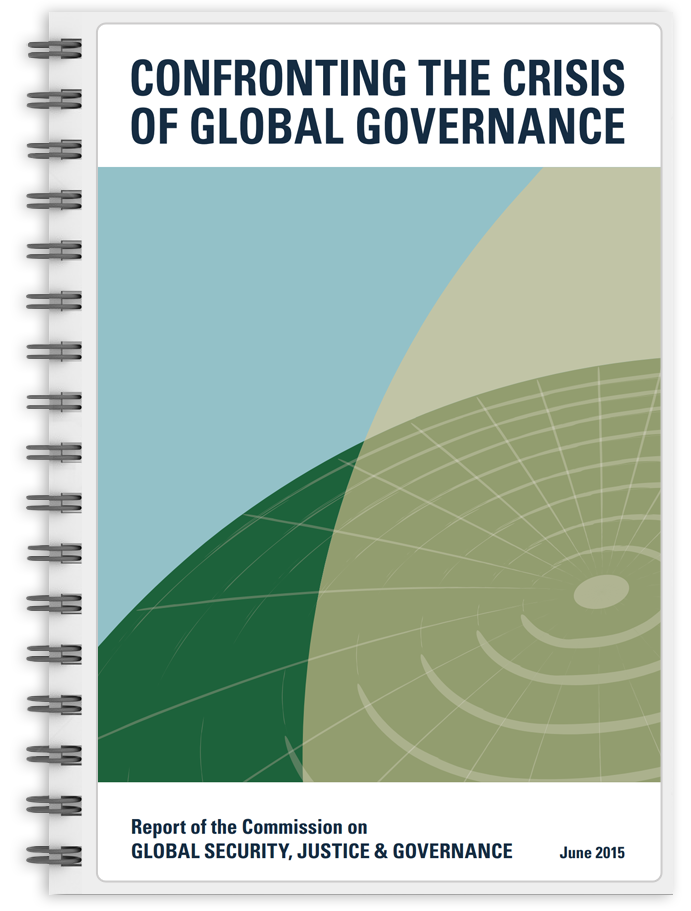
If so, we have a new guide to start the journey. It’s the report from the “Commission on Global Security, Justice, and Governance,” co-chaired by former U.S. Secretary of State Madeleine Albright and former UN Under-Secretary-General Ibrahim Gambari. The name they chose reflects the inescapable links the Commission sees among those three variables. Their report elaborately makes the case that we can’t have security anywhere without justice, or justice anywhere without security. And it asserts that nothing could do more to provide both security and justice to much of humanity than smart 21st Century innovations in global governance.
The Commission employs this paradigm to tackle three broad issue areas – the impact of climate change on the poor and vulnerable, the intersection between “cross-border economic shocks” and various cyber nightmares, and intrastate violence “in fragile states.” Climate? The report proposes an “International Carbon Monitoring Entity” and a “Climate Engineering Advisory Board,” as well as atmospheric modification and climate adaptation efforts – a welcome move beyond the usual focus on emissions reduction. “A hyperconnected global economy?” Vastly increasing Internet access and cybersecurity in the Global South will both help prevent cybercrime and promote a renewed focus on the UN’s Sustainable Development Goals. Eruptions of intrastate bloodshed? The report calls for “peacebuilding audits” focused on atrocity prevention, investments in early-warning capabilities and rapid-response UN mediation teams, national military units designated and trained in advance for UN peacekeeping deployments, and “particular attention to inclusion of women in peace processes.”
The Commission does not just offer “policy proposals” about tackling these transnational issues, but asserts instead that reimagining key elements of international institutions can provide new tools to surmount them. The Commission subtly threads the needle of contemporary political reality, advancing new ideas which one might say stand somewhere in between today’s status quo and a more ideal array of global governance structures adequate to the magnitude of contemporary transnational challenges. So voices beyond the Commission can begin to think about the logical conclusions of some of its carefully parsed recommendations – and to define the eventual historical goals.
Expanding Our Global Governance Imagination
- Regarding the UN Security Council, the Commission calls for adding new members beyond the present 15, creating a new kind of “dissenting vote … (that would) not block passage of a resolution,” and “restraint in the use of the veto.” Under Article 27 of the 1945 UN Charter, the representatives of Britain, France, America, Russia, and China — the winners of a war that took place during the first half of the last century — can “veto” Security Council action. This means that on any issue before the Council, one single country can prevent every other country in the world from any kind of collective action at all. Even when the heavy hand of the veto is not actually cast, it still dominates Council decision-making. The only initiatives that ever get advanced are ones which might actually fly with all five permanent members. It’s the most extreme case of what the American political scientist Walter Dean Burnham calls “the politics of excluded alternatives.” If the UN is ever to become both democratic and effective, the veto doesn’t need to be “restrained.” The veto needs to be eliminated.
- The Commission recommends the creation of a “UN Parliamentary Network … to raise greater awareness and participation in UN governance.” Today’s UN represents only national executive branches. An analogy might be if every single member of the US Congress was appointed by state governors. This innovative new concept proposes that individuals already elected to national legislatures could be selected to sit in this new international body. That very idea has been promoted for years by the international “Campaign for a UN Parliamentary Assembly” based in Berlin. But the hope of this international campaign is that eventually the representatives in such a body would be not selected from national parliaments, but directly elected to a new transnational chamber. That’s not such a far-fetched notion. An American woman living in Los Angeles elects particular individuals to represent her in the LA City Council, the California state legislature, and the U.S. Congress. Why shouldn’t she be able to elect particular individuals to represent her at the global level as well? Whether a Parliamentary Network now or a newly invented Citizens Assembly later, we might just see the emergence of transnational political parties, which could dramatically increase the direct participation of ordinary citizens in global affairs.
- Besides providing a forum for national government executive branches alone, the structure of the UN General Assembly put forth in the United Nations Charter contains two other fundamental flaws – which unfortunately the Commission’s “UN Parliamentary Network” would do nothing to ameliorate. First, the principle of one nation one vote, for states large and small, India and Vanuatu alike, could hardly be more undemocratic or absurd. Second, once votes are cast in the UN General Assembly, its decisions serve only as polite requests to the world. It has no power to make anything like universal laws. The obvious solution to those twin defects is to establish some kind of weighted voting system in the General Assembly (perhaps accounting for both population and monetary contributions to global public initiatives), and then to give the results of its balloting the force of international law (like Security Council decisions already possess). “One nation one vote” (and no power) is surely not the one and only concept we can ever envisage to legislate for and govern our one world.
- “Tents, Water Run Short for Iraqis Fleeing Fallujah.” “Nigerians at Refugee Camp Face Starvation.” “Dire Funding Shortfalls Will Hit Aid to Yemen, UN Says.” These recent Washington Post headlines from one single day demonstrate that the single greatest hindrance to the UN carrying out its multiple and often overwhelming missions is the absence of any kind of funding source beyond voluntary ad hoc contributions from member states. Many proposals have been put forth to remedy this structural deficiency. Probably the most well-known is the “Tobin Tax,” devised by the late Nobel economics laureate James Tobin, which, by placing a microscopic fee on international currency speculation, could provide vast and reliable new resources for the entire UN system.
- Finally, the Commission does not to put forth the most promising idea for preventing genocide and crimes against humanity – a permanent, directly-recruited, all-volunteer UN Rapid Deployment Force (UNRDF). Many don’t realize that “UN Peacekeepers,” in their distinctive blue helmets, are in every case national soldiers, dispatched and ultimately controlled by national governments on a case by case basis. A proposal for such a “UN Legion” was first put forward in 1948 by the first UN Secretary-General, Trygve Lie. A half century later, his successor Kofi Annan observed with some exasperation that the UN is the only fire department that cannot obtain fire engines until after the flames have broken out. A UNRDF would be poised to act not to serve the national interests of any individual state, but the common human interest we all share in relegating genocide to the dustbin of history. It could free the American president in particular from the excruciating dilemma of dispatching “the most powerful military in the world” to stop crimes that have little to do with us, or doing nothing while the nightmares continue to unfold. It might well deter the perpetrators of crimes against humanity from making their fateful choices in the first place. And it would give individual citizens of the world the opportunity not just “to serve their country,” but to put their lives on the line to serve humanity. To bring both security and justice to countless violent conflicts — where national governments are unwilling to deploy their own national forces because the fight in question does not engage their own national interests — the world needs a UN army.
It is the complete absence of these kinds of smart institutional innovations, 70 years on, which lead so many to consider the UN so ineffectual and irrelevant. The problem with the UN is neither “Council deadlock” nor “bureaucratic timidity.” The problem with the UN is the design of the UN.
In 2020: A World Summit on Global Governance
Fortunately, however, the Commission atones for any of its hesitancies with one overarching recommendation. It calls for convening in 2020 — the 75th anniversary of the birth of the United Nations – a formal global summit, of both governments and non-governmental actors, called a “World Summit on Global Security, Justice, and Governance.”
The Commission report emphasizes that most of what it proposes could be accomplished in 2020 without revising the 1945 UN Charter. But it does acknowledge that to advance the broad overall agenda, “consideration could be given … to Articles 108 or 109.” That first is the provision in the Charter for making individual Charter amendments, while the second provides for summoning “A General Conference of the Members of the United Nations for the purpose of reviewing the present Charter.” Indeed, Article 109(3) indicates that the framers intended for such a conference to be held no later than “the 10th annual session” — 1955! Today the UN is into its 71st annual session. But no such formal Charter review process has ever been launched.
A world summit on global governance during the UN’s 75th anniversary year could provide a once-in-our-lifetime opportunity to reinvent humanity’s architectures of world order. It would allow many to suggest that a redesigned United Nations might tackle not just the bloody upheavals inside “fragile states” that the Commission identifies, but the ancient and omnipresent danger of military confrontations between nations — and actually find a way to save succeeding generations from the scourge of war. Civil society activists on a vast variety of other issues – climate, human rights, the education of girls, migration, poverty and inequality and ever-increasing economic globalization – all could pursue global institutional reforms to advance their issues through the vehicle of such a 2020 world summit. NGOs could engage their constituencies on a large menu of imaginative global governance proposals focused upon their own agendas. (The Commission to its credit urges nongovernmental participation and civil society agitation on nearly every page.) Indeed, the American NGO Citizens for Global Solutions (founded in 1947 as the “United World Federalists for World Government with Limited Powers Adequate to Prevent War”) is already laying plans to mobilize a broad coalition — of multiple actors who might possess a great many different issue priorities and world order visions — behind the singular call for governments to commit now to convening in the year 2020 a world summit on global governance.
Humanity’s “Ultimate Aims”
On November 12, 1946, the Prime Minister of the United Kingdom, Clement Attlee, announced to the House of Commons that nothing less than a world government could serve as “the ultimate aim of Great Britain’s foreign policy.” (Attlee succeeded one Winston Churchill in that post – who repeatedly suggested much the same thing.) What strikes one about this utterly forgotten vision is not just how few world leaders would say anything like it today, but how rarely they speak about any sort of “ultimate aims” in the realm of world order at all.
As we approach the year 2020, our agenda should not be limited solely to what we might practically try to achieve in the year 2020. We also ought to begin to talk about the kinds of structures of global governance we might hope to enact by, oh, the UN’s 100th anniversary year, in 2045. And, perhaps too, about the world political structure and the nature of the human condition that we might hope for at the very end of the present century, in 2099. That last might seem inconceivably remote and distant — far too much so to utter any kind of meaningful predictions or prescriptions. And yet a child 6 years old today will be 89 years old in 2099. Surely, we ought not hesitate to express our hopes regarding how future history might unfold during the space of a single human lifetime.
That leads to some Very Big Questions.
What kind of United Nations would we create if we were designing it from scratch today? If the League of Nations was the first and the United Nations the second, can we begin to envision a “Third Generation World Organization” – Version 3.0? Might the modest “UN Parliamentary Network” proposed by the Commission evolve someday into a true world legislature – what Alfred Lord Tennyson called in 1835 “The Parliament of Man?” Can we dream that some distant day the human race might eliminate both permanent national military establishments and endless international arms races, through the establishment of what the University of Chicago’s Committee to Frame a World Constitution in 1948 called a “Federal Republic of the World?”
That idea, of something like a world state, has been repeatedly advanced over the course of many centuries, by geniuses like Albert Einstein, H.G. Wells, Victor Hugo, Immanuel Kant, Jean Jacques Rousseau, William Penn … dating as far back as Dante! But is a world state in fact a desirable destination, or might its costs and risks exceed its benefits? If desirable, could it ever be achievable? If not desirable or not achievable, what are the likely costs, benefits, and risks of the contemporary state sovereignty system enduring indefinitely, on and on into the dim mists of perpetuity? Can we envision any hypothetical models of world order beyond tribes with clubs, Thomas Hobbes’s “bellum omnium contra omnes,” the war of all against all? If we are going to put a message in a bottle and dispatch it to the Earthlings of the 22nd Century – containing our hopes and dreams for them — what do we want it to say?
Almost certainly, the kinds of next steps in the social evolution of the human species suggested in these questions will not be accomplished in the year 2020. Politics, after all, as every freshman learns, is “the art of the possible.” But we profoundly constrain our ability to imagine a brighter human future if we insist that every single proposal be weighed down by the ball and chain of “PPP” – present political possibility. Nothing will ever become a realistic goal unless someone first declares it a desirable goal – and proclaims it, however distantly, as humanity’s eventual historical aspiration.
So civil society needs to begin working right now to persuade national governments to convene the world summit on global governance proposed by the Albright/Gambari Commission in 2020. Then it needs to endeavor to move those governments to push the edges of the envelope as far outward as possible during the UN’s 75th anniversary year. But perhaps more than anything else, campaigns for human progress ought to set out to shatter the limitations – the ones that so many so often so completely take for granted – on humanity’s collective political imagination, the future potential of our single global civilization, and the infinite historical possibility of One World.
++++++++++++++++
Tad Daley, JD, PhD, is a former policy advisor and speechwriter for three Democratic members of the United States Congress. One of these, U.S. Senator Alan Cranston (D-Cal, 1969-1993), served before he ran for public office as president of the United World Federalists (known as Citizens for Global Solutions today). Tad is author of the book from Rutgers University Press called APOCALYPSE NEVER: FORGING THE PATH TO A NUCLEAR-WEAPON FREE WORLD. He now directs the Project on Abolishing War at the Center for War/Peace Studies in New York. Please follow him on Twitter @TheTadDaley.
by Donna Park | Jun 11, 2016 | Global Cooperation, World Federation
I have become the chair of Citizens for Global Solutions Action Network at a difficult time. It was very difficult to lay off our dedicated staff at the beginning of May. But it became clear to all the members of both Boards (Citizens for Global Solutions Education Fund and Citizens for Global Solutions Action Network) that we didn’t have a choice. Financially we couldn’t afford their salaries. Some of our employees had been with us a very long time. The decision and the process were painful. It has been like losing dear friends.
So now we enter a new phase in the life of Citizens for Global Solutions. We are now a volunteer-led, volunteer-run organization. We hope to hire staff and interns again in the future, but for the time being we are looking for a few good volunteers.
So why should you, our members, our colleagues, our friends, our donors, our volunteers stick with us? I believe there are many signs of the times that point to hope for our organization and our world. This blog will share hopeful signs within our organization:
- We have been working hard on our vision, mission, organizational values, goals and objectives. These are all seen on our website at http://globalsolutions.org/about.
- We are not all of one mind and that is a good thing. We believe diversity makes us stronger and helps us to see issues from multiple points of view. We are unique in today’s world in that we bring together democrats, republicans, libertarians and green party supporters. We also bring together conservatives and liberals. Another way to explain our diversity of opinions is with the following affinity groups although they are not mutually exclusive and some people self- select themselves to be connected with all three:
- world federation advocates who want to win the hearts and minds of US citizens that we need a democratic world federation to bring about world peace through world law with justice (check out http://globalsolutions.org/about/world-federalist-institute to learn more);
- world federation advocates who are more interested in talking about and working on incremental steps like transforming the UN system (check out http://globalsolutions.org/about/world-federalist-institute/world-system-transformations to learn more)
- internationalists who are committed to causes such as the environment, or principles such as international cooperation rather than governmental or imperial dominance, and have no particular allegiance to proposals for world federation. (for one example, check out http://org2.salsalabs.com/o/5550/p/dia/action3/common/public/?action_KEY=22879).
- We have remarkably dedicated members of our two Boards of Directors. We have no problem getting quotas of our members at all board meetings…and we have been meeting a lot! We are actively working on strengthening our relationships to improve our effectiveness.
- We have a very strong slate of four candidates running for the Board of Directors of our Citizens for Global Solutions Action Network. All members should have received a ballot in the mail recently along with our fund raising campaign. Please make sure you return your ballot and vote! The candidates are:
- Tobi Ojo resides in Philadelphia, PA and works as a Financial Advisor at Vanguard. Tobi has a degree in International Studies and Anthropology and has been very involved in the Model United Nations Development Organization.
- David Oughton has been the treasurer, secretary, or board member for the St. Louis Chapter of Citizens for Global Solutions/World Federalist Association for the last 30 years. He is currently teaching in the Department of Theological Studies at Saint Louis University
- Nicole Wilsey is a board member of the CGS Chicago Chapter and senior manager at the Model United Nations Development Organization. She has a degree in Political Science and a minor in Communication Studies. Nicole also works at Cloudview Real Estate and LPL Financial.
- Akvile Zakarauskaite lives in Memphis Tennessee and just received her degree in International Studies and Political Science. She conducted field research in Rwanda, Bosnia and Herzegovina on the development of minority political parties, and interned at an NGO working on building a sustainable peace in the Balkans.
- We have the most passionate, dedicated volunteers working at both the local and national levels.
Thank you for your continued support and interest. Please write and let me know if you have any questions or concerns. My next blog will focus on what gives me hope in our world.
In peace,
Donna Park
Chair, Citizens for Global Solutions Action Network
by Ronald Glossop | May 29, 2016 | Peace & Disarmament, World Federation
Thanks to President Obama for visiting Hiroshima and thereby calling attention to the increasing horror of warfare. The President has an important message which much of the media seems to be missing, that in the future humanity must avoid not only nuclear war but all warfare.
It is past time for the world’s leaders to see that the development of any kind of weapons is not the cause of war but rather the effect of leaders expecting wars and wanting to win them rather than lose them. Wars are a disease of our human society, and the desire to make ever more destructive weapons is a symptom of that disease.
Some people think that we must always have wars because there will always be conflicts, but that is a mistake. Not all conflicts are wars. Humans engage in warfare when they do not rely on a better way to deal with conflicts.
In fact, we humans have developed a peaceful way of resolving conflicts, even intense conflicts between groups with opposing interests. It is called democratic government, and we are seeing it at work right in our election taking place this November. Different groups have different views about what policies the government of our community should follow. A few even want to continue to use violence to deal with these conflicts, but fortunately most are committed to having elections according to agreed-upon rules. Then the winning majority make laws which are in effect until the next election. Courts are established to determine how the laws apply to particular cases. We will have a very contentious election, but there will not be a war.
The United States of America is not the only country that has demonstrated the value of democracy, that is, of resolving conflicts by political and judicial means along with regular elections. Democracy promotes bit-by-bit progress over a long period of time.
Our national history also provides another important lesson for the world community today. After winning the Revolutionary War, our thirteen newly independent colonies began fighting wars with each other. The Articles of Confederation worked rather well during the war, but after that we needed the federation called the United States of America. Under the leadership of Federalists such as Alexander Hamilton, James Madison, Benjamin Franklin, and George Washington some but not all of the sovereignty of the 13 states was subordinated to the sovereignty of the new nation. The tension between the sovereignty of the states and the sovereignty of the federation eventually led to the Civil War won by the Union forces. The tension remains, but the supremacy of the welfare of the country as a whole was established.
In order to eliminate war among the nation-states with their unlimited national sovereignty, a similar move from the confederal United Nations to a democratic world federation is needed. It may need to be preceded by regional federations such as the European Union and the African Union, but to avoid wars between those regional federations a democratic world federation is also needed. Forming such a federation will not be easy, but it is the only way to abolish warfare.
by Donna Park | May 20, 2016 | Global Cooperation, World Federation
Dear Citizens for Global Solutions friends, members and supporters,
The boards of Citizens for Global Solutions are excited to announce a new direction for the organization — one that reflects our current resource capacities and some difficult but realistic decisions by our volunteer leadership.
Opportunities lie ahead of us, and we feel these changes will allow us to take advantage of them.
Earlier this month, the boards agreed to transition to a volunteer-run association. Our current staff is moving on to new opportunities. Over the next year our boards and trustees will oversee renovation of our national offices into housing for young interns.
We are maintaining our issue-driven website and social media, our advocacy and educational efforts, and our commitment to donors and activists.
We will leverage our new partnership with the Commission on Global Security, Justice and Governance in support of several urgently needed global reforms, and several chapters will participate again in the Global Week of Action this October.
Nationally and locally, our activists will continue educating and advocating for solutions to climate change, mass atrocities, and nuclear proliferation. As always, these efforts come together to ensure our goal of a democratically governed world, which remains an inspiring vision for many.
The new approach will engage our leadership around the country and revitalize our local chapters. During this time, CGS will build upon the strategy adopted last year that seeks to ensure long term success. As appropriate, CGS will also work with professional consultants to assist us as we continue much of our grassroots mobilization to “build political will in the United States for international cooperation and democratic global institutions that establish peace, justice and sustainability under the rule of law.”
We look forward to your continued support for our engagement on the most important global challenges for our country and our world. If you have any questions, please reach out to us personally on social media or via email.
In peace,
by Ronald Glossop | Apr 5, 2016 | Peace & Disarmament, World Federation
Many thanks to President Obama and the 50+ world leaders who came to Washington for the international nuclear summit on how to keep nuclear weapons and materials out of the hands of terrorists and rogue nations. Efforts to accomplish that goal are certainly to be lauded.
Nevertheless, I wish that all our world leaders could do more “out-of-the-box” thinking. Why do these nuclear weapons and materials even exist? I think that it is rather evident that like all the weapons of war, they have been created by national governments in order to dominate other national governments or to protect their own nation against possible attacks by other nations.
Why is the situation so different within our country? Why don’t some states have to have nuclear weapons to protect themselves against a possible attack from another state? When we put the issue this way, it becomes evident that the problem is not really nuclear weapons or cruise missiles or drones or cyber warfare or any other kind of weapons. Rather, it is the need of national governments to be ready to use military actions and war because of the absence of another, better way of resolving international conflicts.
Let’s think out of the box. If we look at what is happening within our own country, we can see that there are many intense conflicts based on ideological views or religious views or racial differences or economic advantages and disadvantages. We are soon going to have an election, and who gets elected (not only for President but for many other political positions) will make a great deal of difference. In our democracy, these elections along with the courts provide a nonviolent alternative to war and weaponry. We also enjoy the democratic advantage that the winners in elections are in policy-making positions of power for only a limited period of time.
At the core of warfare is the notion of unlimited national sovereignty, of wanting to be a national community that can do as it wishes with no concern for the broader global community. At one time in this country we had the Articles of Confederation, where each of the 13 newly independent former colonies had unlimited state sovereignty with its own legislature, its own army, its own currency, its own local loyalty, and so on. In the short period after the Revolutionary War and before the adoption of the federal U.S. Constitution, these colonies had economic and military battles against each other. There was no higher authority to resolve conflicts, just as in our ultimately lawless world today.
Fortunately for us, men such as George Washington, Alexander Hamilton, James Madison, Benjamin Franklin and other “Federalists,” led us from that unstable confederation of the 13 colonies to the United States of America, a new system of federation where each state would retain some sovereignty, but it would be limited by the sovereignty of the larger national community. Unfortunately, it took the Civil War to determine that the Union would remain a federation rather than retreat to a confederation again.
If we want to get rid of nuclear weapons and war, we should think out of the box. Let us do at the global level what our Founding Fathers did for our country. Carl van Doren wrote in The Great Rehearsal, “In 1787 the problem was how the people could learn to think nationally, not locally, about the United States.” Now the problem is how the people of various nations can learn to think globally, not nationalistically, about the long-term welfare of all the inhabitants of planet Earth.
by Tony Fleming | Apr 2, 2016 | Global Cooperation, World Federation
Next month, the international community will actively engage with the seven men and women who have put their names forward as candidates for UN Secretary-General. The manner of the engagement will be unprecedented. For the first time, member states of the UN General Assembly—representing all UN member states—will have the opportunity to hear from candidates and pose questions to them.
In the end, the selection will still be made by the General Assembly upon recommendation by the Security Council. The person they choose will guide the international community as it faces enormous challenges: implementing the new Sustainable Development Goals, ending the civil war and rebuilding devastated cities in Syria, and reducing carbon emissions to secure our climate.
These issues affect every man, woman and child on our planet. So they should have the opportunity to engage those who will hold the high office and lead this charge. In the organization’s 70-year history, the Council has always nominated a single candidate whom the Assembly has subsequently approved. Prior to the nomination, there was very little discussion outside Council chambers that would inform other member states, let alone the public, who was being considered. Since 2006, a number of countries and civil society groups have urged a more transparent process, one that would include periodic sharing of names by the Council with the Assembly and informal dialogues between candidates and other member states.
Those reforms were put into effect this year through a process spearheaded by the President of the General Assembly, Mr. Mogens Lykketoft, and agreed to by members of the Council. To many observers, they go even further than reform advocates could have hoped. The UN’s rules of procedure almost always require events of this type to take place in closed sessions. In contrast to regular practice, the informal dialogues between candidates and states in April will be webcast live to the entire world. Following, civil society groups and the media will be able to post questions to candidates during a media stakeout.
In advance of the public dialogues next month, citizens around the world have been invited to submit questions through an official UN website. This process is being managed by the UN’s Non-governmental Liaison Service (UN-NGLS), an inter-agency programme of the United Nations that works to develop constructive relations between the UN and civil society organizations.
These changes are remarkable in scope and hint at the role that a UN parliamentary assembly (UNPA) might play in future selections. The role being played by the UN-NGLS could be taken up by citizens’ own representative within the United Nations. The establishment of a such a body is supported by over 1,400 current and former Members of Parliament in over 140 countries. It was recently endorsed by former U.S. Secretary of State Madeleine Albright and other high ranking officials as part of the Commission on Global Security, Justice, and Governance.
As proposed, such a body would not alter the existing Charter-based provisions, but it could take on the active role that the civil society-focused UN-NGLS is playing this year to bring in the voices of citizens. Following their informal dialogue with governments in the General Assembly, candidates for Secretary-General could be invited to respond to questions that represent the concerns and interests of parliamentarians’ constituents. A UNPA that includes opposition or minority party members would also ensure that candidates hear views that may challenge official government positions in the Assembly and Council. It is highly unlikely that any candidates would avoid the opportunity to participate in such a democratic forum, webcast live before the global public.
As recently noted by the Albright-Gambari Commission, participation in such global decision-making by elected or appointed parliamentarians would contribute to a more accountable shaping of globalization and the development of a more transnational democratic culture. Though the Council and the General Assembly would not be bound by its views or recommendations, a formal role for parliamentarians could strongly contribute to the perceived credibility and legitimacy of the selection. It could also endow the office-holder with a democratic mandate to bring more transparency, oversight, and effective governance to the Secretariat.
The choice of the UN Secretary-General seems worthy of such accountability, engagement and democratic involvement.
This article was originally published on the international Campaign for a UNPA blog and has been cross-posted with the author’s permission.

 The Commission employs this paradigm to tackle three broad issue areas – the impact of climate change on the poor and vulnerable, the intersection between “cross-border economic shocks” and various cyber nightmares, and intrastate violence “in fragile states.” Climate? The report proposes an “International Carbon Monitoring Entity” and a “Climate Engineering Advisory Board,” as well as atmospheric modification and climate adaptation efforts – a welcome move beyond the usual focus on emissions reduction. “A hyperconnected global economy?” Vastly increasing Internet access and cybersecurity in the Global South will both help prevent cybercrime and promote a renewed focus on the UN’s Sustainable Development Goals. Eruptions of intrastate bloodshed? The report calls for “peacebuilding audits” focused on atrocity prevention, investments in early-warning capabilities and rapid-response UN mediation teams, national military units designated and trained in advance for UN peacekeeping deployments, and “particular attention to inclusion of women in peace processes.”