by Citizens for Global Solutions | Sep 30, 2007 | Global Justice, News, World Federation
Dear Citizens for Global Solutions family,
We are writing you today to let you know that Charles Brown has informed us of his decision to step down as President and CEO of Citizens for Global Solutions, effective September 30, 2007. We deeply appreciate all that Charlie has accomplished during the past three years and we know that you join us in wishing him well as he pursues new challenges.
Over the coming weeks, the boards, working with our talented and committed staff leadership, will set out criteria for the selection of our next leader. We would, of course, especially value nominations and suggestions from you, our larger family. Until a new person is appointed, Raj Purohit, who has so ably served CGS over the past two years as our senior policy analyst, will serve as Interim Director.
Charlie has been at the helm during three years of extraordinary accomplishments. Thanks to your work and that of our terrific staff, we were able to repel the Bush Administration’s attacks on the International Criminal Court (ICC), in the process helping put a stop to the Administration’s efforts to penalize those countries who have joined the ICC. We have helped convince key officials that it is in America’s best interests to start working with the ICC to bring an end to the genocide in Darfur.
We worked with partner organizations to defeat the unilateralist campaign against the United Nations, preventing their efforts to cut UN dues – and in the very near future – to end the cap on peacekeeping dues. We continue to work with our partners and friends to promote the bold concept of the international community’s Responsibility to Protect those at risk of mass atrocities. In these and other ways, CGS has worked to make the UN the effective and capable institution we need to respond to the threats and challenges of a new century.
We have been able to connect the global to local in cities like Indianapolis, Des Moines, Santa Fe, Pittsburgh and Minneapolis, helping build local coalitions of activists and giving them the skills they need to talk about global issues in their home towns. And as we saw earlier this year with the Darfur divestment campaign in Indiana, we are beginning to help local activists have an impact not only at home, but around the world as well.
We are proud that over 90 percent of the candidates we endorsed and supported were elected to Congress in 2006, helping to reverse the neoconservative tide in Washington and bring some balance to our lawmakers’ deliberations. Our annual Congressional Report Card is a “must-read” on Capitol Hill, with Congressional staff now encouraging their bosses to take actions just to improve their grades. The combined impact of our PAC, our professional advocacy staff, and your efforts back in the districts has meant that when Citizens for Global Solutions calls, Washington listens as never before. Candidates from both parties eagerly seek out our endorsement and our support.
Some of our most cherished long-term initiatives – including the creation of a UN Emergency Peace Service (UNEPS) and Senate ratification of the UN Convention on the Law of the Sea (UNCLOS) – are closer to becoming a reality than ever before. This summer, Congress may hold the first-ever hearings on UNEPS and this fall, the Senate should ratify UNCLOS.
CGS has helped organize youth around global warming, encouraged the leaders of cities to recognize what they can do to help the environment, and helped change the frame in the energy debate from independence to interconnectedness and diversity. We have brought in a new generation of activists to help make our work happen – more than 36,000 young people are now part of our online network, and our website now averages more than 1.5 million hits each month. Our flash animation competitions and online poetry slams have generated tremendous buzz and interest, in the process encouraging entirely new communities and groups to get involved in our work.
And thanks in part to our bold and collaborative leadership, John Bolton is no longer the U.S. Ambassador to the United Nations.
I know that Charlie shares our pride in what our superb staff and activists have accomplished during his tenure. On behalf of the entire CGS family, we wish Charlie all the best and we look forward to opportunities to work together in support of the cause that we so passionately share. We are dedicated to ensuring the continued growth and strength that will permit Citizens for Global Solutions to accomplish its vision and mission.
Sincerely,
Marjorie Ramp, Chair, Citizens for Global Solutions
Don Ferencz, Chair, Citizens for Global Solutions Education Fund
________________________________________________________________________________________
To all my friends and colleagues at Citizens for Global Solutions,
I write today to let you know that, after three wonderful years as CGS’s first President and CEO, I have informed our Boards that the time has come for me to move on to new challenges. My last day will be September 30, 2007.
It has been a privilege serving as your President, following in the footsteps of such extraordinary leaders as Norman Cousins and John Anderson. The opportunities I have had to work with so many of you over my tenure will remain among my most valued and cherished memories. And I am proud to have led the finest staff in Washington, bar none.
In my three years, we have managed to make Citizens for Global Solutions one of the most effective and recognized organizations working in Washington today. We are frequently cited as the peer of organizations ten or twenty times our size. And we are beginning to make ourselves known beyond the beltway as well. I am confident that under the leadership of our outstanding boards and our capable staff, recognition of our important work will continue to grow.
Citizens for Global Solutions is dedicated to the idea that no one country – not even the United States – can solve the world’s problems on its own. We know that global problems require global solutions. That core principle is, if anything, even more important and relevant today. I look forward to continuing to work with all of you – both as a member and as a donor – to make our vision a reality. Working together, we will build peace, justice, and freedom in a democratically governed world.
All my best,
Charles J. Brown
by Raj Purohit | Aug 27, 2007 | Global Justice, World Federation
Today was an interesting first day at the WFM 60th anniversary annual meeting. Bill Pace, the head of the WFM’s international secretariat and the convenor of the CICC, did a nice job of outlining some of the key challenges facing the movement over the coming years. One comment, more of an aside really, that struck me was his reference to efforts to bring together the various international peace and justice coalition efforts – from the landmines and small arms to child soldiers and the ICC, civil society has made terrific strides in recent years. What is necessary is to connect these efforts and get the benefits of linkage. Funders, both private and individual, can play a role in helping these networks coalesce around more integrated agendas. I hope to engage in follow up conversations with others at the conference on this point….it is also something to raise back in the United States among peers in the NGO community.
<
by Citizens for Global Solutions | Jul 6, 2007 | Global Cooperation, World Federation
Washington Post columnist Harold Meyerson ran an intriguing piece yesterday worth mentioning. In Global Safeguards for a Global Economy he suggests a “modest proposal” to take “the regulated, more-social capitalism that created mass prosperity in this nation and Western Europe in the second half of the 20th century” and re-create it on a global scale. I’m tempted to quote heavily from the piece, but it’s probably easier if you give it a quick read and come back to continue the conversation…
… that was quick, glad you are back. OK, here are few paraphrased points to think about:
- The debate on how the U.S. should relate to the rest of the world isn’t fruitful. Realists believe advancing our interests requires abandoning our values. The other side believes our interests are served by advancing our values with our allies (liberal viewpoint) or by ourselves with force (neoconservative viewpoint).
- None of these viewpoints take into account the global economy, which presents many problems that can only be solved globally.
- Globalization, economic stability, and “economic opportunity in the United States will require regulating markets and empowering labor on a global scale.”
This leads to Meyerson’s penultimate thought that “over time, the globalization of the economy will compel progressives to create, haltingly and piecemeal, a form of global government, just as the transformation of the American economy from a locally to a nationally based one between 1865 and 1935 compelled the progressives of that time to create a genuine national government.”
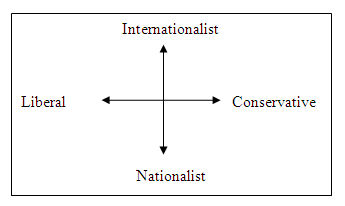
Meyerson’s singing my song, but a bit out of key. He suggests that this should be the “centerpiece of the liberal project for the 21st century.” If he means liberal very broadly in the classic sense of emphasizing individual rights and equality of opportunity, then this could make some sense. But in the context of U.S. politics, this should not be a liberal project. Nor should it be a conservative project. Liberal vs. conservative is the wrong frame to use for this discussion. A better way to look at it is internationalist vs. nationalist. Like this:

Since the League of Nations nationalists have successfully fought to limit U.S. participation in global institutions and agreements. The long list of un-ratified treaties from the Test Ban Treaty to the International Criminal Court is a testament to their determination and their ability to portray these instruments in a light that makes them unpalatable to conservative internationalists.
Internationalist sucesses, like the formation of the United Nations or the ratification of the Chemical Weapons Convention, are the result of coalitions between liberal and conservative internationalists. The momentum to ratify the Law of the Sea convention is based on a similar alliance.
Meyerson’s framing of what is perhaps the most important endeavor that humanity has ever undertaken as a “liberal project” could doom it to failure. Granted, the desire and motivation to embark on this long term effort resides more in the liberal/internationalist domain. But it will never succeed without conservative internationalists playing an integral role.
Let me know how you think we should frame this project to bring “into an uncertain future our economic achievements and democratic ideals.”
by Citizens for Global Solutions | Jun 8, 2007 | Global Cooperation, News, World Federation
I spent my morning meeting kids at Barnard Elementary School in D.C.’s Petworth neighborhood. I talked a bit about the problems I care about and learned a good deal about the problems they see as relevant to them.
It turns out that violence, pollution, and crime matter a lot to the Barnard kids, both locally and globally. And – who’d have figured – it takes teamwork in Petworth to solve problems just like it takes teamwork to solve problems at the global scale.
The kids learned about diplomacy at the United Nations. We made a circle, joined hands across the circle to make a “human knot,” and then tried to untangle ourselves. The lesson: just because you’re strong and have a loud voice doesn’t mean that yelling or pulling hardest will solve problems.
We learned that the United Nations – and the world – works best when we work together and recognize that we’re all in the same boat.
It’s amazing how many of the solutions we need today are intuitive. Teamwork, active listening, not bullying, and humility really are second grade-friendly concepts.
Is it depressing that the current administration doesn’t get it? It sure is. But the fact that kids understand these concepts so easily does give me hope.
by Citizens for Global Solutions | Jan 19, 2005 | Global Cooperation, News, World Federation
Washington, DC – Citizens for Global Solutions is pleased to announce the establishment of the Edward Rawson Fellows Program, which provides recent college and university graduates the opportunity to obtain hands-on experience working on global issues with one of the country’s leading educational and advocacy organizations.
The Rawson Fellows Program is designed to (1) provide a unique educational experience to outstanding individuals who might otherwise not have the opportunity to work on global issues in Washington, DC; (2) develop leadership skills that can serve the Fellow throughout a career in public service; (3) and continue the work of Edward Rawson by encouraging young people to become active in international affairs and promote active U.S. engagement within global institutions.
Each quarter, Citizens for Global Solutions will offer between three and five Fellowships. Currently, the first round of Fellows will work on Government Relations, Peace & Security, Communications and Strategic Planning, and Health and Environment.
In launching this new initiative, Citizens for Global Solutions named the program after longtime board member and supporter Edward Rawson, an exceptional global leader who has committed his life to promoting peace, justice and freedom for a democratically governed world.
In announcing the program, Charles J. Brown, the President and CEO of Citizens for Global Solutions said, “I can think of no better way to will honor and sustain the extraordinary work of Edward Rawson. Throughout his professional career with USAID, the U.S. Department of State, and other international institutions, Ed remained dedicated to global solutions. His life, which has been guided by an unrelenting dedication to peace, justice and democracy, is truly a model for us all.
“Rawson Fellows will have the chance to hone their skills, learn how Washington works, demonstrate their commitment to global issues, and be a part of an innovative organization seeking long-term global solutions to some of the most pressing global issues of today.”
“I am delighted and honored to have my name associated with this exciting new program,” said Edward Rawson. “Over the past decade it has become increasingly important for education and advocacy organizations like Citizens for Global Solutions to have a strong Washington, DC presence, with staff who know the issues and who can help leverage member activism in the halls of Congress. Bringing young leaders to our nation’s capital to learn about — and have an impact on — policy-making will greatly benefit both our work and the careers of outstanding young men and women.”
Prospective Rawson Fellows should be recent graduates of undergraduate or graduate programs in history, international relations, economics, political science, law, public policy, or another field relevant to the work of Citizens for Global Solutions. They should have a strong track record of outstanding academic achievement and a strong interest in U.S. global engagement and the global issues facing the international community. Prior experience with public-interest activism or advocacy is a plus, but not a prerequisite.
Supported by a monthly stipend, Fellows will serve for three months as program officers, with the possibility of renewal for an additional three months. Should they demonstrate a strong record during their fellowship, they also will receive preferred consideration for permanent positions with the organization.
Citizens for Global Solutions is an Equal Opportunity Employer. Women, people of color, and members of other underrepresented communities are strongly encouraged to apply.
by Citizens for Global Solutions | Oct 21, 2004 | Global Justice, News, World Federation
Citizens for Global Solutions Launches Debate and Discussion Forum Devoted to ‘Big Picture’ thinking about Global Institutions
Washington, DC – Today, Citizens for Global Solutions launched the World Federalist Institute (WFI), which aims to explore – through research, discussion, and creative thought – the values, concepts, and principles of world federalism. Topics that the WFI may address include assessment and reform of member state voting at the United Nations and the creation of a standing international police force to limit the scope of local wars and prevent genocide and humanitarian disasters. WFI will propose new projects, draft policy papers, and publicize the results of its research and deliberation.
Charles J. Brown, Citizens for Global Solutions’ President and CEO, welcomed the launch of WFI: “The World Federalist Institute gives our organization and its members the capacity to think about and propose solutions to some of the most fundamental challenges facing the world today. I look forward to working with staff, members, and WFI fellows as they examine how best to advance the cause of democratic global governance.”
WFI will operate through an interactive website that will include a Citizens for Global Solutions Members Forum to discuss any relevant issues, as well as a Fellows Forum that will encourage open debate and discussion of new ideas. Fellows will also introduce and discuss policy papers and provide answers to policy questions being explored by Citizens for Global Solutions.
WFI may present its proposals and concepts at events and conferences hosted by Citizens for Global Solutions and other NGOs and institutions, as well as in the form of commentary in appropriate journals.
Scott L. Hoffman, Director of the World Federalist Institute, stated: “I’m very excited to be present at the inception of this vital part of our movement. We owe a tremendous debt to the Board of Advisors – Thesil Morlan, Ron Glossop, and Steve Damours – as well as our Chair, Lucy Webster. WFI will help keep bright the beautiful vision of a peaceful, clean and just planet.”