
Originally published on the CGS blog on July 6, 2007.
Washington Post columnist Harold Meyerson ran an intriguing piece yesterday worth mentioning. In Global Safeguards for a Global Economy he suggests a “modest proposal” to take “the regulated, more-social capitalism that created mass prosperity in this nation and Western Europe in the second half of the 20th century” and re-create it on a global scale. I’m tempted to quote heavily from the piece, but it’s probably easier if you give it a quick read and come back to continue the conversation…
… that was quick, glad you are back. OK, here are few paraphrased points to think about:
- The debate on how the U.S. should relate to the rest of the world isn’t fruitful. Realists believe advancing our interests requires abandoning our values. The other side believes our interests are served by advancing our values with our allies (liberal viewpoint) or by ourselves with force (neoconservative viewpoint).
- None of these viewpoints take into account the global economy, which presents many problems that can only be solved globally.
- Globalization, economic stability, and “economic opportunity in the United States will require regulating markets and empowering labor on a global scale.”
This leads to Meyerson’s penultimate thought that “over time, the globalization of the economy will compel progressives to create, haltingly and piecemeal, a form of global government, just as the transformation of the American economy from a locally to a nationally based one between 1865 and 1935 compelled the progressives of that time to create a genuine national government.”
Meyerson’s singing my song, but a bit out of key. He suggests that this should be the “centerpiece of the liberal project for the 21st century.” If he means liberal very broadly in the classic sense of emphasizing individual rights and equality of opportunity, then this could make some sense. But in the context of U.S. politics, this should not be a liberal project. Nor should it be a conservative project. Liberal vs. conservative is the wrong frame to use for this discussion. A better way to look at it is internationalist vs. nationalist. Like this:
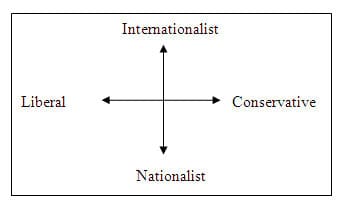
Since the League of Nations nationalists have successfully fought to limit U.S. participation in global institutions and agreements. The long list of un-ratified treaties from the Test Ban Treaty to the International Criminal Court is a testament to their determination and their ability to portray these instruments in a light that makes them unpalatable to conservative internationalists.
Internationalist sucesses, like the formation of the United Nations or the ratification of the Chemical Weapons Convention, are the result of coalitions between liberal and conservative internationalists. The momentum to ratify the Law of the Sea convention is based on a similar alliance.
Meyerson’s framing of what is perhaps the most important endeavor that humanity has ever undertaken as a “liberal project” could doom it to failure. Granted, the desire and motivation to embark on this long term effort resides more in the liberal/internationalist domain. But it will never succeed without conservative internationalists playing an integral role.
Let me know how you think we should frame this project to bring “into an uncertain future our economic achievements and democratic ideals.”