by Citizens for Global Solutions | Oct 11, 2007 | Global Cooperation, United Nations
The relationship between the United States and the U.N. has often been compared to a marriage. This October will be their 63rd anniversary. Like most marriages there are moments when life is wonderful, and moments when it is not. As in any relationship, we need to find common ground and rules we can all live by. We need to sit around the table and iron out the family’s problems.
 Yesterday I had the pleasure of moderating a briefing held in the Capitol on U.S. policy for the 62nd United Nations General Assembly. The program featured Kristen Silverberg, the Assistant Secretary of State for International Organizations. This is one in a series of briefings and discussions sponsored by the United Nations Associations’ Council of Organizations. The Council is a coalition of over 100 nongovernmental organizations and I serve as a member of its Washington DC executive committee.
I have often been at odds with the administration’s policies regarding the U.N., but I had no complaints regarding Secretary Silverberg’s presentation. She had recently returned from New York where she attended the opening sessions of the 62nd General Assembly. If you get a second you can look through her blog posts on the recently created DipNote (when I asked Secretary Silverberg if there had been internal negotiations at State about
the blog’s name, she said she wished that there had been). During a 4 day marathon she was part of a team engaged in issues ranging from the U.N.’s role in Iraq, Afghanistan, progress on bilateral middle east talks, climate change, Burma, North Korea, a Round table on Democracy, Darfur, HIV AIDs, a new Security Council sanctions resolution on Iran.
Her presentation was a quick snapshot of current U.S. efforts at the U.N. In her discussion of Burma and Darfur Silverberg noted that:
“…as we survey the great threats to global peace and stability, we find more and more proof of Shakespeare’s lament that ‘when sorrows come, they come not single spies but in battalions.’
The UN is well-positioned to confront these battalions of sorrows and the tyrants who lead them. Its vast organization includes not only expert bodies on health and development, but on elections, anti-corruption, economic reform, and other issues critical to good governance. Furthermore, to many nations, the UN has special legitimacy and moral authority to intervene in support of political and economic reform. We need, therefore, a UN prepared to advance democratic reform and good governance.”
This is a refreshing change from the anti-U.N. comments that used we regularly used to hear from former U.N. Ambassador John Bolton.
On the peacekeeping front Silverberg said:
In 2005, our annual assessment for UN peacekeeping was $1.26 billion. In 2008, we anticipate assessment of over $2.4 billion including over $1 billion for Sudan alone.
During the Q & A session I asked Silverberg how the FY09 peacekeeping request was looking, noting the huge shortfall the U.S. has in keeping up with its peacekeeping dues. She noted how difficult it was to budget for peacekeeping missions, considering their ad hoc nature, but stressed the administration’s commitment to paying our fair share, noting how difficult it is for the U.S. to ask other nations to contribute peacekeepers when we don’t pay our all of our dues. Hopefully the number crunchers at OMB will agree with her assessment.
I also asked about the administration’s position on the Coburn amendment to the Senate Foreign Ops bill, which would withhold funds to the U.N. and its programs and specialized agencies unless the Secretary of State could certify that they are fully and publicly transparent and have posted on the web all contract, grants, audits, budgets and progress reports for the 2007 fiscal year. Silverberg replied that while the administration supports the intent behind the amendment (its hard to argue with transparency) it paints with too broad a brush. Not only would it apply to the UN Secretariat, but to all the funds and programs. That means that it could cut off funding to important funds and programs like UNICEF, the World Food Program, and a number of peacekeeping operations in places like Lebanon and Darfur. The bottom line is that they have concerns about achievability and scope of the Coburn amendment. I couldn’t agree more.
Based on this conversation, I’d say the U.S. / U.N. marriage is in better condition than it has been in a very long time.
And speaking of marriages according to the Washington Post , congratulations are in order for Secretary Silverberg’s recent engagement. So Secretary Silverberg, congratulations and thank you for the good work that you are doing.
Don Kraus
by Rich Stazinski | Oct 11, 2007 | Global Justice, United Nations
According to a Washington Post report: “More than a decade after the United Nations was criticized for failing to stop genocide in Rwanda, the world body is more able to prevent another such atrocity, scholars and U.N. officials said on Wednesday.”
However, it seems to me, that that’s the right answer to exactly the wrong question. The question should be: Is the United Nations able to prevent genocide? Answer: NO. It can’t, and never will, without far greater international political will. Sure the UN’s record of genocide prevention in places like Bosnia, Rwanda and Sudan is imperfect and in need of marked improvement, but considering the lack of timely, robust political support for genocide prevention within the international community that’s to be expected. Without the full support of member countries, whether it be financial, logistical, or military, the UN cannot promise a fundamentally different response to tomorrow’s genocide.
A thoughtful Jean-Marie Guehenno, U.N. undersecretary-general for peacekeeping operations, stated:
“We’ve been haunted in the last 15 years by what happened in Yugoslavia and what happened in Rwanda. And none of us can avoid the question, would that happen again?” he said.
“And I think we have to be honest. There has been some progress in the international discussion. But does that mean that it will be fundamentally different tomorrow? Not necessarily.”
It’s up to each and everyone of us to create a fundamentally different tomorrow and make sure our elected officials and policymakers understand that when we promise “Never Again!”, we mean it. That means not standing by while a genocide burns and then passing a symbolic congressional resolution decades after the last victim has been butchered and unceremoniously buried in a mass grave.
And if you’re looking for something to do now that Season Three of Top Chef is over, why not let your elected officials know that you want the United States to play a constructive role in bringing peace and security to the long-suffering people of Burma and Sudan? The time to act is now.
by Rich Stazinski | Oct 9, 2007 | Global Cooperation, United Nations
…but Reject LOST’s commercial is more creepy and weird than scary! I guess Darth Vader was booked, and since Vincent Price and Bela Lugosi are both dead, our always entertaining friends at Reject LOST were left to conjure up something even more spooky and dastardly than a really sound international treaty. What could possibly be more spooky and dastardly than a really sound international treaty you might ask? Well, a ghoulishly disembodied voice prounouncing “reform” and “treaty” in a menacing baritone of course! AAAHHH!!!
If you don’t believe me, check it out for yourself…but beware…it’s truly frightening (in its blatant and unwarranted fearmongering)!
Bar your doors. Protect the women and children. Have your pitchfork and/or torch at the ready. “They” (of “them, not “us”) are after your sovereignty!
I just wish those jokers at Reject LOST would have chosen a more hip and modern Pirate-based Halloween theme. “Spooky” is so passe, and fearmongering is much more palatable when spoken with lots “arghs” and “scurvy dogs”. Wouldn’t the SOVEREIGNTY THREATS section of the Reject LOST web site sound better like this?
The Law o’ th’ Sea Treaty’s stated purpose be th’ establishment o’ a “legal order fer th’ seas an’ oceans.” T’ that end, LOST establishes rules governing: navigation o’ th’ oceans, territorial waters an’ straits; marine research; protection o’ th’ marine environment; deep seabed mining: an’ other oceans-related issues.
LOST also establishes UN-affiliated agencies t’ implement th’ Treaty, as well as international tribunals t’ hear disputes between state parties as t’ th’ Treaty’s application. If th’ disputin’ parties fail t’ reach an agreement on the’r own, they be required t’ submit th’ matter fer resolution t’ one o’ LOST’s mechanisms: th’ International Tribunal on th’ Law o’ th’ Sea (ITLOS), an arbitration panel or a special arbitration panel.
In order t’ engage in exploitation o’ th’ seabeds’ natural resources, parties t’ LOST must make payments o’ various kinds t’ th’ Treaty’s International Seabed Captainliness (ISA).
After negotiations on LOST be completed in 1982, th’ Treaty be rejected by President Reagan. ‘t be subsequently signed by President Clinton in 1994 followin’ th’ negotiation o’ a separate accord known as th’ Agreement? that be spake t’ be havin’ addressed Mr. Reagan’s concerns. T’ date, th’ Senate has nay consented t’ th’ ratification o’ LOST.
Argh. Now dat be fearmongerin’ wit’ a proper Halloween season theme, matey!
by Citizens for Global Solutions | Oct 9, 2007 | Global Cooperation, News, United Nations
Canadian racecar driver Jacques Villeneuve made his NASCAR Nextel Cup debut yesterday at the famous Talladega Superspeedway in the UN-blue, number 27 UNICEF car. Villeneuve, the first Formula One Champion to make the jump to NASCAR, has committed to donating all the money raised through his promotional efforts to UNICEF-sponsored child health programs.
“This Cup race is in addition to the test and race schedule that we’d committed to, so we had the chance to do something different with the car,” Mr. Villeneuve said. “I have a desire to see children all over the world safe, healthy and happy, and that’s UNICEF’s sole focus.”
Here’s to the beginning of a wonderful relationship…TRES BIEN, JACQUES!
by Raj Purohit | Oct 2, 2007 | Global Cooperation, United Nations
On September 22nd the PTR ran an article by Bill Steigerwald in opposition to the UN Convention on the Law of the Sea. The article was based on an interview with Cliff Kincaid and it both mentioned CGS and contained several incorrect statements. We submitted a letter to the editor and followed up with repeated calls but to date have neither heard from the PTR nor seen any sign that they will let us respond in print.
Reasonable people can disagree on issues such as the Law of the Sea. However, it strikes me that there is something wrong with a newspaper refusing to allow an organization to respond to criticism leveled at it in a column.
by Rich Stazinski | Sep 23, 2007 | United Nations
Last week, the Center for American Progress (CAP) released Congress and the United Nations: How to a Build a Better Relationship and Move Forward on Needed U.N. Reforms. The report states:
The relationship between the United States and the United Nations is in desperate need of repair. Although the United Nations owes its existence to the post-World War II leadership of America and its allies, in recent years the U.S.?U.N. relationship has spiraled downward into one that is too often dysfunctional. While the relationship has never been without tension, having endured Cold War-related polarization and other political disagreements, much of the breakdown has happened over the past decade—with the U.N. Secretariat, U.N. member states, and the U.S. executive and legislative branches all deserving a share of the blame. A significant part of the problem, however, has been the failure of the United States to provide sufficient support and leadership for the world body.
Unfortunately, the timing couldn’t be worse. The United States needs the United Nations more than ever to help tackle a range of transnational challenges that directly threaten U.S. national security interests. The dire situations in Iraq and Darfur, the continuing threat of global terrorism, the nuclear standoff in Iran, and the ongoing civil strife in Lebanon are just a few of the problems that cannot be adequately addressed without robust United Nations involvement.
Without an engaged and supportive United States, the United Nations will be unable to fulfill its mission. Fundamentally, without a strong and capable United Nations, the United States will be unable to accomplish many of its own strategic objectives.
The good news is that with a new Congress, a new U.N. Secretary-General, and a new U.S. Ambassador to the United Nations there is a unique opportunity for positive change in this troubled relationship. While it may be difficult to fully repair U.S.?U.N. relations before a new U.S. administration can make a fresh start in 2009, there are several steps that the 110th Congress can take in the short run to demonstrate leadership and improve relations, thus improving the chances of pushing forward needed U.N. Secretariat, management, and budget reforms that affect U.S. interests.
In addition to the well-timed report on the U.S.-U.N. relationship, CAP also released the following Public Opinion Snapshot, Wanted: An Engaged U.N.
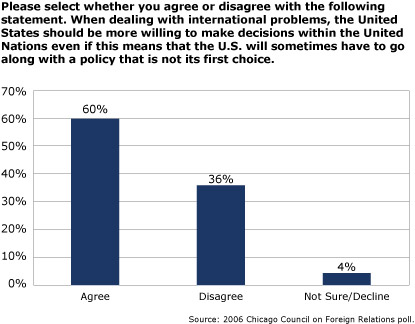
The Iraq war has not been kind to the notion that the United States should ignore the United Nations by unilaterally launching ?wars of choice? without the support of the international organization. No wonder the U.S. public, in a 2006 Chicago Council of Foreign Relations poll, agreed by a 60 percent-to-36 percent margin that the United States should be willing to make decisions within the U.N.?even if that means the United States may sometimes not be able to follow its first choice of course of action.
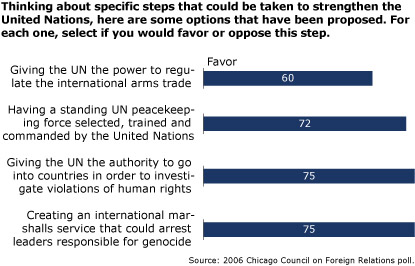
In fact, the American public is clearly interested in having the U.N. do more, not less. For example, 75 percent in the CCFR poll favored giving the United Nations authority to go into countries in order to investigate violations of human rights. Seventy-five percent also favored creating an international marshals service that could arrest leaders responsible for genocide. U.N. peacekeeping operations are also popular, with 72 percent in favor of a standing U.N. peacekeeping force selected, trained, and commanded by the United Nations. And 60 percent favored giving the United Nations the power to regulate the international arms trade.
As the General Assembly of the United Nations gathers in New York this week and next, the Bush administration’s new ambassador to the United Nations, Zalmay Kahlilzad, should heed these poll numbers by working to repair our damaged relationship with the U.N. Congressional leaders on both sides of the aisle should also consider these poll numbers when they debate whether to pay the $1 billion the United States owes the U.N. in arrears for, among other things, peacekeeping operations around the globe.

 Yesterday I had the pleasure of moderating a briefing held in the Capitol on U.S. policy for the 62nd United Nations General Assembly. The program featured Kristen Silverberg, the Assistant Secretary of State for International Organizations. This is one in a series of briefings and discussions sponsored by the United Nations Associations’ Council of Organizations. The Council is a coalition of over 100 nongovernmental organizations and I serve as a member of its Washington DC executive committee.