by Ronald Glossop | May 26, 2017 | Global Justice, World Federation
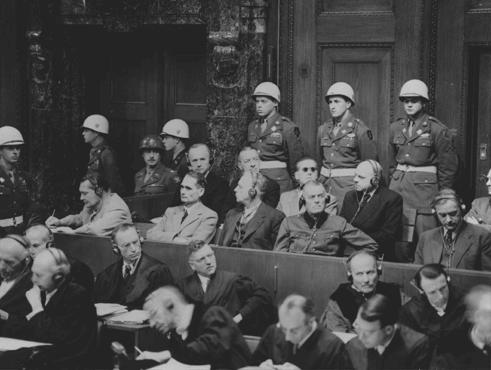
“60 MINUTES” on Sunday evenings is a very popular weekly TV news programs. The second segment of the May 7, 2017 program focused on Ben Ferencz, a prosecutor for the Nuremberg Trials after World War II. In those trials Nazi leaders were convicted for the killing of millions of Jews and others in what became known as “the Holocaust.” Fortunately you can see Leslie Stahl’s wonderful interview of Ben again and again at <http://www.cbsnews.com/news/what-the-last-nuremberg-prosecutor-alive-wants-the-world-to-know/>.
An important part of the interview comes near the end when Ferencz clearly makes the point that war turns generally good people into murderers. His goal during much of his 97 years has been to end war by means of the use of law. The disaster of wars exists because the world of nation-states with unlimited national sovereignty still lacks a system of law and government at the global level.
The interview very briefly mentioned the work of Ferencz to help create the International Criminal Court (ICC) which can prosecute leaders who disobey international laws against genocide and committing crimes against humanity. In addition to his crucial role in the development of the ICC and teaching international law for decades, Ben has authored many important books such as New Legal Foundations for Global Survival: Security through the Security Council (1994) and the more popular-oriented A Common Sense Guide to World Peace (1985). That book became the basis for the even more popular Planethood: The Key to Your Future (1991) co-authored by Ken Keyes, Jr.
Our thanks to Ben Ferencz for his life dedicated to “world peace through world law” and to CBS for calling attention to it.
by Jennifer Keck | May 6, 2017 | Global Justice
As a student of Latin American history, I vividly recall debating why the region’s governments collapsed into dictatorship time and time again. Argentina, Bolivia, Brazil, Chile, Paraguay, Peru, Uruguay…yet Venezuela was largely absent from the conversation.
Maybe it was because the country seemed to have settled on a democratic system in 1958 after the people overthrew their “final” dictatorship, and avoided the mid-century military massacres their neighbors faced.
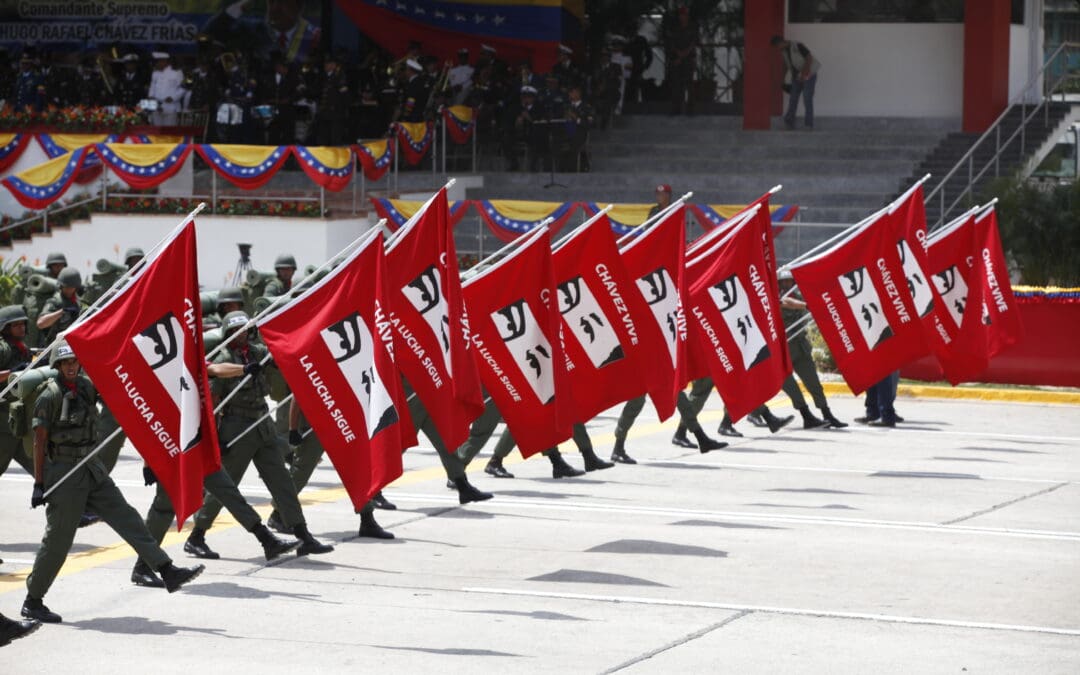
Or maybe it was the controversy surrounding President Hugo Chavez and his Bolivarian Revolution, loved by the Left and hated by the Right. And despite his clashes with the U.S., his approval rating remained high at home, due in part to a booming economy, which made him an unlikely harbinger for military rule.
The End of Venezuelan Democracy?
Flash forward to today, and Venezuela is a very different place. Plagued by record-high inflation, shortages of food and medical supplies, and violent protests, human rights have been suspended in favor of law and order. And although President Nicolás Maduro has slowly continued to erode democratic institutions since he took office in 2013, the once promising nation may officially revert back to authoritarian rule in 2017.
Exhibit A:In October 2016, Maduro cancelled a presidential recall referendum and postponed regional elections indefinitely. The country had already been declared under a state of emergency since January.
Exhibit B: On March 29, 2017, the Venezuelan Supreme Court, which is controlled by the executive branch, took over the National Assembly. While the ruling was reversed just days later, the separation of powers remains murky.
Exhibit C: On April 26, 2017, Venezuela announced it will leave the Organization of American States due to its criticism of Maduro’s expanding executive powers, which clash with its mission to promote democratic rule.
Exhibit D: On May 4, 2017, Maduro announced a decree to re-write the nation’s constitution, amid anti-government demonstrations. If his previous decrees are any indication, the re-writes will only serve to further cement his power.
Why Venezuela Matters
Democracies remain fragile throughout the region. Over the past two decades, elected leaders such as Evo Morales in Boliva, Rafael Correa in Ecuador, Daniel Ortega in Nicaragua, and of course, Hugo Chavez and his successor Nicolás Maduro have passed constitutional amendments to stay in power indefinitely.
Inspired by Chavez’s Bolivarian revolution, leftist presidents have turned away from the U.S. and toward dictatorships such as Cuba. Now Venezuela is strengthening its ties to authoritarian regimes in Russia and China. Will Bolivia, Ecuador and Nicaragua do the same?
What’s more alarming is that Venezuela has faced few consequences from the international community for its actions at home and abroad. A suspension from the regional trade bloc MERCOSUR has been demoted to a “cessation”, and Venezuela’s decision to leave the OAS has been met with support from Russia.
Yet a soft dictatorship is much more difficult to identify. A move against a democratically elected government could be viewed as a violation of sovereignty, leaving the international community in a tough position: facing criticism for intervening or for not intervening until it’s too late.
The Future of Venezuela
For now, the Maduro administration and the pro-democracy opposition party, Mesa de La Unidad (MUD), are locked in a cycle of protests, violence, and repression. MUD’s peaceful demonstrations continue to be met with military force, which only increases support for MUD and ignites more protests.
The future of Venezuela’s government remains uncertain. However, if the opposition can pressure the current administration into conceding to some of its demands, the country may begin to turn back toward a true democracy. And it may also serve as a warning for Latin American leaders who are following an authoritarian path.
by Rene Wadlow | Apr 19, 2017 | Global Justice, Human Rights
The Association of World Citizens calls for the re-affirmation of humanitarian international law. It is a call to the soldiers and militia members in armed conflicts to refuse orders to violate humanitarian international law by refusing to use weapons outlawed by international treaties such as chemical weapons, land mines, cluster munitions or any weapon to attack civilians, especially children and women. We must defend all who use their individual conscience to refuse to follow orders to violate humanitarian international law.
At the heart of this growing phenomenon of mass violence and social disintegration is a crisis of values. Perhaps the most fundamental loss a society can suffer is the collapse of its own value system. Many societies exposed to protracted conflicts have seen their community values radically undermined if not shattered altogether. This has given rise to an ethical vacuum, a setting in which international standards are ignored with impunity and where local value systems have lost their sway. Olara Otunnu, then Special Representative of the U.N. Secretary-General for Children and Armed Conflict, Report to U.N. General Assembly, 1998
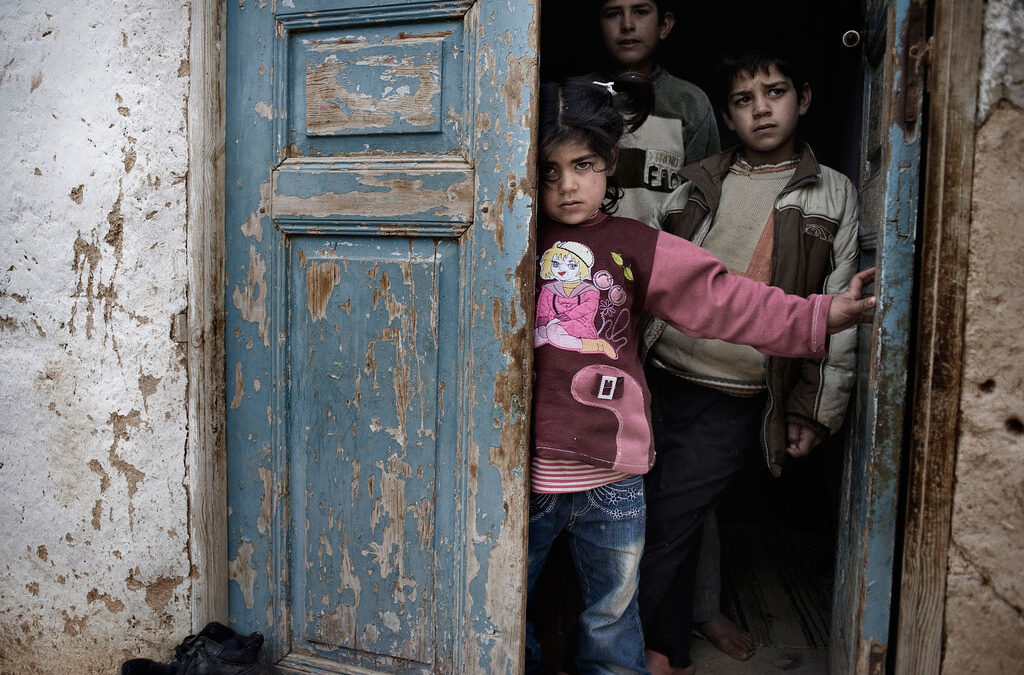
The attack on Khan Sheikhoon in Idib Province of Syria on 4 April 2017 raises at least two essential issues concerning humanitarian international law and the protection of children in times of armed conflict.
A major issue is the use of chemical weapons, probably sarin or a sarin-like substance in violation of the 1925 Geneva Protocol for the Prohibition of the Use in War of Asphyxiating, Poisonous or other Gases, and of Bacteriological Methods of Warfare of which Syria was a party, among the 135 governments which have signed. The attack was also a violation of the Convention on the Prohibition of the Development, Production, Stockpiling and Use of Chemical Weapons and on their Destruction which came into force in 1997. The Convention created The Hague-based Organization for the Prohibition of Chemical Weapons (OPCW). Syria signed the Convention in 2013 as part of a compromise decision to have its chemical-weapon stock destroyed.
The use of poison gas strikes deep, partly subconscious, reactions not provoked in the same way as seeing someone shot by a machine gun. The classic Greeks and Romans had a prohibition against the use of poison in war, especially poisoning a water well because everyone needs to drink. Likewise poison gas is abhorred because everyone needs to breath to live.
There is a real danger that the Geneva Protocol of 1925, one of the oldest norms of humanitarian international law, will be undermined and the use of chemical weapons “normalized”. The Organization for the Prohibition of Chemical Weapons is already investigating the use of chemical weapons in seven other locations in Syria.
Chemical weapons have been used in armed conflicts in the Middle East before. Although Egypt had signed the 1925 Geneva Protocol, Egyptian forces used chemical weapons widely in their support of the republican forces in the Yemen Civil War (1962-1967) with very few international outcries. As a result of the lack of any sanctions against Egypt, Syria requested Egyptian technical assistance in developing its own chemical weapons capabilities shortly after 1967 – well before the al-Assad dynasty came to power.
Humanitarian international law is largely based on self-imposed restraints. Although the International Criminal Court has a mandate to try crimes of war and crimes against humanity, its impact on the way armed conflicts are currently carried out is small. Thus, restraints need to rest on the refusal of soldiers and militia members to carry out actions that they know to be against both humanitarian international law and the local value system. This is especially true of the non-harming of children in times of armed conflict.
Humanitarian international law creates an obligation to maintain the protection of all non-combatants caught in the midst of violent conflicts as set out in the Geneva Conventions of 1949 and their Additional Protocols of 1977. Moreover, there is an urgent need to focus special attention on the plight of children. They are the least responsible for the conflict and yet are most vulnerable. They need special protection. The norms to protect children in armed conflicts are set out clearly in the Additional Protocols which has 25 articles specifically pertaining to children. The norms are also clearly stated in the Convention on the Rights of the Child, the most universally ratified international treaty. The Convention calls for the protection of the child’s right to life, education, health and other fundamental needs. These provisions apply equally in times of armed conflict and in times of peace.
As with the use of weapons prohibited by international treaty such as chemical weapons, land mines, and cluster munitions, the protection of children must be embodied in local values and practice. The classic Chinese philosopher Mencius, in maintaining that humans were basically good, used the example of a child about to fall into a well who would be saved by anyone regardless of status or education.
The Association of World Citizens has called for a United Nations-led conference on the re-affirmation of humanitarian, international law. There needs to be a world-wide effort on the part of governments and non-governmental organizations to re-affirm humanitarian values and the international treaties which make them governmental obligations. Such a conference would bring together into a coherent synthesis the four avenues of humanitarian international law:
1) The Geneva Conventions – Red Cross-mandated treaties;
2) The Hague Convention tradition dealing with prohibited weapons, highlighting recent treaties such as those on land mines and cluster munitions;
3) Human rights conventions and standards, valid at all times but especially violated in times of armed conflicts;
4) The protection of sites and monuments which have been designated by UNESCO as part of the cultural heritage of humanity, highlighting the August 2016 decision of the International Criminal Court on the destruction of Sufi shrines in northern Mali.
There is also a need to use whatever avenues of communication we have to stress to those living in Syria-Iraq-ISIS-Kurd-majority areas-and Turkey that they have a moral duty to disobey orders that violate humanitarian international law. We on the outside must do all we can to protect those who so act humanly in accord with their conscience.
Rene Wadlow, President, Association of World Citizens
by Lucy Webster | Apr 9, 2017 | Global Justice, Peace & Disarmament
Ever since President Obama drew a red line to prevent further use of poison gas by Bashar al-Assad to murder Syrian citizens, I have advocated action to enforce the treaty against the use of such weapons. The U.S. Congress refused to review and endorse Obama’s call for action because Russia and other supporters of Assad said they would remove the remaining poison gas from Syria and take it to Russia. However, they did not actually fulfill this commitment. This lack of action was wrong, morally and legally.
Now, we can move forward—carefully. Let us take creative notice of the fact that Russia and Iran have been acting as the protectors of the use of poison gas. Let us state that clearly. Let us, the United States of America, stand for international law and justice for people worldwide. Let us continue to mend relationships with Arab leaders who also support law and justice. Let us continue our efforts to defeat ISIS and its violence against the people of Syria, Iraq and other nations, but let us note that this is above all a war of ideas. It is basically a war for human rights and a struggle for a peaceful world.
One important aspect of the situation is the fact that President Bashar al-Assad and his father, Hafiz al-Assad, are part of an ethnic-religious group, the Alawi, that represents only a small part of the population of Syria. This group does not need to rule all of Syria in order to have safety for themselves. Russia could be allowed to continue leasing the naval base in the Mediterranean on the Western edge of Syria. This matter could be negotiated as an end in itself and as part of an effort to improve Russian-US relations. Assuring Bashar al-Assad and/or his supporters control of Western Syria could open the way to free and fair elections for the rest of Syria, supervised by the UN, which has extensive experience supervising elections. This proposed solution would also provide space for many Kurds to live in peace and prosperity.
This Blog comes from Lucy Law Webster who worked as a Political Affairs Officer in the UN Department for Disarmament Affairs during the period when the International Protocol on the Prohibition of Chemical Weapons was drafted, negotiated and ratified.
by Tad Daley | Mar 26, 2017 | Global Justice, World Federation
In his speeches before both CPAC and the U.S. Congress, President Trump described with pinpoint accuracy the sovereign state system of today. But might we see a global anthem tomorrow, and a world flag, and even a United Earth? This posting is a short version of Tad’s longer article posted on AlterNet on March 10, 2017. Click here to read his full article and join in the discussion taking place there.
“We will serve the citizens of the United States of America, believe me,” said President Donald Trump at the Conservative Political Action Conference (CPAC) on February 24th. “There is no such thing as a global anthem, a global currency, or a global flag.” Four days later, in his first speech before a joint session of Congress, he continued, “My job is not to represent the world. My job is to represent the United States of America.”
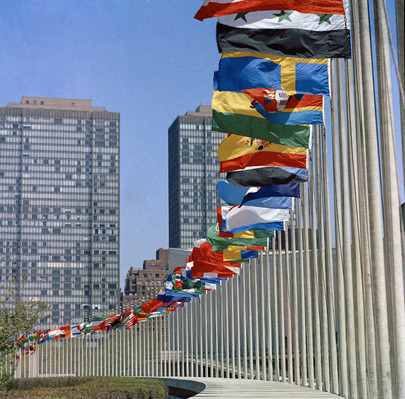
But someday, is it possible that people around the world might actually sing a global anthem together? And hoist a global flag? And dwell together as citizens of a United Earth?
Our world grows smaller and more interconnected every day. No grand historical development is more defining of the modern age. Can we imagine the same feelings of camaraderie, kindred spiritedness, and tribal solidarity about our single human community? Can our loyalty to the world as a whole — as it does for many for one’s nation — make our blood rush a little more quickly through our veins? Might our allegiance to our nations be accompanied by an allegiance to humanity?
There’s no reason why people cannot declare right now that they see themselves as both citizens of their countries and citizens of the world. That their national patriotism is for them transcended by their planetary patriotism. And that all of us on this fragile planet must now consider ourselves, in the science fiction author Spider Robinson’s memorable phrase, to be “crewmates on Spaceship Earth.”
These ideals of larger loyalty have been promulgated by some of the greatest figures in the human heritage. It’s what Voltaire called “the party of humanity.” It’s what Victor Hugo meant when he said, “I belong to a party which does not yet exist — the party of revolution and civilization.” It’s what the signatories of the 1955 “Einstein-Russell Manifesto” were describing when they claimed to speak “not as members of this or that nation, continent, or creed, but as human beings, members of the species Man, whose continued existence is in doubt.”
Who Does “Represent the World?”
President Trump is not wrong about who he “represents.” It’s that way for every president. There’s nothing unusual or unprecedented or groundbreaking about it. The oath an American president swears is about protecting the United States of America and its constitution — nothing else!
But this leads to a rather severe problem in our ever shrinking world. Some 200 separate sovereign units, each pursuing their own individual national interests, can hardly guarantee optimal outcomes for the common human interest. And we see this in cold, hard realities, from the massive displacement and refugee flows generated by economic hopelessness, to transborder cyberattacks and runaway climate change. Stronger multilateralism, robust support for international institutions and enhanced mechanisms of global governance are the optimal policy tools.
So who, today, which individuals in which elected offices, can we identify whose raison d’etre is to serve the larger collectivity, the whole of the human community, the global public good?
The answer is no one. It’s not Donald Trump’s job … but it’s no one else’s either. There is no supranational authority that stands above the nation state. There is no institution, no elected official anywhere, whose job it is to “represent” the human race.
It’s hardly self-evident that what political scientists call the “Westphalian state system” (originating in the peace treaty of 1648 that ended Europe’s calamitous wars of religion) will endure as a permanent feature of human history.
We can imagine a redesigned and democratized and empowered United Nations. Former U.S. Secretary of State Madeleine Albright recently co-chaired a “Commission on Global Security Justice and Governance.” It proposed a “World Summit on Global Governance” during the UN’s 75th anniversary year in 2020. Further down the road it’s not impossible to envision that the same basic structures of governance long established almost universally at city, state, and national levels worldwide — a legislature and an executive and a judiciary — might someday be fashioned and founded at the global level as well.
This vision too — not just the intangible ideal of global citizenship but the tangible idea of a world state — has been put forth by some of the greatest figures in the human heritage. “I dipt into the future, far as human eye could see, Saw the vision of the world, and all the wonders that would be … Till the war-drum throbbed no longer, and the battle flags were furl’d, In the Parliament of Man, the Federation of the World.” That’s Alfred Lord Tennyson, Poet Laureate to Queen Victoria, in his 1842 masterpiece Locksley Hall. “The Earth is but one country, and mankind its citizens.” That’s Baha’u’llah, the founder of the Baha’i Faith, in 1857. (By most accounts it’s the first or second fastest growing religion in the world today.) “Without some effective world supergovernment … the prospects of peace and human progress are dark … (But) if it is found possible to build a world organization of irresistible force and inviolable authority … there are no limits to the blessings which all men may enjoy and share.” That’s conservative hero Winston Churchill in 1949.
These kinds of possible future developments might someday give tangible content and historical meaning to the planetary patriotism that, perhaps, more and more Earthlings might over time declare. Perhaps this hypothetical future entity might be established, some distant day, by a duly negotiated and legally enacted world constitution. They might call it an “Earth Union,” or the “Federal Republic of the World,” or a “United Earth.” In the fictional future history of STAR TREK, after all, the “United Federation of Planets” in the galaxy was preceded by a “United Federation of Nations” on Earth. Hundreds of science fiction novels contain similar depictions of a politically unified human race. If writers can make such a future seem so plausible and believable, is it really so ridiculous simply to ask whether we can aspire to it as an actual historical goal?
“We are one people with one destiny,” said President Trump toward the end of his speech to Congress — addressing himself, of course, exclusively to Americans. But perhaps it is not too much to suppose that someday, some political leader will sit in a position, and maintain the responsibility, and show a sufficient elevation of the human spirit, to say not just to the citizens of one particular country but to all the people of Planet Earth, “We are one people with one destiny.”
The Road to One World
So which comes first? A sentiment of planetary patriotism or an actually politically unified planet? It’s sort of like the proverbial question about the chicken and the egg — only prospective instead of retrospective. It may be that we’ll never see any kind of tangible progress toward world political unity until a substantial number of people feel, deep in their bones, something like an ethic of human unity. Or it may be instead that we’ll never have a great many people who see themselves primarily as citizens of the world until every living human being has in fact become a citizen — with both rights and responsibilities — of a United Earth.
Tad Daley, author of APOCALYPSE NEVER: Forging the Path to a Nuclear Weapon-Free World from Rutgers University Press, is a fellow with the Center for War/Peace Studies. He’s currently writing his second book, on the extraordinary history and possible future of the idea of a world republic. Follow him on Twitter @TheTadDaley.
by Jennifer Keck | Jan 15, 2017 | Global Justice, Human Rights, News
Mercosur didn’t waste any time. The South American trade group warned that it would suspend Venezuela’s membership if it didn’t improve human rights and immigration conditions by December 1st. On December 2nd, Mercosur did in fact suspend Venezuela, according to the AP Press. The move came after the country failed to meet the standards it agreed to comply with upon joining in 2012.
However, despite the unanimous decision from Mercosur’s four founding members—Argentina, Brazil, Paraguay, and Uruguay—the Venezuela government plans to fight back. President Nicolas Maduro has already threatened to take the matter to international authorities, stating that the decision was “a coup d’état.” Yet the country is unlikely to receive much sympathy in a world that is quickly veering toward the right.
When Venezuela joined Mercosur, South America was dominated by left-wing governments. But much has changed since 2012—Argentina and Brazil elected centrist leaders, and the country’s regional influence has declined since it began cutting back on oil shipments. And without the support of its neighbors, Venezuela is vulnerable to further punitive action from other nations. The Organization of American States has already debated suspending the country from the hemispheric body due to its growing authoritarianism, and some U.S. Congress members have suggested imposing economic sanctions.
Venezuela crashes the party
Yet the country shows no sign of backing down. Venezuela’s Foreign Minister Delcy Rodriguez didn’t let lack of an invitation keep her from attending a Mercosur meeting in Buenos Aires on December 15th. When she arrived to find the meeting room empty, she accused the Argentina, Brazil, and Paraguay of colluding against her country. (The meeting of foreign ministers took place in a different, smaller room.)
Argentine Foreign Minister Susana Marcorra later told BBC News that the organization ultimately allowed Rodriguez to join the meeting “because we all agreed that we did not want the situation to escalate into something bigger.” She also said that the suspension would be overturned if Venezuela complied with Mercosur’s requirements. Venezuela claims it has incorporated all the regulations except ones that conflict with its domestic laws.
Running out of options
The country has obviously taken a bold stance given catastrophic its shortages of food, medicine, and other essentials. Meanwhile, protests and waning support for President Maduro have only led to more human rights violations. Authorities have jailed hundreds of activists in recent years and suppressed opposition media.
At present, Venezuela seems to be locked in a vicious cycle of shortages, protests, and government crack downs, and the loss of its closest trading partners will only exacerbate this. If the socialist nation is to recover, it must improve its human rights record and restore relations with its fellow South Americans.