by Charles Marsh | Aug 8, 2017 | Global Cooperation, World Federation
The initial news of Brexit was greeted with dismay by a majority of people with a liberal internationalist outlook, myself included. Most saw it as a serious setback for the European Union (E.U.), with some even hailing it as the beginning of the end for the bloc. However, in the aftermath of this event, we are beginning to see a different picture emerging. The immediate after effect was not a propagation of nationalist movements, but rather a reaction against them. Geert Wilder’s Partij voor de Vrijheid (Party for Freedom) party failed to gain power in Denmark, as did Marine Le Pen’s Front Nationale in France. In Germany, the previously expanding Alternative für Deutschland (Alternative for Germany) experienced a precipitous decline in popular support. This lack of proliferation of nationalism is an encouraging sign, and the E.U. has not, as some may have feared or indeed hoped, experienced any similar shocks since Brexit.
Conversely, what we are instead seeing is the E.U. emerging as a new global core of liberalised free trade. As the U.S. withdraws from its dominant positon, due to the Trump government’s protectionist policies, we are seeing a greater role emerge for the E.U. as the norm entrepreneur of this era. Indeed, the fact that it was able to quickly and easily agree one of the largest free trade deals in history with Japan shows that the bloc’s prestige and capability is hardly damaged. This is particularly apparent in the nascent Brexit negotiations, where the E.U. has been proving to be remarkably united, in contrast to the disarray of the British government. Indeed, in all aspects of these negotiations Britain seems remarkably outmatched, while the E.U. seems to be united, with a strong common viewpoint going forward. As such, it seems unlikely that Britain will be able to leave with a deal that favours their own nationalistic interests, which in turn makes the prospect of secession even more unappealing for any likeminded nations. Therefore, in the year since Brexit, we have not seen the E.U. begin to disintegrate under the force of nationalist politics. Instead, we seen its popularity rise and, more importantly, its global position reassessed following the changes in America. With this in mind, it might be important to ask: what could come next for the E.U.?
It is important to note that Britain has somewhat been the black sheep of the E.U. family, blocking reforms, impeding integration, and all too often being at odds with the vision many other nations had for the bloc. This was most apparent in the field of security integration, with Britain often exploiting their veto to block any meaningful reforms in this area. Without Britain, much of this obstruction is likely gone. To compound this change, France’s President Macron has been elected on a position of European reform, and his prominent role in the E.U. bloc makes his aspirations likely to succeed. Indeed, these reforms are more probable after Brexit, as it may have shaken the E.U. out of complacency, and made it reassess its current position, and how it may need to change in the future.
As such, a combination of Britain’s impeding influence being removed, France’s new president being reform focused, and Brexit highlighting a need for change, means that the E.U. is in a better position to reform itself than it has ever been. More importantly, based upon the conclusions of the first paragraph, it has before it a new role to fulfil, the keystone of Western Liberalism that was previously being occupied by America. As such, and at this point I’m afraid I will rather diverge into my own hopes for the bloc, if the E.U. undergoes the correct reforms, most notably reduction of bureaucracy and heavy focus on democratization, I believe it would be well placed to succeed America’s position as the “Leader of the Free World”. Whether this is a mere aspiration or a realistic possibility depends upon the actions of a great many individuals, but from where I stand at this time, I see a great deal of potential for the future of the E.U.

by Ronald Glossop | Apr 15, 2017 | Global Cooperation, World Federation
Citizens for Global Solutions is very indebted to many activists who contributed much to making the World Federalist Association (WFA) and the Campaign for U.N. Reform CUNR) influential organizations that flourished from the end of World War II until 2003 when they were merged to form Citizens for Global Solutions (CGS). CGS regrets that we probably have not sufficiently honored many of these now deceased members from the past.
Nevertheless we are glad now to honor two of them, Betty and Howard Taylor of Akron/Stow, Ohio on the occasion of Betty’s death April 10, 2017 at the age of 93. Howard died September 16, 2006. Married in 1944, they had three children–Bruce, Susan, and Karen. From the beginning of the world federalist movement in 1947 they became leaders locally and nationally. Betty was Akron WFA chapter president for decades. Both were active in the Campaign for U.N. Reform and worked with elected officials friendly to our aims. Betty later served on the Steering Committee of the World Federalist Institute (WFI).
Betty was also active in the local UN Association, the Akron Peace Council, and the League of Women Voters as well as doing her volunteer work on behalf of local artists. Howard and Betty were honored with the “Arts Alive” Volunteer Award by the Akron Area Arts Alliance in 2003.
In lieu of flowers, the family suggests that memorial donations in Betty’s name be made to Summit Artspace (which Betty and Howard helped to found), 140 East Market Street, Akron, Ohio 44308, or to Citizens for Global Solutions Education Fund, Memorial Gift Program, PO Box 15256, Washington, DC 20003.
by Ronald Glossop | Jan 19, 2017 | Global Cooperation, World Federation
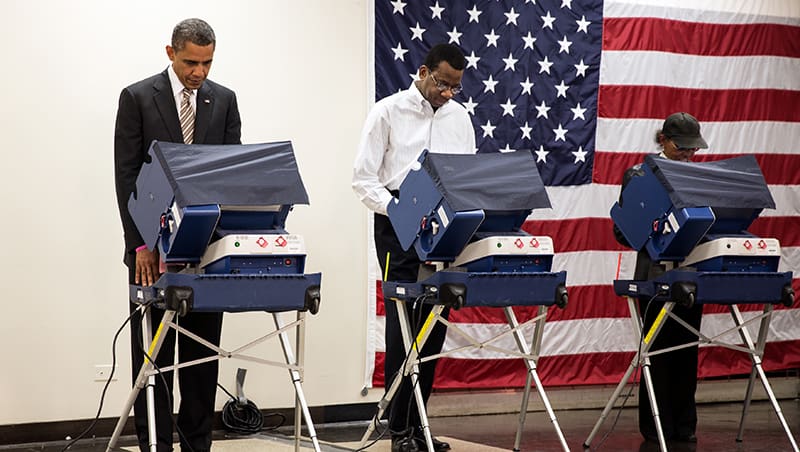
Discussions of Obama’s legacy are often too narrow. They focus on specific policies that were adopted or not adopted. They don’t pay enough attention to what Obama himself said at his January 10 valedictory speech in Chicago. When the audience began shouting “No, no, no, no, no” as he mentioned the coming change in the White House, Obama responded with a statement that displays his wisdom and his understanding of the important role of the United States in world history, namely that one of our nation’s great strengths “is the peaceful transfer of power from one president to the next.”
We have constructed a large and prosperous democratic nation that decides who should have ultimate political power in our country for the next few years on the basis of elections rather than fighting violent military battles. In a democracy groups with opposing views and interests realize that the results of an election can be reversed in the next election and the next and the next. Violence is not necessary.
In a stable democracy there is no one winner-take-all for the foreseeable future. The rulers for the moment can be changed in the next election. Progress toward an ideal community can be made gradually and even with steps forward and back.
We had our very destructive Civil War (1861-1865) to determine that we would preserve the democratic federal Union. For a century and a half after that our country has experienced the wonderful benefits of a united democratic federal government that determines its rulers by elections instead of wars and is governed by law and courts rather than destructive military battles. Obama realizes that, and his whole life as well as his presidency has been guided by it.
This legacy is even broader than just for this county or even for many other federal democratic countries following in our nation’s footsteps. It provides a lesson for the whole world community that the way to end war not only within countries but also within the planetary community is to establish a democratic federal government.
What a huge blessing it would be for all of humanity if the global community would transform the United Nations into a global democratic government just as our country made the transformation from the ineffective Articles of Confederation to the democratic federal union when the U.S. Constitution was created and ratified in 1787-1789 and George Washington became our first elected President.
by Shirley Davis | Oct 27, 2016 | Global Cooperation, World Federation
The Global Week of Action for a UN Parliamentary Assembly runs until Oct 30, 2016, but there is nothing magic about that date. CGS encourages actions in support of this important idea before, during and after the official Global Week of Action.
On the afternoon of September 17, 2016, the Maine Chapter of Citizens for Global Solutions had a table and map display in support of the Campaign for a UN Parliamentary Assembly (UNPA). We did this in conjunction with many other organizations participating in the End Violence Together program in downtown Bangor, Maine. Our banner in support of UNPA was suspended from a table. We displayed a world map on an easel that demonstrated areas in the world where action has already taken place in support of this goal.
The Campaign for a United Nations Parliamentary Assembly is a global network of parliamentarians, non-governmental organizations, scholars, and dedicated citizens that advocates democratic representation of the world’s citizens at the United Nations. A United Nations Parliamentary Assembly, UNPA, for the first time would give elected citizen representatives, not only states, a direct and influential role in global policy.
Institutionsthat have expressed support include numerous civil society organizations, parliaments, international parliamentary assemblies and party networks. For instance, the Pan-African Parliament, the European Parliament, and the Latin-American Parliament have adopted resolutions ñ as have the Socialist International, the Liberal International, or the Green World Congress. 1466 members of parliaments from 120 countries endorse the campaign.
by Rene Wadlow | Oct 24, 2016 | Global Cooperation, World Federation
UN Day, 24 October, this year is marked by preparations for a changing of the guard. The ten years of Ban Ki-moon as Secretary-General will give way on one January 2017 to the new Secretary- General, Antonio Guterres, who was during the same ten-year period the UN High Commissioner for Refugees. As with the changing of the guard in front of a palace or national monument, the persons change but the guards have the same uniform.
Ban Ki-moon brought his long experience in South Korean diplomacy and a certain non-confrontational Asian style – somewhat similar to that of the Berman U Thant- to the UN. (1) The major road marks of UN action during his leadership of the organization were related to socio-economic development: the setting of the 2015-2030 Sustainable Development Goals and the Paris Agreement on Climate Change. Both agreements are important and needed a good deal of “behind the meeting hall” efforts to reach consensus. However development goals and anti-poverty measures have been relatively the same since the early 1960s when the former African colonies joined the UN. As has been said, setting goals is relatively simple, reaching them is more difficult.
Development is at the heart of the UN system – the UN and its programmes and the major Specialized Agencies (FAO, ILO, WHO, UNESCO) as well as the two financial bodies (the World Bank and the IMF). There are issues of coordination and overlap of tasks, but basically the development efforts continue with few changes.
The same steady continuation can be said to be true of the UN’s human rights efforts. The international norms have been set, but the UN Secretariat has relatively few ways of control or pressure on what member States do in the human rights field. In keeping with the development focus of the UN system, there has been a somewhat greater emphasis on socio-economic rights and the fight against poverty but most of these goals had also been set earlier.
The reputation of the UN Secretary General most often rests on peace-making and conflict resolution. The UN was designed in 1945 as a bulwark against invasion of one State by another on the model of the Second World War. In today’s world, security is more often threatened rather by forces acting trans-nationally such as ISIS or by the internal disintegration of a State on the model of Somalia. On the “peace front” there have been no breakthroughs or radical improvements under Ban Ki-moon. There has been some increase in combined UN-regional organization- basically the African Union – peace-keeping missions, but with little increased impact on armed conflict resolution. UN military can keep people apart by controlling a road as they do in the Central African Republic, but the military can do little to bring people together which requires non-military skills and techniques.
The leadership of Antonio Guterres as High Commissioner for Refugees was appreciated by many in the UN system. He faced an unprecedented flow of refugees without the funds necessary nor much cooperation from governments. He was confronted with the need to deal with the armed conflicts which cause the refugee flows. He was able to develop strong cooperation with non-governmental organizations which are at the heart of work with refugees, their care and their re-settlement. He had good working relations with his staff as well as with the diplomatic milieu.
Thus many of us who have close relations with the UN system have high hopes for the role that Antonio Guterres will play. The UN in New York has recently taken the comic strip character of Wonder Woman as a role model for the equality and dynamism of women. Unfortunately, there are no Wonder Woman or Superman in real UN life. Overly high expectations of what one individual can accomplish can lead to disappointment. We must accompany Antonio Guterres with our encouragement, but more important, we need to see how non-governmental organizations can facilitate reaching UN goals.
Note
1) See Tom Plate. What the United Nations is Really Like. The View from the Top: Conversations with Ban Ki-moon (Singapore: Marshall Cavendish Editions, 2013, 238pp)
Rene Wadlow is President, Association of World Citizens.
by Jennifer Keck | Sep 23, 2016 | Global Cooperation, Human Rights, News
Japanese novelist Haruki Murakami famously wrote, “Hell has no true bottom.” And Venezuela may be proof. As the country continues its downward economic spiral, it now faces pressure from Mercosur to meet the organization’s human rights and immigration standards. The South American trade bloc warned that Venezuela’s membership will be suspended if it fails to meet the December 1st deadline to improve conditions, Bloomberg reported. (Upon joining in 2012, the country agreed to the four-year timeline to meet all the requirements.)
In June, Caracas was set to assume the bloc’s rotating presidency, but leading members Argentina, Brazil, Paraguay, and Uruguay filled the role using an interim team from other states in order to “preserve and strengthen Mercosur,” the ministers said. It was an early warning sign that Venezuela was on shaky ground with its trading partners.
The decline in global commodity prices has led Mercosur to seek out new ties with other trade blocs—including the European Union, which evaluates the human rights records of potential partners. Given Venezuela’s increasing political turmoil, the oil-rich nation is quickly becoming a liability.
“The European Union has condemned Venezuela for human rights violations. So (Venezuelan President Nicolas) Maduro isn’t exactly the best face for Mercosur to have right now,” Roberto Moritan, a former deputy foreign minister in Argentina, told The Wallstreet Journal.
But lack of E.U. support isn’t the only roadblock. As Latin America shifts right, the left-leaning nation is gaining more critics than allies. Argentine President Mauricio Macri has publically called out Venezuela’s human rights record, while Chile and Brazil have voiced concern about the county’s lack of due process and increase of arbitrary detentions.
Inside Venezuela, citizens have taken to the streets to protest triple digit inflation and shortages of basic goods. And President Maduro’s approval rating hovers around 20 percent, signaling that the end of his presidency may be near. In August, he accused the right-wing opposition of planning a coup under the guise of a protest.
Meanwhile, the country continues strengthening some of its controversial ties. Venezuela hosted delegates from Cuba, Iran, North Korea, and Syria, among others during the 17th summit of the Non-Aligned Movement, a group of states that are not formally aligned with any major power bloc. It was an odd move for an increasingly isolated country that wants Mercosur’s approval.
“Having that Mercosur membership is seen as important by the Venezuelan regime to show its population that it is integrated in the region,” said Oliver Stuenkel, professor of international relations at Sao Paulo-based think tank FGV. “This will certainly add pressure, but is unlikely to change things in Venezuela,” he told Deutsche Welle.
With the December deadline fast approaching, Venezuela may not be able comply in time. According to Brazil, it has only met 30 percent of the requirements. Yet founding Mercosur members haven’t specified what steps the country must take to meet them.
It’s unclear whether Mercosur will stand by its promise to suspend Venezuela’s membership if it doesn’t comply. However, it’s a powerful threat to a country that is in the midst of economic collapse. In that sense, anything that nudges Venezuela toward a better human rights record is a step in the right direction.