by Ronald Glossop | Nov 24, 2017 | Global Cooperation, World Federation
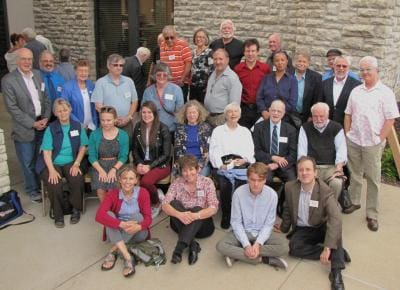
The 2017 national convention of Citizens for Global Solutions in St. Louis October 20-22 marked a new focus in its efforts to bring about a democratically governed world. “Just Security 2020: Citizen Action for an Effective and Inclusive UN” was the theme of the convention. The featured speaker, Dr. Richard Ponzio, Director of the Just Security 2020 Program at the Stimson Center in Washington DC, explained how broad institutional reforms at the UN are designed to culminate in a 2020 summit on the UN’s 75th anniversary. The specific recommendations of the Albright-Gambari Commission on Global Security, Justice and Governance can be found on the CGS website http://globalsolutions.org/issues/commission-global-security-justice-governance
David Lionel used videos in an interactive session to encourage discussion about what local groups can do to raise awareness of the Just Security 2020 effort and how to educate them about its specific recommendations. The challenge is to find ways of generating local enthusiasm for this project for global justice and knowing how to bring other non-governmental organizations into a collaborative effort.
The World Federalist Institute’s Friday meeting began with a report via Skype with Andreas Bummel in Germany about how a UN Parliamentary Assembly is needed to make the UN more democratic. After that, the first topic discussed was what WFI’s role should be in CGS in emphasizing global governance messaging and outreach. The next topic was why WFI should be promoting a UN Parliamentary Assembly and how to do that. The third topic was how WFI could and should promote World Federation Education and how such education is critical for the kind of social change we want to implement.
During the convention the two CGS boards approved a new Strategic Plan. The plan details goals and objectives to guide the organization through the next 5 years. Work has already begun to implement these goals and objectives. The Saturday evening banquet was followed by a “Lifetime Achievement Award” presentation to Ronald Glossop for his long-time commitment to CGS and World Federation. There was a fund raising event for CGS in Ron’s honor. If you are interested in participating, please click here to donate. Saturday evening also included a talk by Tad Daley about his energizing meeting with the Young European Federalists in Italy.
Sunday morning we held a lively discussion about framing our message based on George Lakoff’s book Don’t Think of an Elephant: Know your Values and Frame the Debate. There is much more work to be done in this area. If you are interested in helping please send an e-mail to dpark@globalsolutions.org.
Sunday afternoon the convention concluded with the viewing of “The World Is My Country” a captivating film directed by Arthur Kanegis about the life of world citizen, Garry Davis. David Gallup, Executive Director of Garry Davis’ World Service Authority, was present to accept applications for a World Passport, a simple way to affirm your global citizenship and declare your allegiance to humanity and the earth.
Participants are looking forward to another national convention, maybe in California in 2019.
by CGS Blog Archive | Nov 19, 2017 | Climate Justice, Global Cooperation
Deforestation is defined as “the action or process of clearing of forests” by the Merriam Webster Dictionary. Currently, 30% of the world is covered by trees, but with the current rate of deforestation across the globe, the world’s rainforests could completely vanish in just one hundred years.
Deforestation is mainly caused by humans, with most of it being caused by agriculture and logging. In order to plant more crops and create room for grazing livestock, some farmers participate in a process called slash and burn agriculture (the process of burning and cutting down trees to support agriculture). Due to the Earth’s dramatically increasing population size, more food is needed, resulting in forests being destroyed to create room for agriculture. Additionally, logging operations (some of which are illegal) are cutting trees to provide the world with paper and wood, but they are also cutting trees to create more living space for people.
What are the effects of deforestation?
- Deforestation causes habitat loss and food loss for many organisms; this leads to the extinction of many animals. It is estimated that 15 mammal, 30 bird, and 10 amphibian species will go extinct within the next few years in the Amazon Rainforest, with thousands more going extinct across the globe.
- Deforestation causes more than 1.5 billion tons of carbon dioxide to be released into the atmosphere annually, primarily due to the burning and cutting of trees. This is dangerous because the emission of carbon dioxide, a greenhouse gas, into the atmosphere causes global temperatures to rise. This also can cause weather and storms to intensify over time.
- The Amazon rainforest actually absorbs around 2.2 billion tons of carbon dioxide annually, as trees use carbon dioxide to perform photosynthesis; this means that the rainforest helps decrease the amount of carbon dioxide in the atmosphere. However, with the deforestation of the rainforest, the number of trees is quickly decreasing, resulting in less carbon dioxide being absorbed by the forest.
One of the best ways that we can help reduce deforestation is by shopping for products that are primarily made from recycled materials. By purchasing products that primarily come from recycled materials, we can decrease the number of trees cut down across the globe. Additionally, we should try to recycle as much as possible. Although most schools and offices have recycling programs, if there are no recycling programs in your area, you can always start your own! However, the best way to reduce deforestation is by consuming less paper in general.
by CGS Blog Archive | Oct 31, 2017 | Global Cooperation, World Federation
Recently two separate countries dealt with succession movements from within. First was Iraq where Kurds, emboldened by their recent battlefield success against ISIS, formally voted for independence.[1] This referendum would essentially solidify the current situation in the country where Kurds have long held autonomous power in the region known as “Kurdistan.” The other country battling a secessionist movement is Spain. In their case, Catalonia, a wealthy province in the northeast part of Spain, is attempting to break free in order to more fully embrace its own culture and to avoid paying taxes to prop up poorer parts of the country.[2]
These two movements share far more than just a desire for independence. In both cases the desire to achieve independence traces at least some of its roots to history. In the case of the Kurds, they have been a marginalized ethnic group in Northern Iraq for decades and were also the targets of ethnic cleansing by former Dictator Saddam Hussein. For Catalonians, it stems back to the Spanish Civil war when that region served as a center of resistance to Franco’s Fascist regime in Madrid and thus was the focus of his animosity.
Perhaps the greatest similarity the two regions face though is the reaction they have faced after independence declarations. The Kurds were immediately met with threats from several neighboring countries that fear potential instability from their own large Kurdish minorities. (With more than 30 million Kurds worldwide, if not the largest, they are one of the largest ethnic groups without a state of their own.) Even the US, traditionally a strong ally of the Kurds, opposed the vote. Their vote was also ruled illegal by the Iraqi Supreme Court. In the case of Catalonia the authorities did away with threats and moved right into using violence. Spanish police were sent in during the referendum to block voters with the unsurprisingly result of destruction to property and violence. The Spanish Supreme court also ruled their referendum illegal.
The problem with these two approaches, which was basically just the same one with slight twists, is that they do not look at the bigger picture. In the case of Iraq and the neighboring countries looking at Kurdistan and seeing instability, they need to focus on the future. If and when the Kurds finally achieve their independence, with a large supply of oil they would likely look to join organizations such as OPEC and a free-trade area in the Middle East if that is established similar to the EU. Speaking of the European Union, instead of worrying about Catalonia leaving Spain the powers that be should focus on its remaining in the EU, the most successful free-trade organization to date.
Instead, in both instances the reactions show a lack of foresight and even appear to be in direct opposition to stated goals. As anyone who glimpsed the Arab Spring and countless recent wars in the region knows, if you try too hard to keep a group of people down, it can only lead to an uprising. This is especially perplexing in the case of the Kurds who not only served as the vanguard in much of the fight against ISIS but who have also flourished despite being frequent targets of the government and other groups. In Catalonia it is a similar story, where a member of the EU, an organization created with the specific purpose to prevent European conflict, is attempting to force another region to submit through force.
It is a puzzling paradox indeed. If Catalonia were to leave Spain but remain in the EU, how would that actually change much? The answer then seems to be that countries are still more focused on and cognizant of the idea of sovereignty of a nation-state. In other words, while they may be part of a larger whole they are no longer part of the small part of the whole (i.e. Spain), that is something which Spain cannot accept. In the case of the Kurds, although there is nothing approaching the collective trans-national body of the EU, as mentioned earlier there are some regional organizations that create binds. Furthermore, the explanation that Kurdish independence could cause instability is laughable in a region where ISIS and Al-Qaeda still exist and where several civil wars are on-going as part of a larger proxy war between the regions’ two most supposedly stable countries, Iran and Saudi Arabia.
These issues of independence then are very closely related as should be the remedy to deal with them. As suggested, let the Catalans get independence but make a concerted effort to keep them in the EU either way. While the region may want greater autonomy for its culture, renegotiating a seemingly endless string of treaties may lead them to decide being a part of Spain is not the worst thing in the world; just ask England. When it comes to Iraq, it appears the Kurds will get their state eventually. Not only do they have the bastion in Iraq but also another area in Syria, so they control their process to freedom. Make sure they join organizations like OPEC and sign military agreements as well if that would ease the collective mind. Trying to suppress this sentiment with force is like trying to hold up a collapsing dam. The solution then to these separate but very similar independence movements is not the use of force but making sure the energy that served as the catalyst for change is funneled into keeping these new countries within the existing global order.
[1] CNN: Kurds vote overwhelmingly in favor of independence from Iraq. http://www.cnn.com/2017/09/27/middleeast/kurdish-referendum-results/index.html
[2] The Guardian: Spanish court suspends Catalan parliament session in attempt to block independence. https://www.theguardian.com/world/2017/oct/05/spanish-pm-mariano-rajoy-warns-of-greater-harm-from-catalonia-independence-plans
by Tad Daley | Oct 9, 2017 | Global Cooperation, World Federation
America first. Russia first. China first.
The United States of America puts American interests first. Just as every other nation in the world puts its own interests first. President Donald Trump was right about that in his first speech before the United Nations, on Sept. 19. Few world leaders have so nakedly expressed the essence of the Westphalian state system, established by treaty in 1648, and under which every human being dwells today.
“As president of the United States,” Trump said, “I will always put America first, just like you, as the leaders of your countries, will always, and should always, put your countries first.” This is controversial? Every undergraduate learns this on the first day of International Relations 101. It is the first principle of the realpolitik practiced by Henry Kissinger, Winston Churchill and Otto von Bismarck.
Virtually every other American president has made the same point. President Barack Obama, expressing his conception of larger interests during his final speech before the United Nations in 2016, returned in the end to his own primary obligation—and that of his counterparts. “Sometimes I’m criticized in my own country for professing a belief in international norms and multilateral institutions. But I am convinced that in the long run, giving up some freedom of action — not giving up our ability to protect ourselves or pursue our core interests, but binding ourselves to international rules over the long term — enhances our security. And I think that’s not just true for us.”
Similarly, at the Rio Earth Summit in 1992, President George H.W. Bush—who didn’t even agree to show up until the last minute—declared, “I’m the president of the United States. I’m not the president of the world. And while I’m here, I’m going to do what best serves the interests of the American people.”
So what reason is there to believe that a couple of hundred sovereign nations pursuing their separate national interests will produce optimal outcomes for the whole of the human community? “The nation-state remains the best vehicle for elevating the human condition,” Trump declared to the U.N. But he did not make a case for why that might be so. We live in a world whose crises interconnect us more than ever before. The runaway climate change that may have just produced three “thousand-year storms” in the space of three weeks. Genocide. Terror. Pandemic. The digital economy. An ever-increasing chasm of inequality, both within and among nations. An endless river of refugees generated by economic hopelessness—and global population totals that only go up. “Failed states” where national governments disintegrate and disappear. And most of all, succeeding generations not yet saved from the scourge of war.
All of these challenges are quintessentially transnational in nature. So is it anyone’s job today—as primary responsibility, not just when it happens to coincide with a national interest—to discern and pursue the transnational interest, the common human interest, the global public good?
One answer, which could provide at least one small step for humanity tomorrow, is the proposal to establish a new international body called a United Nations Parliamentary Assembly. At the U.N., national “ambassadors” are currently appointed by executive branches of national governments. It is as if all 535 members of the United States Congress—House and Senate alike—were appointed by the governors of the 50 states. But on every lower level of governance—cities, states or provinces, and countries—we take for granted that the bedrock of democracy is some kind of legislature, whose individual members are selected by citizens at the ballot box. Why in the world can’t this exist on the global level as well?
A UNPA would seat individuals who had already been elected to national parliaments—the Japanese Diet and the U.S. Congress and the British House of Commons. It could be created by a simple vote of the U.N. General Assembly under Article 22 of the U.N. charter. This would, for the first time in history, provide a direct voice on the global level not just for governments, but for people. Most importantly, its members would not answer to national governments, or articulate solely the interests of their national communities. They would be free to articulate the larger, collective interest of humankind—and to manifest not just the national patriotism of their voters, but a larger, planetary patriotism.
Some see the establishment of a UNPA as the first step on the road to democratizing our global institutions and representing our common humanity. One next step would be having UNPA members selected not from national parliaments, but elected directly by voters. Imagine going into the booth on Election Day in Chicago, for example, and casting your vote for candidates you believe will best represent your views in the Chicago City Council, the Illinois House and Senate, the U.S. House and Senate and the United Nations Parliamentary Assembly.
Over time, the intangible authority that would emanate from resolutions passed by a UNPA—the international organization that would embody the collective views of all “citizens of the world” more than any other—would evolve into a more tangible authority. The U.N. General Assembly, the U.N. Security Council and national governments would find it increasingly difficult to take actions that directly contradicted opinions and debates and outcomes at the UNPA. Perhaps this new body might eventually provide the seeds for establishing what Alfred Tennyson envisioned in his poem “Locksley Hall” 180 years ago—a genuine Parliament of Humanity.
….click here to read Tad’s complete article posted on TruthDig
by CGS Blog Archive | Sep 5, 2017 | Climate Justice, Global Cooperation
Scientists have projected that the Earth’s oceans could rise by between 2 and 5 feet within the next 80 years. This will prove to be detrimental for citizens of island nations, such as the people of Kiribati and especially the inhabitants of the Maldives. The Maldives is the lowest-lying nation in the world; this means that if seas were to rise just 3 feet, the whole nation would cease to exist. Without homes, the people of the Maldives (a population of over 400,000 residents) would need to relocate — something that would not be easy to accomplish.
You may be wondering how exactly this will affect Americans. First, the Maldives and the US have had diplomatic relations since 1966 and have had economic ties with one another for decades. Additionally, the Maldives has opened itself to US investment through its tourism and business sectors, meaning that American investors’ money will disappear along with the island. The scary part is that it is not just the dozens of small island nations being affected, rather it is the whole world being affected: even the US will be directly damaged by rising sea levels. Coastal communities, especially those in Florida, are highly susceptible to rising sea levels. The rising sea levels are causing chronic flooding, forcing residents to move away because of the uninhabitable conditions. With a 3 foot increase in ocean levels, more than 4 million Americans will be severely affected.
Why are rising sea levels a problem?
- When the ocean levels rise, saltwater moves inland. This is dangerous because it poisons crops, causing massive amounts of catastrophe to the economies of coastal communities. Additionally, when salt water moves inland, it begins to leak into freshwater sources. This is dangerous because people rely on wells for drinking water and will be forced to find new sources of freshwater.
- Rising sea levels cause flooding and can break the infrastructure in cities, such as buildings, roads, and houses. This endangers lives while also hurting the economy.
The sea levels are rising at an alarming rate because of the melting of the polar ice caps. When the ice caps melt, the water that used to be ice goes directly into the ocean, increasing the volume of the ocean. This means that Arctic animals are also losing their homes because of the rapidly decreasing ice mass.
In the US, roads are being raised, flood gates are being built, and seawalls are being repaired. However, this is only a temporary solution; people must work together to ensure that the ice caps stop melting. Nations like Finland are at the forefront of the fight for the Earth. Finland was given the highest Environmental Performance Index (a higher score indicates a more environmentally-friendly nation) while the US was ranked as the 26th most environmentally-friendly nation. Both nations are highly developed, but Finland’s commitment to becoming a carbon-neutral nation by 2050 is very apparent; 25% of Finland’s energy comes from renewable energy sources compared to 14% in the US.
If we are to save the polar ice caps and our own cities before it is too late, we must take action and try to reduce our carbon footprint. This may seem like a daunting task, but every action counts. Taking public transportation or walking/biking instead of driving can have great benefits for the environment. In order to save energy (and money), we can turn off lights when they are not in use. With 50% of all produce in the US being thrown away, we must find ways to waste less food; doing so will be beneficial as it will save energy and money in the long run.
by Charles Marsh | Aug 29, 2017 | Global Cooperation, World Federation
In 2015, the world community decided upon 17 Sustainable Development Goals, themselves containing 169 separate targets. These goals range from elimination of poverty to tackling climate change, but they all share a common intention; by the time they are completed, ideally in 2030, the world will be fairer, cleaner, and more sustainable than ever before.
To try and raise awareness of the Sustainable Development Goals, the “World’s Largest Lesson” campaign was launched, with the intent of educating all about what the Goals seek to achieve, and how we can help. Providing resources and advice to teachers and pupils alike, it aims to facilitate participation at all levels. By doing so, they hope to create the sort of grass roots support that has in the past affected real change, and can do so again in the future. We know this sort of movement is possible, and we know the things it can achieve. As such, I encourage all who are interested to visit the website of the “World’s Largest Lesson”, at: http://worldslargestlesson.globalgoals.org/
Perhaps most interesting of these is goal number 17, Partnership for the Goals, which encourages unprecedented global integration. Indeed, I believe it is only through this increased participation that the other 16 goals can be met in a timely matter. This goal is not overly ambitious, or overly optimistic; already we are seeing countries seize upon it, with Norway and India pledging further cooperation. These goals are thus very much within the reach of the global community, which has shown that when possessed of a common purpose, it can achieve monumental changes. Most people will remember the elimination of C.F.C.’s; when faced with a clear ecological challenge, the world united to resolve it. Within a few decades, the matter had been overcome and the hole in the ozone layer had begun to shrink. It is this spirit of cooperation that these goals seek to re-evoke, and in particular Goal 17. It is also the spirit that sits at the heart of this organisation’s worldview.
These goals serve as the successors to the Millennium Development Goals, which sought to achieve similar, if less wide ranging, objectives. The Millennium Development Goals achieved some considerable successes, such as halving the amount of people living on less than $1 a day seven years ahead of schedule. However, the success or failure of certain goals were all too often decided by the actions of individual countries, and rarely by cooperation or altruism between states. This is why I put such focus on Goal 17, to ensure greater cooperation between nations. The successes attained will mean relativity little if they are counterweighted by failures in countries that have received little or no support, and left to suffer alone. Therefore, the success of this grand proposal will mean nothing if it is not the success of humanity as a whole.
This is once again where the need for a global federal union comes in. By uniting humanity in a government of common interests, we can ensure that burdens and successes alike are fairly spread, that the achievements might not be marked by fulfilled quotas, but by tangible and equitable improvements in human welfare. If even one of these goals is not met, we cannot congratulate ourselves at the success of the others; we must instead lament the fact that there is still suffering in this world we have yet to resolve. This is why I feel Goal 17 is instrumental to the success of the other 16, because it is only once we fairly share the burden of human suffering that we can declare true equity among our people.