by Melissa Kaplan | Nov 8, 2011 | Global Cooperation, News, United Nations
The annual game of hurry-up-and-wait has begun in earnest for those of us who follow the congressional appropriations process. Although Fiscal Year 2012 officially began on October 1st, neither the full House nor the full Senate has yet approved legislation to fund the State Department and other international affairs agencies for the upcoming year, and it remains unclear exactly how or when they will do so.
For the past few weeks, the talk in the Senate has been about “minibuses”-combinations of several appropriations bills, which are smaller versions of the large “omnibus” packages to fund the entire federal government to which Congress frequently resorts when it fails to pass individual appropriations bills on time. The Senate Appropriations Committee has passed the State/Foreign Operations appropriations bill, which provides the bulk of international affairs funding, and this bill was expected to be combined with several other appropriations bills into a minibus and brought to the Senate floor for a vote last week. However, delays have set in, and the latest word is that no Senate action on a State/Foreign operations bill is likely until at least next week, and possibly even later than that.
The Senate State/Foreign Ops bill provides a good level of funding for the United Nations budget accounts considering the current fiscal climate. It would fund the Contributions to International Organizations (CIO) account, which pays U.S. dues to the U.N. general budget as well as dues to organizations such as NATO and the International Atomic Energy Agency (IAEA), at a level of $1.58 billion for next year, and provides $1.9 billion to the Contributions to International Peacekeeping Activities (CIPA) account, which funds U.N. peacekeeping missions. These numbers are considerably higher than those approved by the House Appropriations subcommittee last summer for the U.N. accounts. Citizens for Global Solutions hopes to see a final budget number close to the Senate totals for these important accounts.
So, when it comes to FY12 appropriations, uncertainty abounds as usual. We’ll keep you posted….
by Amanda Bowen | Nov 1, 2011 | Global Cooperation, United Nations
Yesterday UNESCO, the U.N. agency most famously known for designating world heritage sites and tasked with promoting education, science, and freedom of expression around the world, voted to approve full membership to Palestine, with 107 members voting in favor, 14 voting against it, and 52 abstaining.
Immediately following the vote, Rep. Kay Granger (R-TX), chairwoman of the House Appropriations State and Foreign Operations Subcommittee, denounced the vote and said she will advocate “for all funding to be cut off.” The United States contributes $60 million to the agency, comprising 22% of UNESCO’s annual budget. After the announcement, the State Department said it would halt the payment of its contribution to UNESCO and would follow suit with other U.N. agencies should they replicate UNESCO’s decision to recognize a Palestinian state. However, the wisdom of this policy isn’t even up for debate because existing U.S. law requires funding be denied to any U.N. agency that gives the Palestinian Liberation Organization the same standing of a member state before the Israelis and Palestinians reach a peace agreement.
Holding funding hostage to the U.N. on a singular issue is irresponsible. The United Nations is an institution, made up of member states. A select number of member states have decided to bring up the question of recognizing Palestine. Funding for the United Nations should not be held hostage based on the actions of some of its members. It’s similar to blaming Madison Square Garden for the New York Knicks losing a game.
This action also sends the wrong message to our partners. We must hold ourselves to the standards we expect other nations to abide. If another country decided to break the rules and not pay its fair share due to a disagreement over a single policy at the U.N., there would be an international uproar.
Slashing funding doesn’t serve United States’ interests. UNESCO is the U.N.’s cultural agency that works on issues relating to global development, all of which align with America’s foreign policy goals, including the promotion of science, literacy, clean water, and the equal treatment of women and girls throughout the world.
UNESCO’s work also aligns with American values. The agency advocates for freedom of the press and the promotion of an independent media. It speaks out against persecutions and killings of journalists. It also supports community-based media programs to expand discourse in nations that have state-controlled media and to promote the voices of minorities.
Americans value ingenuity, which UNESCO promotes through “scientific diplomacy,” bringing scientists together from around the world to forge cooperation on technological advancements, including improving access to clean water. This partnership also allows for scientists to come together to tackle the world’s most pressing problems, such as assessing damage caused by flooding in Pakistan last year and discovering ways to prevent future catastrophes.
Our nation also recognizes the importance of education. UNESCO created a pilot program for to improve literacy for girls in Pakistan by using cell phones as a platform. Not only does this improve literacy rates among girls; it also empowers girls by connecting them to the larger community.
The diversity of U.S. organizations that partner with UNESCO speaks to the importance of its engagement around the world. The Smithsonian Institute has worked with the agency on initiatives to educate local populations on the preservation of artifacts. Other U.S. organizations and companies that work with UNESCO include the Boys and Girls’ Club, the U.S. Chamber of Commerce, the Library of Congress, Apple, Cisco, Proctor & Gamble, and Microsoft.
Disengaging with UNESCO by cutting its funding will only hurt our foreign policy priorities and elevate the agendas of nations that wish to undercut the agency. U.S. engagement with UNESCO assured that World Philosophy Day would not be hosted in Iran, a country well-known for its lack of freedom of expression.
The American people understand that resolving the conflict in the Middle East and funding U.N. agencies are two important but separate issues. A poll from the Better World Campaign found that a majority of Americans support the United Nations, with 85% of voters saying that it is important for the U.S. to maintain an active role in the U.N. Democrats, Republicans, and Independents alike all support paying U.N. dues on time and in full.
As a nation, we need to take a step back and realize we gain nothing from cutting funding and disengaging with U.N. agencies over Palestinian statehood. But by withholding funding, we will lose the ability to promote American values that we cherish, such as freedom of expression, the right to education, the promotion of ingenuity, and working together to tackle the world’s most difficult problems.
There are reports that the International Atomic Energy Agency could be next to recognize Palestine, thereby again activating the law for the U.S. to halt payment of our contributions. The IAEA has been instrumental in monitoring nuclear weapons programs in North Korea and Iran. If we withold paying what we owe, we are risking losing the ability to keep track of nuclear weapons around the world and ensure the safe use of nuclear energy. Congress should reexamine this unwise policy and repeal the law that forces U.N. funding to be tied to the recognition of Palestine.
Click here to read an interview with U.S. Ambassador to UNESCO David Killion conducted by Citizens for Global Solutions CEO Don Kraus.
by Anu Joshi | Oct 24, 2011 | Global Cooperation, United Nations
On this day 66 years ago (1945) the 5 permanent members of the Security Council and a majority of the 46 member countries voted to establish the United Nations as the method to establish a lasting peace for all mankind. Today we celebrate the 66th Anniversary of the signing of the UN Charter. The role and usefulness of the United Nations will be an issue that has and will continue to be debated ardently (especially in this country, but also around the world). But, on this day I realize that the words that the founders used in drafting the UN Charter still ring true today and can act as the guide in our quest “to maintain international peace and security.”
James F. Byrnes, Secretary of State at the time, had this to say: “The United Nations Charter is now a part of the law of nations. This is a memorable day for the peace-loving peoples of all nations. As I have frequently said, the maintenance of peace depends not upon any document, but upon what is in the minds and hearts of men. But the peoples of this earth who yearn for peace must be organized to maintain the peace. This charter provides the organization.”
The UN Charter states the following: “The purpose of the United Nations are… To develop friendly relations among nations based on respect for the principle of equal rights and self-determination of peoples, and to take other appropriate measures to strengthen universal peace; To achieve international co-operation in solving international problems of an economic, social, cultural, or humanitarian character, and in promoting and encouraging respect for human rights and for fundamental freedoms for all without distinction as to race, sex, language, or religion; and To be a centre for harmonizing the actions of nations in the attainment of these common ends.”
The United Nations is more than just a sum of its parts. Although the General Assembly and the UN Security Council often get the most media attention the 30 plus affiliated organizations, UN Peacekeeping and corollary institutions like the ICC are often at the heart of fulfilling the UN Charter’s Mandate. We salute all parts of the UN today, the 66th Annual UN Day.
by Amanda Bowen | Oct 19, 2011 | Global Cooperation, News, Peace & Disarmament
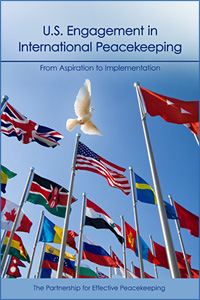
Citizens for Global Solutions, as a partner organization in the Partnership for Effective Peacekeeping, launched a new peacekeeping report today at the National Press Club. The report provides Congress and the Administration with tangible recommendations on how the U.S. can improve its participation in international peacekeeping missions.
The impetus for the report came from a desire to implement the aspirations of the Obama Administration for the U.S. to increase involvement in peacekeeping missions. In 2009, President Obama delivered a speech to the leaders of the top troop contributing countries where he said,
“We will consider contributing more U.S. civilian police, civilian personnel, and military staff officers to U.N. missions.”
This report’s goal is to provide a plan for implementing this mission.
The event featured a key note address from Amb. Nancy Soderberg, President of the Connect U.S. Fund and former Alternative Representative to the U.N. Soderberg believed the report’s recommendatoins were important, and said,
“This report should be read by senior policymakers within the U.S. government writ large.”
Soderberg also noted,
“U.S. Engagement in International Peacekeeping: From Aspiration to Implementation is really a great blueprint for the state now of U.N. peacekeeping and where it needs to go. This report provides a summary of where things stand and what needs to be done.I fully endorse this report’s recommendations.”
Victoria Holt, the Deputy Assistant Secertary for the Bureau of International Organization Affairs also provided remarks at the report release. Holt said,
“The analysis, the policy ideas, and the work you all do really is helpful to us as an Administration, trying to think ourselves about how to move forward on this.”
Holt highlighted the report’s chapter on women in peacekeeping, stating,
“We know the U.N.’s own aspiration to increase the number of women, both in leadership roles as well as within the civilian police and military ranks of peacekeeping personnel is a top priority for them and one we completely share.”
The recommendations, detailed in the report, “U.S. Engagement in International Peacekeeping: From Aspiration to Implementation” asks for:
- Full funding of the U.S. contribution to U.N. peacekeeping missions
- United States leadership at the U.N. to advance peacekeeping reforms that provide for more timely and cost-effective delivery of human and material resources to peacekeeping operations and permits changes to the Peacekeeping Reserve Fund and flexible funding to speed the initial deployment or the expansion of missions
- Bolster the Presidential Peacekeeping Initiative, which contemplates increasing the number of U.S. personnel sent to peacekeeping operations
- The Department of Defense provides a contingent of military support and increases the number of women sent to peacekeeping missions
- The U.S. supports an increase of U.N. police standing capacity
The entire report details 26 specific recommendations to enhance and increase U.S, involvement in international peacekeeping.
Don Kraus, Citizens for Global Solutions CEO and co-chair of the Parntership for Effective Peacekeeping said,
“This report provides a pragmatic blueprint developed by leading experts on how the Administration and Congress can work to better leverage U.S. participation in international peacekeeping efforts, to provide greater peace and security for the United States and the world.”
Watch the recordings from the launch on the report launch event page.
by Melissa Kaplan | Oct 13, 2011 | Global Cooperation, United Nations
The House of Representatives took yet another regrettable step today to disengage the U.S. from the United Nations, as the House Foreign Affairs Committee (HFAC) voted to approve the “United Nations Transparency, Accountability, and Reform Act” by a 23 to 15 margin. The vote was along party lines, with Republicans on the committee supporting the bill and Democrats opposing it.
The United Nations Transparency, Accountability, and Reform Act, introduced in August by HFAC Chair Ileana Ros-Lehtinen (R-FL), is bad legislation in many ways. It would cut U.S. funding for the U.N.’s general budget in half if the United Nations does not enact a long series of reforms within a two-year time period. It would prohibit the U.S. from holding a seat on, or providing funding for, the Human Rights Council, where the U.S. has been using its influence to keep human rights violators such as Syria and Iran from obtaining seats. And it would establish a moratorium on new or expanded peacekeeping missions, at a time where instability around the globe means that the U.N. needs the flexibility to react to events and adjust its missions to protect civilians accordingly.
In the words of Citizens for Global Solutions’ CEO Don Kraus, “Chairman Ros-Lehtinen has shown, yet again, that she is more interested in bashing the U.N. than improving it. She wants to hold U.N. funds hostage if her demands aren’t met. This bill will not lead to constructive improvements at the U.N. What will be held hostage is our leadership, credibility, and influence on the world stage.”
Despite the disappointing outcome of today’s vote, there were some positive sentiments expressed by committee members about the importance of U.S. engagement at the United Nations. Rep. Gary Ackerman (D-NY) pointed out that the U.N. is meant to be a place where the world comes together to discuss grievances, rather than going to war over them. Rep. Elliot Engel (D-NY) acknowledged frustration with the U.N. but asserted that there’s a good case to be made that it’s better for the U.S. to be part of the world body and work to influence its decisions rather than “take our marbles and go home.” Rep. Russ Carnahan (D-MO) said that many people want reform at the U.N., but “not retreat,” and that responsible U.S. engagement and meeting of financial obligations is the best way to achieve our foreign policy goals.
The full House of Representatives has yet to vote on the bill. It has not been introduced in the Senate, and even if passed by the House, would not be expected to advance in the other chamber. We will continue to keep you posted as and if the bill moves forward.
by Whitney Shepard | Sep 29, 2011 | Global Cooperation
On Thursday, September 15, 2011 Senator Rand Paul (R-KY) proposed an amendment to cut nearly $7 billion from the State Department and USAID to offset disaster relief funding.
This amendment would have cut nearly $7 billion from the State Department and USAID to offset disaster relief funding. By cutting spending from the State Department, our primary agent in foreign relations and the Department designated for U.S. global engagement, our need for National Security funding would nearly triple. The USAID is responsible for administering civilian foreign aid and is responsible for disaster relief, poverty relief, technical cooperation on global issues, and other global issues. The United States has a responsibility to maintain global engagement as a super power of the world. Paul was quoted saying, “Increasing our national debt at a time when our country is in financial dire straits is irresponsible and a dereliction of our responsibility to the American people. By cutting from the coffers that fund overseas welfare and nation-building and injecting that funding into disaster assistance for Americans, we are able to continue disaster assistance commitments to communities without borrowing on the backs of our children and grandchildren.” His Republican colleague Senator Graham (R-SC) vehemently opposed saying, “I want to try to get our fiscal house in order, but we have to defend this country. The foreign operations account is national security in another form.”
YES, in-country disaster relief has been an issue in the past, with Hurricane Katrina victims still needing help as well as an increasing poverty rate. However, the appropriate funding has been made available to deliver solutions for these issues. Much of the backing for our (US) funding comes from our trade relations that we have with the global community. Severing ties with our global partners means severing resources that would otherwise prove necessary in the case of a major disaster. Like all things there is room for improvement but not at such a drastic level.
Similar to Rep. Ileana Ros-Lehtinen (R-FL), chair of the House Foreign Affairs Committee, proposed the H.R. 2829, an extreme bill that would hold U.N. funding as well as U.S. leadership, prestige, and influence at the U.N. hostage, unless Ros-Lehtinen’s outrageous demands are met. Like Paul, Ros-Lehtinen would sacrifice the benefits of U.S. leadership at the U.N. at a time when the U.S. is successfully promoting its national security and foreign policy priorities on the world stage. Just like this proposal, Paul’s amendment would have had devastating consequences for America’s engagement in the world.
In a follow-up statement to the press, U.S. Sen. Rand Paul, R-Ky., denounced his colleagues who voted against his amendment to offset federal funding disaster relief through cuts to foreign aid. By rejecting the proposal, Senator Paul says it is another example of reckless government spending. Democratic Senate member Senator John Kerry (D-MA) said that “such a cut would be “absolutely devastating” and reminded Senators that “foreign assistance is an investment in our national security, it is not a gift.”
Thankfully, the amendment was not agreed to, with a strong bipartisan final vote of 78-20.