by Citizens for Global Solutions | Sep 17, 2009 | Climate Justice, Global Cooperation, News
181 of the world’s largest investors – collectively managing over $13 trillion in assets – have signed a U.N.- backed statement for concrete action against climate change.
The statement calls for a new global climate treaty to reduce pollution, catalyze global funding for energy-efficient and low-carbon technologies and to include a target for emissions reductions of between 50 and 85 per cent of 1990 levels by 2050.
It also appeals for action to reduce deforestation and support, as well as for support for adaptation measures.
The move comes ahead of this December’s UN talks in Copenhagen, Denmark, where nations are expected to create a new pact to curb greenhouse gas emissions.
Rob Tacon, Chair of the UN Environment Programme’s Financial Initiative said, “Climate change has quite rightly been framed as the greatest market failure ever…The magnitude of the negative economic impacts and the potential of climate change to bankrupt our global financial system, as well as to threaten the planet’s life-supporting natural ecosystems, are calling.”
by Citizens for Global Solutions | Sep 9, 2009 | Climate Justice, Global Cooperation
The Partnership for a New America, a bipartisan group of 32 former secretaries of State, national security advisers, senators, military leaders and senior foreign policy officials, is urging Congress to act on climate change.
The group recently released a statement calling for Congress to do just that, as well as reduce the country’s dependence on petroleum and cut greenhouse gas emissions.
One of the signatories, Frank Wisner (former Ambassador to India, Philippines, Egypt and Zambia), said that climate change affects water and food supplies, contributes to mass migration and refugee crises, and destabilizes weak governments. “”We must take this issue on as a matter of foreign policy and exercise leadership”, he said.
The statement does not specifically endorse the Waxman-Markey Bill which passed the House in late June and is under consideration by the Senate, but it does urge the Senate to act soon and create a bipartisan plan to address the crisis. Another one of the signatories, R. James Woolsey (CIA director 1993-1995) criticized the Waxman-Markey Bill for not doing enough to reduce U.S. dependence on oil. “It’s not a question of imported oil versus domestic oil — it’s oil,” Woolsey said. “We need to destroy its monopoly on transportation.”
by Courtney Smith | Aug 31, 2009 | Climate Justice, Global Cooperation, News
Today was the start of the Third World Climate Conference (WCC-3) in Geneva. The main theme of this conference is climate change and how to spread information on the effects of this global phenomenon. Not only is the WCC-3 focusing on the long-term effects of climate change, but also the day to day impacts (also known as climate variability).
While most climate conferences have focused on how to reduce greenhouse gas emissions, WCC-3 is focusing on how to deal with the already present effects of climate change. It hopes to provide a framework in which climate predictions can be made, for example rainfall predictions and drought monitoring. With this information individuals can have advance warning of heavy rainfall (which may cause Malaria outbreaks) or other potential cases for extreme weather which could escalate to disasters (floods, wildfires). Using this knowledge, proper preparations or evacuation measures can be taken in advance.
A wide array of professionals, including scientists, high-level policy makers, and business leaders are attending this conference. The interactions of these different types of people are important because it connects the people who develop the climate information with those who utilize it to create policies.
by Citizens for Global Solutions | Jul 13, 2009 | Climate Justice, Global Cooperation
On July 10, the Center for Strategic and International Studies hosted a summit on energy security. Experts from a variety of government agencies and organizations discussed the different ways that America can attain a cleaner, more diverse, and more sustainable energy economy. Although the speakers tended to disagree on how the United States can achieve energy security, all agreed that the future must involve a dramatic expansion of renewable energy production. The devil, of course, is in the details.
The first speaker, from the World Resource Institute, spoke of the need for significant improvements in research and development and investment in renewable energy technology. The next presenter claimed that existing technology could start us on the path. He stated that what is most important is strong policy leadership among decision makers that will guide us towards energy security. There was discussion of the new cap-and-trade bill and Congress’ failure to go as far with the legislation as many environmentalists wanted. Emerging technologies such as Carbon Capture and Storage, which seeks to trap greenhouse gases in storage containers before they can damage the environment, were debated; as was the viability of continuing to use more traditional energy sources such as nuclear energy and coal. What was most reassuring was that despite the differences of opinion among the event speakers, what they had in common was the conviction that in order for both America to remain economically competitive, and for the sake of the world environment, the current situation must be changed.
For CSIS’s page on the Energy Security conference, audio and video of the event, and links to the World Resource Institute’s report, visit:
http://csis.org/event/evaluating-energy-security-implications-carbon-constrained-us-economy
For Citizens for Global Solution’s page on the new United States legislation on preventing climate change, visit:
http://www.globalsolutions.org/everything_you_need_to_know_about_the_climate_bill
by Citizens for Global Solutions | Jul 10, 2009 | Climate Justice, Global Cooperation
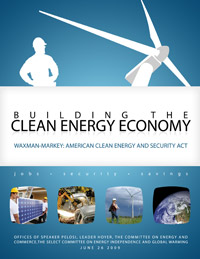
After passing through the House, The American Clean Energy and Security Act, H.R. 2454, has continued to attract much attention and controversy as it awaits Senate vote. Opponents have tried to brand it as a tax-raising, economy-shattering piece of legislation. But this is not so.
Hearings have begun to discuss the climate legislation under the leadership of Senator Boxer and partnering chairs of other Senate committees. Many different views have been expressed, and some have stood out. One such view promotes establishing a cap-and-trade system and imposing a price on polluting. The climate bill puts in place powerful incentive possibilities to spur investment and research in energy technology. Senator Kerry noted that the energy market is a 6 trillion dollar market with about 4.5 billion eligible users. This represents enormous opportunities, and explains why China is currently investing aggressively in alternative energy development. Whoever pushes through this industry and establishes themselves first will be the winner, and this climate bill creates the incentives to make that happen in the U.S.
The provision of allowances, whereby certain companies would be given pollution permits instead of having to buy them, has also come under heavy fire. But these allowances, if distributed carefully, constitute an important method to secure the economic feasibility of the bill. Energy intensive industries vulnerable to international competition need such provisions to help them transition to a new, green economy. Otherwise, they would be tempted to move production to another country with lower standards, instead of reducing their emissions. Visit Robert Stavins’ blog to see how the allowances have been allocated beneficially.
Witnesses also advised against playing industries off each other, and framing some (like coal) as losers and others (like wind energy) as winners. This must be seen as an economy-wide attempt to transition to a fair and healthier form of development. Further, improvements in energy efficiency- boosted by the right kind of legislation- are in the financial interest of every company. Dow Energy has demonstrated this by making energy efficiency investments that saved the company over 8 billion dollars and made energy efficiency gains equaling all the power used by every home in California in a year since 1994.
On the other side of the bill, senators have raised a broad range of excuses for opposing it. Senator Inhofe has employed scare-tactics, which shouldn’t be surprising considering his history of questioning the reality of global warming. Many have continued to harp on “India and China,” insisting that the U.S. must wait for them to do something significant. Senator Kerry, who recently returned from China, pointed out the China is willing to constructively engage on the issue after seeing U.S. leadership. Other countries are also looking forward to U.S. leadership ahead of the international climate talks in Copenhagen this December. Experts have testified that the threat of international competition with respect to India and China applies to limited exports, so there is room to work around it. The developed and developing world can’t keep waiting for each other to act and get stuck in a chicken-and-egg situation. The point is, there is technology available to reduce domestic and overseas emissions, and the right kind of legislation is needed to help proliferate it.
The old method of development, and the fear of “India and China,” has not helped. Our old industries have failed to create the amount of jobs needed in the economy, and have contributed to global warming, causing a range of health hazards. Stimulating an energy efficient economy will create much needed investment and create new jobs, like the production of wind turbines and solar panels. It’s time for the Senate to see the light.
For more information, click here
by Komal Hiranandani | Jul 1, 2009 | Climate Justice, Global Cooperation
Thomas Friedman said of the Waxman-Markey Bill: “It stinks. It’s a mess… Now let’s get it passed in the Senate and make it law.”
So why does he want this stinky, messy bill to become law?
In the New York Times, Friedman explained that this bill, for all its imperfections, is “the first comprehensive attempt by America to mitigate climate change by putting a price on carbon emissions. Rejecting this bill would have been read in the world as America voting against the reality and urgency of climate change and would have undermined clean energy initiatives everywhere.”
To muster enough support for the bill to be passed through the House, the bill had to include provisions that would weaken it. Still, it creates incentives for businesses to cut costs by going green: “weaving carbon emissions into every business decision will drive innovation and deployment of clean technologies to a whole new level and make energy efficiency much more affordable.” Through the bill, new buildings and appliances will be more energy efficient, forests will be conserved, and mindsets will change- factoring in pollution as a production cost will change the way we make things.
Let’s heed Friedman’s final words of wisdom: “Now that the bill is heading for the Senate… we must, ideally, try to improve it, but, at a minimum, guard against diluting it any further.”
* ACT NOW in support of strengthened environmental protection policy!
To read the full article, click here
For more information on the legislation, click here
To learn more about climate change, click here





 climate bill puts in place powerful incentive possibilities to spur investment and research in energy technology. Senator Kerry noted that the energy market is a 6 trillion dollar market with about 4.5 billion eligible users. This represents enormous opportunities, and explains why China is currently investing aggressively in alternative energy development. Whoever pushes through this industry and establishes themselves first will be the winner, and this climate bill creates the incentives to make that happen in the U.S.