
Originally published on the CGS blog on June 9, 2013.
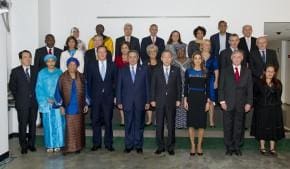
The Secretary-General of the United Nations’ panel of experts recently released a report detailing goals for the Post-2015 Development Agenda. This 27-person panel made recommendations for development beyond 2015, building upon and amending the Millennium Developmental Goals of 2000.
As before, the overarching objective is to eradicate extreme poverty from the earth by 2030. The overall tone of the report is positive, with the panel stating they have a “great optimism that a transformation to end poverty through sustainable development is possible within our generation.” To help achieve this, the panel illustrates five fundamental or transformative shifts, summarized below:
1) Leave No One Behind:The panel emphasizes that we cannot simply focus on reducing extreme poverty, but instead must focus on ending it. No person should be denied universal human rights or basic economic opportunities.
2) Put Sustainable Development at the Core: We need to focus on development that is long-lasting and environmentally friendly. The panel argues that at least 1/3 of the activities needed to lower global carbon emissions (such as switching to LED lighting) more than pay for themselves under current market conditions, although we still need incentives to make people more willing to take actions that foster sustainable development.
3) Transform Economies for Jobs and Inclusive Growth: The panel emphasizes the need to ensure everyone has access to quality education, healthcare, clean water, electricity, telecommunications, and transport. With this comes the imperative for implementing good urban management, raising productivity, and providing a stable environment that allows businesses to flourish.
4) Build Peace and Effective, Open and Accountable Public Institutions: We need transparent, accountable governments and public institutions.
5) Forge a new Global Partnership: The panel stresses the need for a spirit of solidarity and that countries need to cooperate to achieve these goals. National governments have the responsibility for ensuring human rights, deciding on national targets, taxes, policies, plans and regulations that will make the goals a reality. We also need to bring in local authorities because targets might be pursued differently at the sub-national level.
Finally, the panel advises that goals and targets be SMART: Specific, Measurable, Attainable, Relevant and Time-bound.
I really don’t want to bash this report or the guiding spirit behind it. However, in some ways, it eerily reminds me of my own New Year’s Resolutions. Let’s take an example: one of my resolutions was to cook more real meals, rather than just throwing jelly on a bagel and calling it breakfast (or lunch, or dinner). I realized that it would be beneficial to cook more and it was easy to think of specific ways to meet this goal, such as finding exciting new recipes and planning grocery store trips. The problem came in the implementation: it was up to me to make myself actually get myself out the door to the grocery store or into the kitchen to cook – and that is where I encountered all of the real difficulties. (As an aside – this resolution is still very much a work in progress).
The report is commendable in that the goals are all worthy, and, happily, the panel has detailed some concrete steps for how countries can work towards them. But, as we have learned so many times in the past, the UN has problems actually enforcing its recommendations. This report leaves all of the responsibility up to each individual country to determine how it wants to implement the goals, but does little to indicate any sort of mechanism that will hold countries accountable.
I understand that the UN has neither the power nor the desire to be a world-wide babysitter, but I just can’t imagine their goals being prioritized in each country without an incentive or enforcement apparatus in place. Will the countries follow through, or will there be another update 15 years from now singing roughly the same old song? What do you think?


