
Originally published on the CGS blog on March 1, 2012.
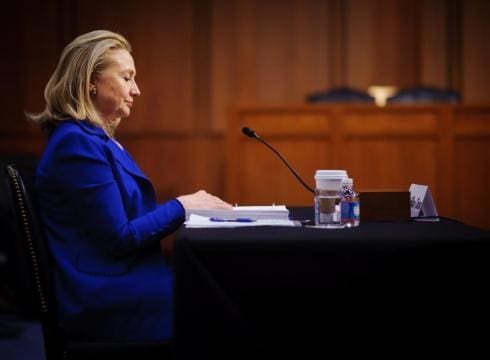
On Tuesday I attended the Senate Foreign Relations Committee hearing on “National Security & Foreign Policy Priorities in the FY 2013 International Affairs Budget,” which featured Secretary of State Hilary Clinton as the key witness. While the foreign assistance portion of the U.S. budget is around 1%, this area of funding has been slightly reduced. In her testimony, Clinton identified the State Department’s top five priorities for the coming year within the State Department’s proposed budget.
The first priority is to sustain the current missions in Iraq, Afghanistan and Pakistan. Clinton reminded the committee that “as troops come home, civilians remain to carry out the critical missions of diplomacy and development. Our request reflects the temporary, extraordinary costs of operating on the frontlines.” There is now an important diplomatic role for the U.S. to play in Afghanistan.
The second priority the Secretary mentioned is Asia, where the U.S. needs to strengthen its relationships and maintain its Pacific presence. This effort is called “forward deployed diplomacy,” in which the U.S. is seeking out better relations within the region.
The third priority is the Arab world. A major part of this is the proposed “Middle East and North Africa Incentive Fund to encourage major political and economic reforms.” This fund will also help with efforts in Syria and will allow for more flexibility with our work in the region.
The fourth priority is economic statecraft, which is the use of diplomacy to bolster the economy. Clinton noted that this project is important because “We are pushing back against corruption, red tape, favoritism, distorted currencies and intellectual property theft.”
The fifth and final priority was encompassing worldwide development issues. Falling into this category are “poverty, disease, hunger, and climate change.” Through the Global Health and Feed the Future Initiatives, the State Department is looking to make lasting progress in developing areas overseas. The way these projects are done is changing, with the State Department and USAID working on development with local groups and empowering citizens to take control of their futures. Clinton ended her opening statement by saying that “people look to us to protect our allies, stand by our principles and serve as an honest broker in making peace; to fight hunger, poverty and disease, and to stand up to bullies and tyrant. American leadership is not just respected. It is required.”
The committee members questioned the Secretary about the budget and other foreign policy issues. Senator Dick Lugar was concerned about the safety of our diplomatic missions in Israel, Afghanistan, Pakistan, Iraq and Egypt. Secretary Clinton assured him that our diplomats are well aware of the risks they take. In Iraq, the Department of State is figuring out how best to utilize local security forces.
Senator Bob Corker asked Clinton about what actions she would like to see the House and Senate take in regard to Iran. She affirmed that sanctions are the most effective strategy that we currently have to handle the issue. An important step is securing support for these sanctions from other countries. Secretary Clinton said that peaceful negotiations are the top priority, with the two part approach of “pressure and engagement” being the best action to take. She noted that the intelligence community has concluded that Iran has not yet made a decision to produce a nuclear weapon, but it will be important to continue to evaluate the situation.
Secretary Clinton also commented on why reform in Libya was a challenge and whether or not there will be a similar transition in Syria. Muammar Gaddafi destroyed all the institutions in Libya and the U.S. is now working closely with Libya to reorganize their militia members into a military force and into the civil service. The State Department is trying to find a way to assist the Syrian people, but the situation is much more complicated.
The Committee also discussed funding of the United Nations Education, Scientific, and Culture Organization, which was frozen when the agency allowed Palestinian membership. Two U.S. laws required this withholding of contributions, but one proposed solution offered is providing a waiver that will allow the U.S. to continue funding UNESCO. Secretary Clinton supported this waiver, saying that the U.S. benefits from membership to UNESCO. Israel is also still a member of UNESCO, despite Palestine’s membership. In general, Secretary Clinton reaffirmed her support for staunch U.N. reform. She noted that the United Nations performs vital missions, including peacekeeping operations, but there needs to be more “accountability and transparency” in their system.
Senator Mike Lee questioned the Secretary about the situation in Egypt, including its negotiations with Israel and the effect of our foreign aid influencing the Egyptian government. Secretary Clinton assured him that there has been no evidence that Israel is not upholding its treaties and that aid had historically been used to keep Egypt on the right path.
Secretary Clinton, the Department of State, and USAID have done a great job reorganizing the foreign assistance budget. The new Middle East and North Africa Incentive fund will assist the Department of State in handling the crises that might emerge in the region. Clinton’s testimony made it more apparent that even with modest funding for foreign affairs, the United States is able to positively impact the far corners of the world. It is crucial that this vital aid be continually supported and funded by Congress.


