Originally published on the CGS blog on June 25, 2012.
UPDATE (6/27/12): Earlier today, President Morsi announced that he would appoint a woman as one of his vice presidents, and a Coptic Christian as his other. On the whole, this move should help to assuage the concerns of those who feared that Morsi’s affiliation with the Muslim Brotherhood would lead him to adopt radical Islamist policies. In addition, this announcement followed news that an administrative court in Cairo has overturned the military’s declared right to make warantless arrests. Overall, a good day for democracy in Egypt, though, of course, much work remains to be done.
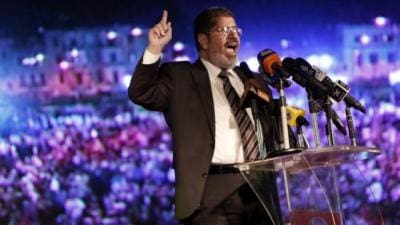
This past Sunday, Egypt took another tenuous step along the road to democracy, as the Supreme Presidential Election Council declared the Muslim Brotherhood’s candidate, Mohamed Morsi, the winner of Egypt’s first presidential elections since the fall of Hosni Mubarak. According to statistics released by the Election Council, Morsi garnered 51.7% of the popular vote, compared with a 48.3% share for his opponent, Ahmed Shafiq.
The official announcement came after a tension-filled week in which both candidates declared victory, and the Egyptian military granted itself sweeping powers over the country’s legislative and constitutional processes. Nonetheless, Morsi’s victory will come as a minor relief to those who feared that the elections would merely mark a continuation of Mubarak-style rule, as Shafiq had previously served as Mubarak’s final prime minister.
Despite this positive news, however, Egypt’s nascent democracy still faces a “long road ahead,” as one anonymous celebrator in Tahrir Square put it. In particular, Morsi’s affiliation with the Muslim Brotherhood will undoubtedly spark tensions with the Egyptian military, which had banned the organization during Egypt’s period of military rule. Even after Mubarak’s fall, the military has not been shy about demonstrating its distaste for the organization, even going so far as to dissolve the Brotherhood-dominated Egyptian Parliament before the presidential election’s final round of voting.
Furthermore, the constitutional declaration issued by the SCAF (Supreme Council of the Armed Forces, a body consisting of 21 senior Egyptian military officers) a little more than a week ago has been deemed a cause for concern by numerous pro-democracy advocates. As the BBC reported, the declaration grants the SCAF “legislative powers, control over the budget, and over who writes the permanent constitution,” while also “[stripping] the president of any authority over the army” and guaranteeing members of the SCAF “jobs for life.” Though the SCAF has pledged to hand over power to a civilian government by the end of June, that promise has done little to assuage fears about the military’s actual level of commitment to democracy. In light of the SCAF’s aforementioned assumption of political power, it remains unclear what powers Morsi will actually possess once in office, or which political entity will possess the final say in government matters.
However, ongoing tension between the Muslim Brotherhood and the SCAF is far from the only challenge that Morsi will face in the early days of his presidency. For example, the explicitly Islamist nature of the Brotherhood has worried a broad spectrum of parties, ranging from Egyptian Christians to the Israeli government, with a common concern being that Morsi’s ideology will lead him to adopt radical Islamist policies. Meanwhile, Morsi’s comments in a recent interview that he favors a restoration of “normal relations” with Iran are unlikely to ingratiate him with the Western powers, who have sought to diplomatically isolate Iran over its nuclear program.
It is clear, then, that while the election of Morsi is certainly a positive development for Egypt’s democratic institutions, it remains to be seen whether this event will succeed as a catalyst for an enduring democracy. If Morsi is to be able to govern effectively, he will have to be careful not to alienate the significant portion of the Egyptian population that is less than enthusiastic about the prospect of Brotherhood-controlled government. To that end, Morsi has started his administration off on a positive note, using his victory speech to declare himself a “a president for all Egyptians.”
Of course, even if Morsi is able to successfully define himself as such, there remains the problem of the Egyptian military. The world will soon discover exactly how much power, if any, the SCAF intends to hand over to the new civilian government; however, there is certainly cause to be skeptical about whether the military, which has held a substantial stake in the Egyptian government for decades, actually has any enduring commitment to democratic institutions that would presumably limit its power. Unfortunately, however, it appears that the military will have an outsized role in determining whether Egypt’s young democracy will succeed or fail, at least for the time being.